Record Information
Version1.0
Creation Date2014-08-29 06:51:34 UTC
Update Date2026-04-14 20:07:51 UTC
Accession NumberCHEM003427
Identification
Common NameChitin
ClassSmall Molecule
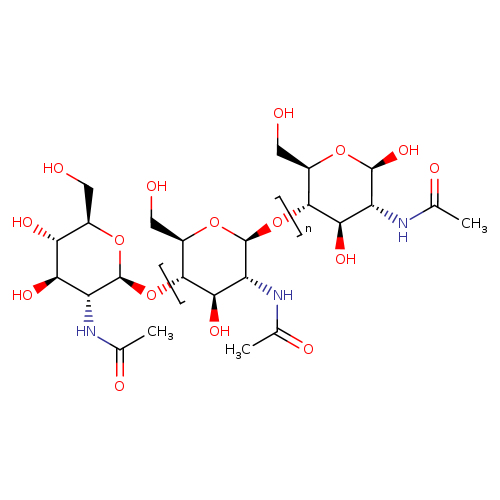
DescriptionChitin is an unusual substance as it is a naturally occurring polymer. Its breakdown is conducted by bacteria which have receptors to simple sugars from the decomposition of chitin. If chitin is detected they then produce enzymes to digest the chitin by reducing it to simple sugars and ammonia. Chitin (IPA: [Kaitin]) is one of the main components in the cell walls of fungi, the exoskeletons of insects and other arthropods, and in some other animals. It is a polysaccharide; it is constructed from units of acetylglucosamine (more completely, N-acetyl-D-glucos-2-amine). These are linked together in beta-1,4 fashion (in a similar manner to the glucose units which form cellulose). In effect chitin may be described as cellulose with one hydroxyl group on each monomer replaced by an acetylamine group. This allows for increased hydrogen bonding between adjacent polymers, giving the polymer increased strength. A linear polysaccharide of beta-1->4 linked units of acetylglucosamine. It is the second most abundant biopolymer on earth, found especially in insects and fungi. When deacetylated it is called chitosan.
Contaminant Sources
  • FooDB Chemicals
  • T3DB toxins
Contaminant Type
  • Animal Toxin
  • Ether
  • Food Toxin
  • Household Toxin
  • Insect Toxin
  • Metabolite
  • Natural Compound
  • Organic Compound
Chemical Structure
Thumb
Synonyms
ValueSource
(beta)-N,N',n''-triacetyl chitotrioseChEBI
beta-D-GlcNAc-(1->4)-beta-D-glcnac-(1->4)-beta-D-glcnacChEBI
beta-N,N',n''-triacetylchitotrioseChEBI
GlcNAcb1-4glcnacb1-4glcnacbChEBI
GlcNAcbeta1-4glcnacbeta1-4glcnacbetaChEBI
N,N',n''-triacetyl chitotriose beta-anomerChEBI
N-Acetyl-beta-D-glucosaminyl-(1->4)-N-acetyl-beta-D-glucosaminyl-(1->4)-N-acetyl-beta-D-glucosamineChEBI
(b)-N,N',n''-triacetyl chitotrioseGenerator
(Β)-N,n',n''-triacetyl chitotrioseGenerator
b-D-GlcNAc-(1->4)-b-D-glcnac-(1->4)-b-D-glcnacGenerator
Β-D-glcnac-(1->4)-β-D-glcnac-(1->4)-β-D-glcnacGenerator
b-N,N',n''-triacetylchitotrioseGenerator
Β-N,n',n''-triacetylchitotrioseGenerator
N,N',n''-triacetyl chitotriose b-anomerGenerator
N,N',n''-triacetyl chitotriose β-anomerGenerator
N-Acetyl-b-D-glucosaminyl-(1->4)-N-acetyl-b-D-glucosaminyl-(1->4)-N-acetyl-b-D-glucosamineGenerator
N-Acetyl-β-D-glucosaminyl-(1->4)-N-acetyl-β-D-glucosaminyl-(1->4)-N-acetyl-β-D-glucosamineGenerator
b-D-GlcpNAc-(1->4)-b-D-glcpnac-(1->4)-b-D-glcpnacHMDB
Β-D-glcpnac-(1->4)-β-D-glcpnac-(1->4)-β-D-glcpnacHMDB
Chemical FormulaC28H49N3O16
Average Molecular Mass683.699 g/mol
Monoisotopic Mass683.311 g/mol
CAS Registry Number1398-61-4
IUPAC NameNot Available
Traditional NameNot Available
SMILESCC(=O)NC1[C@H](O)OC(CO)[C@@H](COC[C@@H]2OC(CO)[C@@H](COC[C@@H]3OC(CO)[C@@H](O)[C@H](O)C3NC(C)=O)[C@H](O)C2NC(C)=O)[C@@H]1O
InChI IdentifierInChI=1S/C28H49N3O16/c1-11(35)29-21-19(9-44-8-15-17(5-33)47-28(42)23(25(15)39)31-13(3)37)45-16(4-32)14(24(21)38)7-43-10-20-22(30-12(2)36)27(41)26(40)18(6-34)46-20/h14-28,32-34,38-42H,4-10H2,1-3H3,(H,29,35)(H,30,36)(H,31,37)/t14-,15-,16?,17?,18?,19+,20+,21?,22?,23?,24+,25+,26-,27-,28-/m1/s1
InChI KeyDJHJJVWPFGHIPH-OODMECLYSA-N
Chemical Taxonomy
Description belongs to the class of organic compounds known as acylaminosugars. These are organic compounds containing a sugar linked to a chain through N-acyl group.
KingdomOrganic compounds
Super ClassOrganic oxygen compounds
ClassOrganooxygen compounds
Sub ClassCarbohydrates and carbohydrate conjugates
Direct ParentAcylaminosugars
Alternative Parents
Substituents
  • Oligosaccharide
  • Acylaminosugar
  • N-acyl-alpha-hexosamine
  • Glycosyl compound
  • O-glycosyl compound
  • Oxane
  • Acetamide
  • Carboxamide group
  • Hemiacetal
  • Secondary carboxylic acid amide
  • Secondary alcohol
  • Acetal
  • Carboxylic acid derivative
  • Oxacycle
  • Organoheterocyclic compound
  • Hydrocarbon derivative
  • Organic oxide
  • Organic nitrogen compound
  • Organopnictogen compound
  • Carbonyl group
  • Alcohol
  • Primary alcohol
  • Organonitrogen compound
  • Aliphatic heteromonocyclic compound
Molecular FrameworkAliphatic heteromonocyclic compounds
External Descriptors
Biological Properties
StatusDetected and Not Quantified
OriginExogenous
Cellular Locations
  • Extracellular
  • Membrane
Biofluid LocationsNot Available
Tissue Locations
  • Fibroblasts
  • Intestine
  • Spleen
  • Testes
Pathways
NameSMPDB LinkKEGG Link
Amino Sugar MetabolismSMP00045 map00520
Glutamate MetabolismSMP00072 map00250
Tay-Sachs DiseaseSMP00390 Not Available
Applications
Biological Roles
Chemical RolesNot Available
Physical Properties
StateSolid
AppearanceWhite powder.
Experimental Properties
PropertyValue
Melting PointNot Available
Boiling PointNot Available
SolubilityNot Available
Predicted Properties
PropertyValueSource
Water Solubility75.8 g/LALOGPS
logP-2.5ALOGPS
logS-0.92ALOGPS
Rule of FiveNoChemAxon
Ghose FilterNoChemAxon
Spectra
Spectra
Spectrum TypeDescriptionSplash KeyView
Predicted GC-MSPredicted GC-MS Spectrum - GC-MS (TMS_1_1) - 70eV, PositiveNot AvailableSpectrum
Predicted GC-MSPredicted GC-MS Spectrum - GC-MS (TMS_1_2) - 70eV, PositiveNot AvailableSpectrum
Predicted GC-MSPredicted GC-MS Spectrum - GC-MS (TMS_1_3) - 70eV, PositiveNot AvailableSpectrum
Predicted GC-MSPredicted GC-MS Spectrum - GC-MS (TMS_1_4) - 70eV, PositiveNot AvailableSpectrum
Predicted GC-MSPredicted GC-MS Spectrum - GC-MS (TMS_1_5) - 70eV, PositiveNot AvailableSpectrum
Predicted GC-MSPredicted GC-MS Spectrum - GC-MS (TMS_1_6) - 70eV, PositiveNot AvailableSpectrum
Predicted GC-MSPredicted GC-MS Spectrum - GC-MS (TMS_1_7) - 70eV, PositiveNot AvailableSpectrum
Predicted GC-MSPredicted GC-MS Spectrum - GC-MS (TMS_1_8) - 70eV, PositiveNot AvailableSpectrum
Predicted GC-MSPredicted GC-MS Spectrum - GC-MS (TMS_1_9) - 70eV, PositiveNot AvailableSpectrum
Predicted GC-MSPredicted GC-MS Spectrum - GC-MS (TMS_1_10) - 70eV, PositiveNot AvailableSpectrum
Predicted GC-MSPredicted GC-MS Spectrum - GC-MS (TMS_1_11) - 70eV, PositiveNot AvailableSpectrum
Predicted GC-MSPredicted GC-MS Spectrum - GC-MS (TMS_2_1) - 70eV, PositiveNot AvailableSpectrum
Predicted GC-MSPredicted GC-MS Spectrum - GC-MS (TMS_2_2) - 70eV, PositiveNot AvailableSpectrum
Predicted GC-MSPredicted GC-MS Spectrum - GC-MS (TMS_2_3) - 70eV, PositiveNot AvailableSpectrum
Predicted GC-MSPredicted GC-MS Spectrum - GC-MS (TMS_2_4) - 70eV, PositiveNot AvailableSpectrum
Predicted GC-MSPredicted GC-MS Spectrum - GC-MS (TMS_2_5) - 70eV, PositiveNot AvailableSpectrum
Predicted GC-MSPredicted GC-MS Spectrum - GC-MS (TMS_2_6) - 70eV, PositiveNot AvailableSpectrum
Predicted GC-MSPredicted GC-MS Spectrum - GC-MS (TMS_2_7) - 70eV, PositiveNot AvailableSpectrum
Predicted GC-MSPredicted GC-MS Spectrum - GC-MS (TMS_2_8) - 70eV, PositiveNot AvailableSpectrum
Predicted GC-MSPredicted GC-MS Spectrum - GC-MS (TMS_2_9) - 70eV, PositiveNot AvailableSpectrum
Predicted GC-MSPredicted GC-MS Spectrum - GC-MS (TMS_2_10) - 70eV, PositiveNot AvailableSpectrum
Predicted GC-MSPredicted GC-MS Spectrum - GC-MS (TMS_2_11) - 70eV, PositiveNot AvailableSpectrum
Predicted GC-MSPredicted GC-MS Spectrum - GC-MS (TMS_2_12) - 70eV, PositiveNot AvailableSpectrum
Predicted GC-MSPredicted GC-MS Spectrum - GC-MS (TMS_2_13) - 70eV, PositiveNot AvailableSpectrum
Predicted GC-MSPredicted GC-MS Spectrum - GC-MS (TMS_2_14) - 70eV, PositiveNot AvailableSpectrum
Predicted LC-MS/MSPredicted LC-MS/MS Spectrum - 10V, Positivesplash10-01si-0020195000-2e6a56a958abe902a3e9Spectrum
Predicted LC-MS/MSPredicted LC-MS/MS Spectrum - 20V, Positivesplash10-11ec-0273492000-ace7f79ec49825bd5fd6Spectrum
Predicted LC-MS/MSPredicted LC-MS/MS Spectrum - 40V, Positivesplash10-0zmr-6594462000-c3586d5d836795b9e53aSpectrum
Predicted LC-MS/MSPredicted LC-MS/MS Spectrum - 10V, Negativesplash10-006w-1352911000-863eeeb6aa19c4b1a13eSpectrum
Predicted LC-MS/MSPredicted LC-MS/MS Spectrum - 20V, Negativesplash10-0a4i-2344295000-9c0b132184373172725cSpectrum
Predicted LC-MS/MSPredicted LC-MS/MS Spectrum - 40V, Negativesplash10-0zfr-4957010000-d6d15cd685b32cc6a8cdSpectrum
Predicted LC-MS/MSPredicted LC-MS/MS Spectrum - 10V, Negativesplash10-00ai-0000190000-6edcc24d4bf1dd7ae865Spectrum
Predicted LC-MS/MSPredicted LC-MS/MS Spectrum - 20V, Negativesplash10-0a4i-5001391000-7e5b14aac0963d66ab7eSpectrum
Predicted LC-MS/MSPredicted LC-MS/MS Spectrum - 40V, Negativesplash10-0abc-9022240000-288bdbd056f808dedbb7Spectrum
Predicted LC-MS/MSPredicted LC-MS/MS Spectrum - 10V, Positivesplash10-116r-0251519000-1653bc016143a1446468Spectrum
Predicted LC-MS/MSPredicted LC-MS/MS Spectrum - 20V, Positivesplash10-0m99-3941354000-8656850f46179cee5b75Spectrum
Predicted LC-MS/MSPredicted LC-MS/MS Spectrum - 40V, Positivesplash10-01qi-7900000000-d7d93fd040c9f9381f77Spectrum
1D NMR1H NMR SpectrumNot AvailableSpectrum
1D NMR13C NMR SpectrumNot AvailableSpectrum
1D NMR1H NMR SpectrumNot AvailableSpectrum
1D NMR13C NMR SpectrumNot AvailableSpectrum
1D NMR1H NMR SpectrumNot AvailableSpectrum
1D NMR13C NMR SpectrumNot AvailableSpectrum
1D NMR1H NMR SpectrumNot AvailableSpectrum
1D NMR13C NMR SpectrumNot AvailableSpectrum
1D NMR1H NMR SpectrumNot AvailableSpectrum
1D NMR13C NMR SpectrumNot AvailableSpectrum
1D NMR1H NMR SpectrumNot AvailableSpectrum
1D NMR13C NMR SpectrumNot AvailableSpectrum
1D NMR1H NMR SpectrumNot AvailableSpectrum
1D NMR13C NMR SpectrumNot AvailableSpectrum
1D NMR1H NMR SpectrumNot AvailableSpectrum
1D NMR13C NMR SpectrumNot AvailableSpectrum
1D NMR1H NMR SpectrumNot AvailableSpectrum
1D NMR13C NMR SpectrumNot AvailableSpectrum
1D NMR1H NMR SpectrumNot AvailableSpectrum
1D NMR13C NMR SpectrumNot AvailableSpectrum
Toxicity Profile
Route of ExposureNot Available
Mechanism of ToxicityNot Available
MetabolismNot Available
Toxicity ValuesNot Available
Lethal DoseNot Available
Carcinogenicity (IARC Classification)No indication of carcinogenicity to humans (not listed by IARC).
Uses/SourcesIf chitin is detected they then produce enzymes to digest the chitin by reducing it to simple sugars and ammonia. It is the second most abundant biopolymer on earth, found especially in insects and fungi.
Minimum Risk LevelNot Available
Health EffectsNot Available
SymptomsNot Available
TreatmentNot Available
Concentrations
Not Available
DrugBank IDDB04194
HMDB IDHMDB0003362
FooDB IDFDB023154
Phenol Explorer IDNot Available
KNApSAcK IDNot Available
BiGG IDNot Available
BioCyc IDNot Available
METLIN IDNot Available
PDB IDNot Available
Wikipedia LinkChitin
Chemspider IDNot Available
ChEBI ID71404
PubChem Compound ID444514
Kegg Compound IDNot Available
YMDB IDYMDB16156
ECMDB IDECMDB21648
References
Synthesis ReferenceKurita, Keisuke; Koyama, Yoshiyuki; Nishimura, Shinichiro; Kamiya, Mami. Facile preparation of water-soluble chitin from chitosan. Chemistry Letters (1989), (9), 1597-8.
MSDSLink
General References
1. Kurita, Keisuke; Koyama, Yoshiyuki; Nishimura, Shinichiro; Kamiya, Mami. Facile preparation of water-soluble chitin from chitosan. Chemistry Letters (1989), (9), 1597-8.
2. Nakajima M, Atsumi K, Kifune K, Miura K, Kanamaru H: Chitin is an effective material for sutures. Jpn J Surg. 1986 Nov;16(6):418-24.
3. Soule JB, Halverson AL, Becker RB, Pistole MC, Orenstein JM: A patient with acquired immunodeficiency syndrome and untreated Encephalitozoon (Septata) intestinalis microsporidiosis leading to small bowel perforation. Response to albendazole. Arch Pathol Lab Med. 1997 Aug;121(8):880-7.
4. Gheri G, Sgambati E, Thyrion GD, Vichi D, Orlandini GE: The oligosaccharidic content of the glycoconjugates of the prepubertal descended and undescended testis: lectin histochemical study. Ital J Anat Embryol. 2004 Apr-Jun;109(2):69-84.
5. Hatcher VB, Schwarzmann GO, Jeanloz RW, McArthur JW: Changes in the sialic acid concentration in the major cervical glycoprotein from the bonnet monkey (Macaca radiata) during a hormonally induced cycle. Fertil Steril. 1977 Jun;28(6):682-8.
6. Piskun RP, Pentiuk AA, Serkova VK, Polesia TL, Savitskaia EA: [Enterosorbents in the treatment of atherosclerosis]. Eksp Klin Farmakol. 1998 Mar-Apr;61(2):69-74.
7. Kawashita M, Nakao M, Minoda M, Kim HM, Beppu T, Miyamoto T, Kokubo T, Nakamura T: Apatite-forming ability of carboxyl group-containing polymer gels in a simulated body fluid. Biomaterials. 2003 Jun;24(14):2477-84.
8. Howling GI, Dettmar PW, Goddard PA, Hampson FC, Dornish M, Wood EJ: The effect of chitin and chitosan on the proliferation of human skin fibroblasts and keratinocytes in vitro. Biomaterials. 2001 Nov;22(22):2959-66.
9. Vasstrand EN, Jensen HB: Affinity chromatography of human saliva lysozyme and effect of pH and ionic strength on lytic activity. Scand J Dent Res. 1980 Jun;88(3):219-28.
10. Collard CD, Montalto MC, Reenstra WR, Buras JA, Stahl GL: Endothelial oxidative stress activates the lectin complement pathway: role of cytokeratin 1. Am J Pathol. 2001 Sep;159(3):1045-54.
11. Shibuya N, Nakamura K, Ogoshi K, Ohta T, Hori Y, Kodama K, Yamamoto M: Modification of mutagenic activities of pro-mutagens by glyco-ursodeoxycholic acid in the Ames assay. Tohoku J Exp Med. 1999 Sep;189(1):1-9.
12. Ishihara C, Yoshimatsu K, Tsuji M, Arikawa J, Saiki I, Tokura S, Azuma I: Anti-viral activity of sulfated chitin derivatives against Friend murine leukaemia and herpes simplex type-1 viruses. Vaccine. 1993;11(6):670-4.
13. Zampini M, Pruzzo C, Bondre VP, Tarsi R, Cosmo M, Bacciaglia A, Chhabra A, Srivastava R, Srivastava BS: Vibrio cholerae persistence in aquatic environments and colonization of intestinal cells: involvement of a common adhesion mechanism. FEMS Microbiol Lett. 2005 Mar 15;244(2):267-73.
14. Xu Y, Olman V, Xu D: Clustering gene expression data using a graph-theoretic approach: an application of minimum spanning trees. Bioinformatics. 2002 Apr;18(4):536-45.
15. Sharaev PN, Strelkov NS, Sannikova AA, Zvorykin IA, Men'shikova NN, Sakhabutdinova EP, Gabdrakhmanova NK: [The method for detection of urinary lysozyme]. Klin Lab Diagn. 2001 Apr;(4):52-3.
16. Farnia P, Mohammadi F, Zarifi Z, Tabatabee DJ, Ganavi J, Ghazisaeedi K, Farnia PK, Gheydi M, Bahadori M, Masjedi MR, Velayati AA: Improving sensitivity of direct microscopy for detection of acid-fast bacilli in sputum: use of chitin in mucus digestion. J Clin Microbiol. 2002 Feb;40(2):508-11.
17. Sano H, Matsukubo T, Shibasaki K, Itoi H, Takaesu Y: Inhibition of adsorption of oral streptococci to saliva treated hydroxyapatite by chitin derivatives. Bull Tokyo Dent Coll. 1991 Feb;32(1):9-17.
18. Johnson SM, Pappagianis D: The coccidioidal complement fixation and immunodiffusion-complement fixation antigen is a chitinase. Infect Immun. 1992 Jul;60(7):2588-92.
19. https://www.ncbi.nlm.nih.gov/pubmed/?term=19443021
20. https://www.ncbi.nlm.nih.gov/pubmed/?term=25568069
21. https://www.ncbi.nlm.nih.gov/pubmed/?term=31537530