Record Information
Version1.0
Creation Date2014-08-29 06:51:31 UTC
Update Date2026-04-03 00:27:45 UTC
Accession NumberCHEM003421
Identification
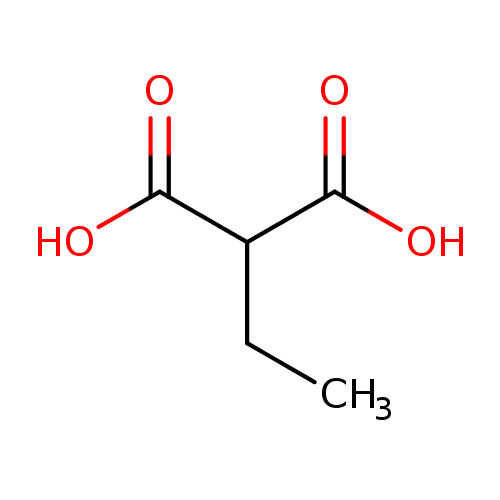
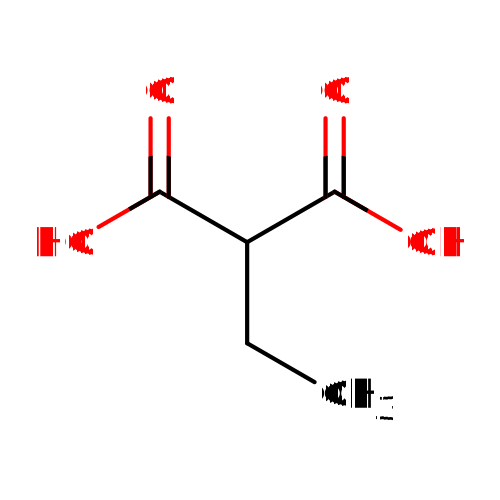
Common NameEthylmalonic acid
ClassSmall Molecule
DescriptionEthylmalonic acid is identified in the urine of patients with short-chain acyl-coenzyme A dehydrogenase deficiency, which is a fatty acid metabolism disorder.
Contaminant Sources
  • FooDB Chemicals
  • HMDB Contaminants - Urine
  • T3DB toxins
Contaminant Type
  • Animal Toxin
  • Food Toxin
  • Metabolite
  • Natural Compound
  • Organic Compound
Chemical Structure
Thumb
Synonyms
ValueSource
1,1-Propanedicarboxylic acidChEBI
2-Ethylmalonic acidChEBI
alpha-Carboxybutyric acidChEBI
1,1-PropanedicarboxylateGenerator
2-EthylmalonateGenerator
a-CarboxybutyrateGenerator
a-Carboxybutyric acidGenerator
alpha-CarboxybutyrateGenerator
Α-carboxybutyrateGenerator
Α-carboxybutyric acidGenerator
EthylmalonateGenerator
Ethyl-malonic acidHMDB
2-Ethylpropanedioic acidHMDB
Ethylmalonic acidHMDB
Chemical FormulaC5H8O4
Average Molecular Mass132.115 g/mol
Monoisotopic Mass132.042 g/mol
CAS Registry Number601-75-2
IUPAC Name2-ethylpropanedioic acid
Traditional Nameethylmalonic acid
SMILESCCC(C(O)=O)C(O)=O
InChI IdentifierInChI=1S/C5H8O4/c1-2-3(4(6)7)5(8)9/h3H,2H2,1H3,(H,6,7)(H,8,9)
InChI KeyUKFXDFUAPNAMPJ-UHFFFAOYSA-N
Chemical Taxonomy
Description belongs to the class of organic compounds known as branched fatty acids. These are fatty acids containing a branched chain.
KingdomOrganic compounds
Super ClassLipids and lipid-like molecules
ClassFatty Acyls
Sub ClassFatty acids and conjugates
Direct ParentBranched fatty acids
Alternative Parents
Substituents
  • Branched fatty acid
  • 1,3-dicarbonyl compound
  • Dicarboxylic acid or derivatives
  • Carboxylic acid
  • Carboxylic acid derivative
  • Organic oxygen compound
  • Organic oxide
  • Hydrocarbon derivative
  • Organooxygen compound
  • Carbonyl group
  • Aliphatic acyclic compound
Molecular FrameworkAliphatic acyclic compounds
External Descriptors
Biological Properties
StatusDetected and Not Quantified
OriginEndogenous
Cellular Locations
  • Cytoplasm
  • Extracellular
  • Membrane
Biofluid LocationsNot Available
Tissue Locations
  • Fibroblasts
  • Prostate
  • Skeletal Muscle
Pathways
NameSMPDB LinkKEGG Link
Short Chain Acyl CoA Dehydrogenase Deficiency (SCAD Deficiency)SMP00235 Not Available
ApplicationsNot Available
Biological Roles
Chemical RolesNot Available
Physical Properties
StateSolid
AppearanceWhite powder.
Experimental Properties
PropertyValue
Melting Point112 - 114°C
Boiling PointNot Available
Solubility712.0 mg/mL
Predicted Properties
PropertyValueSource
Water Solubility94.1 g/LALOGPS
logP0.43ALOGPS
logP0.66ChemAxon
logS-0.15ALOGPS
pKa (Strongest Acidic)2.5ChemAxon
Physiological Charge-2ChemAxon
Hydrogen Acceptor Count4ChemAxon
Hydrogen Donor Count2ChemAxon
Polar Surface Area74.6 ŲChemAxon
Rotatable Bond Count3ChemAxon
Refractivity28.16 m³·mol⁻¹ChemAxon
Polarizability11.98 ųChemAxon
Number of Rings0ChemAxon
Bioavailability1ChemAxon
Rule of FiveYesChemAxon
Ghose FilterNoChemAxon
Veber's RuleNoChemAxon
MDDR-like RuleNoChemAxon
Spectra
Spectra
Spectrum TypeDescriptionSplash KeyView
GC-MSGC-MS Spectrum - GC-EI-TOF (Pegasus III TOF-MS system, Leco; GC 6890, Agilent Technologies) (Non-derivatized)splash10-0002-0910000000-ff684346010454e439ecSpectrum
GC-MSGC-MS Spectrum - EI-B (Non-derivatized)splash10-0gvx-9100000000-9713da0bdd2cd0b28ebaSpectrum
GC-MSGC-MS Spectrum - EI-B (Non-derivatized)splash10-0002-0920000000-c6908d036ed13e7ba519Spectrum
GC-MSGC-MS Spectrum - GC-EI-TOF (Non-derivatized)splash10-0002-0910000000-ff684346010454e439ecSpectrum
Predicted GC-MSPredicted GC-MS Spectrum - GC-MS (Non-derivatized) - 70eV, Positivesplash10-004u-9400000000-c51992693b05221f3a8aSpectrum
Predicted GC-MSPredicted GC-MS Spectrum - GC-MS (2 TMS) - 70eV, Positivesplash10-00dr-9220000000-10ce85512076eaa6afdeSpectrum
Predicted GC-MSPredicted GC-MS Spectrum - GC-MS (Non-derivatized) - 70eV, PositiveNot AvailableSpectrum
Predicted GC-MSPredicted GC-MS Spectrum - GC-MS (TMS_1_1) - 70eV, PositiveNot AvailableSpectrum
Predicted GC-MSPredicted GC-MS Spectrum - GC-MS (TBDMS_1_1) - 70eV, PositiveNot AvailableSpectrum
Predicted GC-MSPredicted GC-MS Spectrum - GC-MS (TBDMS_2_1) - 70eV, PositiveNot AvailableSpectrum
LC-MS/MSLC-MS/MS Spectrum - Quattro_QQQ 10V, Negative (Annotated)splash10-000l-9000000000-ed08eca90f357944aee9Spectrum
LC-MS/MSLC-MS/MS Spectrum - Quattro_QQQ 25V, Negative (Annotated)splash10-0006-9000000000-b6e83c7aef56876fa1b3Spectrum
LC-MS/MSLC-MS/MS Spectrum - Quattro_QQQ 40V, Negative (Annotated)splash10-0006-9000000000-409423c1bfecc553b24eSpectrum
LC-MS/MSLC-MS/MS Spectrum - , negativesplash10-000i-9000000000-d15979561ae10b3c94dfSpectrum
LC-MS/MSLC-MS/MS Spectrum - 10V, Negativesplash10-000i-9000000000-6cd825b16df28e77024aSpectrum
LC-MS/MSLC-MS/MS Spectrum - 20V, Negativesplash10-00kr-9000000000-32cc5c19f1f63ea75c17Spectrum
LC-MS/MSLC-MS/MS Spectrum - 40V, Negativesplash10-0gb9-9000000000-c8fadac6a17104d7abf6Spectrum
LC-MS/MSLC-MS/MS Spectrum - 35V, Negativesplash10-000i-9000000000-e7765d86ee8d74f0f9d6Spectrum
LC-MS/MSLC-MS/MS Spectrum - 35V, Negativesplash10-000i-9000000000-4086dd4566bac56688a9Spectrum
Predicted LC-MS/MSPredicted LC-MS/MS Spectrum - 10V, Positivesplash10-00lr-3900000000-7ad5e5da82f0646b39dbSpectrum
Predicted LC-MS/MSPredicted LC-MS/MS Spectrum - 20V, Positivesplash10-014i-9600000000-00a7e2649b402719b2faSpectrum
Predicted LC-MS/MSPredicted LC-MS/MS Spectrum - 40V, Positivesplash10-00kf-9000000000-6cd3362f5cdb53773ce8Spectrum
Predicted LC-MS/MSPredicted LC-MS/MS Spectrum - 10V, Negativesplash10-0019-9400000000-257e80506d0172d05d98Spectrum
Predicted LC-MS/MSPredicted LC-MS/MS Spectrum - 20V, Negativesplash10-000l-9000000000-e79d02ff9ead3516adaaSpectrum
Predicted LC-MS/MSPredicted LC-MS/MS Spectrum - 40V, Negativesplash10-0006-9000000000-c55403c45b1243b9628eSpectrum
Predicted LC-MS/MSPredicted LC-MS/MS Spectrum - 10V, Positivesplash10-00ku-9100000000-bf24e61d0219e165c8deSpectrum
Predicted LC-MS/MSPredicted LC-MS/MS Spectrum - 20V, Positivesplash10-014i-9000000000-f4c23282a114d4982d2dSpectrum
Predicted LC-MS/MSPredicted LC-MS/MS Spectrum - 40V, Positivesplash10-0006-9000000000-5a0f73206eec5978645dSpectrum
Predicted LC-MS/MSPredicted LC-MS/MS Spectrum - 10V, Negativesplash10-000i-9300000000-fec5eeeb4f241984f787Spectrum
Predicted LC-MS/MSPredicted LC-MS/MS Spectrum - 20V, Negativesplash10-014r-9000000000-08c6ded2366ed022deabSpectrum
Predicted LC-MS/MSPredicted LC-MS/MS Spectrum - 40V, Negativesplash10-014i-9000000000-76b92022e3a050e0fb1eSpectrum
MSMass Spectrum (Electron Ionization)splash10-0udr-9300000000-e531a154ddaf695ebe5bSpectrum
1D NMR1H NMR SpectrumNot AvailableSpectrum
2D NMR[1H,13C] 2D NMR SpectrumNot AvailableSpectrum
Toxicity Profile
Route of ExposureNot Available
Mechanism of ToxicityEthylmalonic acid is identified in the urine of patients with short-chain acyl-coenzyme A dehydrogenase deficiency, which is a fatty acid metabolism disorder.
MetabolismNot Available
Toxicity ValuesNot Available
Lethal DoseNot Available
Carcinogenicity (IARC Classification)No indication of carcinogenicity to humans (not listed by IARC).
Uses/SourcesThis is an endogenously produced metabolite found in the human body. It is used in metabolic reactions, catabolic reactions or waste generation.
Minimum Risk LevelNot Available
Health EffectsChronically high levels of ethylmalonic acid are associated with at least 2 inborn errors of metabolism including: Short Chain Acyl CoA Dehydrogenase Deficiency (SCAD Deficiency) and Ethylmalonic Encephalopathy.
SymptomsNot Available
TreatmentNot Available
Concentrations
Not Available
DrugBank IDNot Available
HMDB IDHMDB0000622
FooDB IDFDB022147
Phenol Explorer IDNot Available
KNApSAcK IDC00052274
BiGG IDNot Available
BioCyc IDNot Available
METLIN ID4180
PDB IDNot Available
Wikipedia LinkNot Available
Chemspider ID11263
ChEBI ID741548
PubChem Compound ID11756
Kegg Compound IDNot Available
YMDB IDNot Available
ECMDB IDNot Available
References
Synthesis ReferenceZakharova, T. V.; Ternovaya, T. V.; Pirkes, S. B.; Kostromina, N. A. Study of complexing in the neodymium-ethylmalonic acid system by a spectrographic method. Zhurnal Neorganicheskoi Khimii (1979), 24(7), 1827-31.
MSDSLink
General References
1. https://www.ncbi.nlm.nih.gov/pubmed/?term=12061367
2. https://www.ncbi.nlm.nih.gov/pubmed/?term=1269146
3. https://www.ncbi.nlm.nih.gov/pubmed/?term=14595061
4. https://www.ncbi.nlm.nih.gov/pubmed/?term=14732903
5. https://www.ncbi.nlm.nih.gov/pubmed/?term=15096407
6. https://www.ncbi.nlm.nih.gov/pubmed/?term=16773466
7. https://www.ncbi.nlm.nih.gov/pubmed/?term=19212411
8. https://www.ncbi.nlm.nih.gov/pubmed/?term=20187168
9. https://www.ncbi.nlm.nih.gov/pubmed/?term=22133302
10. https://www.ncbi.nlm.nih.gov/pubmed/?term=23161776
11. https://www.ncbi.nlm.nih.gov/pubmed/?term=6860317
12. https://www.ncbi.nlm.nih.gov/pubmed/?term=7776094
13. https://www.ncbi.nlm.nih.gov/pubmed/?term=8087979
14. https://www.ncbi.nlm.nih.gov/pubmed/?term=9439441
15. Zakharova, T. V.; Ternovaya, T. V.; Pirkes, S. B.; Kostromina, N. A. Study of complexing in the neodymium-ethylmalonic acid system by a spectrographic method. Zhurnal Neorganicheskoi Khimii (1979), 24(7), 1827-31.
16. Tiranti V, D'Adamo P, Briem E, Ferrari G, Mineri R, Lamantea E, Mandel H, Balestri P, Garcia-Silva MT, Vollmer B, Rinaldo P, Hahn SH, Leonard J, Rahman S, Dionisi-Vici C, Garavaglia B, Gasparini P, Zeviani M: Ethylmalonic encephalopathy is caused by mutations in ETHE1, a gene encoding a mitochondrial matrix protein. Am J Hum Genet. 2004 Feb;74(2):239-52. Epub 2004 Jan 19.
17. McGowan KA, Nyhan WL, Barshop BA, Naviaux RK, Yu A, Haas RH, Townsend JJ: The role of methionine in ethylmalonic encephalopathy with petechiae. Arch Neurol. 2004 Apr;61(4):570-4.
18. Guneral F, Bachmann C: Age-related reference values for urinary organic acids in a healthy Turkish pediatric population. Clin Chem. 1994 Jun;40(6):862-6.
19. Birkebaek NH, Simonsen H, Gregersen N: Hypoglycaemia and elevated urine ethylmalonic acid in a child homozygous for the short-chain acyl-CoA dehydrogenase 625G > A gene variation. Acta Paediatr. 2002;91(4):480-2.
20. Tanaka K, Ramsdell HS, Baretz BH, Keefe MB, Kean EA, Johnson B: Identification of ethylmalonic acid in urine of two patients with the vomitting sickness of Jamaica. Clin Chim Acta. 1976 May 17;69(1):105-12.
21. Bhala A, Willi SM, Rinaldo P, Bennett MJ, Schmidt-Sommerfeld E, Hale DE: Clinical and biochemical characterization of short-chain acyl-coenzyme A dehydrogenase deficiency. J Pediatr. 1995 Jun;126(6):910-5.
22. Bok LA, Vreken P, Wijburg FA, Wanders RJ, Gregersen N, Corydon MJ, Waterham HR, Duran M: Short-chain Acyl-CoA dehydrogenase deficiency: studies in a large family adding to the complexity of the disorder. Pediatrics. 2003 Nov;112(5):1152-5.
23. Barschak AG, Ferreira Gda C, Andre KR, Schuck PF, Viegas CM, Tonin A, Dutra Filho CS, Wyse AT, Wannmacher CM, Vargas CR, Wajner M: Inhibition of the electron transport chain and creatine kinase activity by ethylmalonic acid in human skeletal muscle. Metab Brain Dis. 2006 Mar;21(1):11-9. Epub 2006 Apr 28.
24. Sreekumar A, Poisson LM, Rajendiran TM, Khan AP, Cao Q, Yu J, Laxman B, Mehra R, Lonigro RJ, Li Y, Nyati MK, Ahsan A, Kalyana-Sundaram S, Han B, Cao X, Byun J, Omenn GS, Ghosh D, Pennathur S, Alexander DC, Berger A, Shuster JR, Wei JT, Varambally S, Beecher C, Chinnaiyan AM: Metabolomic profiles delineate potential role for sarcosine in prostate cancer progression. Nature. 2009 Feb 12;457(7231):910-4. doi: 10.1038/nature07762.
25. Elshenawy S, Pinney SE, Stuart T, Doulias PT, Zura G, Parry S, Elovitz MA, Bennett MJ, Bansal A, Strauss JF 3rd, Ischiropoulos H, Simmons RA: The Metabolomic Signature of the Placenta in Spontaneous Preterm Birth. Int J Mol Sci. 2020 Feb 4;21(3). pii: ijms21031043. doi: 10.3390/ijms21031043.