Record Information
Version1.0
Creation Date2014-08-29 06:51:25 UTC
Update Date2026-05-14 18:07:13 UTC
Accession NumberCHEM003417
Identification
Common NameN-Acetylneuraminic acid
ClassSmall Molecule
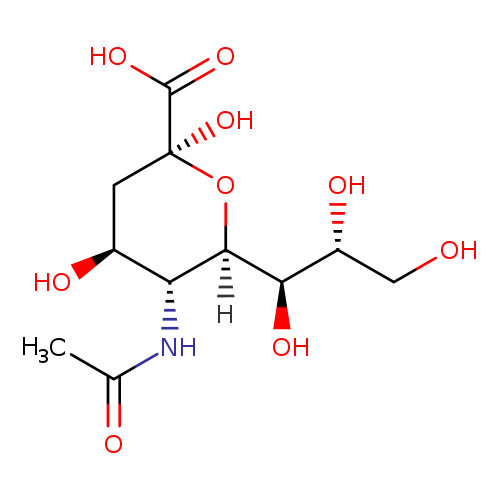
DescriptionN-Acetylneuraminic acid (NeuAc) or sialic acid is an acetyl derivative of the amino sugar neuraminic acid. It occurs in many glycoproteins, glycolipids, and polysaccharides in both mammals and bacteria. The most abundant sialic acid, NeuAc, is synthesized in vivo from N-acetylated D-mannosamine (ManNAc) or D-glucosamine (GlcNAc). NeuAc and its activated form, CMP-NeuAc, are biosynthesized in five consecutive reactions: UDP-N-acetylglucosamine (UDP-GlcNAc) N-acetylmannosamine (ManNAc) ManNAc 6-phosphate NeuAc 9-phosphate NeuAc CMP-NeuAc. CMP-NeuAc is transported into the Golgi apparatus and, with the aid of specific sialyltransferases, added onto nonreducing positions on oligosaccharide chains of glycoproteins and glycolipids. NeuAc is widely distributed throughout human tissues and found in several fluids, including serum, cerebrospinal fluid, saliva, urine, amniotic fluid, and breast milk. It is found in high levels in the brain, adrenal glands, and the heart. Serum and urine levels of the free acid are elevated in individuals suffering from renal failure. Serum and saliva Neu5Ac levels are also elevated in alcoholics. A disorder known as Salla disease or infantile NeuAc storage disease is also characterized by high serum and urine levels of this compound. The negative charge of is responsible for the slippery feel of saliva and mucins coating the body's organs. This particular sialic acid is known to act as a decoy for invading pathogens. Along with involvement in preventing infections (mucus associated with mucous membranes mouth, nose, GI, respiratory tract), Neu5Ac acts as a receptor for influenza viruses, allowing attachment to mucous cells via hemagglutinin (an early step in acquiring influenzavirus infection). NeuAc is also becoming known as an agent necessary for mediating ganglioside distribution and structures in the brain. Sialic acid (SA) is an N-acetylated derivative of neuraminic acid that is an abundant terminal monosaccharide of glycoconjugates. Normal human serum SA is largely bound to glycoproteins or glycolipids (Total sialic acid, TSA, 1.5-2.5 mmol/L), with small amounts of free SA (1-3 umol/L). Negatively charged SA units stabilize glycoprotein conformation in cell surface receptors to increase cell rigidity. This enables signal recognition and adhesion to ligands, antibodies, enzymes and microbes. SA residues are antigenic determinant residues in carbohydrate chains of glycolipids and glycoproteins, chemical messengers in tissue and body fluids, and may regulate glomeruli basement membrane permeability. Sialic acids are structurally unique nine-carbon keto sugars occupying the interface between the host and commensal or pathogenic microorganisms. An important function of host sialic acid is to regulate innate immunity. Sialic acid is the moiety most actively recycled for metabolic purposes in the salvage pathways in glycosphingolipid metabolism. Sialic acid is indispensable for the neuritogenic activities of gangliosides constituents which are unique in that a sialic acid directly binds to the glucose of the cerebroside, they are mutually connected in tandem, and some are located in the internal parts of the sugar chain. Sialylation (sialic acid linked to galactose, N-acetylgalactosamine, or linked to another sialic acid) represents one of the most frequently occurring terminations of the oligosaccharide chains of glycoproteins and glycolipids. The biosynthesis of the various linkages is mediated by the different members of the sialyltransferase family. (1, 2, 3, 4, 5, 6).
Contaminant Sources
  • FooDB Chemicals
  • HMDB Contaminants - Feces
  • HMDB Contaminants - Urine
  • T3DB toxins
  • ToxCast & Tox21 Chemicals
Contaminant Type
  • Animal Toxin
  • Food Toxin
  • Mammal Toxin
  • Metabolite
  • Natural Compound
  • Organic Compound
Chemical Structure
Thumb
Synonyms
ValueSource
5-N-ACETYL-BETA-D-neuraminIC ACIDChEBI
beta-Neu5acChEBI
5-N-ACETYL-b-D-neuraminateGenerator
5-N-ACETYL-b-D-neuraminic acidGenerator
5-N-ACETYL-beta-D-neuraminateGenerator
5-N-ACETYL-β-D-neuraminateGenerator
5-N-ACETYL-β-D-neuraminic acidGenerator
b-Neu5acGenerator
Β-neu5acGenerator
N-AcetylneuraminateGenerator
5-(Acetylamino)-3,5-dideoxy-D-glycero-b-D-galacto-2-nonulopyranosonateHMDB
5-(Acetylamino)-3,5-dideoxy-D-glycero-b-D-galacto-2-nonulopyranosonic acidHMDB
5-(Acetylamino)-3,5-dideoxy-D-glycero-D-galacto-2-nonulosonateHMDB
5-(Acetylamino)-3,5-dideoxy-D-glycero-D-galacto-2-nonulosonic acidHMDB
5-(Acetylamino)-3,5-dideoxy-delta-glycero-beta-delta-galacto-2-nonulopyranosonateHMDB
5-(Acetylamino)-3,5-dideoxy-delta-glycero-beta-delta-galacto-2-nonulopyranosonic acidHMDB
5-(Acetylamino)-3,5-dideoxy-delta-glycero-delta-galacto-2-nonulosonateHMDB
5-(Acetylamino)-3,5-dideoxy-delta-glycero-delta-galacto-2-nonulosonic acidHMDB
5-Acetamido-3,5-dideoxy-D-glycero-D-galacto-nonulosonateHMDB
5-Acetamido-3,5-dideoxy-D-glycero-D-galacto-nonulosonic acidHMDB
5-Acetamido-3,5-dideoxy-delta-glycero-delta-galacto-nonulosonateHMDB
5-Acetamido-3,5-dideoxy-delta-glycero-delta-galacto-nonulosonic acidHMDB
5-N-Acetyl-beta-delta-neuraminic acidHMDB
5-N-Acetyl-D-neuraminateHMDB
5-N-Acetyl-D-neuraminic acidHMDB
5-N-Acetyl-delta-neuraminateHMDB
5-N-Acetyl-delta-neuraminic acidHMDB
5-N-AcetylneuraminateHMDB
5-N-Acetylneuraminic acidHMDB
AceneuramateHMDB
Aceneuramic acidHMDB
AcetylneuraminateHMDB
Acetylneuraminic acidHMDB
b-5-Acetamido-3,5-dideoxy-D-glycero-D-galacto-nonulopyranosonateHMDB
b-5-Acetamido-3,5-dideoxy-D-glycero-D-galacto-nonulopyranosonic acidHMDB
b-Sialic acidHMDB
beta-5-Acetamido-3,5-dideoxy-delta-glycero-delta-galacto-nonulopyranosonateHMDB
beta-5-Acetamido-3,5-dideoxy-delta-glycero-delta-galacto-nonulopyranosonic acidHMDB
beta-Sialic acidHMDB
LactaminateHMDB
Lactaminic acidHMDB
N-Acetyl-b-D-neuraminateHMDB
N-Acetyl-b-D-neuraminic acidHMDB
N-Acetyl-b-neuraminateHMDB
N-Acetyl-beta-delta-neuraminateHMDB
N-Acetyl-beta-delta-neuraminic acidHMDB
N-Acetyl-beta-neuraminateHMDB
N-Acetyl-D-neuraminateHMDB
N-Acetyl-D-neuraminic acidHMDB
N-Acetyl-delta-neuraminateHMDB
N-Acetyl-delta-neuraminic acidHMDB
N-Acetyl-neuraminateHMDB
N-Acetyl-neuraminic acidHMDB
N-AcetylneuramateHMDB
N-Acetylneuramic acidHMDB
N-AcetylsialateHMDB
N-Acetylsialic acidHMDB
NANHMDB
NANAHMDB
Neu5acHMDB
Sialic acidHMDB
Acid, sialicHMDB
Acid, N-acetylneuraminicHMDB
N Acetylneuraminic acidHMDB
N-Acetyl-beta-D-neuraminic acidHMDB
N-Acetyl-beta-neuraminic acidHMDB
N-Acetyl-β-D-neuraminic acidHMDB
N-Acetyl-β-neuraminic acidHMDB
N-Acetylneuraminic acidHMDB
Chemical FormulaC11H19NO9
Average Molecular Mass309.270 g/mol
Monoisotopic Mass309.106 g/mol
CAS Registry Number131-48-6
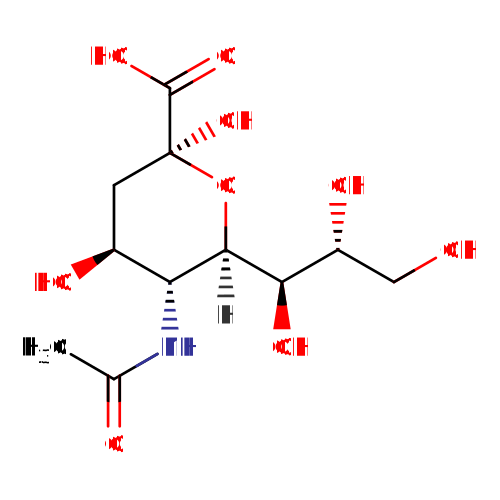
IUPAC Name(2S,4S,5R,6R)-5-acetamido-2,4-dihydroxy-6-[(1R,2R)-1,2,3-trihydroxypropyl]oxane-2-carboxylic acid
Traditional Nameβ-neu5ac
SMILESCC(=O)N[C@@H]1[C@@H](O)C[C@](O)(O[C@H]1[C@H](O)[C@H](O)CO)C(O)=O
InChI IdentifierInChI=1S/C11H19NO9/c1-4(14)12-7-5(15)2-11(20,10(18)19)21-9(7)8(17)6(16)3-13/h5-9,13,15-17,20H,2-3H2,1H3,(H,12,14)(H,18,19)/t5-,6+,7+,8+,9+,11-/m0/s1
InChI KeySQVRNKJHWKZAKO-PFQGKNLYSA-N
Chemical Taxonomy
Description belongs to the class of organic compounds known as n-acylneuraminic acids. These are neuraminic acids carrying an N-acyl substituent.
KingdomOrganic compounds
Super ClassOrganic oxygen compounds
ClassOrganooxygen compounds
Sub ClassCarbohydrates and carbohydrate conjugates
Direct ParentN-acylneuraminic acids
Alternative Parents
Substituents
  • N-acylneuraminic acid
  • Neuraminic acid
  • C-glucuronide
  • C-glycosyl compound
  • Glycosyl compound
  • Alpha-hydroxy acid
  • Pyran
  • Hydroxy acid
  • Oxane
  • Acetamide
  • Carboxamide group
  • Hemiacetal
  • Secondary carboxylic acid amide
  • Secondary alcohol
  • Carboxylic acid derivative
  • Carboxylic acid
  • Oxacycle
  • Organoheterocyclic compound
  • Monocarboxylic acid or derivatives
  • Polyol
  • Alcohol
  • Hydrocarbon derivative
  • Organic nitrogen compound
  • Organopnictogen compound
  • Primary alcohol
  • Organic oxide
  • Carbonyl group
  • Organonitrogen compound
  • Aliphatic heteromonocyclic compound
Molecular FrameworkAliphatic heteromonocyclic compounds
External Descriptors
Biological Properties
StatusDetected and Not Quantified
OriginEndogenous
Cellular Locations
  • Cytoplasm
  • Lysosome
  • Membrane
  • Nucleus
Biofluid LocationsNot Available
Tissue Locations
  • Adrenal Gland
  • Brain
  • Myelin
  • Prostate
  • Testes
Pathways
NameSMPDB LinkKEGG Link
Amino Sugar MetabolismSMP00045 map00520
Salla Disease/Infantile Sialic Acid Storage DiseaseSMP00240 Not Available
Sialuria or French Type SialuriaSMP00216 Not Available
Sjogren Larsson SyndromeSMP00217 Not Available
Applications
Biological Roles
Chemical Roles
Physical Properties
StateSolid
AppearanceWhite powder.
Experimental Properties
PropertyValue
Melting Point186°C
Boiling PointNot Available
SolubilityNot Available
Predicted Properties
PropertyValueSource
Water Solubility227 g/LALOGPS
logP-2.8ALOGPS
logP-3.6ChemAxon
logS-0.13ALOGPS
pKa (Strongest Acidic)3ChemAxon
pKa (Strongest Basic)-1.3ChemAxon
Physiological Charge-1ChemAxon
Hydrogen Acceptor Count9ChemAxon
Hydrogen Donor Count7ChemAxon
Polar Surface Area176.78 ŲChemAxon
Rotatable Bond Count5ChemAxon
Refractivity63.78 m³·mol⁻¹ChemAxon
Polarizability27.82 ųChemAxon
Number of Rings1ChemAxon
Bioavailability1ChemAxon
Rule of FiveNoChemAxon
Ghose FilterNoChemAxon
Veber's RuleNoChemAxon
MDDR-like RuleNoChemAxon
Spectra
Spectra
Spectrum TypeDescriptionSplash KeyView
GC-MSGC-MS Spectrum - GC-MS (7 TMS)splash10-0fr2-1961000000-3acdbc4b39a5bf685996Spectrum
GC-MSGC-MS Spectrum - GC-MS (6 TMS)splash10-014j-0492000000-8e4279660c77b0c70a30Spectrum
GC-MSGC-MS Spectrum - GC-MS (1 MEOX; 7 TMS)splash10-00l6-1792200000-863a168c10243229e892Spectrum
GC-MSGC-MS Spectrum - GC-MS (Non-derivatized)splash10-0fr2-1961000000-3acdbc4b39a5bf685996Spectrum
GC-MSGC-MS Spectrum - GC-MS (Non-derivatized)splash10-014j-0492000000-8e4279660c77b0c70a30Spectrum
GC-MSGC-MS Spectrum - GC-MS (Non-derivatized)splash10-00l6-1792200000-863a168c10243229e892Spectrum
Predicted GC-MSPredicted GC-MS Spectrum - GC-MS (Non-derivatized) - 70eV, Positivesplash10-0h2f-9660000000-f7a1f63f319c23f8e72aSpectrum
Predicted GC-MSPredicted GC-MS Spectrum - GC-MS (5 TMS) - 70eV, Positivesplash10-0zfr-4620249000-1d39f85a16504ef9ea46Spectrum
Predicted GC-MSPredicted GC-MS Spectrum - GC-MS (Non-derivatized) - 70eV, PositiveNot AvailableSpectrum
LC-MS/MSLC-MS/MS Spectrum - Quattro_QQQ 10V, Positive (Annotated)splash10-00di-0190000000-a3a5aaa2e10a6cfed08aSpectrum
LC-MS/MSLC-MS/MS Spectrum - Quattro_QQQ 25V, Positive (Annotated)splash10-0fk9-3900000000-7100e174e13e94736ae7Spectrum
LC-MS/MSLC-MS/MS Spectrum - Quattro_QQQ 40V, Positive (Annotated)splash10-00si-9300000000-1166885a787fd53086b0Spectrum
LC-MS/MSLC-MS/MS Spectrum - 20V, Negativesplash10-000i-9100000000-260b6f27d6f3469ede2fSpectrum
LC-MS/MSLC-MS/MS Spectrum - 40V, Negativesplash10-000i-9000000000-35b6da9206192d33828eSpectrum
LC-MS/MSLC-MS/MS Spectrum - 10V, Negativesplash10-000i-9301000000-47798651a02647e16452Spectrum
LC-MS/MSLC-MS/MS Spectrum - 30V, Negativesplash10-000i-9000000000-1096dd07227387a97604Spectrum
Predicted LC-MS/MSPredicted LC-MS/MS Spectrum - 10V, Positivesplash10-01ox-1091000000-11c42df33f8993522db0Spectrum
Predicted LC-MS/MSPredicted LC-MS/MS Spectrum - 20V, Positivesplash10-03kc-5090000000-5d0c74aa0d8a2c8d321cSpectrum
Predicted LC-MS/MSPredicted LC-MS/MS Spectrum - 40V, Positivesplash10-03di-9320000000-cfda0db8085e62f50516Spectrum
Predicted LC-MS/MSPredicted LC-MS/MS Spectrum - 10V, Negativesplash10-0a4j-3391000000-68ee32ef5e2ba6223c42Spectrum
Predicted LC-MS/MSPredicted LC-MS/MS Spectrum - 20V, Negativesplash10-000i-9110000000-9ae00577454ddf4db073Spectrum
Predicted LC-MS/MSPredicted LC-MS/MS Spectrum - 40V, Negativesplash10-0a4i-9300000000-798cb916675bb1245a78Spectrum
Predicted LC-MS/MSPredicted LC-MS/MS Spectrum - 10V, Positivesplash10-03kc-0095000000-8f7746cc3f652b12033fSpectrum
Predicted LC-MS/MSPredicted LC-MS/MS Spectrum - 20V, Positivesplash10-02tc-1392000000-3e251c9d2583e71f866aSpectrum
Predicted LC-MS/MSPredicted LC-MS/MS Spectrum - 40V, Positivesplash10-03di-7910000000-ba41b78e53cb934a9b19Spectrum
Predicted LC-MS/MSPredicted LC-MS/MS Spectrum - 10V, Negativesplash10-0a4i-3039000000-4348eff0515b0da3bc08Spectrum
Predicted LC-MS/MSPredicted LC-MS/MS Spectrum - 20V, Negativesplash10-0a59-6290000000-5ac6f13cca0827ab0dd0Spectrum
Predicted LC-MS/MSPredicted LC-MS/MS Spectrum - 40V, Negativesplash10-0a4u-9100000000-ac22477eeca403481effSpectrum
1D NMR1H NMR SpectrumNot AvailableSpectrum
1D NMR13C NMR SpectrumNot AvailableSpectrum
1D NMR1H NMR SpectrumNot AvailableSpectrum
1D NMR13C NMR SpectrumNot AvailableSpectrum
1D NMR1H NMR SpectrumNot AvailableSpectrum
1D NMR13C NMR SpectrumNot AvailableSpectrum
1D NMR1H NMR SpectrumNot AvailableSpectrum
1D NMR13C NMR SpectrumNot AvailableSpectrum
1D NMR1H NMR SpectrumNot AvailableSpectrum
1D NMR13C NMR SpectrumNot AvailableSpectrum
1D NMR1H NMR SpectrumNot AvailableSpectrum
1D NMR13C NMR SpectrumNot AvailableSpectrum
1D NMR1H NMR SpectrumNot AvailableSpectrum
1D NMR13C NMR SpectrumNot AvailableSpectrum
1D NMR1H NMR SpectrumNot AvailableSpectrum
1D NMR13C NMR SpectrumNot AvailableSpectrum
1D NMR1H NMR SpectrumNot AvailableSpectrum
1D NMR13C NMR SpectrumNot AvailableSpectrum
1D NMR1H NMR SpectrumNot AvailableSpectrum
1D NMR13C NMR SpectrumNot AvailableSpectrum
2D NMR[1H,1H] 2D NMR SpectrumNot AvailableSpectrum
2D NMR[1H,13C] 2D NMR SpectrumNot AvailableSpectrum
Toxicity Profile
Route of ExposureNot Available
Mechanism of ToxicityNot Available
MetabolismNot Available
Toxicity ValuesNot Available
Lethal DoseNot Available
Carcinogenicity (IARC Classification)No indication of carcinogenicity to humans (not listed by IARC).
Uses/SourcesThis is an endogenously produced metabolite found in the human body. It is used in metabolic reactions, catabolic reactions or waste generation.
Minimum Risk LevelNot Available
Health EffectsNot Available
SymptomsNot Available
TreatmentNot Available
Concentrations
Not Available
DrugBank IDDB04265
HMDB IDHMDB0000230
FooDB IDNot Available
Phenol Explorer IDNot Available
KNApSAcK IDNot Available
BiGG IDNot Available
BioCyc IDNot Available
METLIN IDNot Available
PDB IDNot Available
Wikipedia LinkN-Acetylneuraminic acid
Chemspider ID392810
ChEBI ID45744
PubChem Compound ID445063
Kegg Compound IDC19910
YMDB IDNot Available
ECMDB IDECMDB00830
References
Synthesis ReferenceYamamoto, Toshihiro; Teshima, Tadashi; Inami, Kaoru; Shiba, Tetsuo. Synthesis of sialic acid through aldol condensation of glucose with oxalacetic acid. Tetrahedron Letters (1992), 33(3), 325-8.
MSDSNot Available
General References
1. Yamamoto, Toshihiro; Teshima, Tadashi; Inami, Kaoru; Shiba, Tetsuo. Synthesis of sialic acid through aldol condensation of glucose with oxalacetic acid. Tetrahedron Letters (1992), 33(3), 325-8.
2. Domschke W, Lux G, Domschke S: Furan H2-antagonist ranitidine inhibits pentagastrin-stimulated gastric secretion stronger than cimetidine. Gastroenterology. 1980 Dec;79(6):1267-71.
3. Bosmann HB: Platelet adhesiveness and aggregation. II. Surface sialic acid, glycoprotein: N-acetylneuraminic acid transferase, and neuraminidase of human blood platelets. Biochim Biophys Acta. 1972 Oct 25;279(3):456-74.
4. Rack J, Sonnenberg A: The influence of smoking and intravenous nicotine on gastric mucus. Hepatogastroenterology. 1983 Dec;30(6):258-60.
5. Bell JD, Brown JC, Nicholson JK, Sadler PJ: Assignment of resonances for 'acute-phase' glycoproteins in high resolution proton NMR spectra of human blood plasma. FEBS Lett. 1987 May 11;215(2):311-5.
6. Brusque A, Rotta L, Pettenuzzo LF, Junqueira D, Schwarzbold CV, Wyse AT, Wannmacher CM, Dutra-Filho CS, Wajner M: Chronic postnatal administration of methylmalonic acid provokes a decrease of myelin content and ganglioside N-acetylneuraminic acid concentration in cerebrum of young rats. Braz J Med Biol Res. 2001 Feb;34(2):227-31.
7. Seppala R, Renlund M, Bernardini I, Tietze F, Gahl WA: Renal handling of free sialic acid in normal humans and patients with Salla disease or renal disease. Lab Invest. 1990 Aug;63(2):197-203.
8. Loomis RE, Prakobphol A, Levine MJ, Reddy MS, Jones PC: Biochemical and biophysical comparison of two mucins from human submandibular-sublingual saliva. Arch Biochem Biophys. 1987 Nov 1;258(2):452-64.
9. Nakata D, Munster AK, Gerardy-Schahn R, Aoki N, Matsuda T, Kitajima K: Molecular cloning of a unique CMP-sialic acid synthetase that effectively utilizes both deaminoneuraminic acid (KDN) and N-acetylneuraminic acid (Neu5Ac) as substrates. Glycobiology. 2001 Aug;11(8):685-92.
10. Suzuki M, Suzuki A, Yamakawa T, Matsunaga E: Characterization of 2,7-anhydro-N-acetylneuraminic acid in human wet cerumen. J Biochem. 1985 Feb;97(2):509-15.
11. Baumkotter J, Cantz M, Mendla K, Baumann W, Friebolin H, Gehler J, Spranger J: N-Acetylneuraminic acid storage disease. Hum Genet. 1985;71(2):155-9.
12. Weiss P, Tietze F, Gahl WA, Seppala R, Ashwell G: Identification of the metabolic defect in sialuria. J Biol Chem. 1989 Oct 25;264(30):17635-6.
13. McGee DJ, Rest RF: Regulation of gonococcal sialyltransferase, lipooligosaccharide, and serum resistance by glucose, pyruvate, and lactate. Infect Immun. 1996 Nov;64(11):4630-7.
14. Sonnenberg A, Steinkamp U, Weise A, Berges W, Wienbeck M, Rohner HG, Peter P: Salivary secretion in reflux esophagitis. Gastroenterology. 1982 Oct;83(4):889-95.
15. Riebe D, Thorn W: Influence of carbohydrate moieties of human serum transferrin on the determination of its molecular mass by polyacrylamide gradient gel electrophoresis and staining with periodic acid-Schiff reagent. Electrophoresis. 1991 Apr;12(4):287-93.
16. Watzlawick H, Walsh MT, Ehrhard I, Slayter HS, Haupt H, Schwick HG, Jourdian GW, Hase S, Schmid K, Brossmer R: The effect of the carbohydrate moiety upon the size and conformation of human plasma galactoglycoprotein as judged by electron microscopy and circular dichroism. Structural studies of a glycoprotein after stepwise enzymic carbohydrate removal. Biochem J. 1991 Aug 1;277 ( Pt 3):753-8.
17. Gopaul KP, Crook MA: Sialic acid: a novel marker of cardiovascular disease? Clin Biochem. 2006 Jul;39(7):667-81. Epub 2006 Apr 19.
18. Sreekumar A, Poisson LM, Rajendiran TM, Khan AP, Cao Q, Yu J, Laxman B, Mehra R, Lonigro RJ, Li Y, Nyati MK, Ahsan A, Kalyana-Sundaram S, Han B, Cao X, Byun J, Omenn GS, Ghosh D, Pennathur S, Alexander DC, Berger A, Shuster JR, Wei JT, Varambally S, Beecher C, Chinnaiyan AM: Metabolomic profiles delineate potential role for sarcosine in prostate cancer progression. Nature. 2009 Feb 12;457(7231):910-4. doi: 10.1038/nature07762.
19. Dall'Olio F: The sialyl-alpha2,6-lactosaminyl-structure: biosynthesis and functional role. Glycoconj J. 2000 Oct;17(10):669-76.
20. Keppler OT, Horstkorte R, Pawlita M, Schmidt C, Reutter W: Biochemical engineering of the N-acyl side chain of sialic acid: biological implications. Glycobiology. 2001 Feb;11(2):11R-18R.
21. Tettamanti G, Bassi R, Viani P, Riboni L: Salvage pathways in glycosphingolipid metabolism. Biochimie. 2003 Mar-Apr;85(3-4):423-37.
22. Yamada K: [Chemo-pharmaceutical studies on the glycosphingolipid constituents from echinoderm, sea cucumbers, as the medicinal materials]. Yakugaku Zasshi. 2002 Dec;122(12):1133-43.
23. Vimr ER, Kalivoda KA, Deszo EL, Steenbergen SM: Diversity of microbial sialic acid metabolism. Microbiol Mol Biol Rev. 2004 Mar;68(1):132-53.
24. Elshenawy S, Pinney SE, Stuart T, Doulias PT, Zura G, Parry S, Elovitz MA, Bennett MJ, Bansal A, Strauss JF 3rd, Ischiropoulos H, Simmons RA: The Metabolomic Signature of the Placenta in Spontaneous Preterm Birth. Int J Mol Sci. 2020 Feb 4;21(3). pii: ijms21031043. doi: 10.3390/ijms21031043.
25. https://www.ncbi.nlm.nih.gov/pubmed/?term=10768179
26. https://www.ncbi.nlm.nih.gov/pubmed/?term=19443021
27. https://www.ncbi.nlm.nih.gov/pubmed/?term=25568069
28. https://www.ncbi.nlm.nih.gov/pubmed/?term=27373998
29. https://www.ncbi.nlm.nih.gov/pubmed/?term=31537530
30. https://www.ncbi.nlm.nih.gov/pubmed/?term=6301475