Record Information
Version1.0
Creation Date2014-08-29 06:51:24 UTC
Update Date2026-04-05 15:28:05 UTC
Accession NumberCHEM003414
Identification
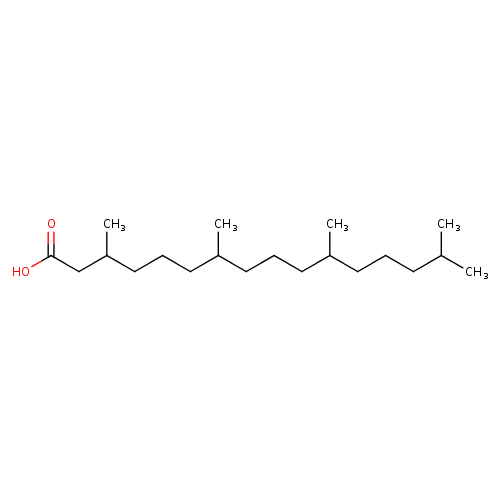
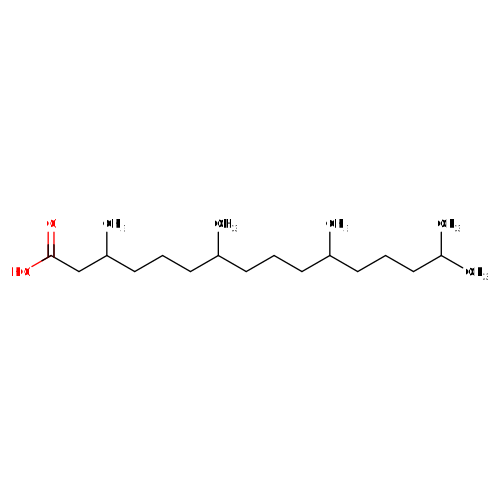
Common NamePhytanic acid
ClassSmall Molecule
DescriptionPhytanic acid is a 20-carbon branched chain fatty acid, Phytanic acid is present in animal (primarily herbivores or omnivores) tissues where it may be derived from the chlorophyll in consumed plant material. Phytanic acid derives from the corresponding alcohol, phytol, and is ultimately oxidized into pristanic acid. In phytanic acid storage disease (Refsum disease) this lipid may comprise as much as 30% of the total fatty acids in plasma. These high levels in Refsum disease (a neurological disorder) are due to a phytanic acid alpha-hydroxylase deficiency.
Contaminant Sources
  • FooDB Chemicals
  • T3DB toxins
Contaminant Type
  • Animal Toxin
  • Food Toxin
  • Metabolite
  • Natural Compound
  • Organic Compound
  • Plant Toxin
Chemical Structure
Thumb
Synonyms
ValueSource
3,7,11,15-Tetramethyl hexadecanoic acidChEBI
3,7,11,15-Tetramethyl-hexadecanoic acidChEBI
3,7,11,15-Tetramethyl-hexadecansaeureChEBI
3,7,11,15-Tetramethylhexadecanoic acidKegg
3,7,11,15-Tetramethyl hexadecanoateGenerator
3,7,11,15-Tetramethyl-hexadecanoateGenerator
3,7,11,15-TetramethylhexadecanoateGenerator
PhytanateGenerator
3,7,11,15-TetramethylhexadecoanoateHMDB
3,7,11,15-Tetramethylhexadecoanoic acidHMDB
PhytanoateHMDB
Phytanoic acidHMDB
Acid, phytanicHMDB
Chemical FormulaC20H40O2
Average Molecular Mass312.530 g/mol
Monoisotopic Mass312.303 g/mol
CAS Registry Number14721-66-5
IUPAC Name3,7,11,15-tetramethylhexadecanoic acid
Traditional Namephytanic acid
SMILESCC(C)CCCC(C)CCCC(C)CCCC(C)CC(O)=O
InChI IdentifierInChI=1S/C20H40O2/c1-16(2)9-6-10-17(3)11-7-12-18(4)13-8-14-19(5)15-20(21)22/h16-19H,6-15H2,1-5H3,(H,21,22)
InChI KeyRLCKHJSFHOZMDR-UHFFFAOYSA-N
Chemical Taxonomy
Description belongs to the class of organic compounds known as acyclic diterpenoids. These are diterpenoids (compounds made of four consecutive isoprene units) that do not contain a cycle.
KingdomOrganic compounds
Super ClassLipids and lipid-like molecules
ClassPrenol lipids
Sub ClassDiterpenoids
Direct ParentAcyclic diterpenoids
Alternative Parents
Substituents
  • Acyclic diterpenoid
  • Long-chain fatty acid
  • Methyl-branched fatty acid
  • Branched fatty acid
  • Fatty acyl
  • Fatty acid
  • Monocarboxylic acid or derivatives
  • Carboxylic acid
  • Carboxylic acid derivative
  • Organic oxygen compound
  • Organic oxide
  • Hydrocarbon derivative
  • Organooxygen compound
  • Carbonyl group
  • Aliphatic acyclic compound
Molecular FrameworkAliphatic acyclic compounds
External Descriptors
Biological Properties
StatusDetected and Not Quantified
OriginEndogenous
Cellular Locations
  • Cytoplasm
  • Extracellular
  • Membrane
  • Peroxisome
Biofluid LocationsNot Available
Tissue Locations
  • Fibroblasts
  • Liver
  • Myelin
  • Prostate
Pathways
NameSMPDB LinkKEGG Link
Oxidation of Branched Chain Fatty AcidsSMP00030 Not Available
Phytanic Acid Peroxisomal OxidationSMP00450 Not Available
Refsum DiseaseSMP00451 Not Available
ApplicationsNot Available
Biological RolesNot Available
Chemical RolesNot Available
Physical Properties
StateSolid
AppearanceWhite powder.
Experimental Properties
PropertyValue
Melting PointNot Available
Boiling PointNot Available
SolubilityNot Available
Predicted Properties
PropertyValueSource
Water Solubility8.2e-05 g/LALOGPS
logP7.28ALOGPS
logP7.4ChemAxon
logS-6.6ALOGPS
pKa (Strongest Acidic)5.04ChemAxon
Physiological Charge-1ChemAxon
Hydrogen Acceptor Count2ChemAxon
Hydrogen Donor Count1ChemAxon
Polar Surface Area37.3 ŲChemAxon
Rotatable Bond Count14ChemAxon
Refractivity95.28 m³·mol⁻¹ChemAxon
Polarizability41.09 ųChemAxon
Number of Rings0ChemAxon
Bioavailability0ChemAxon
Rule of FiveNoChemAxon
Ghose FilterNoChemAxon
Veber's RuleNoChemAxon
MDDR-like RuleNoChemAxon
Spectra
Spectra
Spectrum TypeDescriptionSplash KeyView
Predicted GC-MSPredicted GC-MS Spectrum - GC-MS (Non-derivatized) - 70eV, Positivesplash10-0006-9780000000-d08f456f5acb304b7ea2Spectrum
Predicted GC-MSPredicted GC-MS Spectrum - GC-MS (1 TMS) - 70eV, Positivesplash10-00y0-9443000000-5bbc79ddca11ee15c346Spectrum
Predicted GC-MSPredicted GC-MS Spectrum - GC-MS (Non-derivatized) - 70eV, PositiveNot AvailableSpectrum
Predicted GC-MSPredicted GC-MS Spectrum - GC-MS (TBDMS_1_1) - 70eV, PositiveNot AvailableSpectrum
LC-MS/MSLC-MS/MS Spectrum - Quattro_QQQ 10V, Positive (Annotated)splash10-03di-0009000000-1344b5ce122597753d72Spectrum
LC-MS/MSLC-MS/MS Spectrum - Quattro_QQQ 25V, Positive (Annotated)splash10-00e9-9000000000-d058ed1cd7bf2496d801Spectrum
LC-MS/MSLC-MS/MS Spectrum - Quattro_QQQ 40V, Positive (Annotated)splash10-01b9-9000000000-b91cf96bf3e1ed9907c9Spectrum
Predicted LC-MS/MSPredicted LC-MS/MS Spectrum - 10V, Positivesplash10-0002-0192000000-404c7c552fbd445291f4Spectrum
Predicted LC-MS/MSPredicted LC-MS/MS Spectrum - 20V, Positivesplash10-00mk-4790000000-c4c72f2a0388e83c4d50Spectrum
Predicted LC-MS/MSPredicted LC-MS/MS Spectrum - 40V, Positivesplash10-0a4i-9720000000-e2429e81001f3469126aSpectrum
Predicted LC-MS/MSPredicted LC-MS/MS Spectrum - 10V, Negativesplash10-03xr-0089000000-e67aa3a53cb223588aceSpectrum
Predicted LC-MS/MSPredicted LC-MS/MS Spectrum - 20V, Negativesplash10-02tc-1094000000-c8ba97412b0185f5a5b3Spectrum
Predicted LC-MS/MSPredicted LC-MS/MS Spectrum - 40V, Negativesplash10-0a4l-8590000000-02e2e52e9c0e6f20a064Spectrum
Predicted LC-MS/MSPredicted LC-MS/MS Spectrum - 10V, Negativesplash10-03di-0009000000-849ba1e3311607445182Spectrum
Predicted LC-MS/MSPredicted LC-MS/MS Spectrum - 20V, Negativesplash10-03di-0029000000-1d86a3df25ae3d6f62b5Spectrum
Predicted LC-MS/MSPredicted LC-MS/MS Spectrum - 40V, Negativesplash10-06r6-8393000000-8564c0781362b5ca2da4Spectrum
Predicted LC-MS/MSPredicted LC-MS/MS Spectrum - 10V, Positivesplash10-03di-4569000000-0ae84af33d4a6cee1563Spectrum
Predicted LC-MS/MSPredicted LC-MS/MS Spectrum - 20V, Positivesplash10-06y9-9720000000-8d0e05ef1818d392c4fbSpectrum
Predicted LC-MS/MSPredicted LC-MS/MS Spectrum - 40V, Positivesplash10-0a4l-9000000000-19bc307031b7da7b3414Spectrum
1D NMR13C NMR SpectrumNot AvailableSpectrum
1D NMR1H NMR SpectrumNot AvailableSpectrum
1D NMR13C NMR SpectrumNot AvailableSpectrum
1D NMR1H NMR SpectrumNot AvailableSpectrum
1D NMR13C NMR SpectrumNot AvailableSpectrum
1D NMR1H NMR SpectrumNot AvailableSpectrum
1D NMR13C NMR SpectrumNot AvailableSpectrum
1D NMR1H NMR SpectrumNot AvailableSpectrum
1D NMR13C NMR SpectrumNot AvailableSpectrum
1D NMR1H NMR SpectrumNot AvailableSpectrum
1D NMR13C NMR SpectrumNot AvailableSpectrum
1D NMR1H NMR SpectrumNot AvailableSpectrum
1D NMR13C NMR SpectrumNot AvailableSpectrum
1D NMR1H NMR SpectrumNot AvailableSpectrum
1D NMR13C NMR SpectrumNot AvailableSpectrum
1D NMR1H NMR SpectrumNot AvailableSpectrum
1D NMR13C NMR SpectrumNot AvailableSpectrum
1D NMR1H NMR SpectrumNot AvailableSpectrum
1D NMR13C NMR SpectrumNot AvailableSpectrum
1D NMR1H NMR SpectrumNot AvailableSpectrum
Toxicity Profile
Route of ExposureNot Available
Mechanism of ToxicityNot Available
MetabolismNot Available
Toxicity ValuesNot Available
Lethal DoseNot Available
Carcinogenicity (IARC Classification)No indication of carcinogenicity to humans (not listed by IARC).
Uses/SourcesThis is an endogenously produced metabolite found in the human body. It is used in metabolic reactions, catabolic reactions or waste generation.
Minimum Risk LevelNot Available
Health EffectsNot Available
SymptomsNot Available
TreatmentNot Available
Concentrations
Not Available
DrugBank IDNot Available
HMDB IDHMDB0000801
FooDB IDFDB022252
Phenol Explorer IDNot Available
KNApSAcK IDNot Available
BiGG ID37991
BioCyc IDNot Available
METLIN ID5765
PDB IDNot Available
Wikipedia LinkPhytanic acid
Chemspider ID25001
ChEBI ID16285
PubChem Compound ID26840
Kegg Compound IDC01607
YMDB IDNot Available
ECMDB IDNot Available
References
Synthesis ReferenceKarrer, P.; Epprecht, A.; Konig, Hans. General method of preparation for 2-methyl-3-alkylnaphthoquinones. Constitution and vitamin K activity. Helvetica Chimica Acta (1940), 23 272-83.
MSDSLink
General References
1. https://www.ncbi.nlm.nih.gov/pubmed/?term=12187408
2. https://www.ncbi.nlm.nih.gov/pubmed/?term=17956237
3. https://www.ncbi.nlm.nih.gov/pubmed/?term=9819701
4. Karrer, P.; Epprecht, A.; Konig, Hans. General method of preparation for 2-methyl-3-alkylnaphthoquinones. Constitution and vitamin K activity. Helvetica Chimica Acta (1940), 23 272-83.
5. Komen JC, Duran M, Wanders RJ: Characterization of phytanic acid omega-hydroxylation in human liver microsomes. Mol Genet Metab. 2005 Jul;85(3):190-5. Epub 2005 Mar 17.
6. Schonfeld P, Struy H: Refsum disease diagnostic marker phytanic acid alters the physical state of membrane proteins of liver mitochondria. FEBS Lett. 1999 Aug 27;457(2):179-83.
7. Xu J, Thornburg T, Turner AR, Vitolins M, Case D, Shadle J, Hinson L, Sun J, Liu W, Chang B, Adams TS, Zheng SL, Torti FM: Serum levels of phytanic acid are associated with prostate cancer risk. Prostate. 2005 May 15;63(3):209-14.
8. Molzer B, Kainz-Korschinsky M, Sundt-Heller R, Bernheimer H: Phytanic acid and very long chain fatty acids in genetic peroxisomal disorders. J Clin Chem Clin Biochem. 1989 May;27(5):309-14.
9. Cakirer S, Savas MR: Infantile Refsum disease: serial evaluation with MRI. Pediatr Radiol. 2005 Feb;35(2):212-5. Epub 2004 Oct 6.
10. Bernscherer G, Berenyi E, Karabelyos C, Laszlo A, David Z, Hollody K, Toth EZ: [Refsum disease]. Orv Hetil. 2000 Jan 2;141(1):31-4.
11. Heim M, Johnson J, Boess F, Bendik I, Weber P, Hunziker W, Fluhmann B: Phytanic acid, a natural peroxisome proliferator-activated receptor (PPAR) agonist, regulates glucose metabolism in rat primary hepatocytes. FASEB J. 2002 May;16(7):718-20. Epub 2002 Mar 26.
12. Zomer AW, van Der Burg B, Jansen GA, Wanders RJ, Poll-The BT, van Der Saag PT: Pristanic acid and phytanic acid: naturally occurring ligands for the nuclear receptor peroxisome proliferator-activated receptor alpha. J Lipid Res. 2000 Nov;41(11):1801-7.
13. Pahan K, Singh I: Intraorganellar localization of CoASH-independent phytanic acid oxidation in human liver peroxisomes. FEBS Lett. 1993 Oct 25;333(1-2):154-8.
14. Poggi-Travert F, Fournier B, Poll-The BT, Saudubray JM: Clinical approach to inherited peroxisomal disorders. J Inherit Metab Dis. 1995;18 Suppl 1:1-18.
15. Yao JK, Dyck PJ: Tissue distribution of phytanic acid and its analogues in a kinship with Refsum's disease. Lipids. 1987 Feb;22(2):69-75.
16. Young SP, Johnson AW, Muller DP: Effects of phytanic acid on the vitamin E status, lipid composition and physical properties of retinal cell membranes: implications for adult Refsum disease. Clin Sci (Lond). 2001 Dec;101(6):697-705.