Record Information
Version1.0
Creation Date2014-08-29 06:51:23 UTC
Update Date2026-04-13 21:33:39 UTC
Accession NumberCHEM003411
Identification
Common NameDeoxyinosine
ClassSmall Molecule
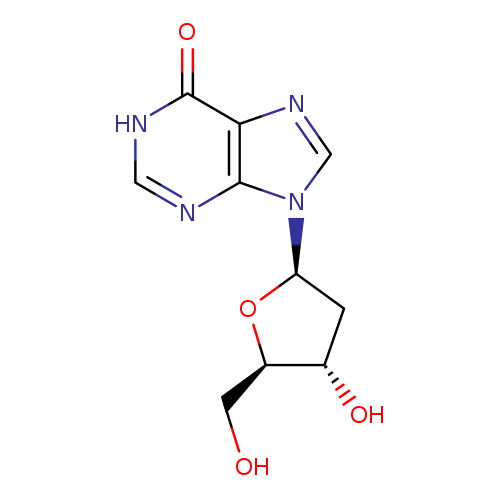
DescriptionDeoxyinosine is a nucleoside that is formed when hypoxanthine is attached to a deoxyribose ring (also known as a ribofuranose) via a beta-N9-glycosidic bond. Deoxyinosine is found in DNA while Inosine is found in RNA. Inosine is a nucleic acid important for RNA editing. Adenosine deaminase (ADA) catalyzes the conversion of adenosine and deoxyadenosine to inosine and deoxyinosine, respectively. ADA-deficient individuals suffer from severe combined immunodeficiency (SCID) and are unable to produce significant numbers of mature T or B lymphocytes. This occurs as a consequence of the accumulation of ADA substrates or their metabolites. Inosine is also an intermediate in a chain of purine nucleotides reactions required for muscle movements.
Contaminant Sources
  • FooDB Chemicals
  • HMDB Contaminants - Urine
  • STOFF IDENT Compounds
  • T3DB toxins
Contaminant Type
  • Amine
  • Animal Toxin
  • Ether
  • Metabolite
  • Natural Compound
  • Organic Compound
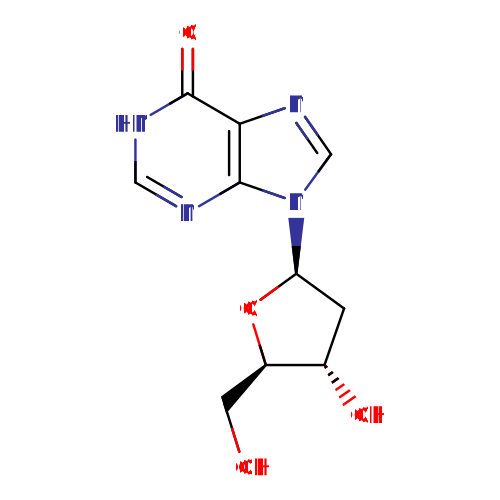
Chemical Structure
Thumb
Synonyms
ValueSource
9-(2-Deoxy-beta-D-erythro-pentofuranosyl)-9H-purin-6-olChEBI
9-(2-Deoxy-b-D-erythro-pentofuranosyl)-9H-purin-6-olGenerator
9-(2-Deoxy-β-D-erythro-pentofuranosyl)-9H-purin-6-olGenerator
2'-DeoxyinosineHMDB
2-Deoxy-inosineHMDB
9-(2-Deoxy-b-D-erythro-pentofuranosyl)-1,9-dihydro-6H-purin-6-oneHMDB
9-(2-Deoxy-b-D-erythro-pentofuranosyl)-hypoxanthineHMDB
9-(2-Deoxy-beta-D-erythro-pentofuranosyl)-hypoxanthineHMDB
9-(2-Deoxy-beta-delta-erythro-pentofuranosyl)-1,9-dihydro-6H-purin-6-oneHMDB
9-(2-Deoxy-beta-delta-erythro-pentofuranosyl)-hypoxanthineHMDB
D-InoHMDB
delta-InoHMDB
DInosineHMDB
Deoxyribose-inosineHMDB
DeoxyinosineChEBI
Chemical FormulaC10H12N4O4
Average Molecular Mass252.230 g/mol
Monoisotopic Mass252.086 g/mol
CAS Registry Number890-38-0
IUPAC Name9-[(2R,4S,5R)-4-hydroxy-5-(hydroxymethyl)oxolan-2-yl]-9H-purin-6-ol
Traditional Name2'-deoxy-inosine
SMILESOC[C@H]1O[C@H](C[C@@H]1O)N1C=NC2=C1N=CNC2=O
InChI IdentifierInChI=1S/C10H12N4O4/c15-2-6-5(16)1-7(18-6)14-4-13-8-9(14)11-3-12-10(8)17/h3-7,15-16H,1-2H2,(H,11,12,17)/t5-,6+,7+/m0/s1
InChI KeyVGONTNSXDCQUGY-RRKCRQDMSA-N
Chemical Taxonomy
Description belongs to the class of organic compounds known as purine 2'-deoxyribonucleosides. Purine 2'-deoxyribonucleosides are compounds consisting of a purine linked to a ribose which lacks a hydroxyl group at position 2.
KingdomOrganic compounds
Super ClassNucleosides, nucleotides, and analogues
ClassPurine nucleosides
Sub ClassPurine 2'-deoxyribonucleosides
Direct ParentPurine 2'-deoxyribonucleosides
Alternative Parents
Substituents
  • Purine 2'-deoxyribonucleoside
  • Hypoxanthine
  • Imidazopyrimidine
  • Purine
  • Hydroxypyrimidine
  • N-substituted imidazole
  • Pyrimidine
  • Tetrahydrofuran
  • Heteroaromatic compound
  • Azole
  • Imidazole
  • Secondary alcohol
  • Azacycle
  • Organoheterocyclic compound
  • Oxacycle
  • Hydrocarbon derivative
  • Organooxygen compound
  • Organonitrogen compound
  • Alcohol
  • Organic oxygen compound
  • Primary alcohol
  • Organic nitrogen compound
  • Organopnictogen compound
  • Aromatic heteropolycyclic compound
Molecular FrameworkAromatic heteropolycyclic compounds
External Descriptors
Biological Properties
StatusDetected and Not Quantified
OriginEndogenous
Cellular Locations
  • Cytoplasm
  • Extracellular
  • Nucleus
Biofluid LocationsNot Available
Tissue Locations
  • All Tissues
Pathways
NameSMPDB LinkKEGG Link
Purine MetabolismSMP00050 map00230
Purine Nucleoside Phosphorylase DeficiencySMP00210 Not Available
ApplicationsNot Available
Biological Roles
Chemical RolesNot Available
Physical Properties
StateSolid
AppearanceWhite powder.
Experimental Properties
PropertyValue
Melting Point250°C
Boiling PointNot Available
SolubilityNot Available
Predicted Properties
PropertyValueSource
Water Solubility10.1 g/LALOGPS
logP-1.7ALOGPS
logP-0.66ChemAxon
logS-1.4ALOGPS
pKa (Strongest Acidic)11.68ChemAxon
pKa (Strongest Basic)-0.1ChemAxon
Physiological Charge0ChemAxon
Hydrogen Acceptor Count7ChemAxon
Hydrogen Donor Count3ChemAxon
Polar Surface Area113.52 ŲChemAxon
Rotatable Bond Count2ChemAxon
Refractivity58.97 m³·mol⁻¹ChemAxon
Polarizability23.69 ųChemAxon
Number of Rings3ChemAxon
Bioavailability1ChemAxon
Rule of FiveYesChemAxon
Ghose FilterNoChemAxon
Veber's RuleNoChemAxon
MDDR-like RuleNoChemAxon
Spectra
Spectra
Spectrum TypeDescriptionSplash KeyView
GC-MSGC-MS Spectrum - GC-EI-TOF (Pegasus III TOF-MS system, Leco; GC 6890, Agilent Technologies) (Non-derivatized)splash10-0udi-0933100000-09d719c947c60bf0f309Spectrum
GC-MSGC-MS Spectrum - GC-EI-TOF (Pegasus III TOF-MS system, Leco; GC 6890, Agilent Technologies) (Non-derivatized)splash10-0zfr-0940000000-e72ee71b7bb48b638ddcSpectrum
GC-MSGC-MS Spectrum - GC-MS (3 TMS)splash10-0zfr-2930000000-4781d246f6996b2513f8Spectrum
GC-MSGC-MS Spectrum - GC-EI-TOF (Non-derivatized)splash10-0udi-0933100000-09d719c947c60bf0f309Spectrum
GC-MSGC-MS Spectrum - GC-EI-TOF (Non-derivatized)splash10-0zfr-0940000000-e72ee71b7bb48b638ddcSpectrum
GC-MSGC-MS Spectrum - GC-MS (Non-derivatized)splash10-0zfr-2930000000-4781d246f6996b2513f8Spectrum
Predicted GC-MSPredicted GC-MS Spectrum - GC-MS (Non-derivatized) - 70eV, Positivesplash10-059x-9460000000-45b38a8f7526df1e95a5Spectrum
Predicted GC-MSPredicted GC-MS Spectrum - GC-MS (2 TMS) - 70eV, Positivesplash10-0v6u-8976000000-3868aac5f35f48870953Spectrum
Predicted GC-MSPredicted GC-MS Spectrum - GC-MS (Non-derivatized) - 70eV, PositiveNot AvailableSpectrum
Predicted GC-MSPredicted GC-MS Spectrum - GC-MS (TMS_1_1) - 70eV, PositiveNot AvailableSpectrum
Predicted GC-MSPredicted GC-MS Spectrum - GC-MS (TMS_1_2) - 70eV, PositiveNot AvailableSpectrum
Predicted GC-MSPredicted GC-MS Spectrum - GC-MS (TMS_1_3) - 70eV, PositiveNot AvailableSpectrum
Predicted GC-MSPredicted GC-MS Spectrum - GC-MS (TMS_2_2) - 70eV, PositiveNot AvailableSpectrum
Predicted GC-MSPredicted GC-MS Spectrum - GC-MS (TMS_2_3) - 70eV, PositiveNot AvailableSpectrum
Predicted GC-MSPredicted GC-MS Spectrum - GC-MS (TBDMS_1_1) - 70eV, PositiveNot AvailableSpectrum
Predicted GC-MSPredicted GC-MS Spectrum - GC-MS (TBDMS_1_2) - 70eV, PositiveNot AvailableSpectrum
Predicted GC-MSPredicted GC-MS Spectrum - GC-MS (TBDMS_1_3) - 70eV, PositiveNot AvailableSpectrum
Predicted GC-MSPredicted GC-MS Spectrum - GC-MS (TBDMS_2_1) - 70eV, PositiveNot AvailableSpectrum
Predicted GC-MSPredicted GC-MS Spectrum - GC-MS (TBDMS_2_2) - 70eV, PositiveNot AvailableSpectrum
Predicted GC-MSPredicted GC-MS Spectrum - GC-MS (TBDMS_2_3) - 70eV, PositiveNot AvailableSpectrum
LC-MS/MSLC-MS/MS Spectrum - Quattro_QQQ 10V, Positive (Annotated)splash10-000i-0900000000-699f2e0add16852a454cSpectrum
LC-MS/MSLC-MS/MS Spectrum - Quattro_QQQ 25V, Positive (Annotated)splash10-000i-1900000000-ab78094925c0c212f113Spectrum
LC-MS/MSLC-MS/MS Spectrum - Quattro_QQQ 40V, Positive (Annotated)splash10-000i-5900000000-f14b9bd6e2a698307815Spectrum
Predicted LC-MS/MSPredicted LC-MS/MS Spectrum - 10V, Positivesplash10-000i-0920000000-a304c7b397cc865f33d1Spectrum
Predicted LC-MS/MSPredicted LC-MS/MS Spectrum - 20V, Positivesplash10-000i-0900000000-984f375947cefdcfb884Spectrum
Predicted LC-MS/MSPredicted LC-MS/MS Spectrum - 40V, Positivesplash10-01p9-0900000000-9bc9620b62695f652342Spectrum
Predicted LC-MS/MSPredicted LC-MS/MS Spectrum - 10V, Negativesplash10-0udi-0290000000-5c34e254b55e1aa880ccSpectrum
Predicted LC-MS/MSPredicted LC-MS/MS Spectrum - 20V, Negativesplash10-000i-0910000000-877252e0b2d402f920abSpectrum
Predicted LC-MS/MSPredicted LC-MS/MS Spectrum - 40V, Negativesplash10-052u-3900000000-d17c7ebc047d144462a1Spectrum
Predicted LC-MS/MSPredicted LC-MS/MS Spectrum - 10V, Negativesplash10-0f79-0970000000-3ec5c5a89b8c9af39d7eSpectrum
Predicted LC-MS/MSPredicted LC-MS/MS Spectrum - 20V, Negativesplash10-052r-0900000000-40c1b23e6815e6181307Spectrum
Predicted LC-MS/MSPredicted LC-MS/MS Spectrum - 40V, Negativesplash10-0a5l-3900000000-9d7c6bf0280c77658451Spectrum
Predicted LC-MS/MSPredicted LC-MS/MS Spectrum - 10V, Positivesplash10-000i-0900000000-b2e36fb98660834d7d24Spectrum
Predicted LC-MS/MSPredicted LC-MS/MS Spectrum - 20V, Positivesplash10-000i-0900000000-f660b2a54215a2689fa2Spectrum
Predicted LC-MS/MSPredicted LC-MS/MS Spectrum - 40V, Positivesplash10-000i-1900000000-4cf4a407cd370c6b4927Spectrum
MSMass Spectrum (Electron Ionization)splash10-0f79-9300000000-1d2cd609ae1f49c1960fSpectrum
1D NMR1H NMR SpectrumNot AvailableSpectrum
1D NMR13C NMR SpectrumNot AvailableSpectrum
1D NMR1H NMR SpectrumNot AvailableSpectrum
1D NMR13C NMR SpectrumNot AvailableSpectrum
1D NMR1H NMR SpectrumNot AvailableSpectrum
1D NMR13C NMR SpectrumNot AvailableSpectrum
1D NMR1H NMR SpectrumNot AvailableSpectrum
1D NMR13C NMR SpectrumNot AvailableSpectrum
1D NMR1H NMR SpectrumNot AvailableSpectrum
1D NMR13C NMR SpectrumNot AvailableSpectrum
1D NMR1H NMR SpectrumNot AvailableSpectrum
1D NMR13C NMR SpectrumNot AvailableSpectrum
1D NMR1H NMR SpectrumNot AvailableSpectrum
1D NMR13C NMR SpectrumNot AvailableSpectrum
1D NMR1H NMR SpectrumNot AvailableSpectrum
1D NMR13C NMR SpectrumNot AvailableSpectrum
1D NMR1H NMR SpectrumNot AvailableSpectrum
1D NMR13C NMR SpectrumNot AvailableSpectrum
1D NMR1H NMR SpectrumNot AvailableSpectrum
1D NMR13C NMR SpectrumNot AvailableSpectrum
1D NMR1H NMR SpectrumNot AvailableSpectrum
1D NMR13C NMR SpectrumNot AvailableSpectrum
1D NMR1H NMR SpectrumNot AvailableSpectrum
1D NMR13C NMR SpectrumNot AvailableSpectrum
2D NMR[1H,13C] 2D NMR SpectrumNot AvailableSpectrum
Toxicity Profile
Route of ExposureNot Available
Mechanism of ToxicityNot Available
MetabolismNot Available
Toxicity ValuesNot Available
Lethal DoseNot Available
Carcinogenicity (IARC Classification)No indication of carcinogenicity to humans (not listed by IARC).
Uses/SourcesThis is an endogenously produced metabolite found in the human body. It is used in metabolic reactions, catabolic reactions or waste generation.
Minimum Risk LevelNot Available
Health EffectsNot Available
SymptomsNot Available
TreatmentNot Available
Concentrations
Not Available
DrugBank IDDB02380
HMDB IDHMDB0000071
FooDB IDFDB012323
Phenol Explorer IDNot Available
KNApSAcK IDNot Available
BiGG ID45942
BioCyc IDDEOXYINOSINE
METLIN ID3383
PDB IDNot Available
Wikipedia LinkNot Available
Chemspider ID58569
ChEBI ID28997
PubChem Compound ID65058
Kegg Compound IDC05512
YMDB IDYMDB00659
ECMDB IDECMDB00071
References
Synthesis ReferenceNot Available
MSDSLink
General References
1. Robins, Morris J.; Basom, Gerald L. Nucleic Acid Related Compounds. 8. Direct Conversion of 2′-Deoxyinosine to 6-Chloropurine 2′-Deoxyriboside and Selected 6-Substituted Deoxynucleosides and Their Evaluation As Substrates of Adenosine Deaminase. Canadian Journal of Chemistry, 1973, 51(19): 3161-3169, https://doi.org/10.1139/v73-471
2. Robins, Morris J.; Basom, Gerald L. Nucleic Acid Related Compounds. 8. Direct Conversion of 2′-Deoxyinosine to 6-Chloropurine 2′-Deoxyriboside and Selected 6-Substituted Deoxynucleosides and Their Evaluation As Substrates of Adenosine Deaminase. Canadian Journal of Chemistry, 1973, 51(19): 3161-3169, https://doi.org/10.1139/v73-471
3. Cohen A, Doyle D, Martin DW Jr, Ammann AJ: Abnormal purine metabolism and purine overproduction in a patient deficient in purine nucleoside phosphorylase. N Engl J Med. 1976 Dec 23;295(26):1449-54.
4. Kewn S, Hoggard PG, Henry-Mowatt JS, Veal GJ, Sales SD, Barry MG, Back DJ: Intracellular activation of 2',3'-dideoxyinosine and drug interactions in vitro. AIDS Res Hum Retroviruses. 1999 Jun 10;15(9):793-802.
5. Bemi V, Tazzni N, Banditelli S, Giorgelli F, Pesi R, Turchi G, Mattana A, Sgarrella F, Tozzi MG, Camici M: Deoxyadenosine metabolism in a human colon-carcinoma cell line (LoVo) in relation to its cytotoxic effect in combination with deoxycoformycin. Int J Cancer. 1998 Mar 2;75(5):713-20.
6. Chantin C, Bonin B, Boulieu R, Bory C: Liquid-chromatographic study of purine metabolism abnormalities in purine nucleoside phosphorylase deficiency. Clin Chem. 1996 Feb;42(2):326-8.
7. Ablett E, Pedley J, Dannoy PA, Sturm RA, Parsons PG: UVB-specific regulation of gene expression in human melanocytic cells: cell cycle effects and implication in the generation of melanoma. Mutat Res. 1998 Nov 9;422(1):31-41.
8. Bazar LS, Collier GB, Vanek PG, Siles BA, Kow YW, Doetsch PW, Cunningham RP, Chirikjian JG: Mutation identification DNA analysis system (MIDAS) for detection of known mutations. Electrophoresis. 1999 Jun;20(6):1141-8.
9. Sjoberg AH, Wang L, Eriksson S: Substrate specificity of human recombinant mitochondrial deoxyguanosine kinase with cytostatic and antiviral purine and pyrimidine analogs. Mol Pharmacol. 1998 Feb;53(2):270-3.
10. Brunk E, Sahoo S, Zielinski DC, Altunkaya A, Drager A, Mih N, Gatto F, Nilsson A, Preciat Gonzalez GA, Aurich MK, Prlic A, Sastry A, Danielsdottir AD, Heinken A, Noronha A, Rose PW, Burley SK, Fleming RMT, Nielsen J, Thiele I, Palsson BO: Recon3D enables a three-dimensional view of gene variation in human metabolism. Nat Biotechnol. 2018 Mar;36(3):272-281. doi: 10.1038/nbt.4072. Epub 2018 Feb 19.
11. Elshenawy S, Pinney SE, Stuart T, Doulias PT, Zura G, Parry S, Elovitz MA, Bennett MJ, Bansal A, Strauss JF 3rd, Ischiropoulos H, Simmons RA: The Metabolomic Signature of the Placenta in Spontaneous Preterm Birth. Int J Mol Sci. 2020 Feb 4;21(3). pii: ijms21031043. doi: 10.3390/ijms21031043.
12. https://www.ncbi.nlm.nih.gov/pubmed/?term=23408659
13. https://www.ncbi.nlm.nih.gov/pubmed/?term=24292023