Record Information
Version1.0
Creation Date2014-08-29 06:51:22 UTC
Update Date2026-05-14 18:07:41 UTC
Accession NumberCHEM003410
Identification
Common NameInosine
ClassSmall Molecule
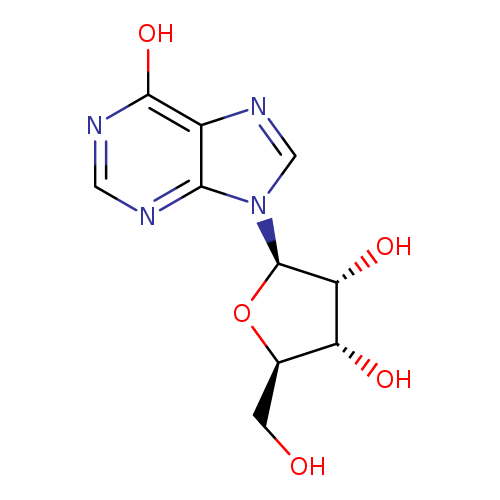
DescriptionA purine nucleoside that has hypoxanthine linked by the N9 nitrogen to the C1 carbon of ribose. It is an intermediate in the degradation of purines and purine nucleosides to uric acid and in pathways of purine salvage. It also occurs in the anticodon of certain transfer RNA molecules. (Dorland, 28th ed)
Contaminant Sources
  • FooDB Chemicals
  • HMDB Contaminants - Feces
  • HMDB Contaminants - Urine
  • STOFF IDENT Compounds
  • T3DB toxins
  • ToxCast & Tox21 Chemicals
Contaminant Type
  • Amine
  • Animal Toxin
  • Ether
  • Food Toxin
  • Metabolite
  • Natural Compound
  • Organic Compound
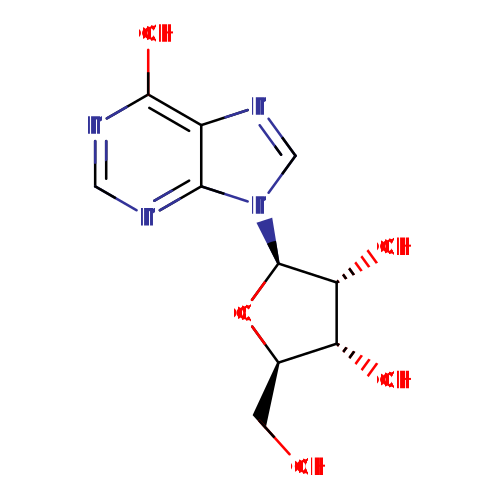
Chemical Structure
Thumb
Synonyms
ValueSource
9-beta-D-Ribofuranosyl-9H-purin-6-olChEBI
9-beta-D-RibofuranosylhypoxanthineChEBI
Hypoxanthine D-ribosideChEBI
HypoxanthosineChEBI
iChEBI
InosinChEBI
InosinaChEBI
InosinumChEBI
InotinKegg
9-b-D-Ribofuranosyl-9H-purin-6-olGenerator
9-Β-D-ribofuranosyl-9H-purin-6-olGenerator
9-b-D-RibofuranosylhypoxanthineGenerator
9-Β-D-ribofuranosylhypoxanthineGenerator
(-)-InosineHMDB
1,9-Dihydro-9-b-D-ribofuranosyl-6H-purin-6-oneHMDB
1,9-Dihydro-9-beta-D-ribofuranosyl-6H-purin-6-oneHMDB
1,9-Dihydro-9-beta-delta-ribofuranosyl-6H-purin-6-oneHMDB
9-b-D-Ribofuranosyl-hypoxanthineHMDB
9-beta-D-Ribofuranosyl-hypoxanthineHMDB
9-beta-delta-Ribofuranosyl-hypoxanthineHMDB
9-beta-delta-RibofuranosylhypoxanthineHMDB
9beta-D-RibofuranosylhypoxanthineHMDB
9beta-delta-RibofuranosylhypoxanthineHMDB
AtorelHMDB
beta-D-Ribofuranoside hypoxanthine-9HMDB
beta-delta-Ribofuranoside hypoxanthine-9HMDB
beta-InosineHMDB
HXRHMDB
Hypoxanthine 9-beta-D-ribofuranosideHMDB
Hypoxanthine 9-beta-delta-ribofuranosideHMDB
Hypoxanthine nucleosideHMDB
Hypoxanthine ribonucleosideHMDB
Hypoxanthine ribosideHMDB
Hypoxanthine-9 beta-D-ribofuranosideHMDB
Hypoxanthine-9 beta-delta-ribofuranosideHMDB
Hypoxanthine-9-beta-D-ribofuranosideHMDB
Hypoxanthine-9-beta-delta-ribofuranosideHMDB
Hypoxanthine-9-D-ribofuranosideHMDB
Hypoxanthine-9-delta-ribofuranosideHMDB
Hypoxanthine-riboseHMDB
Indole-3-carboxaldehydeHMDB
InoHMDB
InosieHMDB
Iso-prinosineHMDB
OxiaminHMDB
Panholic-LHMDB
Pantholic-LHMDB
RibonosineHMDB
SelferHMDB
TrophicardylHMDB
Chemical FormulaC10H12N4O5
Average Molecular Mass268.226 g/mol
Monoisotopic Mass268.081 g/mol
CAS Registry Number58-63-9
IUPAC Name9-[(2R,3R,4S,5R)-3,4-dihydroxy-5-(hydroxymethyl)oxolan-2-yl]-6,9-dihydro-3H-purin-6-one
Traditional Nameinosine
SMILESOC[C@H]1O[C@H]([C@H](O)[C@@H]1O)N1C=NC2=C1NC=NC2=O
InChI IdentifierInChI=1S/C10H12N4O5/c15-1-4-6(16)7(17)10(19-4)14-3-13-5-8(14)11-2-12-9(5)18/h2-4,6-7,10,15-17H,1H2,(H,11,12,18)/t4-,6-,7-,10-/m1/s1
InChI KeyUGQMRVRMYYASKQ-KQYNXXCUSA-N
Chemical Taxonomy
Description belongs to the class of organic compounds known as purine nucleosides. Purine nucleosides are compounds comprising a purine base attached to a ribosyl or deoxyribosyl moiety.
KingdomOrganic compounds
Super ClassNucleosides, nucleotides, and analogues
ClassPurine nucleosides
Sub ClassNot Available
Direct ParentPurine nucleosides
Alternative Parents
Substituents
  • Purine nucleoside
  • Glycosyl compound
  • N-glycosyl compound
  • 6-oxopurine
  • Hypoxanthine
  • Pentose monosaccharide
  • Purinone
  • Imidazopyrimidine
  • Purine
  • Pyrimidone
  • Pyrimidine
  • Monosaccharide
  • N-substituted imidazole
  • Vinylogous amide
  • Tetrahydrofuran
  • Heteroaromatic compound
  • Azole
  • Imidazole
  • Secondary alcohol
  • Oxacycle
  • Azacycle
  • Organoheterocyclic compound
  • Alcohol
  • Organonitrogen compound
  • Organic nitrogen compound
  • Organooxygen compound
  • Organic oxide
  • Organopnictogen compound
  • Organic oxygen compound
  • Hydrocarbon derivative
  • Primary alcohol
  • Aromatic heteropolycyclic compound
Molecular FrameworkAromatic heteropolycyclic compounds
External Descriptors
Biological Properties
StatusDetected and Not Quantified
OriginEndogenous
Cellular Locations
  • Cytoplasm
  • Extracellular
  • Lysosome
  • Mitochondria
Biofluid LocationsNot Available
Tissue Locations
  • Brain
  • Erythrocyte
  • Fibroblasts
  • Intestine
  • Kidney
  • Liver
  • Nerve Cells
  • Pancreas
  • Placenta
  • Platelet
  • Prostate
  • Spleen
  • Testes
Pathways
NameSMPDB LinkKEGG Link
Purine MetabolismSMP00050 map00230
Purine Nucleoside Phosphorylase DeficiencySMP00210 Not Available
ApplicationsNot Available
Biological Roles
Chemical RolesNot Available
Physical Properties
StateSolid
AppearanceWhite powder.
Experimental Properties
PropertyValue
Melting Point218 °C
Boiling PointNot Available
Solubility1.58E+004 mg/L (at 20 °C)
Predicted Properties
PropertyValueSource
logP-2ChemAxon
pKa (Strongest Acidic)6.94ChemAxon
pKa (Strongest Basic)2.74ChemAxon
Physiological Charge0ChemAxon
Hydrogen Acceptor Count8ChemAxon
Hydrogen Donor Count4ChemAxon
Polar Surface Area129.2 ŲChemAxon
Rotatable Bond Count2ChemAxon
Refractivity60.9 m³·mol⁻¹ChemAxon
Polarizability24.6 ųChemAxon
Number of Rings3ChemAxon
Bioavailability1ChemAxon
Rule of FiveYesChemAxon
Ghose FilterNoChemAxon
Veber's RuleNoChemAxon
MDDR-like RuleNoChemAxon
Spectra
Spectra
Spectrum TypeDescriptionSplash KeyView
GC-MSGC-MS Spectrum - GC-EI-TOF (Pegasus III TOF-MS system, Leco; GC 6890, Agilent Technologies) (Non-derivatized)splash10-0frt-0890000000-c0c5ebc2bbf12c1a7edfSpectrum
GC-MSGC-MS Spectrum - GC-EI-TOF (Pegasus III TOF-MS system, Leco; GC 6890, Agilent Technologies) (4 TMS)splash10-00di-9440000000-566aadb777ee03fb22fbSpectrum
GC-MSGC-MS Spectrum - GC-MS (4 TMS)splash10-0fsi-1690000000-364bf8794afeeff6ba51Spectrum
GC-MSGC-MS Spectrum - GC-EI-TOF (Non-derivatized)splash10-0frt-0890000000-c0c5ebc2bbf12c1a7edfSpectrum
GC-MSGC-MS Spectrum - GC-EI-TOF (Non-derivatized)splash10-00di-9440000000-566aadb777ee03fb22fbSpectrum
GC-MSGC-MS Spectrum - GC-MS (Non-derivatized)splash10-0fsi-1690000000-364bf8794afeeff6ba51Spectrum
Predicted GC-MSPredicted GC-MS Spectrum - GC-MS (Non-derivatized) - 70eV, Positivesplash10-0adl-9250000000-d6ee10ae0804bda3e4ceSpectrum
Predicted GC-MSPredicted GC-MS Spectrum - GC-MS (3 TMS) - 70eV, Positivesplash10-0lmr-8659500000-9f567e118aa09e880541Spectrum
Predicted GC-MSPredicted GC-MS Spectrum - GC-MS (Non-derivatized) - 70eV, PositiveNot AvailableSpectrum
Predicted GC-MSPredicted GC-MS Spectrum - GC-MS (TMS_1_1) - 70eV, PositiveNot AvailableSpectrum
Predicted GC-MSPredicted GC-MS Spectrum - GC-MS (TMS_1_2) - 70eV, PositiveNot AvailableSpectrum
Predicted GC-MSPredicted GC-MS Spectrum - GC-MS (TMS_1_3) - 70eV, PositiveNot AvailableSpectrum
Predicted GC-MSPredicted GC-MS Spectrum - GC-MS (TMS_1_4) - 70eV, PositiveNot AvailableSpectrum
Predicted GC-MSPredicted GC-MS Spectrum - GC-MS (TMS_2_1) - 70eV, PositiveNot AvailableSpectrum
Predicted GC-MSPredicted GC-MS Spectrum - GC-MS (TMS_2_2) - 70eV, PositiveNot AvailableSpectrum
Predicted GC-MSPredicted GC-MS Spectrum - GC-MS (TMS_2_3) - 70eV, PositiveNot AvailableSpectrum
Predicted GC-MSPredicted GC-MS Spectrum - GC-MS (TMS_2_4) - 70eV, PositiveNot AvailableSpectrum
Predicted GC-MSPredicted GC-MS Spectrum - GC-MS (TMS_2_5) - 70eV, PositiveNot AvailableSpectrum
Predicted GC-MSPredicted GC-MS Spectrum - GC-MS (TMS_2_6) - 70eV, PositiveNot AvailableSpectrum
Predicted GC-MSPredicted GC-MS Spectrum - GC-MS (TMS_3_1) - 70eV, PositiveNot AvailableSpectrum
Predicted GC-MSPredicted GC-MS Spectrum - GC-MS (TMS_3_2) - 70eV, PositiveNot AvailableSpectrum
Predicted GC-MSPredicted GC-MS Spectrum - GC-MS (TMS_3_3) - 70eV, PositiveNot AvailableSpectrum
Predicted GC-MSPredicted GC-MS Spectrum - GC-MS (TMS_3_4) - 70eV, PositiveNot AvailableSpectrum
Predicted GC-MSPredicted GC-MS Spectrum - GC-MS (TMS_4_1) - 70eV, PositiveNot AvailableSpectrum
Predicted GC-MSPredicted GC-MS Spectrum - GC-MS (TBDMS_1_1) - 70eV, PositiveNot AvailableSpectrum
LC-MS/MSLC-MS/MS Spectrum - Quattro_QQQ 10V, Positive (Annotated)splash10-000i-0900000000-012b2024bf3b3837c54cSpectrum
LC-MS/MSLC-MS/MS Spectrum - Quattro_QQQ 25V, Positive (Annotated)splash10-000i-0900000000-08a2204bd9dd4d300b73Spectrum
LC-MS/MSLC-MS/MS Spectrum - Quattro_QQQ 40V, Positive (Annotated)splash10-000i-2900000000-8da9aa27b202f672fb83Spectrum
LC-MS/MSLC-MS/MS Spectrum - LC-ESI-ITFT (LTQ Orbitrap XL, Thermo Scientfic) , Positivesplash10-001i-0930000000-ee37a7516ef378cd665dSpectrum
LC-MS/MSLC-MS/MS Spectrum - LC-ESI-ITFT (LTQ Orbitrap XL, Thermo Scientfic) , Positivesplash10-014i-0900000000-e0575da4ae91163a2a90Spectrum
LC-MS/MSLC-MS/MS Spectrum - LC-ESI-ITFT (LTQ Orbitrap XL, Thermo Scientfic) , Positivesplash10-000i-0900000000-379f5383e1bd290db9b6Spectrum
LC-MS/MSLC-MS/MS Spectrum - LC-ESI-ITFT (LTQ Orbitrap XL, Thermo Scientfic) , Positivesplash10-0udi-0900000000-cd539725f09d01a39e25Spectrum
LC-MS/MSLC-MS/MS Spectrum - LC-ESI-ITFT (LTQ Orbitrap XL, Thermo Scientfic) , Positivesplash10-0uxr-0930000000-b69310182305cd88dbc5Spectrum
LC-MS/MSLC-MS/MS Spectrum - LC-ESI-ITFT (LTQ Orbitrap XL, Thermo Scientfic) , Positivesplash10-00l2-9300000000-65a24aadb3a2b262cacfSpectrum
LC-MS/MSLC-MS/MS Spectrum - LC-ESI-ITFT (LTQ Orbitrap XL, Thermo Scientfic) , Positivesplash10-001i-0900000000-9c77149cd916c0340573Spectrum
LC-MS/MSLC-MS/MS Spectrum - LC-ESI-ITFT (LTQ Orbitrap XL, Thermo Scientfic) , Positivesplash10-000i-0900000000-e8f9aac2c9bfc820dc7dSpectrum
LC-MS/MSLC-MS/MS Spectrum - LC-ESI-ITFT (LTQ Orbitrap XL, Thermo Scientfic) , Negativesplash10-014r-0490020000-6eeacbf0ca8726ed8542Spectrum
LC-MS/MSLC-MS/MS Spectrum - LC-ESI-ITFT (LTQ Orbitrap XL, Thermo Scientfic) , Negativesplash10-0006-9100000000-cdcc2e477ba37ca8f07aSpectrum
LC-MS/MSLC-MS/MS Spectrum - LC-ESI-ITFT (LTQ Orbitrap XL, Thermo Scientfic) , Negativesplash10-001i-0900000000-f96733a8f63a90d3644dSpectrum
LC-MS/MSLC-MS/MS Spectrum - LC-ESI-ITFT (LTQ Orbitrap XL, Thermo Scientfic) , Negativesplash10-0002-0900000000-b9b05cbee9a42ce87c0fSpectrum
LC-MS/MSLC-MS/MS Spectrum - LC-ESI-ITFT (LTQ Orbitrap XL, Thermo Scientfic) , Negativesplash10-015i-0696011000-c836d8cd13395c898ae1Spectrum
LC-MS/MSLC-MS/MS Spectrum - LC-ESI-ITFT (LTQ Orbitrap XL, Thermo Scientfic) , Negativesplash10-0006-9100000000-d8c6fdb9231ac2c6e939Spectrum
LC-MS/MSLC-MS/MS Spectrum - LC-ESI-ITFT (LTQ Orbitrap XL, Thermo Scientfic) , Negativesplash10-001i-0900000000-632ba91cd477e5aaf9e5Spectrum
LC-MS/MSLC-MS/MS Spectrum - LC-ESI-ITFT (LTQ Orbitrap XL, Thermo Scientfic) , Negativesplash10-001i-0910000000-fc11279b73334e4ea0a8Spectrum
LC-MS/MSLC-MS/MS Spectrum - LC-ESI-QQ (API3000, Applied Biosystems) 10V, Negativesplash10-014i-0090000000-00981efb4a9571473866Spectrum
LC-MS/MSLC-MS/MS Spectrum - LC-ESI-QQ (API3000, Applied Biosystems) 20V, Negativesplash10-014i-0390000000-989ff580a7b60b151996Spectrum
LC-MS/MSLC-MS/MS Spectrum - LC-ESI-QQ (API3000, Applied Biosystems) 30V, Negativesplash10-000i-0920000000-b78cba83cbf8f1ae48f3Spectrum
LC-MS/MSLC-MS/MS Spectrum - LC-ESI-QQ (API3000, Applied Biosystems) 40V, Negativesplash10-000i-0910000000-505a6507fcb525fe9a14Spectrum
LC-MS/MSLC-MS/MS Spectrum - LC-ESI-QQ (API3000, Applied Biosystems) 50V, Negativesplash10-052r-2900000000-33d1372d34f6b06e3a2fSpectrum
LC-MS/MSLC-MS/MS Spectrum - LC-ESI-QTOF (UPLC Q-Tof Premier, Waters) , Positivesplash10-000i-0900000000-a0601a44cbbc12888cc2Spectrum
1D NMR1H NMR SpectrumNot AvailableSpectrum
1D NMR13C NMR SpectrumNot AvailableSpectrum
1D NMR1H NMR SpectrumNot AvailableSpectrum
1D NMR13C NMR SpectrumNot AvailableSpectrum
1D NMR1H NMR SpectrumNot AvailableSpectrum
1D NMR13C NMR SpectrumNot AvailableSpectrum
1D NMR1H NMR SpectrumNot AvailableSpectrum
1D NMR13C NMR SpectrumNot AvailableSpectrum
1D NMR1H NMR SpectrumNot AvailableSpectrum
1D NMR13C NMR SpectrumNot AvailableSpectrum
1D NMR1H NMR SpectrumNot AvailableSpectrum
1D NMR13C NMR SpectrumNot AvailableSpectrum
1D NMR1H NMR SpectrumNot AvailableSpectrum
1D NMR13C NMR SpectrumNot AvailableSpectrum
1D NMR1H NMR SpectrumNot AvailableSpectrum
1D NMR13C NMR SpectrumNot AvailableSpectrum
1D NMR1H NMR SpectrumNot AvailableSpectrum
1D NMR13C NMR SpectrumNot AvailableSpectrum
1D NMR1H NMR SpectrumNot AvailableSpectrum
1D NMR13C NMR SpectrumNot AvailableSpectrum
2D NMR[1H,1H] 2D NMR SpectrumNot AvailableSpectrum
2D NMR[1H,13C] 2D NMR SpectrumNot AvailableSpectrum
Toxicity Profile
Route of ExposureIngested inosine is absorbed from the small intestine.
Mechanism of ToxicityInosine has been found to have potent axon-promoting effects in vivo following unilateral transection of the corticospinal tract of rats. The mechanism of this action is unclear. Possibilities include serving as an agonist of a nerve growth factor-activated protein kinase (N-Kinase), conversion to cyclic nucleotides that enable advancing nerve endings to overcome the inhibitory effects of myelin, stimulation of differentiation in rat sympathetic neurons, augmentation of nerve growth factor-induced neuritogenesis and promotion of the survival of astrocytes, among others. The mechanism of inosine's possible cardioprotective effect is similarly unclear. Inosine has been reported to have a positive inotropic effect and also to have mild coronary vasodilation activity. Exogenous inosine may contribute to the high-energy phosphate pool of cardiac muscle cells and favorably affect bioenergetics generally. Inosine has also been reported to enhance the myocardial uptake of carbohydrates relative to free fatty acids as well as glycolysis. In cell culture studies, inosine has been found to inhibit the production, in immunostimulated macrophages and spleen cells, of the proinflammatory cytokines, tumor necrosis factor (TNF)-alpha, interleukin (IL)-1, interleukin (IL)-12, macrophage-inflammatory protein-1 alpha and interferon (IFN)-gamma. It also suppressed proinflammatory cytokine production and mortality in a mouse endotoxemic model. These actions might account for the possible immunomodulatory, anti-inflammatory and anti-ischemic actions of inosine.
MetabolismIn the liver, inosine may be catabolized by a series of reactions culminating in the production of uric acid and also may be metabolized to adenine- and guanine-containing nucleotides. Inosine not metabolized in the liver is transported via the systemic circulation and distributed to various tissues of the body, where it is metabolized in similar fashion as in the liver. Uric acid, the purine end-product of inosine catabolism, is excreted in the urine.
Toxicity ValuesNot Available
Lethal DoseNot Available
Carcinogenicity (IARC Classification)Not listed by IARC.
Uses/SourcesThe primary popular claim made for inosine, that it enhances exercise and athletic performance, is refuted by the available research data. There is some preliminary evidence that inosine may have some neurorestorative, anti-inflammatory, immunomodulatory and cardioprotective effects.
Minimum Risk LevelNot Available
Health EffectsNot Available
SymptomsNot Available
TreatmentNot Available
Concentrations
Not Available
DrugBank IDDB04335
HMDB IDHMDB0000195
FooDB IDFDB011802
Phenol Explorer IDNot Available
KNApSAcK IDC00019692
BiGG ID34525
BioCyc IDINOSINE
METLIN ID84
PDB IDNot Available
Wikipedia LinkInosine
Chemspider ID5799
ChEBI ID17596
PubChem Compound ID6021
Kegg Compound IDC00294
YMDB IDYMDB00510
ECMDB IDECMDB00195
References
Synthesis Reference

U.S. Patent 3,049,536
U.S. Patent 3,111,459

MSDSLink
General References
1. Shi, Qingshan; Qiu, Yutang; Li, Liangqiu; Lin, Xiaoping. New inosine-producing bacterium and method for producing inosine. Faming Zhuanli Shenqing Gongkai Shuomingshu (2003), 6 pp.
2. Schlimme E, Raezke KP, Ott FG: Ribonucleosides as minor milk constituents. Z Ernahrungswiss. 1991 Jun;30(2):138-52.
3. Schlimme E, Martin D, Meisel H: Nucleosides and nucleotides: natural bioactive substances in milk and colostrum. Br J Nutr. 2000 Nov;84 Suppl 1:S59-68.
4. Shi, Qingshan; Qiu, Yutang; Li, Liangqiu; Lin, Xiaoping. New inosine-producing bacterium and method for producing inosine. Faming Zhuanli Shenqing Gongkai Shuomingshu (2003), 6 pp.
5. Nakao T, Nagai F, Nakao M: Posttransfusion viability of rabbit erythrocytes preserved in a medium containing inosine, adenine, and isoosmotic sucrose. Vox Sang. 1982;42(4):217-22.
6. Castro-Gago M, Cid E, Trabazo S, Pavon P, Camina F, Rodriguez-Segade S, Einis Punal J, Rodriguez-Nunez A: Cerebrospinal fluid purine metabolites and pyrimidine bases after brief febrile convulsions. Epilepsia. 1995 May;36(5):471-4.
7. Harkness RA, Lund RJ: Cerebrospinal fluid concentrations of hypoxanthine, xanthine, uridine and inosine: high concentrations of the ATP metabolite, hypoxanthine, after hypoxia. J Clin Pathol. 1983 Jan;36(1):1-8.
8. Hsiao G, Lin KH, Chang Y, Chen TL, Tzu NH, Chou DS, Sheu JR: Protective mechanisms of inosine in platelet activation and cerebral ischemic damage. Arterioscler Thromb Vasc Biol. 2005 Sep;25(9):1998-2004. Epub 2005 Jun 23.
9. Jabs CM, Sigurdsson GH, Neglen P: Plasma levels of high-energy compounds compared with severity of illness in critically ill patients in the intensive care unit. Surgery. 1998 Jul;124(1):65-72.
10. Fazekas L, Horkay F, Kekesi V, Huszar E, Barat E, Fazekas R, Szabo T, Juhasz-Nagy A, Naszlady A: Enhanced accumulation of pericardial fluid adenosine and inosine in patients with coronary artery disease. Life Sci. 1999;65(10):1005-12.
11. Mattle HP, Lienert C, Greeve I: [Uric acid and multiple sclerosis]. Ther Umsch. 2004 Sep;61(9):553-5.
12. Nakayama Y, Kinoshita A, Tomita M: Dynamic simulation of red blood cell metabolism and its application to the analysis of a pathological condition. Theor Biol Med Model. 2005 May 9;2:18.
13. Rodriguez-Nunez A, Camina F, Lojo S, Rodriguez-Segade S, Castro-Gago M: Concentrations of nucleotides, nucleosides, purine bases and urate in cerebrospinal fluid of children with meningitis. Acta Paediatr. 1993 Oct;82(10):849-52.
14. Fukumori Y, Takeda H, Fujisawa T, Ushijima K, Onodera S, Shiomi N: Blood glucose and insulin concentrations are reduced in humans administered sucrose with inosine or adenosine. J Nutr. 2000 Aug;130(8):1946-9.
15. Chantin C, Bonin B, Boulieu R, Bory C: Liquid-chromatographic study of purine metabolism abnormalities in purine nucleoside phosphorylase deficiency. Clin Chem. 1996 Feb;42(2):326-8.
16. Burger DM, Kraayeveld CL, Meenhorst PL, Mulder JW, Hoetelmans RM, Koks CH, Beijnen JH: Study on didanosine concentrations in cerebrospinal fluid. Implications for the treatment and prevention of AIDS dementia complex. Pharm World Sci. 1995 Nov 24;17(6):218-21.
17. Mabley JG, Rabinovitch A, Suarez-Pinzon W, Hasko G, Pacher P, Power R, Southan G, Salzman A, Szabo C: Inosine protects against the development of diabetes in multiple-low-dose streptozotocin and nonobese diabetic mouse models of type 1 diabetes. Mol Med. 2003 Mar-Apr;9(3-4):96-104.
18. Yamamoto T, Moriwaki Y, Cheng J, Takahashi S, Tsutsumi Z, Ka T, Hada T: Effect of inosine on the plasma concentration of uridine and purine bases. Metabolism. 2002 Apr;51(4):438-42.
19. Eells JT, Spector R: Purine and pyrimidine base and nucleoside concentrations in human cerebrospinal fluid and plasma. Neurochem Res. 1983 Nov;8(11):1451-7.
20. Kurtz TW, Kabra PM, Booth BE, Al-Bander HA, Portale AA, Serena BG, Tsai HC, Morris RC Jr: Liquid-chromatographic measurements of inosine, hypoxanthine, and xanthine in studies of fructose-induced degradation of adenine nucleotides in humans and rats. Clin Chem. 1986 May;32(5):782-6.
21. Niwa T, Takeda N, Yoshizumi H: RNA metabolism in uremic patients: accumulation of modified ribonucleosides in uremic serum. Technical note. Kidney Int. 1998 Jun;53(6):1801-6.
22. Scott GS, Spitsin SV, Kean RB, Mikheeva T, Koprowski H, Hooper DC: Therapeutic intervention in experimental allergic encephalomyelitis by administration of uric acid precursors. Proc Natl Acad Sci U S A. 2002 Dec 10;99(25):16303-8. Epub 2002 Nov 25.
23. Osborne WR, Hammond WP, Dale DC: Human cyclic hematopoiesis is associated with aberrant purine metabolism. J Lab Clin Med. 1985 Apr;105(4):403-9.
24. Sreekumar A, Poisson LM, Rajendiran TM, Khan AP, Cao Q, Yu J, Laxman B, Mehra R, Lonigro RJ, Li Y, Nyati MK, Ahsan A, Kalyana-Sundaram S, Han B, Cao X, Byun J, Omenn GS, Ghosh D, Pennathur S, Alexander DC, Berger A, Shuster JR, Wei JT, Varambally S, Beecher C, Chinnaiyan AM: Metabolomic profiles delineate potential role for sarcosine in prostate cancer progression. Nature. 2009 Feb 12;457(7231):910-4. doi: 10.1038/nature07762.
25. Elshenawy S, Pinney SE, Stuart T, Doulias PT, Zura G, Parry S, Elovitz MA, Bennett MJ, Bansal A, Strauss JF 3rd, Ischiropoulos H, Simmons RA: The Metabolomic Signature of the Placenta in Spontaneous Preterm Birth. Int J Mol Sci. 2020 Feb 4;21(3). pii: ijms21031043. doi: 10.3390/ijms21031043.
26. https://www.ncbi.nlm.nih.gov/pubmed/?term=22770225