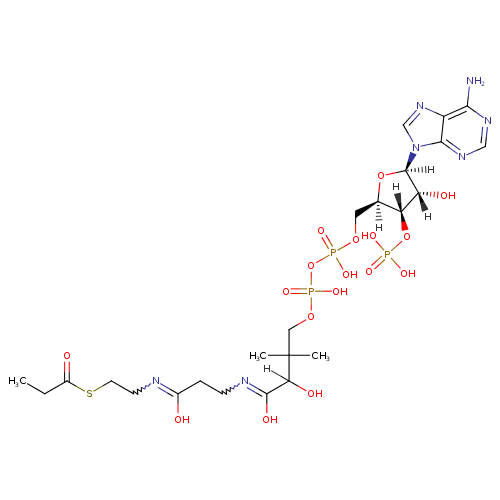
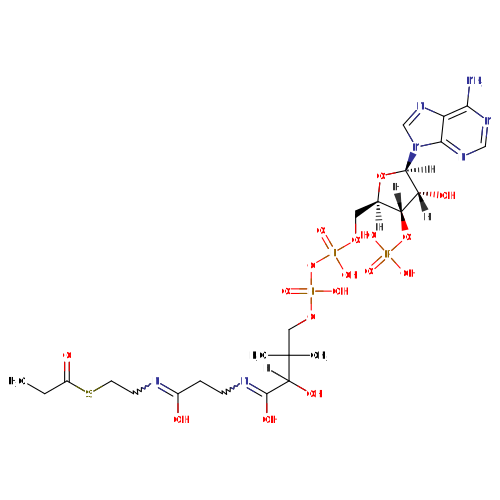
Propionyl-CoA is an intermediate in the metabolism of propanoate. Propionic aciduria is caused by an autosomal recessive disorder of propionyl coenzyme A (CoA) carboxylase deficiency (EC 6.4.1.3). In propionic aciduria, propionyl CoA accumulates within the mitochondria in massive quantities; free carnitine is then esterified, creating propionyl carnitine, which is then excreted in the urine. Because the supply of carnitine in the diet and from synthesis is limited, such patients readily develop carnitine deficiency as a result of the increased loss of acylcarnitine derivatives. This condition demands supplementation of free carnitine above the normal dietary intake to continue to remove (detoxify) the accumulating organic acids. Propionyl-CoA is a substrate for Acyl-CoA dehydrogenase (medium-chain specific, mitochondrial), Acetyl-coenzyme A synthetase 2-like (mitochondrial), Propionyl-CoA carboxylase alpha chain (mitochondrial), Methylmalonate-semialdehyde dehydrogenase (mitochondrial), Trifunctional enzyme beta subunit (mitochondrial), 3-ketoacyl-CoA thiolase (peroxisomal), Acyl-CoA dehydrogenase (long-chain specific, mitochondrial), Malonyl-CoA decarboxylase (mitochondrial), Acetyl-coenzyme A synthetase (cytoplasmic), 3-ketoacyl-CoA thiolase (mitochondrial) and Propionyl-CoA carboxylase beta chain (mitochondrial). (1).
belongs to the class of organic compounds known as acyl coas. These are organic compounds containing a coenzyme A substructure linked to an acyl chain.
In propionic aciduria, propionyl CoA accumulates within the mitochondria in massive quantities; free carnitine is then esterified, creating propionyl carnitine, which is then excreted in the urine. Because the supply of carnitine in the diet and from synthesis is limited, such patients readily develop carnitine deficiency as a result of the increased loss of acylcarnitine derivatives.
Metabolism
Metabolism of organophosphates occurs principally by oxidation, by hydrolysis via esterases and by reaction with glutathione. Demethylation and glucuronidation may also occur. Oxidation of organophosphorus pesticides may result in moderately toxic products. In general, phosphorothioates are not directly toxic but require oxidative metabolism to the proximal toxin. The glutathione transferase reactions produce products that are, in most cases, of low toxicity. Paraoxonase (PON1) is a key enzyme in the metabolism of organophosphates. PON1 can inactivate some organophosphates through hydrolysis. PON1 hydrolyzes the active metabolites in several organophosphates insecticides as well as, nerve agents such as soman, sarin, and VX. The presence of PON1 polymorphisms causes there to be different enzyme levels and catalytic efficiency of this esterase, which in turn suggests that different individuals may be more susceptible to the toxic effect of organophosphate exposure.
No indication of carcinogenicity to humans (not listed by IARC).
Uses/Sources
This is an endogenously produced metabolite found in the human body. It is used in metabolic reactions, catabolic reactions or waste generation.
Minimum Risk Level
Not Available
Health Effects
Propionic acidemia presents in the early neonatal period with progressive encephalopathy. Death can occur quickly, due to secondary hyperammonemia, infection, cardiomyopathy, or basal ganglial stroke. (Wikipedia)
Symptoms
Propionic acidemia is characterized almost immediately in newborns. Symptoms include poor feeding, vomiting, dehydration, acidosis, low muscle tone (hypotonia), seizures, and lethargy. The effects of propionic acidemia quickly become life-threatening. (Wikipedia)
Treatment
The carnitine deficiency associated with propionic acuduria demands supplementation of free carnitine above the normal dietary intake to continue to remove (detoxify) the accumulating organic acids.