Record Information
Version1.0
Creation Date2014-08-29 06:51:17 UTC
Update Date2026-04-17 16:40:34 UTC
Accession NumberCHEM003402
Identification
Common NameGlyoxylic acid
ClassSmall Molecule
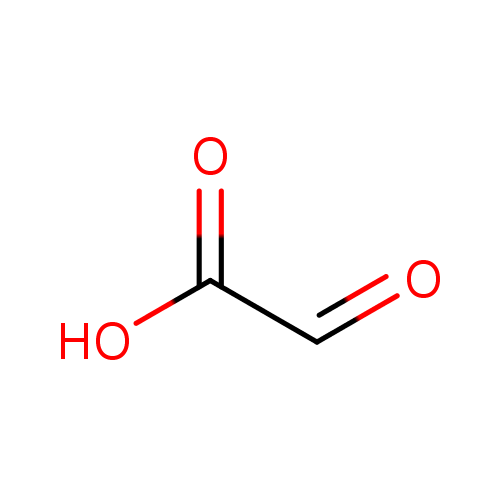
DescriptionGlyoxylic acid or oxoacetic acid is an organic compound that is both an aldehyde and a carboxylic acid. Glyoxylic acid is a liquid with a melting Point of -93 degree centigrade and a boiling Point of 111 degree centigrade. It is an intermediate of the glyoxylate cycle, which enables certain organisms to convert fatty acids into carbohydrates. The conjugate base of gloxylic acid is known as glyoxylate. This compound is an intermediate of the glyoxylate cycle, which enables organisms, such as bacteria, fungi and plants to convert fatty acids into carbohydrates. Glyoxylate is the byproduct of the amidation process in biosynthesis of several amidated peptides. The glyoxylate cycle is a metabolic pathway occurring in plants, and several microorganisms, such as E. coli and yeast. Recent research shows that it is present in vertebrates (including humans) and insects. The glyoxylate cycle allows these organisms to use fats for the synthesis of carbohydrates. (1).
Contaminant Sources
  • FooDB Chemicals
  • HMDB Contaminants - Urine
  • HPV EPA Chemicals
  • OECD HPV Chemicals
  • STOFF IDENT Compounds
  • T3DB toxins
Contaminant Type
  • Animal Toxin
  • Food Toxin
  • Metabolite
  • Natural Compound
  • Organic Compound
Chemical Structure
Thumb
Synonyms
ValueSource
alpha-Ketoacetic acidChEBI
Formylformic acidChEBI
GlyoxalateChEBI
GlyoxalsaeureChEBI
GlyoxylateChEBI
GlyoxylsaeureChEBI
Oxalaldehydic acidChEBI
Oxoethanoic acidChEBI
a-KetoacetateGenerator
a-Ketoacetic acidGenerator
alpha-KetoacetateGenerator
Α-ketoacetateGenerator
Α-ketoacetic acidGenerator
FormylformateGenerator
Glyoxalic acidGenerator
OxalaldehydateGenerator
OxoethanoateGenerator
OxoacetateHMDB
Oxoacetic acidHMDB
Glyoxylic acid, 2-(14)C-labeledHMDB
Glyoxylic acid, sodium saltHMDB
Glyoxylic acid, sodium salt, 2-(14)C-labeledHMDB
Glyoxylic acid, 14c2-labeledHMDB
Glyoxylic acid, calcium saltHMDB
Glyoxylic acid, sodium salt, 14C-labeledHMDB
Chemical FormulaC2H2O3
Average Molecular Mass74.036 g/mol
Monoisotopic Mass74.000 g/mol
CAS Registry Number298-12-4
IUPAC Name2-oxoacetic acid
Traditional Nameglyoxylic acid
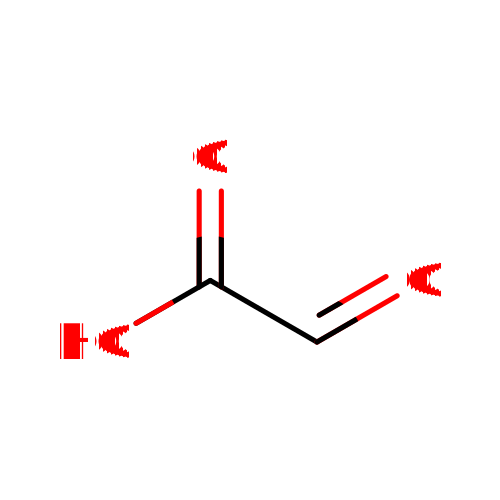
SMILESOC(=O)C=O
InChI IdentifierInChI=1S/C2H2O3/c3-1-2(4)5/h1H,(H,4,5)
InChI KeyHHLFWLYXYJOTON-UHFFFAOYSA-N
Chemical Taxonomy
Description belongs to the class of organic compounds known as carboxylic acids. Carboxylic acids are compounds containing a carboxylic acid group with the formula -C(=O)OH.
KingdomOrganic compounds
Super ClassOrganic acids and derivatives
ClassCarboxylic acids and derivatives
Sub ClassCarboxylic acids
Direct ParentCarboxylic acids
Alternative Parents
Substituents
  • Monocarboxylic acid or derivatives
  • Carboxylic acid
  • Organic oxygen compound
  • Organic oxide
  • Hydrocarbon derivative
  • Short-chain aldehyde
  • Organooxygen compound
  • Carbonyl group
  • Aldehyde
  • Aliphatic acyclic compound
Molecular FrameworkAliphatic acyclic compounds
External Descriptors
Biological Properties
StatusDetected and Not Quantified
OriginEndogenous
Cellular Locations
  • Cytoplasm
  • Extracellular
  • Mitochondria
  • Peroxisome
Biofluid LocationsNot Available
Tissue Locations
  • All Tissues
Pathways
NameSMPDB LinkKEGG Link
Alanine MetabolismSMP00055 map00250
Glycine and Serine MetabolismSMP00004 map00260
Primary Hyperoxaluria Type ISMP00352 Not Available
ApplicationsNot Available
Biological Roles
Chemical RolesNot Available
Physical Properties
StateLiquid
AppearanceNot Available
Experimental Properties
PropertyValue
Melting Point-93°C
Boiling PointNot Available
SolubilityNot Available
Predicted Properties
PropertyValueSource
Water Solubility224 g/LALOGPS
logP-0.59ALOGPS
logP-0.13ChemAxon
logS0.48ALOGPS
pKa (Strongest Acidic)2.61ChemAxon
pKa (Strongest Basic)-9.2ChemAxon
Physiological Charge-1ChemAxon
Hydrogen Acceptor Count3ChemAxon
Hydrogen Donor Count1ChemAxon
Polar Surface Area54.37 ŲChemAxon
Rotatable Bond Count1ChemAxon
Refractivity13.5 m³·mol⁻¹ChemAxon
Polarizability5.35 ųChemAxon
Number of Rings0ChemAxon
Bioavailability1ChemAxon
Rule of FiveYesChemAxon
Ghose FilterNoChemAxon
Veber's RuleNoChemAxon
MDDR-like RuleNoChemAxon
Spectra
Spectra
Spectrum TypeDescriptionSplash KeyView
GC-MSGC-MS Spectrum - GC-MS (1 MEOX; 1 TMS)splash10-03di-3900000000-16bc69e0e9d51e54854eSpectrum
GC-MSGC-MS Spectrum - GC-MS (Non-derivatized)splash10-03di-3900000000-16bc69e0e9d51e54854eSpectrum
Predicted GC-MSPredicted GC-MS Spectrum - GC-MS (Non-derivatized) - 70eV, Positivesplash10-0096-9000000000-042540a05be250278f8bSpectrum
Predicted GC-MSPredicted GC-MS Spectrum - GC-MS (1 TMS) - 70eV, Positivesplash10-00fr-9200000000-c60b627ed670285ec37fSpectrum
Predicted GC-MSPredicted GC-MS Spectrum - GC-MS (Non-derivatized) - 70eV, PositiveNot AvailableSpectrum
Predicted GC-MSPredicted GC-MS Spectrum - GC-MS (TBDMS_1_1) - 70eV, PositiveNot AvailableSpectrum
LC-MS/MSLC-MS/MS Spectrum - Quattro_QQQ 10V, Negative (Annotated)splash10-00di-9000000000-72c34bc34b8c3341442bSpectrum
LC-MS/MSLC-MS/MS Spectrum - Quattro_QQQ 25V, Negative (Annotated)splash10-00di-9000000000-920a0dc738957201d4baSpectrum
LC-MS/MSLC-MS/MS Spectrum - Quattro_QQQ 40V, Negative (Annotated)splash10-00di-9000000000-857c7f2d72c3d4c10dbfSpectrum
LC-MS/MSLC-MS/MS Spectrum - LC-ESI-QQ (API3000, Applied Biosystems) 10V, Negativesplash10-00di-9000000000-9b5825d5d9d8b094fefaSpectrum
LC-MS/MSLC-MS/MS Spectrum - LC-ESI-QQ (API3000, Applied Biosystems) 20V, Negativesplash10-00di-9000000000-de556f03ea428deff5e2Spectrum
LC-MS/MSLC-MS/MS Spectrum - LC-ESI-QQ (API3000, Applied Biosystems) 30V, Negativesplash10-00dl-9000000000-74b253632894213d473cSpectrum
LC-MS/MSLC-MS/MS Spectrum - LC-ESI-QQ , negativesplash10-00di-9000000000-9b5825d5d9d8b094fefaSpectrum
LC-MS/MSLC-MS/MS Spectrum - LC-ESI-QQ , negativesplash10-00di-9000000000-de556f03ea428deff5e2Spectrum
LC-MS/MSLC-MS/MS Spectrum - LC-ESI-QQ , negativesplash10-00dl-9000000000-74b253632894213d473cSpectrum
Predicted LC-MS/MSPredicted LC-MS/MS Spectrum - 10V, Positivesplash10-004i-9000000000-a8cc2c89793394fdf9e4Spectrum
Predicted LC-MS/MSPredicted LC-MS/MS Spectrum - 20V, Positivesplash10-0a6r-9000000000-d20183b08984d4766e8aSpectrum
Predicted LC-MS/MSPredicted LC-MS/MS Spectrum - 40V, Positivesplash10-0a4i-9000000000-ea9968e3933fd734506cSpectrum
Predicted LC-MS/MSPredicted LC-MS/MS Spectrum - 10V, Negativesplash10-00di-9000000000-cef8efc477a2500a7eadSpectrum
Predicted LC-MS/MSPredicted LC-MS/MS Spectrum - 20V, Negativesplash10-00di-9000000000-3817c0865df629803538Spectrum
Predicted LC-MS/MSPredicted LC-MS/MS Spectrum - 40V, Negativesplash10-00di-9000000000-bb935f857fb5fd08c7e3Spectrum
Predicted LC-MS/MSPredicted LC-MS/MS Spectrum - 10V, Positivesplash10-0a4i-9000000000-8f50f0d32d4c40b5b935Spectrum
Predicted LC-MS/MSPredicted LC-MS/MS Spectrum - 20V, Positivesplash10-0a4i-9000000000-b6216caa16afdf328489Spectrum
Predicted LC-MS/MSPredicted LC-MS/MS Spectrum - 40V, Positivesplash10-0a4i-9000000000-aa6a654e73df38a43273Spectrum
Predicted LC-MS/MSPredicted LC-MS/MS Spectrum - 10V, Negativesplash10-00di-9000000000-c6f38ec60bcf8724ecd1Spectrum
Predicted LC-MS/MSPredicted LC-MS/MS Spectrum - 20V, Negativesplash10-00di-9000000000-c6f38ec60bcf8724ecd1Spectrum
Predicted LC-MS/MSPredicted LC-MS/MS Spectrum - 40V, Negativesplash10-00dl-9000000000-641421c616a0929ce01eSpectrum
MSMass Spectrum (Electron Ionization)splash10-004l-9000000000-a04bafbf8e0b990094a3Spectrum
1D NMR1H NMR SpectrumNot AvailableSpectrum
1D NMR13C NMR SpectrumNot AvailableSpectrum
1D NMR1H NMR SpectrumNot AvailableSpectrum
1D NMR13C NMR SpectrumNot AvailableSpectrum
1D NMR1H NMR SpectrumNot AvailableSpectrum
1D NMR13C NMR SpectrumNot AvailableSpectrum
1D NMR1H NMR SpectrumNot AvailableSpectrum
1D NMR13C NMR SpectrumNot AvailableSpectrum
1D NMR1H NMR SpectrumNot AvailableSpectrum
1D NMR13C NMR SpectrumNot AvailableSpectrum
1D NMR1H NMR SpectrumNot AvailableSpectrum
1D NMR13C NMR SpectrumNot AvailableSpectrum
1D NMR1H NMR SpectrumNot AvailableSpectrum
1D NMR13C NMR SpectrumNot AvailableSpectrum
1D NMR1H NMR SpectrumNot AvailableSpectrum
1D NMR13C NMR SpectrumNot AvailableSpectrum
1D NMR1H NMR SpectrumNot AvailableSpectrum
1D NMR13C NMR SpectrumNot AvailableSpectrum
1D NMR1H NMR SpectrumNot AvailableSpectrum
1D NMR13C NMR SpectrumNot AvailableSpectrum
1D NMR1H NMR SpectrumNot AvailableSpectrum
1D NMR13C NMR SpectrumNot AvailableSpectrum
2D NMR[1H,13C] 2D NMR SpectrumNot AvailableSpectrum
Toxicity Profile
Route of ExposureNot Available
Mechanism of ToxicityNot Available
MetabolismNot Available
Toxicity ValuesNot Available
Lethal DoseNot Available
Carcinogenicity (IARC Classification)No indication of carcinogenicity to humans (not listed by IARC).
Uses/SourcesThis is an endogenously produced metabolite found in the human body. It is used in metabolic reactions, catabolic reactions or waste generation.
Minimum Risk LevelNot Available
Health EffectsNot Available
SymptomsNot Available
TreatmentNot Available
Concentrations
Not Available
DrugBank IDDB04343
HMDB IDHMDB0000119
FooDB IDFDB007244
Phenol Explorer IDNot Available
KNApSAcK IDC00001186
BiGG ID33659
BioCyc IDGLYOX
METLIN ID3213
PDB IDNot Available
Wikipedia LinkGlyoxylic_acid
Chemspider ID740
ChEBI ID16891
PubChem Compound ID760
Kegg Compound IDC00048
YMDB IDYMDB00033
ECMDB IDECMDB00119
References
Synthesis ReferenceNot Available
MSDSLink
General References
1. Jie, Yuanping; Song, Zhen. Method for preparing glyoxylic acid. Faming Zhuanli Shenqing Gongkai Shuomingshu (2007), 5pp.
2. Jie, Yuanping; Song, Zhen. Method for preparing glyoxylic acid. Faming Zhuanli Shenqing Gongkai Shuomingshu (2007), 5pp.
3. Naghizadeh F, Barlow D, King J: The reduction of oxo-acids by human tissue extracts. Clin Biochem. 1976 Apr;9(2):65-6.
4. Borondy PE, Michniewicz BM: Metabolic disposition of isoxicam in man, monkey, dog, and rat. Drug Metab Dispos. 1984 Jul-Aug;12(4):444-51.
5. Arvesen A, Maehlen J, Rosen L, Aas P: Myointimal hyperplasia and sympathetic reinnervation following local cold injury and rapid rewarming in the rabbit central ear artery. Vasa. 2001 Jul;30(3):176-83.
6. Motomiya Y, Oyama N, Iwamoto H, Uchimura T, Maruyama I: N epsilon-(carboxymethyl)lysine in blood from maintenance hemodialysis patients may contribute to dialysis-related amyloidosis. Kidney Int. 1998 Oct;54(4):1357-66.
7. Holmes E, Foxall PJ, Spraul M, Farrant RD, Nicholson JK, Lindon JC: 750 MHz 1H NMR spectroscopy characterisation of the complex metabolic pattern of urine from patients with inborn errors of metabolism: 2-hydroxyglutaric aciduria and maple syrup urine disease. J Pharm Biomed Anal. 1997 Jul;15(11):1647-59.
8. Mentasti E, Savigliano M, Marangella M, Petrarulo M, Linari F: High-performance liquid chromatographic determination of glyoxylic acid and other carbonyl compounds in urine. J Chromatogr. 1987 Jul 3;417(2):253-60.
9. Bruzzese FJ, Dix JA, Rava RP, Cerny LC: Resonance Raman spectroscopy of chemically modified hemoglobins. Biomater Artif Cells Artif Organs. 1990;18(2):143-56.
10. Lee SH, Kim SO, Chung BC: Gas chromatographic-mass spectrometric determination of urinary oxoacids using O-(2,3,4,5,6-pentafluorobenzyl)oxime-trimethylsilyl ester derivatization and cation-exchange chromatography. J Chromatogr B Biomed Sci Appl. 1998 Nov 20;719(1-2):1-7.
11. Schmitt A, Gasic-Milenkovic J, Schmitt J: Characterization of advanced glycation end products: mass changes in correlation to side chain modifications. Anal Biochem. 2005 Nov 1;346(1):101-6. Epub 2005 Aug 15.
12. Booth ED, Dofferhoff O, Boogaard PJ, Watson WP: Comparison of the metabolism of ethylene glycol and glycolic acid in vitro by precision-cut tissue slices from female rat, rabbit and human liver. Xenobiotica. 2004 Jan;34(1):31-48.
13. Tainio H, Vaalasti A, Rechardt L: The distribution of sympathetic adrenergic, tyrosine hydroxylase- and neuropeptide Y-immunoreactive nerves in human axillary sweat glands. Histochemistry. 1986;85(2):117-20.
14. Davis WL, Goodman DB: Evidence for the glyoxylate cycle in human liver. Anat Rec. 1992 Dec;234(4):461-8.
15. Arvesen A, Maehlen J, Rosen L, Aas P: Early and late functional and histopathological perturbations in the rabbit ear-artery following local cold injury. Vasa. 1999 May;28(2):85-94.
16. Popov VN, Moskalev EA, Shevchenko MIu, Eprintsev AT: [Comparative analysis of the glyoxylate cycle clue enzyme isocitrate lyases from organisms of different systemic groups]. Zh Evol Biokhim Fiziol. 2005 Nov-Dec;41(6):507-13.
17. https://www.ncbi.nlm.nih.gov/pubmed/?term=11479160
18. https://www.ncbi.nlm.nih.gov/pubmed/?term=16396466
19. https://www.ncbi.nlm.nih.gov/pubmed/?term=22580421
20. https://www.ncbi.nlm.nih.gov/pubmed/?term=23790896