Record Information
Version1.0
Creation Date2014-08-29 06:51:16 UTC
Update Date2026-05-14 17:56:55 UTC
Accession NumberCHEM003397
Identification
Common NamePhenylpyruvic acid
ClassSmall Molecule
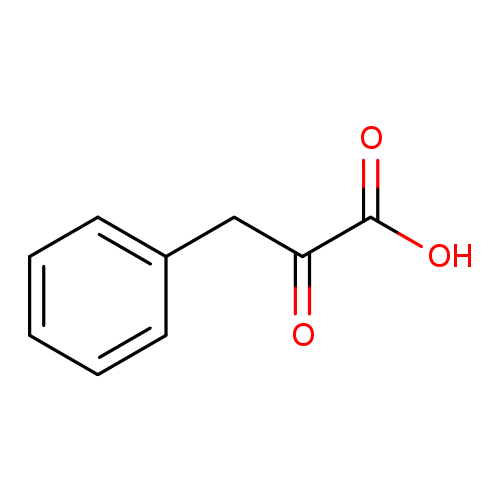
DescriptionPhenylpyruvic acid is a keto-acid that is an intermediate or catabolic byproduct of phenylalanine metabolism. It has a slight honey-like odor. Levels of phenylpyruvate are normally very low in blood or urine. High levels of phenylpyruvic acid can be found in the urine of individuals with phenylketonuria (PKU). PKU is due to lack of the enzyme phenylalanine hydroxylase (PAH), so that phenylalanine is converted not to tyrosine but to phenylpyruvic acid. In particular, excessive phenylalanine can be metabolized into phenylketones through, a transaminase pathway route involving glutamate. Metabolites of this transamination reaction include phenylacetate, phenylpyruvate and phenethylamine. In persons with PKU, dietary phenylalanine either accumulates in the body or some of it is converted to phenylpyruvic acid. Individuals with PKU tend to excrete large quantities of phenylpyruvate, phenylacetate and phenyllactate, along with phenylalanine, in their urine. If untreated, mental retardation effects and microcephaly are evident by the first year along with other symptoms which include: unusual irritability, epileptic seizures and skin lesions. Hyperactivity, EEG abnormalities and seizures, and severe learning disabilities are major clinical problems later in life. A musty or mousy odor of skin, hair, sweat and urine (due to phenylacetate accumulation); and a tendency to hypopigmentation and eczema are also observed. The neural-development effects of PKU are primarily due to the disruption of neurotransmitter synthesis. In particular, phenylalanine is a large, neutral amino acid which moves across the blood-brain barrier (BBB) via the large neutral amino acid transporter (LNAAT). Excessive phenylalanine in the blood saturates the transporter. Thus, excessive levels of phenylalanine significantly decrease the levels of other LNAAs in the brain. But since these amino acids are required for protein and neurotransmitter synthesis, phenylalanine accumulation disrupts brain development, leading to mental retardation.
Contaminant Sources
  • EAFUS Chemicals
  • FooDB Chemicals
  • HMDB Contaminants - Urine
  • STOFF IDENT Compounds
  • T3DB toxins
  • ToxCast & Tox21 Chemicals
Contaminant Type
  • Animal Toxin
  • Food Toxin
  • Metabolite
  • Natural Compound
  • Organic Compound
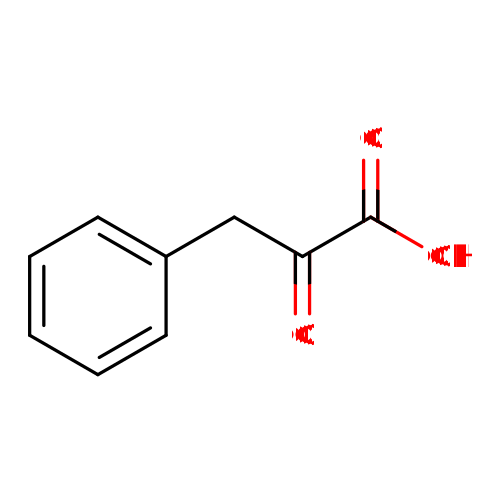
Chemical Structure
Thumb
Synonyms
ValueSource
3-Phenyl-2-oxopropanoateChEBI
3-Phenyl-2-oxopropanoic acidChEBI
3-Phenylpyruvic acidChEBI
alpha-Ketohydrocinnamic acidChEBI
alpha-Oxo-benzenepropanoic acidChEBI
beta-Phenylpyruvic acidChEBI
Keto-phenylpyruvateChEBI
PhenylbrenztraubensaeureChEBI
PhenylpyruvateChEBI
3-PHENYLPYRUVateGenerator
a-KetohydrocinnamateGenerator
a-Ketohydrocinnamic acidGenerator
alpha-KetohydrocinnamateGenerator
α-KetohydrocinnamateGenerator
α-Ketohydrocinnamic acidGenerator
a-Oxo-benzenepropanoateGenerator
a-Oxo-benzenepropanoic acidGenerator
alpha-Oxo-benzenepropanoateGenerator
α-Oxo-benzenepropanoateGenerator
α-Oxo-benzenepropanoic acidGenerator
b-PhenylpyruvateGenerator
b-Phenylpyruvic acidGenerator
beta-PhenylpyruvateGenerator
β-PhenylpyruvateGenerator
β-Phenylpyruvic acidGenerator
keto-Phenylpyruvic acidGenerator
2-Oxo-3-phenylpropanoateHMDB, KEGG
2-Oxo-3-phenylpropanoic acidHMDB, Generator
a-Hydroxycinnamic acidHMDB
FEMA 3892HMDB
Phenylpyruvic acidChEBI
2-Oxo-3-phenylpropionic acidHMDB
3-Phenyl-2-oxopropionic acidHMDB
alpha-Oxobenzenepropanoic acidHMDB
alpha-Oxobenzenepropionic acidHMDB
α-Oxobenzenepropanoic acidHMDB
α-Oxobenzenepropionic acidHMDB
Chemical FormulaC9H8O3
Average Molecular Mass164.158 g/mol
Monoisotopic Mass164.047 g/mol
CAS Registry Number156-06-9
IUPAC Name2-oxo-3-phenylpropanoic acid
Traditional Namephenylpyruvic acid
SMILESOC(=O)C(=O)CC1=CC=CC=C1
InChI IdentifierInChI=1S/C9H8O3/c10-8(9(11)12)6-7-4-2-1-3-5-7/h1-5H,6H2,(H,11,12)
InChI KeyBTNMPGBKDVTSJY-UHFFFAOYSA-N
Chemical Taxonomy
Description belongs to the class of organic compounds known as phenylpyruvic acid derivatives. Phenylpyruvic acid derivatives are compounds containing a phenylpyruvic acid moiety, which consists of a phenyl group substituted at the second position by an pyruvic acid.
KingdomOrganic compounds
Super ClassBenzenoids
ClassBenzene and substituted derivatives
Sub ClassPhenylpyruvic acid derivatives
Direct ParentPhenylpyruvic acid derivatives
Alternative Parents
Substituents
  • Phenylpyruvate
  • 3-phenylpropanoic-acid
  • Keto acid
  • Alpha-keto acid
  • Alpha-hydroxy ketone
  • Ketone
  • Monocarboxylic acid or derivatives
  • Carboxylic acid
  • Carboxylic acid derivative
  • Organic oxygen compound
  • Organic oxide
  • Hydrocarbon derivative
  • Organooxygen compound
  • Carbonyl group
  • Aromatic homomonocyclic compound
Molecular FrameworkAromatic homomonocyclic compounds
External Descriptors
Biological Properties
StatusDetected and Not Quantified
OriginEndogenous
Cellular Locations
  • Cytoplasm
  • Extracellular
  • Mitochondria
Biofluid LocationsNot Available
Tissue LocationsNot Available
Pathways
NameSMPDB LinkKEGG Link
Phenylalanine and Tyrosine MetabolismSMP00008 map00360
PhenylketonuriaSMP00206 Not Available
ApplicationsNot Available
Biological Roles
Chemical RolesNot Available
Physical Properties
StateSolid
AppearanceWhite powder.
Experimental Properties
PropertyValue
Melting Point154°C
Boiling PointNot Available
Solubility112 mg/mL
Predicted Properties
PropertyValueSource
logP1.9ChemAxon
pKa (Strongest Acidic)3.33ChemAxon
pKa (Strongest Basic)-9.8ChemAxon
Physiological Charge-1ChemAxon
Hydrogen Acceptor Count3ChemAxon
Hydrogen Donor Count1ChemAxon
Polar Surface Area54.37 ŲChemAxon
Rotatable Bond Count3ChemAxon
Refractivity42.71 m³·mol⁻¹ChemAxon
Polarizability15.75 ųChemAxon
Number of Rings1ChemAxon
Bioavailability1ChemAxon
Rule of FiveYesChemAxon
Ghose FilterYesChemAxon
Veber's RuleNoChemAxon
MDDR-like RuleNoChemAxon
Spectra
Spectra
Spectrum TypeDescriptionSplash KeyView
GC-MSGC-MS Spectrum - GC-EI-TOF (Pegasus III TOF-MS system, Leco; GC 6890, Agilent Technologies) (1 TMS)splash10-00ko-9700000000-1a891469df1de787159bSpectrum
GC-MSGC-MS Spectrum - GC-EI-TOF (Pegasus III TOF-MS system, Leco; GC 6890, Agilent Technologies) (Non-derivatized)splash10-0006-1900000000-7dc1a5344d13e4dc19acSpectrum
GC-MSGC-MS Spectrum - GC-EI-TOF (Pegasus III TOF-MS system, Leco; GC 6890, Agilent Technologies) (Non-derivatized)splash10-001i-0900000000-bbbc84c54d03c4a14e51Spectrum
GC-MSGC-MS Spectrum - GC-EI-TOF (Pegasus III TOF-MS system, Leco; GC 6890, Agilent Technologies) (Non-derivatized)splash10-0a4i-0900000000-00b547b0371603520b61Spectrum
GC-MSGC-MS Spectrum - GC-EI-TOF (Pegasus III TOF-MS system, Leco; GC 6890, Agilent Technologies) (1 TMS; 1 MEOX)splash10-00di-9100000000-fdd48b632e63c8478078Spectrum
GC-MSGC-MS Spectrum - GC-MS (1 MEOX; 1 TMS)splash10-000f-9300000000-8cd32f87e04ae0b6d6fbSpectrum
GC-MSGC-MS Spectrum - GC-MS (1 MEOX; 1 TMS)splash10-014u-9720000000-7a0b66e6c18ff42ac05eSpectrum
GC-MSGC-MS Spectrum - GC-MS (2 TMS)splash10-0006-9760000000-d94111a7b9babceb265bSpectrum
GC-MSGC-MS Spectrum - GC-EI-TOF (Non-derivatized)splash10-00ko-9700000000-1a891469df1de787159bSpectrum
GC-MSGC-MS Spectrum - GC-EI-TOF (Non-derivatized)splash10-00di-9100000000-fdd48b632e63c8478078Spectrum
GC-MSGC-MS Spectrum - GC-MS (Non-derivatized)splash10-000f-9300000000-8cd32f87e04ae0b6d6fbSpectrum
GC-MSGC-MS Spectrum - GC-MS (Non-derivatized)splash10-014u-9720000000-7a0b66e6c18ff42ac05eSpectrum
GC-MSGC-MS Spectrum - GC-MS (Non-derivatized)splash10-0006-9760000000-d94111a7b9babceb265bSpectrum
GC-MSGC-MS Spectrum - GC-MS (Non-derivatized)splash10-000f-9300000000-8cd32f87e04ae0b6d6fbSpectrum
GC-MSGC-MS Spectrum - GC-MS (Non-derivatized)splash10-014u-9720000000-7a0b66e6c18ff42ac05eSpectrum
GC-MSGC-MS Spectrum - GC-MS (Non-derivatized)splash10-0006-9760000000-d94111a7b9babceb265bSpectrum
GC-MSGC-MS Spectrum - GC-EI-TOF (Non-derivatized)splash10-00ko-9700000000-cec4a53271b8d66c2abcSpectrum
Predicted GC-MSPredicted GC-MS Spectrum - GC-MS (Non-derivatized) - 70eV, Positivesplash10-0006-9300000000-9a8a36c751256480752eSpectrum
Predicted GC-MSPredicted GC-MS Spectrum - GC-MS (1 TMS) - 70eV, Positivesplash10-00r6-9500000000-3e83cb905f1fd4362497Spectrum
Predicted GC-MSPredicted GC-MS Spectrum - GC-MS (Non-derivatized) - 70eV, PositiveNot AvailableSpectrum
Predicted GC-MSPredicted GC-MS Spectrum - GC-MS (TMS_1_2) - 70eV, PositiveNot AvailableSpectrum
Predicted GC-MSPredicted GC-MS Spectrum - GC-MS (TBDMS_1_1) - 70eV, PositiveNot AvailableSpectrum
Predicted GC-MSPredicted GC-MS Spectrum - GC-MS (TBDMS_1_2) - 70eV, PositiveNot AvailableSpectrum
LC-MS/MSLC-MS/MS Spectrum - Quattro_QQQ 10V, Positive (Annotated)splash10-066r-0900000000-ceb2ce23352e0f45ee33Spectrum
LC-MS/MSLC-MS/MS Spectrum - Quattro_QQQ 25V, Positive (Annotated)splash10-004i-9200000000-ed4a6740d574858da982Spectrum
LC-MS/MSLC-MS/MS Spectrum - Quattro_QQQ 40V, Positive (Annotated)splash10-004i-9000000000-c239a9a599daa607e47fSpectrum
LC-MS/MSLC-MS/MS Spectrum - LC-ESI-QFT , negativesplash10-014i-0900000000-36e00f6baa5d907e851bSpectrum
LC-MS/MSLC-MS/MS Spectrum - LC-ESI-QTOF 35V, negativesplash10-014i-0900000000-843a66173124c8fdf184Spectrum
LC-MS/MSLC-MS/MS Spectrum - 35V, Negativesplash10-014i-0900000000-272f6079d347e1b34e86Spectrum
Predicted LC-MS/MSPredicted LC-MS/MS Spectrum - 10V, Positivesplash10-014j-1900000000-5d025096b1bb0e80dc1cSpectrum
Predicted LC-MS/MSPredicted LC-MS/MS Spectrum - 20V, Positivesplash10-014m-3900000000-9d0be907ecb6cc5efe8cSpectrum
Predicted LC-MS/MSPredicted LC-MS/MS Spectrum - 40V, Positivesplash10-0006-9200000000-a4fc563b3536eafc044dSpectrum
Predicted LC-MS/MSPredicted LC-MS/MS Spectrum - 10V, Negativesplash10-03di-1900000000-0f660ae6dc074d939404Spectrum
Predicted LC-MS/MSPredicted LC-MS/MS Spectrum - 20V, Negativesplash10-014j-1900000000-d229883bf098b04e0fcbSpectrum
Predicted LC-MS/MSPredicted LC-MS/MS Spectrum - 40V, Negativesplash10-014i-5900000000-a107b725b71a6441a80cSpectrum
Predicted LC-MS/MSPredicted LC-MS/MS Spectrum - 10V, Negativesplash10-03xr-1900000000-8ba05dd4c5612aae9f50Spectrum
Predicted LC-MS/MSPredicted LC-MS/MS Spectrum - 20V, Negativesplash10-0006-9300000000-946fa61c2a2596d7592dSpectrum
Predicted LC-MS/MSPredicted LC-MS/MS Spectrum - 40V, Negativesplash10-0006-9200000000-fa13a9bfbb6c03b2e12dSpectrum
Predicted LC-MS/MSPredicted LC-MS/MS Spectrum - 10V, Positivesplash10-014l-4900000000-2d56731d3ebcebf8079aSpectrum
Predicted LC-MS/MSPredicted LC-MS/MS Spectrum - 20V, Positivesplash10-0006-9200000000-9b3ae8fbf3992b1b2f28Spectrum
Predicted LC-MS/MSPredicted LC-MS/MS Spectrum - 40V, Positivesplash10-0006-9000000000-089373761153dce3ca74Spectrum
MSMass Spectrum (Electron Ionization)splash10-00kf-9300000000-d1a7d23e7c5270b16883Spectrum
1D NMR1H NMR SpectrumNot AvailableSpectrum
2D NMR[1H,13C] 2D NMR SpectrumNot AvailableSpectrum
Toxicity Profile
Route of ExposureNot Available
Mechanism of ToxicityNot Available
MetabolismNot Available
Toxicity ValuesNot Available
Lethal DoseNot Available
Carcinogenicity (IARC Classification)No indication of carcinogenicity to humans (not listed by IARC).
Uses/SourcesThis is an endogenously produced metabolite found in the human body. It is used in metabolic reactions, catabolic reactions or waste generation.
Minimum Risk LevelNot Available
Health EffectsNot Available
SymptomsNot Available
TreatmentNot Available
Concentrations
Not Available
DrugBank IDDB03884
HMDB IDHMDB0000205
FooDB IDFDB008272
Phenol Explorer IDNot Available
KNApSAcK IDC00000751
BiGG ID34111
BioCyc IDPHENYL-PYRUVATE
METLIN ID328
PDB IDNot Available
Wikipedia LinkPhenylpyruvic_acid
Chemspider ID972
ChEBI ID30851
PubChem Compound ID997
Kegg Compound IDC00166
YMDB IDYMDB00786
ECMDB IDECMDB00205
References
Synthesis ReferenceNot Available
MSDSLink
General References
1. https://www.ncbi.nlm.nih.gov/pubmed/?term=132040
2. https://www.ncbi.nlm.nih.gov/pubmed/?term=153583
3. https://www.ncbi.nlm.nih.gov/pubmed/?term=16742815
4. https://www.ncbi.nlm.nih.gov/pubmed/?term=20504690
5. https://www.ncbi.nlm.nih.gov/pubmed/?term=2291475
6. https://www.ncbi.nlm.nih.gov/pubmed/?term=4025205
7. https://www.ncbi.nlm.nih.gov/pubmed/?term=719897
8. https://www.ncbi.nlm.nih.gov/pubmed/?term=8216688
9. https://www.ncbi.nlm.nih.gov/pubmed/?term=9869358
10. Li, Hongbin; Luo, Yuzhong. Preparation of phenyl-pyruvic acid by dicarbonylation of benzyl halide. Faming Zhuanli Shenqing Gongkai Shuomingshu (1996), 5 pp.
11. Li, Hongbin; Luo, Yuzhong. Preparation of phenyl-pyruvic acid by dicarbonylation of benzyl halide. Faming Zhuanli Shenqing Gongkai Shuomingshu (1996), 5 pp.
12. Lasala JM, Coscia CJ: Accumulation of a tetrahydroisoquinoline in phenylketonuria. Science. 1979 Jan 19;203(4377):283-4.
13. Boulat O, Gradwohl M, Matos V, Guignard JP, Bachmann C: Organic acids in the second morning urine in a healthy Swiss paediatric population. Clin Chem Lab Med. 2003 Dec;41(12):1642-58.
14. Cassidei L, Dell'atti A, Sciacovelli O: Improvement of the FeCl3 test for phenylpyruvic acid. Clin Chim Acta. 1978 Dec 1;90(2):121-7.
15. Michals K, Matalon R: Phenylalanine metabolites, attention span and hyperactivity. Am J Clin Nutr. 1985 Aug;42(2):361-5.
16. Shoemaker JD, Elliott WH: Automated screening of urine samples for carbohydrates, organic and amino acids after treatment with urease. J Chromatogr. 1991 Jan 2;562(1-2):125-38.
17. Lee SH, Kim SO, Chung BC: Gas chromatographic-mass spectrometric determination of urinary oxoacids using O-(2,3,4,5,6-pentafluorobenzyl)oxime-trimethylsilyl ester derivatization and cation-exchange chromatography. J Chromatogr B Biomed Sci Appl. 1998 Nov 20;719(1-2):1-7.
18. Nakahara T, Ishida J, Yamaguchi M, Nakamura M: Determination of alpha-keto acids including phenylpyruvic acid in human plasma by high-performance liquid chromatography with chemiluminescence detection. Anal Biochem. 1990 Nov 1;190(2):309-13.
19. Nierop Groot MN, de Bont JAM: Conversion of phenylalanine to benzaldehyde initiated by an aminotransferase in lactobacillus plantarum Appl Environ Microbiol. 1998 Aug;64(8):3009-13.
20. Yannai, Shmuel. (2004) Dictionary of food compounds with CD-ROM: Additives, flavors, and ingredients. Boca Raton: Chapman & Hall/CRC.