Record Information
Version1.0
Creation Date2014-08-29 06:51:16 UTC
Update Date2026-04-06 11:03:53 UTC
Accession NumberCHEM003396
Identification
Common NameCarbamoyl phosphate
ClassSmall Molecule
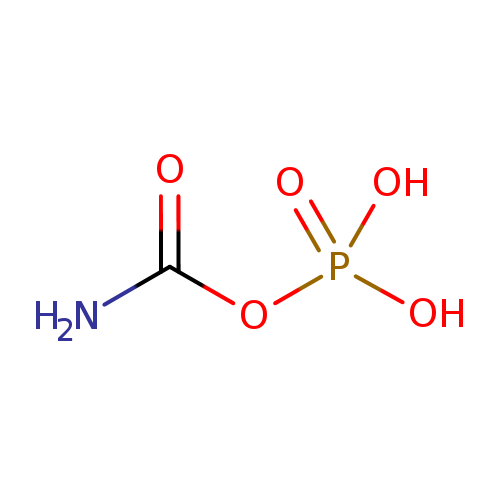
DescriptionCarbamoyl phosphate is a precursor of both arginine and pyrimidine biosynthesis. It is a labile and potentially toxic intermediate. Carbamoyl phosphate is a molecule that is involved in ridding the body of excess nitrogen in the urea cycle, and also in the synthesis of pyrimidines. It is produced from carbon dioxide, ammonia, and phosphate (from ATP) by the enzyme carbamoyl phosphate synthase.
Contaminant Sources
  • FooDB Chemicals
  • T3DB toxins
Contaminant Type
  • Animal Toxin
  • Ester
  • Food Toxin
  • Metabolite
  • Natural Compound
  • Organic Compound
Chemical Structure
Thumb
Synonyms
ValueSource
Aminocarbonyl dihydrogen phosphateChEBI
Carbamic phosphoric monoanhydrideChEBI
Carbamyl phosphateChEBI
Monocarbamoyl phosphateChEBI
Phosphoric acid mono(formamide)esterChEBI
Aminocarbonyl dihydrogen phosphoric acidGenerator
Carbamoyl phosphoric acidGenerator
Carbamyl phosphoric acidGenerator
Monocarbamoyl phosphoric acidGenerator
Phosphate mono(formamide)esterGenerator
Carbamic acid monoanhydride with phosphorateHMDB
Carbamic acid monoanhydride with phosphoric acidHMDB
Carbamoyl-PHMDB
Carbamoyl-phosphateHMDB
CarbamoylphosphateHMDB
Carbamyl-phosphateHMDB
Phosphate, carbamylMeSH, HMDB
Phosphate, carbamoylMeSH, HMDB
(Carbamoyloxy)phosphonic acidHMDB
Carbamoyl phosphateHMDB
Chemical FormulaCH4NO5P
Average Molecular Mass141.020 g/mol
Monoisotopic Mass140.983 g/mol
CAS Registry Number590-55-6
IUPAC Name(carbamoyloxy)phosphonic acid
Traditional Namecarbamoyl-phosphate
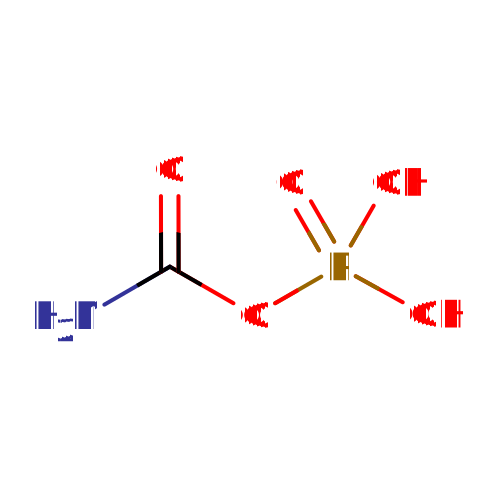
SMILESNC(=O)OP(O)(O)=O
InChI IdentifierInChI=1S/CH4NO5P/c2-1(3)7-8(4,5)6/h(H2,2,3)(H2,4,5,6)
InChI KeyFFQKYPRQEYGKAF-UHFFFAOYSA-N
Chemical Taxonomy
Description belongs to the class of organic compounds known as organic phosphoric acids and derivatives. These are organic compounds containing phosphoric acid or a derivative thereof.
KingdomOrganic compounds
Super ClassOrganic acids and derivatives
ClassOrganic phosphoric acids and derivatives
Sub ClassNot Available
Direct ParentOrganic phosphoric acids and derivatives
Alternative Parents
Substituents
  • Organic phosphoric acid derivative
  • Carboximidic acid derivative
  • Organic nitrogen compound
  • Organic oxygen compound
  • Organopnictogen compound
  • Organic oxide
  • Hydrocarbon derivative
  • Organooxygen compound
  • Organonitrogen compound
  • Imine
  • Aliphatic acyclic compound
Molecular FrameworkAliphatic acyclic compounds
External Descriptors
Biological Properties
StatusDetected and Not Quantified
OriginEndogenous
Cellular Locations
  • Endoplasmic reticulum
  • Membrane
  • Mitochondria
Biofluid LocationsNot Available
Tissue Locations
  • Spleen
Pathways
NameSMPDB LinkKEGG Link
Ammonia RecyclingSMP00009 map00910
Arginine and Proline MetabolismSMP00020 map00330
Glutamate MetabolismSMP00072 map00250
Pyrimidine MetabolismSMP00046 map00240
Urea CycleSMP00059 Not Available
Ornithine Transcarbamylase Deficiency (OTC Deficiency)SMP00205 Not Available
ApplicationsNot Available
Biological RolesNot Available
Chemical RolesNot Available
Physical Properties
StateSolid
AppearanceWhite powder.
Experimental Properties
PropertyValue
Melting PointNot Available
Boiling PointNot Available
SolubilityNot Available
Predicted Properties
PropertyValueSource
Water Solubility15.6 g/LALOGPS
logP-1.5ALOGPS
logP-1.2ChemAxon
logS-0.96ALOGPS
pKa (Strongest Acidic)1.1ChemAxon
Physiological Charge-2ChemAxon
Hydrogen Acceptor Count4ChemAxon
Hydrogen Donor Count3ChemAxon
Polar Surface Area109.85 ŲChemAxon
Rotatable Bond Count2ChemAxon
Refractivity22.48 m³·mol⁻¹ChemAxon
Polarizability9.12 ųChemAxon
Number of Rings0ChemAxon
Bioavailability1ChemAxon
Rule of FiveYesChemAxon
Ghose FilterNoChemAxon
Veber's RuleNoChemAxon
MDDR-like RuleNoChemAxon
Spectra
Spectra
Spectrum TypeDescriptionSplash KeyView
Predicted GC-MSPredicted GC-MS Spectrum - GC-MS (Non-derivatized) - 70eV, Positivesplash10-0002-9100000000-6a951539300f7f5b64d6Spectrum
Predicted GC-MSPredicted GC-MS Spectrum - GC-MS (Non-derivatized) - 70eV, PositiveNot AvailableSpectrum
Predicted LC-MS/MSPredicted LC-MS/MS Spectrum - 10V, Positivesplash10-0002-9000000000-1e9b8619eed467aca3ccSpectrum
Predicted LC-MS/MSPredicted LC-MS/MS Spectrum - 20V, Positivesplash10-0002-9000000000-49d39aaea7b7b239f046Spectrum
Predicted LC-MS/MSPredicted LC-MS/MS Spectrum - 40V, Positivesplash10-0005-9000000000-ff8b83b8641d1d23539fSpectrum
Predicted LC-MS/MSPredicted LC-MS/MS Spectrum - 10V, Negativesplash10-002b-9100000000-9b7601209f4777504c50Spectrum
Predicted LC-MS/MSPredicted LC-MS/MS Spectrum - 20V, Negativesplash10-004i-9000000000-068148ee9b7b7acd6692Spectrum
Predicted LC-MS/MSPredicted LC-MS/MS Spectrum - 40V, Negativesplash10-004i-9000000000-2eef12354837d65af0c1Spectrum
Predicted LC-MS/MSPredicted LC-MS/MS Spectrum - 10V, Positivesplash10-0002-9200000000-df9df6c92477a4e65654Spectrum
Predicted LC-MS/MSPredicted LC-MS/MS Spectrum - 20V, Positivesplash10-0002-9000000000-82163424a165525ca974Spectrum
Predicted LC-MS/MSPredicted LC-MS/MS Spectrum - 40V, Positivesplash10-0006-9000000000-959c63a896bb7c629164Spectrum
Predicted LC-MS/MSPredicted LC-MS/MS Spectrum - 10V, Negativesplash10-004i-9000000000-a5e502a2627af2048a1fSpectrum
Predicted LC-MS/MSPredicted LC-MS/MS Spectrum - 20V, Negativesplash10-004i-9000000000-a5e502a2627af2048a1fSpectrum
Predicted LC-MS/MSPredicted LC-MS/MS Spectrum - 40V, Negativesplash10-004i-9000000000-a5e502a2627af2048a1fSpectrum
1D NMR13C NMR SpectrumNot AvailableSpectrum
1D NMR1H NMR SpectrumNot AvailableSpectrum
1D NMR13C NMR SpectrumNot AvailableSpectrum
1D NMR1H NMR SpectrumNot AvailableSpectrum
1D NMR13C NMR SpectrumNot AvailableSpectrum
1D NMR1H NMR SpectrumNot AvailableSpectrum
1D NMR13C NMR SpectrumNot AvailableSpectrum
1D NMR1H NMR SpectrumNot AvailableSpectrum
1D NMR13C NMR SpectrumNot AvailableSpectrum
1D NMR1H NMR SpectrumNot AvailableSpectrum
1D NMR13C NMR SpectrumNot AvailableSpectrum
1D NMR1H NMR SpectrumNot AvailableSpectrum
1D NMR13C NMR SpectrumNot AvailableSpectrum
1D NMR1H NMR SpectrumNot AvailableSpectrum
1D NMR13C NMR SpectrumNot AvailableSpectrum
1D NMR1H NMR SpectrumNot AvailableSpectrum
1D NMR13C NMR SpectrumNot AvailableSpectrum
1D NMR1H NMR SpectrumNot AvailableSpectrum
1D NMR13C NMR SpectrumNot AvailableSpectrum
1D NMR1H NMR SpectrumNot AvailableSpectrum
Toxicity Profile
Route of ExposureNot Available
Mechanism of ToxicityNot Available
MetabolismNot Available
Toxicity ValuesNot Available
Lethal DoseNot Available
Carcinogenicity (IARC Classification)No indication of carcinogenicity to humans (not listed by IARC).
Uses/SourcesThis is an endogenously produced metabolite found in the human body. It is used in metabolic reactions, catabolic reactions or waste generation.
Minimum Risk LevelNot Available
Health EffectsNot Available
SymptomsNot Available
TreatmentNot Available
Concentrations
Not Available
DrugBank IDNot Available
HMDB IDHMDB0001096
FooDB IDFDB022424
Phenol Explorer IDNot Available
KNApSAcK IDC00007513
BiGG ID34125
BioCyc IDCARBAMOYL-P
METLIN ID6002
PDB IDNot Available
Wikipedia LinkCarbamoyl phosphate
Chemspider ID272
ChEBI ID17672
PubChem Compound ID278
Kegg Compound IDC00169
YMDB IDYMDB00082
ECMDB IDECMDB01096
References
Synthesis ReferenceNot Available
MSDSNot Available
General References
1. Sigoillot FD, Kotsis DH, Serre V, Sigoillot SM, Evans DR, Guy HI: Nuclear localization and mitogen-activated protein kinase phosphorylation of the multifunctional protein CAD. J Biol Chem. 2005 Jul 8;280(27):25611-20. Epub 2005 May 12.
2. Struck J, Uhlein M, Morgenthaler NG, Furst W, Hoflich C, Bahrami S, Bergmann A, Volk HD, Redl H: Release of the mitochondrial enzyme carbamoyl phosphate synthase under septic conditions. Shock. 2005 Jun;23(6):533-8.
3. Schnater JM, Bruder E, Bertschin S, Woodtli T, de Theije C, Pietsch T, Aronson DC, von Schweinitz D, Lamers WH, Kohler ES: Subcutaneous and intrahepatic growth of human hepatoblastoma in immunodeficient mice. J Hepatol. 2006 Sep;45(3):377-86. Epub 2006 May 3.
4. Chen KF, Lai YY, Sun HS, Tsai SJ: Transcriptional repression of human cad gene by hypoxia inducible factor-1alpha. Nucleic Acids Res. 2005 Sep 9;33(16):5190-8. Print 2005.