Record Information
Version1.0
Creation Date2014-08-29 06:51:15 UTC
Update Date2016-11-09 01:09:07 UTC
Accession NumberCHEM003390
Identification
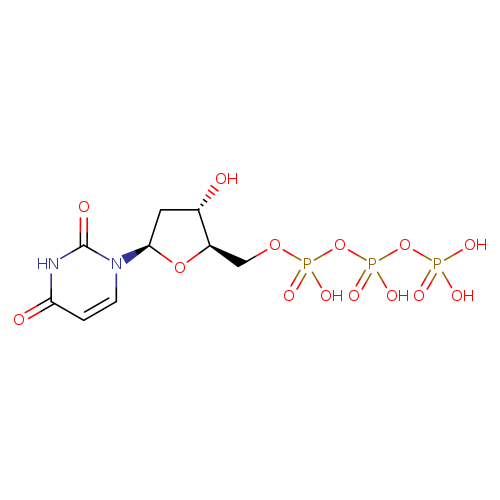
Common NameDeoxyuridine triphosphate
ClassSmall Molecule
DescriptionDeoxyuridine triphosphate is an intermediate in the metabolism of Pyrimidine. It is a substrate for Inosine triphosphate pyrophosphatase, Deoxyuridine 5'-triphosphate nucleotidohydrolase (mitochondrial), Uridine-cytidine kinase 1, Nucleoside diphosphate kinase 3, Nucleoside diphosphate kinase B, Nucleoside diphosphate kinase 6, Nucleoside diphosphate kinase (mitochondrial), Nucleoside diphosphate kinase homolog 5, Nucleoside diphosphate kinase A and Nucleoside diphosphate kinase 7.
Contaminant Sources
  • FooDB Chemicals
  • T3DB toxins
Contaminant Type
  • Amine
  • Animal Toxin
  • Ether
  • Food Toxin
  • Metabolite
  • Natural Compound
  • Organic Compound
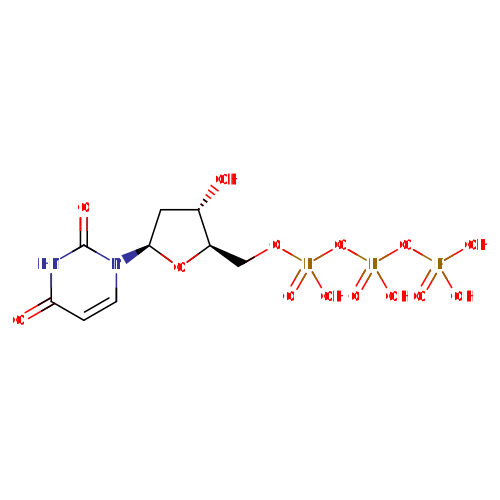
Chemical Structure
Thumb
Synonyms
ValueSource
2'-Deoxyuridine 5'-triphosphateChEBI
2'-Deoxyuridine 5'-triphosphoric acidGenerator
Deoxyuridine triphosphoric acidGenerator
2'-Deoxyuridine-5'-triphosphorateHMDB
2'-Deoxyuridine-5'-triphosphoric acidHMDB
2'-Deoxyuridine-5'-triphosphoric acid = dUTPHMDB
Deoxy-UTPHMDB
Deoxyuridine-5'-triphosphateHMDB
dUTPHMDB
2'-Deoxyuridine 5'-(tetrahydrogen triphosphate)HMDB
2'-deoxy-UTPHMDB
2’-Deoxyuridine 5’-(tetrahydrogen triphosphate)HMDB
2’-Deoxyuridine 5’-triphosphateHMDB
2’-deoxy-UTPHMDB
Deoxyuridine 5'-triphosphateHMDB
Deoxyuridine 5’-triphosphateHMDB
Deoxyuridine triphosphateHMDB
Chemical FormulaC9H15N2O14P3
Average Molecular Mass468.142 g/mol
Monoisotopic Mass467.974 g/mol
CAS Registry Number1173-82-6
IUPAC Name({[({[(2R,3S,5R)-5-(2,4-dioxo-1,2,3,4-tetrahydropyrimidin-1-yl)-3-hydroxyoxolan-2-yl]methoxy}(hydroxy)phosphoryl)oxy](hydroxy)phosphoryl}oxy)phosphonic acid
Traditional NamedUTP
SMILESO[C@H]1C[C@@H](O[C@@H]1COP(O)(=O)OP(O)(=O)OP(O)(O)=O)N1C=CC(=O)NC1=O
InChI IdentifierInChI=1S/C9H15N2O14P3/c12-5-3-8(11-2-1-7(13)10-9(11)14)23-6(5)4-22-27(18,19)25-28(20,21)24-26(15,16)17/h1-2,5-6,8,12H,3-4H2,(H,18,19)(H,20,21)(H,10,13,14)(H2,15,16,17)/t5-,6+,8+/m0/s1
InChI KeyAHCYMLUZIRLXAA-SHYZEUOFSA-N
Chemical Taxonomy
Description belongs to the class of organic compounds known as pyrimidine 2'-deoxyribonucleoside triphosphates. These are pyrimidine nucleotides with a triphosphate group linked to the ribose moiety lacking a hydroxyl group at position 2.
KingdomOrganic compounds
Super ClassNucleosides, nucleotides, and analogues
ClassPyrimidine nucleotides
Sub ClassPyrimidine deoxyribonucleotides
Direct ParentPyrimidine 2'-deoxyribonucleoside triphosphates
Alternative Parents
Substituents
  • Pyrimidine 2'-deoxyribonucleoside triphosphate
  • Pyrimidone
  • Monoalkyl phosphate
  • Hydroxypyrimidine
  • Hydropyrimidine
  • Organic phosphoric acid derivative
  • Phosphoric acid ester
  • Pyrimidine
  • Alkyl phosphate
  • Tetrahydrofuran
  • Heteroaromatic compound
  • Secondary alcohol
  • Organoheterocyclic compound
  • Azacycle
  • Oxacycle
  • Organopnictogen compound
  • Organonitrogen compound
  • Organic oxygen compound
  • Organic nitrogen compound
  • Alcohol
  • Organooxygen compound
  • Hydrocarbon derivative
  • Organic oxide
  • Aromatic heteromonocyclic compound
Molecular FrameworkAromatic heteromonocyclic compounds
External Descriptors
Biological Properties
StatusDetected and Not Quantified
OriginEndogenous
Cellular Locations
  • Membrane
  • Mitochondria
  • Nucleus
Biofluid LocationsNot Available
Tissue Locations
  • Epidermis
  • Muscle
  • Prostate
  • Spleen
Pathways
NameSMPDB LinkKEGG Link
Pyrimidine MetabolismSMP00046 map00240
MNGIE (Mitochondrial Neurogastrointestinal Encephalopathy)SMP00202 Not Available
ApplicationsNot Available
Biological RolesNot Available
Chemical RolesNot Available
Physical Properties
StateSolid
AppearanceWhite powder.
Experimental Properties
PropertyValue
Melting PointNot Available
Boiling PointNot Available
SolubilityNot Available
Predicted Properties
PropertyValueSource
Water Solubility8.63 g/LALOGPS
logP-0.12ALOGPS
logP-2.5ChemAxon
logS-1.7ALOGPS
pKa (Strongest Acidic)0.9ChemAxon
pKa (Strongest Basic)-3.2ChemAxon
Physiological Charge-3ChemAxon
Hydrogen Acceptor Count11ChemAxon
Hydrogen Donor Count6ChemAxon
Polar Surface Area238.69 ŲChemAxon
Rotatable Bond Count8ChemAxon
Refractivity83.67 m³·mol⁻¹ChemAxon
Polarizability34.62 ųChemAxon
Number of Rings2ChemAxon
Bioavailability0ChemAxon
Rule of FiveNoChemAxon
Ghose FilterNoChemAxon
Veber's RuleNoChemAxon
MDDR-like RuleNoChemAxon
Spectra
Spectra
Spectrum TypeDescriptionSplash KeyView
Predicted GC-MSPredicted GC-MS Spectrum - GC-MS (Non-derivatized) - 70eV, Positivesplash10-0a4j-8963100000-15f9b7594aa45581dcc0Spectrum
Predicted GC-MSPredicted GC-MS Spectrum - GC-MS (1 TMS) - 70eV, Positivesplash10-05be-9551020000-12e307f13199997c5947Spectrum
Predicted GC-MSPredicted GC-MS Spectrum - GC-MS (Non-derivatized) - 70eV, PositiveNot AvailableSpectrum
LC-MS/MSLC-MS/MS Spectrum - 10V, Negativesplash10-014i-0100900000-8e7a148aec1d751cc1c4Spectrum
LC-MS/MSLC-MS/MS Spectrum - 40V, Negativesplash10-0a6r-4911000000-4e7687aefa9b30fe654cSpectrum
LC-MS/MSLC-MS/MS Spectrum - 20V, Negativesplash10-0aor-0913400000-108f05d6274de41c6fbcSpectrum
LC-MS/MSLC-MS/MS Spectrum - 35V, Negativesplash10-0a4i-1922000000-1891134d52577ca759f0Spectrum
LC-MS/MSLC-MS/MS Spectrum - 35V, Positivesplash10-001i-9000000000-192f049c7d1787f75c4cSpectrum
LC-MS/MSLC-MS/MS Spectrum - 35V, Positivesplash10-001i-9000000000-57fd03e21769cf32cb69Spectrum
LC-MS/MSLC-MS/MS Spectrum - 35V, Negativesplash10-0a4i-1922000000-489aaa48942eed69703bSpectrum
LC-MS/MSLC-MS/MS Spectrum - 35V, Positivesplash10-001i-9000000000-f4b40a8824847f5ca8a7Spectrum
Predicted LC-MS/MSPredicted LC-MS/MS Spectrum - 10V, Positivesplash10-03di-0900000000-9dfd5f9811270d9aaab8Spectrum
Predicted LC-MS/MSPredicted LC-MS/MS Spectrum - 20V, Positivesplash10-03di-3911000000-b480c4f463f71544be8fSpectrum
Predicted LC-MS/MSPredicted LC-MS/MS Spectrum - 40V, Positivesplash10-03di-5900000000-2ba3b00121251c9adda0Spectrum
Predicted LC-MS/MSPredicted LC-MS/MS Spectrum - 10V, Negativesplash10-01b9-3120900000-dedbedae66448a647f3bSpectrum
Predicted LC-MS/MSPredicted LC-MS/MS Spectrum - 20V, Negativesplash10-057u-9430100000-0b81cc8084e6bd0f3088Spectrum
Predicted LC-MS/MSPredicted LC-MS/MS Spectrum - 40V, Negativesplash10-056r-9510000000-a72cd2e823cab077b0e1Spectrum
Predicted LC-MS/MSPredicted LC-MS/MS Spectrum - 10V, Negativesplash10-014i-0003900000-eff09a2f41b2c9e59343Spectrum
Predicted LC-MS/MSPredicted LC-MS/MS Spectrum - 20V, Negativesplash10-004i-9715400000-83fd98a60651b67d2aeaSpectrum
Predicted LC-MS/MSPredicted LC-MS/MS Spectrum - 40V, Negativesplash10-004i-9201000000-c6b0a4a5f0bb84bc1987Spectrum
Predicted LC-MS/MSPredicted LC-MS/MS Spectrum - 10V, Positivesplash10-03di-2900200000-ad484f076fd7c4b32fb9Spectrum
Predicted LC-MS/MSPredicted LC-MS/MS Spectrum - 20V, Positivesplash10-03di-9701100000-04958af5fb614287d4a0Spectrum
Predicted LC-MS/MSPredicted LC-MS/MS Spectrum - 40V, Positivesplash10-03di-0910000000-52122719a1b16858a2a0Spectrum
1D NMR1H NMR SpectrumNot AvailableSpectrum
1D NMR13C NMR SpectrumNot AvailableSpectrum
1D NMR1H NMR SpectrumNot AvailableSpectrum
1D NMR13C NMR SpectrumNot AvailableSpectrum
1D NMR1H NMR SpectrumNot AvailableSpectrum
1D NMR13C NMR SpectrumNot AvailableSpectrum
1D NMR1H NMR SpectrumNot AvailableSpectrum
1D NMR13C NMR SpectrumNot AvailableSpectrum
1D NMR1H NMR SpectrumNot AvailableSpectrum
1D NMR13C NMR SpectrumNot AvailableSpectrum
1D NMR1H NMR SpectrumNot AvailableSpectrum
1D NMR13C NMR SpectrumNot AvailableSpectrum
1D NMR1H NMR SpectrumNot AvailableSpectrum
1D NMR13C NMR SpectrumNot AvailableSpectrum
1D NMR1H NMR SpectrumNot AvailableSpectrum
1D NMR13C NMR SpectrumNot AvailableSpectrum
1D NMR1H NMR SpectrumNot AvailableSpectrum
1D NMR13C NMR SpectrumNot AvailableSpectrum
1D NMR1H NMR SpectrumNot AvailableSpectrum
1D NMR13C NMR SpectrumNot AvailableSpectrum
Toxicity Profile
Route of ExposureNot Available
Mechanism of ToxicityDeoxyuridine triphosphate (dUTP) can be misincorporated into DNA and cause DNA damage. The extent of DNA damage caused by dUTP is dependent on the levels of the pyrophosphatase dUTPase and uracil-DNA glycosylase (UDG). DNA damage due to dUTP misincorporation is highly dependent on the levels of the pyrophosphatase dUTPase, which limits intracellular accumulation of dUTP. (2) Also, loss of viability following thymidylate synthase (TS) inhibition occurs as a consequence of accumulation of dUTP in some cell lines and subsequent misincorporation of uracil into DNA. (PMCID: PMC2364072)
MetabolismMetabolism of organophosphates occurs principally by oxidation, by hydrolysis via esterases and by reaction with glutathione. Demethylation and glucuronidation may also occur. Oxidation of organophosphorus pesticides may result in moderately toxic products. In general, phosphorothioates are not directly toxic but require oxidative metabolism to the proximal toxin. The glutathione transferase reactions produce products that are, in most cases, of low toxicity. Paraoxonase (PON1) is a key enzyme in the metabolism of organophosphates. PON1 can inactivate some organophosphates through hydrolysis. PON1 hydrolyzes the active metabolites in several organophosphates insecticides as well as, nerve agents such as soman, sarin, and VX. The presence of PON1 polymorphisms causes there to be different enzyme levels and catalytic efficiency of this esterase, which in turn suggests that different individuals may be more susceptible to the toxic effect of organophosphate exposure.
Toxicity ValuesNot Available
Lethal DoseNot Available
Carcinogenicity (IARC Classification)No indication of carcinogenicity to humans (not listed by IARC).
Uses/SourcesThis is an endogenously produced metabolite found in the human body. It is used in metabolic reactions, catabolic reactions or waste generation.
Minimum Risk LevelNot Available
Health EffectsNot Available
SymptomsNot Available
TreatmentNot Available
Concentrations
Not Available
DrugBank IDDB02333
HMDB IDHMDB0001191
FooDB IDFDB030842
Phenol Explorer IDNot Available
KNApSAcK IDC00019636
BiGG ID35037
BioCyc IDDUTP
METLIN ID6069
PDB IDNot Available
Wikipedia LinkNot Available
Chemspider ID58580
ChEBI ID17625
PubChem Compound ID65070
Kegg Compound IDC00460
YMDB IDYMDB00201
ECMDB IDECMDB01191
References
Synthesis ReferenceNot Available
MSDSNot Available
General References
1. Ge YF, Huang YF, Zhang GY, Wang XH, Xu JP: Studies on apoptosis of spermatogenic cells in normal fertile men treated with supraphysiological doses of testosterone undecanoate. Asian J Androl. 1999 Sep;1(3):155-8.
2. Gilhar A, Ullmann Y, Karry R, Shalaginov R, Assy B, Serafimovich S, Kalish RS: Ageing of human epidermis: the role of apoptosis, Fas and telomerase. Br J Dermatol. 2004 Jan;150(1):56-63.
3. Igarashi T, Brown CR, Byrum RA, Nishimura Y, Endo Y, Plishka RJ, Buckler C, Buckler-White A, Miller G, Hirsch VM, Martin MA: Rapid and irreversible CD4+ T-cell depletion induced by the highly pathogenic simian/human immunodeficiency virus SHIV(DH12R) is systemic and synchronous. J Virol. 2002 Jan;76(1):379-91.
4. Russell J, O'Donoghue JA, Finn R, Koziorowski J, Ruan S, Humm JL, Ling CC: Iodination of annexin V for imaging apoptosis. J Nucl Med. 2002 May;43(5):671-7.
5. Oosterhuis GJ, Mulder AB, Kalsbeek-Batenburg E, Lambalk CB, Schoemaker J, Vermes I: Measuring apoptosis in human spermatozoa: a biological assay for semen quality? Fertil Steril. 2000 Aug;74(2):245-50.
6. Lee AY, Youm YH, Kim NH, Yang H, Choi WI: Keratinocytes in the depigmented epidermis of vitiligo are more vulnerable to trauma (suction) than keratinocytes in the normally pigmented epidermis, resulting in their apoptosis. Br J Dermatol. 2004 Nov;151(5):995-1003.
7. Lamperti C, Naini AB, Lucchini V, Prelle A, Bresolin N, Moggio M, Sciacco M, Kaufmann P, DiMauro S: Muscle coenzyme Q10 level in statin-related myopathy. Arch Neurol. 2005 Nov;62(11):1709-12.
8. Sreekumar A, Poisson LM, Rajendiran TM, Khan AP, Cao Q, Yu J, Laxman B, Mehra R, Lonigro RJ, Li Y, Nyati MK, Ahsan A, Kalyana-Sundaram S, Han B, Cao X, Byun J, Omenn GS, Ghosh D, Pennathur S, Alexander DC, Berger A, Shuster JR, Wei JT, Varambally S, Beecher C, Chinnaiyan AM: Metabolomic profiles delineate potential role for sarcosine in prostate cancer progression. Nature. 2009 Feb 12;457(7231):910-4. doi: 10.1038/nature07762.
9. Webley SD, Welsh SJ, Jackman AL, Aherne GW: The ability to accumulate deoxyuridine triphosphate and cellular response to thymidylate synthase (TS) inhibition. Br J Cancer. 2001 Aug 3;85(3):446-52. doi: 10.1054/bjoc.2001.1921.