Record Information
Version1.0
Creation Date2014-08-29 06:51:14 UTC
Update Date2026-04-14 15:20:32 UTC
Accession NumberCHEM003387
Identification
Common Name3-O-Sulfogalactosylceramide (d18:1/24:0)
ClassSmall Molecule
Description3-O-Sulfogalactosylceramide is an acidic, sulfated glycosphingolipid, often known as sulfatide. This lipid occurs in membranes of various cell types, but is found in particularly high concentrations in myelin where it constitutes 3-4% of total membrane lipids. This lipid is synthesized primarily in the oligodendrocytes in the central nervous system. Accumulation of this lipid in the lysosomes is a characteristic of metachromatic leukodystrophy, a lysosomal storage disease caused by the deficiency of arylsulfatase A. Alterations in sulfatide metabolism, trafficking, and homeostasis are present in the earliest clinically recognizable stages of Alzheimer's disease. Cerebrosides are glycosphingolipids. There are four types of glycosphingolipids, the cerebrosides, sulfatides, globosides and gangliosides. Cerebrosides have a single sugar group linked to ceramide. The most common are galactocerebrosides (containing galactose), the least common are glucocerebrosides (containing glucose). Galactocerebrosides are found predominantly in neuronal cell membranes. In contrast glucocerebrosides are not normally found in membranes. Instead, they are typically intermediates in the synthesis or degradation of more complex glycosphingolipids. Galactocerebrosides are synthesized from ceramide and UDP-galactose. Excess lysosomal accumulation of glucocerebrosides is found in Gaucher disease. Sulfatides are glycosphingolipids. There are four types of glycosphingolipids, the cerebrosides, sulfatides, globosides and gangliosides. Sulfatides are the sulfuric acid esters of galactocerebrosides. They are synthesized from galactocerebrosides and activated sulfate, 3'-phosphoadenosine 5'-phosphosulfate (PAPS).
Contaminant Sources
  • FooDB Chemicals
  • HMDB Contaminants - Urine
  • T3DB toxins
Contaminant Type
  • Animal Toxin
  • Ester
  • Food Toxin
  • Metabolite
  • Natural Compound
  • Organic Compound
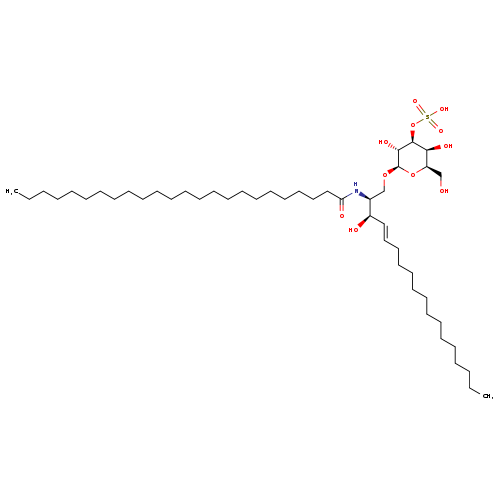
Chemical Structure
Thumb
Synonyms
ValueSource
3'-SulfogalactosylceramideChEBI
Tetracosanoyl sulfatideChEBI
3'-SulphogalactosylceramideGenerator
Tetracosanoyl sulphatideGenerator
3-O-Sulphogalactosylceramide (D18:1/24:0)Generator
3'-O-SulphogalactosylceramideHMDB
3-O-SulfO-beta-D-galactosylceramideHMDB
3-O-SulfO-beta-delta-galactosylceramideHMDB
3-O-SulfogalactosylceramideHMDB
3-O-SulphogalactosylceramideHMDB
Cerebroside 3-sulfateHMDB
Cerebroside 3-sulphateHMDB
Galactosylceramide-sulfateHMDB
Galactosylceramide-sulphateHMDB
GalactosylceramidesulfateHMDB
GalactosylceramidesulphateHMDB
N-[(1S,2R,3E)-2-Hydroxy-1-[[(3-O-sulfO-b-D-galactopyranosyl)oxy]methyl]-3-heptadecen-1-yl]-tetracosanamideHMDB
N-[(1S,2R,3E)-2-Hydroxy-1-[[(3-O-sulfO-b-D-galactopyranosyl)oxy]methyl]-3-heptadecenyl]-tetracosanamideHMDB
N-[(1S,2R,3E)-2-Hydroxy-1-[[(3-O-sulfO-beta-delta-galactopyranosyl)oxy]methyl]-3-heptadecen-1-yl]-tetracosanamideHMDB
N-[(1S,2R,3E)-2-Hydroxy-1-[[(3-O-sulfO-beta-delta-galactopyranosyl)oxy]methyl]-3-heptadecenyl]-tetracosanamideHMDB
SulfatideHMDB
Sulfatide (D18:1/24:0)HMDB
[R-[R*,s*-(e)]]-N-[2-hydroxy-1-[[(3-O-sulfO-b-D-galactopyranosyl)oxy]methyl]-3-heptadecenyl]-tetracosanamideHMDB
[R-[R*,s*-(e)]]-N-[2-hydroxy-1-[[(3-O-sulfO-beta-delta-galactopyranosyl)oxy]methyl]-3-heptadecenyl]-tetracosanamideHMDB
3'-SulfO-galactosylceramideMeSH, HMDB
3-Sulfated galactosylceramideMeSH, HMDB
I(3)so3-galcerMeSH, HMDB
I(3)so3-galactosylceramideMeSH, HMDB
Chemical FormulaC48H93NO11S
Average Molecular Mass892.317 g/mol
Monoisotopic Mass891.647 g/mol
CAS Registry Number151122-71-3
IUPAC Name[(2R,3R,4S,5S,6R)-3,5-dihydroxy-2-{[(2S,3R,4E)-3-hydroxy-2-tetracosanamidooctadec-4-en-1-yl]oxy}-6-(hydroxymethyl)oxan-4-yl]oxidanesulfonic acid
Traditional Name3'-sulfogalactosylceramide
SMILESCCCCCCCCCCCCCCCCCCCCCCCC(=O)N[C@@H](CO[C@@H]1O[C@H](CO)[C@H](O)[C@H](OS(O)(=O)=O)[C@H]1O)[C@H](O)\C=C\CCCCCCCCCCCCC
InChI IdentifierInChI=1S/C48H93NO11S/c1-3-5-7-9-11-13-15-17-18-19-20-21-22-23-24-26-28-30-32-34-36-38-44(52)49-41(42(51)37-35-33-31-29-27-25-16-14-12-10-8-6-4-2)40-58-48-46(54)47(60-61(55,56)57)45(53)43(39-50)59-48/h35,37,41-43,45-48,50-51,53-54H,3-34,36,38-40H2,1-2H3,(H,49,52)(H,55,56,57)/b37-35+/t41-,42+,43+,45-,46+,47-,48+/m0/s1
InChI KeyMEAZTWJVOWHKJM-CIAPRIGGSA-N
Chemical Taxonomy
Description belongs to the class of organic compounds known as glycosphingolipids. These are sphingolipids containing a saccharide moiety glycosidically attached to the sphingoid base. Although saccharide moieties are mostly O-glycosidically linked to the ceramide moiety, other sphingolipids with glycosidic bonds of other types (e.g. S-,C-, or N-type) has been reported.

KingdomOrganic compounds
Super ClassLipids and lipid-like molecules
ClassSphingolipids
Sub ClassGlycosphingolipids
Direct ParentGlycosphingolipids
Alternative Parents
Substituents
  • Glycosphingolipid
  • Fatty acyl glycoside
  • Fatty acyl glycoside of mono- or disaccharide
  • Alkyl glycoside
  • Hexose monosaccharide
  • Glycosyl compound
  • O-glycosyl compound
  • Monosaccharide
  • Fatty acyl
  • Oxane
  • Sulfuric acid ester
  • Alkyl sulfate
  • Sulfate-ester
  • Sulfuric acid monoester
  • Organic sulfuric acid or derivatives
  • Secondary alcohol
  • Acetal
  • Carboximidic acid
  • Carboximidic acid derivative
  • Oxacycle
  • Organoheterocyclic compound
  • Organic 1,3-dipolar compound
  • Propargyl-type 1,3-dipolar organic compound
  • Hydrocarbon derivative
  • Organic oxide
  • Organopnictogen compound
  • Organic nitrogen compound
  • Alcohol
  • Organonitrogen compound
  • Organooxygen compound
  • Organic oxygen compound
  • Primary alcohol
  • Aliphatic heteromonocyclic compound
Molecular FrameworkAliphatic heteromonocyclic compounds
External Descriptors
Biological Properties
StatusDetected and Not Quantified
OriginEndogenous
Cellular Locations
  • Extracellular
  • Lysosome
  • Membrane
Biofluid LocationsNot Available
Tissue Locations
  • Brain
  • Kidney
  • Myelin
Pathways
NameSMPDB LinkKEGG Link
Sphingolipid MetabolismSMP00034 map00600
Metachromatic Leukodystrophy (MLD)SMP00347 Not Available
ApplicationsNot Available
Biological RolesNot Available
Chemical RolesNot Available
Physical Properties
StateSolid
AppearanceWhite powder.
Experimental Properties
PropertyValue
Melting PointNot Available
Boiling PointNot Available
SolubilityNot Available
Predicted Properties
PropertyValueSource
Water Solubility0.00021 g/LALOGPS
logP6.01ALOGPS
logP10.65ChemAxon
logS-6.6ALOGPS
pKa (Strongest Acidic)-1.9ChemAxon
pKa (Strongest Basic)0.025ChemAxon
Physiological Charge-1ChemAxon
Hydrogen Acceptor Count10ChemAxon
Hydrogen Donor Count6ChemAxon
Polar Surface Area192.08 ŲChemAxon
Rotatable Bond Count43ChemAxon
Refractivity244.99 m³·mol⁻¹ChemAxon
Polarizability111.22 ųChemAxon
Number of Rings1ChemAxon
Bioavailability0ChemAxon
Rule of FiveNoChemAxon
Ghose FilterNoChemAxon
Veber's RuleNoChemAxon
MDDR-like RuleNoChemAxon
Spectra
Spectra
Spectrum TypeDescriptionSplash KeyView
Predicted LC-MS/MSPredicted LC-MS/MS Spectrum - 10V, Positivesplash10-00dl-0012023090-f8f118acf3a33b52c3d6Spectrum
Predicted LC-MS/MSPredicted LC-MS/MS Spectrum - 20V, Positivesplash10-0ff0-0033039230-d031a5cf13aa63c1c149Spectrum
Predicted LC-MS/MSPredicted LC-MS/MS Spectrum - 40V, Positivesplash10-00di-5179030110-18ba4d34adc0cc5cd9d2Spectrum
Predicted LC-MS/MSPredicted LC-MS/MS Spectrum - 10V, Negativesplash10-0006-0030004090-903f9e4c1c5f1886854dSpectrum
Predicted LC-MS/MSPredicted LC-MS/MS Spectrum - 20V, Negativesplash10-0006-5043019240-785d6ab50b2cfba8b2daSpectrum
Predicted LC-MS/MSPredicted LC-MS/MS Spectrum - 40V, Negativesplash10-000x-9453000000-700119d3506225365810Spectrum
1D NMR13C NMR SpectrumNot AvailableSpectrum
1D NMR1H NMR SpectrumNot AvailableSpectrum
1D NMR13C NMR SpectrumNot AvailableSpectrum
1D NMR1H NMR SpectrumNot AvailableSpectrum
1D NMR13C NMR SpectrumNot AvailableSpectrum
1D NMR1H NMR SpectrumNot AvailableSpectrum
1D NMR13C NMR SpectrumNot AvailableSpectrum
1D NMR1H NMR SpectrumNot AvailableSpectrum
1D NMR13C NMR SpectrumNot AvailableSpectrum
1D NMR1H NMR SpectrumNot AvailableSpectrum
1D NMR13C NMR SpectrumNot AvailableSpectrum
1D NMR1H NMR SpectrumNot AvailableSpectrum
1D NMR13C NMR SpectrumNot AvailableSpectrum
1D NMR1H NMR SpectrumNot AvailableSpectrum
1D NMR13C NMR SpectrumNot AvailableSpectrum
1D NMR1H NMR SpectrumNot AvailableSpectrum
1D NMR13C NMR SpectrumNot AvailableSpectrum
1D NMR1H NMR SpectrumNot AvailableSpectrum
1D NMR13C NMR SpectrumNot AvailableSpectrum
1D NMR1H NMR SpectrumNot AvailableSpectrum
Toxicity Profile
Route of ExposureNot Available
Mechanism of ToxicityNot Available
MetabolismNot Available
Toxicity ValuesNot Available
Lethal DoseNot Available
Carcinogenicity (IARC Classification)No indication of carcinogenicity to humans (not listed by IARC).
Uses/SourcesThis is an endogenously produced metabolite found in the human body. It is used in metabolic reactions, catabolic reactions or waste generation.
Minimum Risk LevelNot Available
Health EffectsNot Available
SymptomsNot Available
TreatmentNot Available
Concentrations
Not Available
DrugBank IDNot Available
HMDB IDNot Available
FooDB IDFDB021878
Phenol Explorer IDNot Available
KNApSAcK IDNot Available
BiGG IDNot Available
BioCyc IDNot Available
METLIN IDNot Available
PDB IDNot Available
Wikipedia LinkNot Available
Chemspider IDNot Available
ChEBI ID60361
PubChem Compound ID6451121
Kegg Compound IDNot Available
YMDB IDNot Available
ECMDB IDECMDB24014
References
Synthesis ReferenceNot Available
MSDSNot Available
General References
1. https://www.ncbi.nlm.nih.gov/pubmed/?term=16314439
2. https://www.ncbi.nlm.nih.gov/pubmed/?term=27485170