Record Information
Version1.0
Creation Date2014-08-29 06:51:09 UTC
Update Date2026-04-14 15:13:02 UTC
Accession NumberCHEM003377
Identification
Common NameAlpha-Lactose
ClassSmall Molecule
Descriptionalpha-Lactose is the major sugar present in milk and the main source of energy supplied to the newborn mammalian in its mother's milk. Lactose is also an important osmotic regulator of lactation. It is digested by the intestinal lactase (EC 3.2.1.108), an enzyme expressed in newborns. Its activity declines following weaning. As a result, adult mammals are normally lactose-intolerant and more than 75% of the human adult population suffers from lactase deficiency. Lactase deficiency is present in up to 80 percent of blacks and Latinos, and up to 100 percent of American Indians and Asians. Persons with lactose intolerance are unable to digest significant amounts of lactose. Common symptoms include abdominal pain and bloating, excessive flatus, and watery stool following the ingestion of foods containing lactose. A sizable number of adults believe they are lactose intolerant but do not actually have impaired lactose digestion, and some persons with lactase deficiency can tolerate moderate amounts of ingested lactose. A diagnosis of lactose intolerance can usually be made with a careful history supported by dietary manipulation. If necessary, diagnosis can be confirmed by using a breath hydrogen or lactose tolerance test. These mostly uncomfortable symptoms of lactose maldigestion are blamed for a variably dairy consumption. There is, however, emerging evidence that certain lactic acid-producing bacteria, which selectively consume prebiotics, may be beneficial against some lower intestinal diseases. Lactose maldigestion and lactose should perhaps be re-evaluated as a potential provider of such a prebiotic. Treatment consists primarily of avoiding lactose-containing foods. Lactase enzyme supplements may be helpful. The degree of lactose malabsorption varies greatly among patients with lactose intolerance, but most of them can ingest up to 350 mL of milk daily without symptoms. Lactose-intolerant patients must ensure adequate calcium intake. (1, 2, 3, 4).
Contaminant Sources
  • EAFUS Chemicals
  • FooDB Chemicals
  • HMDB Contaminants - Feces
  • HMDB Contaminants - Urine
  • HPV EPA Chemicals
  • STOFF IDENT Compounds
  • T3DB toxins
  • ToxCast & Tox21 Chemicals
Contaminant Type
  • Animal Toxin
  • Food Toxin
  • Household Toxin
  • Mammal Toxin
  • Metabolite
  • Natural Compound
  • Organic Compound
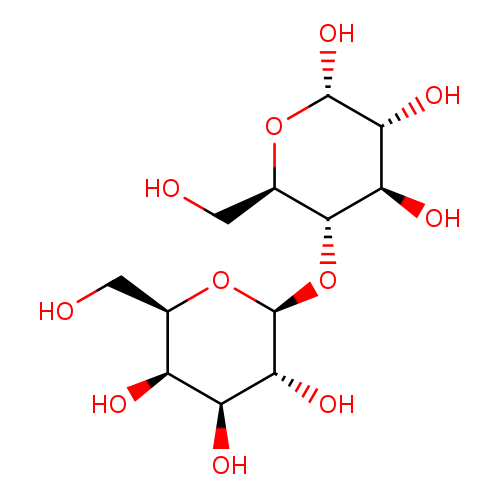
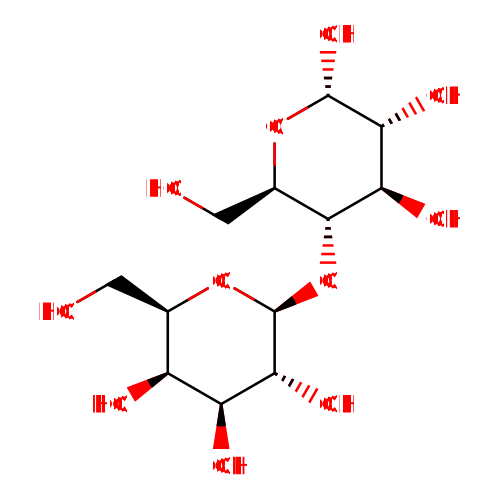
Chemical Structure
Thumb
Synonyms
ValueSource
1-beta-D-Galactopyranosyl-4-alpha-D-glucopyranoseChEBI
4-O-beta-D-Galactopyranosyl-alpha-D-glucopyranoseChEBI
Anhydrous lactoseChEBI
beta-D-Galp-(1->4)-alpha-D-GLCPChEBI
LactoseChEBI
Milk sugarChEBI
1-b-D-Galactopyranosyl-4-a-D-glucopyranoseGenerator
1-Β-D-galactopyranosyl-4-α-D-glucopyranoseGenerator
4-O-b-D-Galactopyranosyl-a-D-glucopyranoseGenerator
4-O-Β-D-galactopyranosyl-α-D-glucopyranoseGenerator
b-D-Galp-(1->4)-a-D-GLCPGenerator
Β-D-galp-(1->4)-α-D-GLCPGenerator
a-LactoseGenerator
Α-lactoseGenerator
(+)-LactoseHMDB
1-beta-delta-Galactopyranosyl-4-alpha-delta-glucopyranoseHMDB
4-O-HexopyranosylhexoseHMDB
AletobioseHMDB
DilactoseHMDB
Fast-flo lactoseHMDB
Flowlac 100HMDB
GalactinumHMDB
GLC-(4-1)GalHMDB
Granulac 140mHMDB
LactinHMDB
Lactin (carbohydrate)HMDB
LactobioseHMDB
Lactohale 300HMDB
Lactose anhydrideHMDB
Lactose fast-floHMDB
OsmolactanHMDB
Pharmatosa DCL 21HMDB
Pharmatose 21HMDB
Pharmatose 325mHMDB
Pharmatose DCL 15HMDB
PrismalacHMDB
Respitose ML 003HMDB
Respitose SV 003HMDB
Saccharum lactinHMDB
SachelacHMDB
Sorbalac 400HMDB
Sorbolac 400HMDB
SpherolacHMDB
Super-tabHMDB
TablettoseHMDB
Tablettose 70HMDB
Tablettose 80HMDB
Zeparox epHMDB
Lactose, anhydrousHMDB
Chemical FormulaC12H22O11
Average Molecular Mass342.297 g/mol
Monoisotopic Mass342.116 g/mol
CAS Registry Number63-42-3
IUPAC Name(2R,3R,4S,5R,6S)-2-(hydroxymethyl)-6-{[(2R,3S,4R,5R,6S)-4,5,6-trihydroxy-2-(hydroxymethyl)oxan-3-yl]oxy}oxane-3,4,5-triol
Traditional Nameα-lactose
SMILESOC[C@H]1O[C@@H](O[C@H]2[C@H](O)[C@@H](O)[C@@H](O)O[C@@H]2CO)[C@H](O)[C@@H](O)[C@H]1O
InChI IdentifierInChI=1S/C12H22O11/c13-1-3-5(15)6(16)9(19)12(22-3)23-10-4(2-14)21-11(20)8(18)7(10)17/h3-20H,1-2H2/t3-,4-,5+,6+,7-,8-,9-,10-,11+,12+/m1/s1
InChI KeyGUBGYTABKSRVRQ-XLOQQCSPSA-N
Chemical Taxonomy
Description belongs to the class of organic compounds known as o-glycosyl compounds. These are glycoside in which a sugar group is bonded through one carbon to another group via a O-glycosidic bond.
KingdomOrganic compounds
Super ClassOrganic oxygen compounds
ClassOrganooxygen compounds
Sub ClassCarbohydrates and carbohydrate conjugates
Direct ParentO-glycosyl compounds
Alternative Parents
Substituents
  • O-glycosyl compound
  • Disaccharide
  • Oxane
  • Secondary alcohol
  • Hemiacetal
  • Oxacycle
  • Organoheterocyclic compound
  • Polyol
  • Acetal
  • Hydrocarbon derivative
  • Primary alcohol
  • Alcohol
  • Aliphatic heteromonocyclic compound
Molecular FrameworkAliphatic heteromonocyclic compounds
External Descriptors
Biological Properties
StatusDetected and Not Quantified
OriginEndogenous
Cellular Locations
  • Cytoplasm
  • Extracellular
  • Golgi apparatus
  • Lysosome
  • Membrane
Biofluid LocationsNot Available
Tissue Locations
  • Bladder
  • Gut
  • Intestine
  • Muscle
  • Platelet
  • Skin
  • Spleen
Pathways
NameSMPDB LinkKEGG Link
Galactose MetabolismSMP00043 map00052
Lactose DegradationSMP00457 Not Available
Lactose SynthesisSMP00444 Not Available
Lactose IntoleranceSMP00458 Not Available
ApplicationsNot Available
Biological Roles
Chemical RolesNot Available
Physical Properties
StateSolid
AppearanceWhite powder.
Experimental Properties
PropertyValue
Melting Point201 - 202°C
Boiling PointNot Available
Solubility195 mg/mL at 20°C
Predicted Properties
PropertyValueSource
Water Solubility586 g/LALOGPS
logP-3ALOGPS
logP-4.7ChemAxon
logS0.23ALOGPS
pKa (Strongest Acidic)11.25ChemAxon
pKa (Strongest Basic)-3ChemAxon
Physiological Charge0ChemAxon
Hydrogen Acceptor Count11ChemAxon
Hydrogen Donor Count8ChemAxon
Polar Surface Area189.53 ŲChemAxon
Rotatable Bond Count4ChemAxon
Refractivity68.34 m³·mol⁻¹ChemAxon
Polarizability30.92 ųChemAxon
Number of Rings2ChemAxon
Bioavailability0ChemAxon
Rule of FiveNoChemAxon
Ghose FilterNoChemAxon
Veber's RuleNoChemAxon
MDDR-like RuleNoChemAxon
Spectra
Spectra
Spectrum TypeDescriptionSplash KeyView
GC-MSGC-MS Spectrum - GC-EI-TOF (Pegasus III TOF-MS system, Leco; GC 6890, Agilent Technologies) (8 TMS)splash10-0uxs-0972000000-af8ca1bf1faa3d01a08dSpectrum
GC-MSGC-MS Spectrum - GC-EI-TOF (Pegasus III TOF-MS system, Leco; GC 6890, Agilent Technologies) (8 TMS; 1 MEOX)splash10-00di-9741000000-a61bf0223a1683f0402eSpectrum
GC-MSGC-MS Spectrum - GC-EI-TOF (Pegasus III TOF-MS system, Leco; GC 6890, Agilent Technologies) (8 TMS; 1 MEOX)splash10-00di-9641000000-12611bfab50cb066e8afSpectrum
Predicted GC-MSPredicted GC-MS Spectrum - GC-MS (Non-derivatized) - 70eV, Positivesplash10-03e9-4897000000-332d470623cd7f1e1cedSpectrum
Predicted GC-MSPredicted GC-MS Spectrum - GC-MS (4 TMS) - 70eV, Positivesplash10-014i-3513539000-d702fa4adb45f44530b6Spectrum
Predicted GC-MSPredicted GC-MS Spectrum - GC-MS (TBDMS_3_3) - 70eV, PositiveNot AvailableSpectrum
Predicted GC-MSPredicted GC-MS Spectrum - GC-MS (TBDMS_3_16) - 70eV, PositiveNot AvailableSpectrum
Predicted GC-MSPredicted GC-MS Spectrum - GC-MS (TBDMS_4_2) - 70eV, PositiveNot AvailableSpectrum
Predicted GC-MSPredicted GC-MS Spectrum - GC-MS (TBDMS_4_10) - 70eV, PositiveNot AvailableSpectrum
Predicted GC-MSPredicted GC-MS Spectrum - GC-MS (TBDMS_4_11) - 70eV, PositiveNot AvailableSpectrum
Predicted GC-MSPredicted GC-MS Spectrum - GC-MS (TBDMS_4_12) - 70eV, PositiveNot AvailableSpectrum
Predicted GC-MSPredicted GC-MS Spectrum - GC-MS (TBDMS_4_20) - 70eV, PositiveNot AvailableSpectrum
Predicted GC-MSPredicted GC-MS Spectrum - GC-MS (TBDMS_4_32) - 70eV, PositiveNot AvailableSpectrum
Predicted GC-MSPredicted GC-MS Spectrum - GC-MS (TBDMS_4_33) - 70eV, PositiveNot AvailableSpectrum
Predicted GC-MSPredicted GC-MS Spectrum - GC-MS (Non-derivatized) - 70eV, PositiveNot AvailableSpectrum
Predicted GC-MSPredicted GC-MS Spectrum - GC-MS ("Alpha-Lactose,3TBDMS,#3" TMS) - 70eV, PositiveNot AvailableSpectrum
Predicted GC-MSPredicted GC-MS Spectrum - GC-MS (TMS_1_1) - 70eV, PositiveNot AvailableSpectrum
Predicted GC-MSPredicted GC-MS Spectrum - GC-MS (TMS_1_2) - 70eV, PositiveNot AvailableSpectrum
Predicted GC-MSPredicted GC-MS Spectrum - GC-MS (TMS_1_3) - 70eV, PositiveNot AvailableSpectrum
Predicted GC-MSPredicted GC-MS Spectrum - GC-MS (TMS_1_4) - 70eV, PositiveNot AvailableSpectrum
Predicted GC-MSPredicted GC-MS Spectrum - GC-MS (TMS_1_5) - 70eV, PositiveNot AvailableSpectrum
Predicted GC-MSPredicted GC-MS Spectrum - GC-MS (TMS_1_6) - 70eV, PositiveNot AvailableSpectrum
Predicted GC-MSPredicted GC-MS Spectrum - GC-MS (TMS_1_7) - 70eV, PositiveNot AvailableSpectrum
Predicted GC-MSPredicted GC-MS Spectrum - GC-MS (TMS_1_8) - 70eV, PositiveNot AvailableSpectrum
Predicted GC-MSPredicted GC-MS Spectrum - GC-MS (TMS_2_1) - 70eV, PositiveNot AvailableSpectrum
LC-MS/MSLC-MS/MS Spectrum - Quattro_QQQ 10V, Positive (Annotated)splash10-03di-0901000000-bcb7aaa42261d980d488Spectrum
LC-MS/MSLC-MS/MS Spectrum - Quattro_QQQ 25V, Positive (Annotated)splash10-000f-9300000000-1bc18b05388cd2213573Spectrum
LC-MS/MSLC-MS/MS Spectrum - Quattro_QQQ 40V, Positive (Annotated)splash10-01p9-9000000000-4483af567feecb34a651Spectrum
Predicted LC-MS/MSPredicted LC-MS/MS Spectrum - 10V, Positivesplash10-03gl-0907000000-a1de7813fbe8b5258c10Spectrum
Predicted LC-MS/MSPredicted LC-MS/MS Spectrum - 20V, Positivesplash10-03e9-0900000000-79cc5059a3f338e8c1ddSpectrum
Predicted LC-MS/MSPredicted LC-MS/MS Spectrum - 40V, Positivesplash10-03di-3900000000-851d0bc84d91b6e09579Spectrum
Predicted LC-MS/MSPredicted LC-MS/MS Spectrum - 10V, Negativesplash10-002f-0749000000-af1d18f2bc3ab8e02883Spectrum
Predicted LC-MS/MSPredicted LC-MS/MS Spectrum - 20V, Negativesplash10-0200-2902000000-67218697344afb9e70faSpectrum
Predicted LC-MS/MSPredicted LC-MS/MS Spectrum - 40V, Negativesplash10-01td-4900000000-40aa2d8125769803cfbbSpectrum
Predicted LC-MS/MSPredicted LC-MS/MS Spectrum - 10V, Negativesplash10-000x-1069000000-9cd867711bca0eecf935Spectrum
Predicted LC-MS/MSPredicted LC-MS/MS Spectrum - 20V, Negativesplash10-0006-9365000000-65403961bfb5e35eaa0dSpectrum
Predicted LC-MS/MSPredicted LC-MS/MS Spectrum - 40V, Negativesplash10-000l-9200000000-0de9785c1c5df1430dd2Spectrum
Predicted LC-MS/MSPredicted LC-MS/MS Spectrum - 10V, Positivesplash10-0006-0109000000-9d0f9a68a67bafd734abSpectrum
Predicted LC-MS/MSPredicted LC-MS/MS Spectrum - 20V, Positivesplash10-01rw-3898000000-7f495a1bcfdbed6466c4Spectrum
Predicted LC-MS/MSPredicted LC-MS/MS Spectrum - 40V, Positivesplash10-01ti-9210000000-b8a83657f0266d372beeSpectrum
1D NMR1H NMR SpectrumNot AvailableSpectrum
1D NMR13C NMR SpectrumNot AvailableSpectrum
1D NMR1H NMR SpectrumNot AvailableSpectrum
1D NMR13C NMR SpectrumNot AvailableSpectrum
1D NMR1H NMR SpectrumNot AvailableSpectrum
1D NMR13C NMR SpectrumNot AvailableSpectrum
1D NMR1H NMR SpectrumNot AvailableSpectrum
1D NMR13C NMR SpectrumNot AvailableSpectrum
1D NMR1H NMR SpectrumNot AvailableSpectrum
1D NMR13C NMR SpectrumNot AvailableSpectrum
1D NMR1H NMR SpectrumNot AvailableSpectrum
1D NMR13C NMR SpectrumNot AvailableSpectrum
1D NMR1H NMR SpectrumNot AvailableSpectrum
1D NMR13C NMR SpectrumNot AvailableSpectrum
1D NMR1H NMR SpectrumNot AvailableSpectrum
1D NMR13C NMR SpectrumNot AvailableSpectrum
1D NMR1H NMR SpectrumNot AvailableSpectrum
1D NMR13C NMR SpectrumNot AvailableSpectrum
1D NMR1H NMR SpectrumNot AvailableSpectrum
1D NMR13C NMR SpectrumNot AvailableSpectrum
1D NMR1H NMR SpectrumNot AvailableSpectrum
1D NMR13C NMR SpectrumNot AvailableSpectrum
2D NMR[1H,1H] 2D NMR SpectrumNot AvailableSpectrum
2D NMR[1H,13C] 2D NMR SpectrumNot AvailableSpectrum
Toxicity Profile
Route of ExposureNot Available
Mechanism of ToxicityNot Available
MetabolismNot Available
Toxicity ValuesNot Available
Lethal DoseNot Available
Carcinogenicity (IARC Classification)No indication of carcinogenicity to humans (not listed by IARC).
Uses/SourcesThis is an endogenously produced metabolite found in the human body. It is used in metabolic reactions, catabolic reactions or waste generation.
Minimum Risk LevelNot Available
Health EffectsNot Available
SymptomsNot Available
TreatmentNot Available
Concentrations
Not Available
DrugBank IDNot Available
HMDB IDHMDB0000186
FooDB IDFDB021789
Phenol Explorer IDNot Available
KNApSAcK IDC00001136
BiGG ID34366
BioCyc IDLACTOSE
METLIN ID267
PDB IDNot Available
Wikipedia LinkNot Available
Chemspider ID76293
ChEBI ID36219
PubChem Compound ID84571
Kegg Compound IDC00243
YMDB IDNot Available
ECMDB IDECMDB00186
References
Synthesis Reference

James P. Danehy, “Synthesis of ascorbic acid from lactose.” U.S. Patent US4259443, issued December, 1956.

MSDSLink
General References
1. Ruffing, Anne; Mao, Zichao; Ruizhen Chen, Rachel. Metabolic engineering of Agrobacterium sp. for UDP-galactose regeneration and oligosaccharide synthesis. Metabolic Engineering (2006), 8(5), 465-473.
2. Klein MS, Almstetter MF, Schlamberger G, Nurnberger N, Dettmer K, Oefner PJ, Meyer HH, Wiedemann S, Gronwald W: Nuclear magnetic resonance and mass spectrometry-based milk metabolomics in dairy cows during early and late lactation. J Dairy Sci. 2010 Apr;93(4):1539-50. doi: 10.3168/jds.2009-2563.
3. Klein MS, Buttchereit N, Miemczyk SP, Immervoll AK, Louis C, Wiedemann S, Junge W, Thaller G, Oefner PJ, Gronwald W: NMR metabolomic analysis of dairy cows reveals milk glycerophosphocholine to phosphocholine ratio as prognostic biomarker for risk of ketosis. J Proteome Res. 2012 Feb 3;11(2):1373-81. doi: 10.1021/pr201017n. Epub 2011 Dec 9.
4. Jensen HB, Poulsen NA, Andersen KK, Hammershoj M, Poulsen HD, Larsen LB: Distinct composition of bovine milk from Jersey and Holstein-Friesian cows with good, poor, or noncoagulation properties as reflected in protein genetic variants and isoforms. J Dairy Sci. 2012 Dec;95(12):6905-17. doi: 10.3168/jds.2012-5675. Epub 2012 Oct 3.
5. Auldist MJ, Walsh BJ, Thomson NA: Seasonal and lactational influences on bovine milk composition in New Zealand. J Dairy Res. 1998 Aug;65(3):401-11.
6. Sundekilde UK, Poulsen NA, Larsen LB, Bertram HC: Nuclear magnetic resonance metabonomics reveals strong association between milk metabolites and somatic cell count in bovine milk. J Dairy Sci. 2013 Jan;96(1):290-9. doi: 10.3168/jds.2012-5819. Epub 2012 Nov 22.
7. Sundekilde UK, Gustavsson F, Poulsen NA, Glantz M, Paulsson M, Larsen LB, Bertram HC: Association between the bovine milk metabolome and rennet-induced coagulation properties of milk. J Dairy Sci. 2014 Oct;97(10):6076-84. doi: 10.3168/jds.2014-8304. Epub 2014 Jul 30.
8. Gopal PK, Gill HS: Oligosaccharides and glycoconjugates in bovine milk and colostrum. Br J Nutr. 2000 Nov;84 Suppl 1:S69-74.
9. O'Callaghan TF, Vazquez-Fresno R, Serra-Cayuela A, Dong E, Mandal R, Hennessy D, McAuliffe S, Dillon P, Wishart DS, Stanton C, Ross RP: Pasture Feeding Changes the Bovine Rumen and Milk Metabolome. Metabolites. 2018 Apr 6;8(2). pii: metabo8020027. doi: 10.3390/metabo8020027.
10. Carbohydrate Polymers 37 (1998) 225-229
11. International Dairy Journal 16 (2006) 1334-1340
12. A. Foroutan et al. The Chemical Composition of Commercial Cow's Milk (in preparation)
13. Fooddata+, The Technical University of Denmark (DTU): https://frida.fooddata.dk/QueryFood.php?fn=milk&lang=en
14. Ruffing, Anne; Mao, Zichao; Ruizhen Chen, Rachel. Metabolic engineering of Agrobacterium sp. for UDP-galactose regeneration and oligosaccharide synthesis. Metabolic Engineering (2006), 8(5), 465-473.
15. Jung SK, Fujimoto D: A novel beta-galactoside-binding lectin in adult rat kidney. J Biochem. 1994 Sep;116(3):547-53.
16. Oozeer R, Furet JP, Goupil-Feuillerat N, Anba J, Mengaud J, Corthier G: Differential activities of four Lactobacillus casei promoters during bacterial transit through the gastrointestinal tracts of human-microbiota-associated mice. Appl Environ Microbiol. 2005 Mar;71(3):1356-63.
17. Dimopoulos MA, Anagnostopoulos A: Thalidomide in relapsed/refractory multiple myeloma: pivotal trials conducted outside the United States. Semin Hematol. 2003 Oct;40(4 Suppl 4):8-16.
18. Muthusamy A, Erickson DR, Sheykhnazari M, Bhavanandan VP: Enhanced binding of modified pentosan polysulfate and heparin to bladder--a strategy for improved treatment of interstitial cystitis. Urology. 2006 Jan;67(1):209-13.
19. Johnson JD, Simoons FJ, Hurwitz R, Grange A, Mitchell CH, Sinatra FR, Sunshine P, Robertson WV, Bennett PH, Kretchmer N: Lactose malabsorption among the Pima indians of Arizona. Gastroenterology. 1977 Dec;73(6):1299-304.
20. Lustenberger RW: [A 23-year old patient with chronic diarrhea. Celiac disease and lactose intolerance]. Praxis (Bern 1994). 2005 Feb 2;94(5):163-4.
21. Sharma A, DiCioccio RA, Allen HJ: Identification and synthesis of a novel 15 kDa beta-galactoside-binding lectin in human leukocytes. Glycobiology. 1992 Aug;2(4):285-92.
22. Rana SV, Bhasin DK, Vinayak VK: Lactose hydrogen breath test in Giardia lamblia-positive patients. Dig Dis Sci. 2005 Feb;50(2):259-61.
23. Mitchell JD, Brand J, Halbisch J: Weight-gain inhibition by lactose in Australian Aboriginal children. A controlled trial of normal and lactose hydrolysed milk. Lancet. 1977 Mar 5;1(8010):500-2.
24. Soupene E, van Heeswijk WC, Plumbridge J, Stewart V, Bertenthal D, Lee H, Prasad G, Paliy O, Charernnoppakul P, Kustu S: Physiological studies of Escherichia coli strain MG1655: growth defects and apparent cross-regulation of gene expression. J Bacteriol. 2003 Sep;185(18):5611-26.
25. Yeoh E, Horowitz M, Russo A, Muecke T, Robb T, Chatterton B: The effects of abdominal irradiation for seminoma of the testis on gastrointestinal function. J Gastroenterol Hepatol. 1995 Mar-Apr;10(2):125-30.
26. Bondesson E, Bengtsson T, Borgstrom L, Nilsson LE, Norrgren K, Olsson B, Svensson M, Wollmer P: Dose delivery late in the breath can increase dry powder aerosol penetration into the lungs. J Aerosol Med. 2005 Spring;18(1):23-33.
27. Roberson CM: Lactose intolerance. Ala Nurse. 2004 Dec-2005 Feb;31(4):23-4; quiz 24.
28. Kim KI, Lee WS, Benevenga NJ: Feeding diets containing high levels of milk products or cellulose decrease urease activity and ammonia production in rat intestine. J Nutr. 1998 Jul;128(7):1186-91.
29. Gunther S, Patterson RE, Kristal AR, Stratton KL, White E: Demographic and health-related correlates of herbal and specialty supplement use. J Am Diet Assoc. 2004 Jan;104(1):27-34.
30. Delaveau P: [Milk lactose. Hypothesis on its biological importance]. Ann Pharm Fr. 2003;61(5):340-2.
31. Vilotte JL: Lowering the milk lactose content in vivo: potential interests, strategies and physiological consequences. Reprod Nutr Dev. 2002 Mar-Apr;42(2):127-32.
32. Szilagyi A: Review article: lactose--a potential prebiotic. Aliment Pharmacol Ther. 2002 Sep;16(9):1591-602.
33. Swagerty DL Jr, Walling AD, Klein RM: Lactose intolerance. Am Fam Physician. 2002 May 1;65(9):1845-50.
34. https://www.ncbi.nlm.nih.gov/pubmed/?term=2432147