Record Information
Version1.0
Creation Date2014-08-29 06:51:05 UTC
Update Date2026-05-14 16:31:22 UTC
Accession NumberCHEM003371
Identification
Common NameL-Proline
ClassSmall Molecule
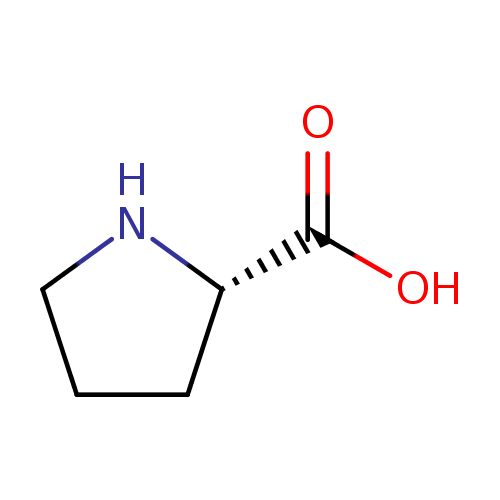
DescriptionL-Proline is one of the twenty amino acids used in living organisms as the building blocks of proteins. Proline is sometimes called an imino acid, although the IUPAC definition of an imine requires a carbon-nitrogen double bond. Proline is a non-essential amino acid that is synthesized from glutamic acid. It is an essential component of collagen and is important for proper functioning of joints and tendons.
Contaminant Sources
  • EAFUS Chemicals
  • FooDB Chemicals
  • HMDB Contaminants - Feces
  • HMDB Contaminants - Urine
  • HPV EPA Chemicals
  • My Exposome Chemicals
  • T3DB toxins
Contaminant Type
  • Amine
  • Animal Toxin
  • Dietary Supplement
  • Drug
  • Food Toxin
  • Household Toxin
  • Metabolite
  • Micronutrient
  • Natural Compound
  • Non-Essential Amino Acid
  • Nutraceutical
  • Organic Compound
  • Supplement
Chemical Structure
Thumb
Synonyms
ValueSource
(-)-(S)-ProlineChEBI
(-)-2-Pyrrolidinecarboxylic acidChEBI
(-)-ProlineChEBI
(2S)-Pyrrolidine-2-carboxylic acidChEBI
(S)-2-CarboxypyrrolidineChEBI
(S)-2-Pyrrolidinecarboxylic acidChEBI
(S)-Pyrrolidine-2-carboxylic acidChEBI
2-Pyrrolidinecarboxylic acidChEBI
L-(-)-ProlineChEBI
L-alpha-Pyrrolidinecarboxylic acidChEBI
L-ProlinChEBI
L-Pyrrolidine-2-carboxylic acidChEBI
PChEBI
ProlinaChEBI
PROLINEChEBI
ProlinumChEBI
(-)-2-PyrrolidinecarboxylateGenerator
(2S)-Pyrrolidine-2-carboxylateGenerator
(S)-2-PyrrolidinecarboxylateGenerator
(S)-Pyrrolidine-2-carboxylateGenerator
2-PyrrolidinecarboxylateGenerator
L-a-PyrrolidinecarboxylateGenerator
L-a-Pyrrolidinecarboxylic acidGenerator
L-alpha-PyrrolidinecarboxylateGenerator
L-Α-pyrrolidinecarboxylateGenerator
L-Α-pyrrolidinecarboxylic acidGenerator
L-Pyrrolidine-2-carboxylateGenerator
(S)-(-)-ProlineHMDB
(S)-(-)-Pyrrolidine-2-carboxylateHMDB
(S)-(-)-Pyrrolidine-2-carboxylic acidHMDB
(S)-2-PyrralidinecarboxylateHMDB
(S)-2-Pyrralidinecarboxylic acidHMDB
(S)-ProlineHMDB
L ProlineHMDB
Chemical FormulaC5H9NO2
Average Molecular Mass115.131 g/mol
Monoisotopic Mass115.063 g/mol
CAS Registry Number147-85-3
IUPAC Name(2S)-pyrrolidine-2-carboxylic acid
Traditional NameL-proline
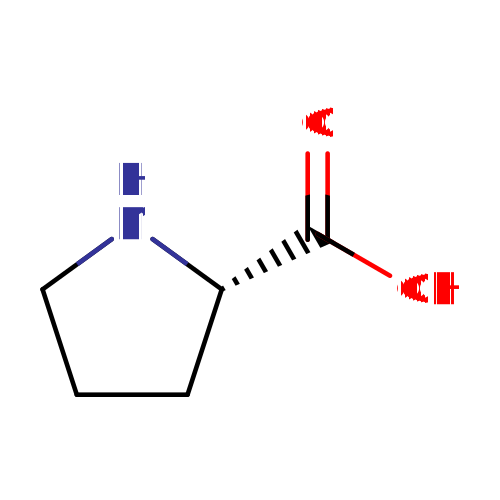
SMILESOC(=O)[C@@H]1CCCN1
InChI IdentifierInChI=1S/C5H9NO2/c7-5(8)4-2-1-3-6-4/h4,6H,1-3H2,(H,7,8)/t4-/m0/s1
InChI KeyONIBWKKTOPOVIA-BYPYZUCNSA-N
Chemical Taxonomy
Description belongs to the class of organic compounds known as proline and derivatives. Proline and derivatives are compounds containing proline or a derivative thereof resulting from reaction of proline at the amino group or the carboxy group, or from the replacement of any hydrogen of glycine by a heteroatom.
KingdomOrganic compounds
Super ClassOrganic acids and derivatives
ClassCarboxylic acids and derivatives
Sub ClassAmino acids, peptides, and analogues
Direct ParentProline and derivatives
Alternative Parents
Substituents
  • Proline or derivatives
  • Alpha-amino acid
  • L-alpha-amino acid
  • Pyrrolidine carboxylic acid
  • Pyrrolidine carboxylic acid or derivatives
  • Pyrrolidine
  • Amino acid
  • Carboxylic acid
  • Secondary aliphatic amine
  • Monocarboxylic acid or derivatives
  • Secondary amine
  • Organoheterocyclic compound
  • Azacycle
  • Organic oxygen compound
  • Organooxygen compound
  • Organonitrogen compound
  • Amine
  • Organopnictogen compound
  • Organic oxide
  • Carbonyl group
  • Organic nitrogen compound
  • Hydrocarbon derivative
  • Aliphatic heteromonocyclic compound
Molecular FrameworkAliphatic heteromonocyclic compounds
External Descriptors
Biological Properties
StatusDetected and Not Quantified
OriginEndogenous
Cellular Locations
  • Cytoplasm
  • Endoplasmic reticulum
  • Extracellular
  • Lysosome
  • Membrane
  • Mitochondria
Biofluid LocationsNot Available
Tissue Locations
  • All Tissues
  • Prostate
Pathways
NameSMPDB LinkKEGG Link
Arginine and Proline MetabolismSMP00020 map00330
Transcription/TranslationSMP00019 Not Available
Hyperprolinemia Type ISMP00361 Not Available
Hyperprolinemia Type IISMP00360 Not Available
IminoglycinuriaSMP00193 Not Available
Prolinemia Type IISMP00208 Not Available
Pyruvate Carboxylase DeficiencySMP00350 Not Available
Applications
Biological Roles
Chemical RolesNot Available
Physical Properties
StateSolid
AppearanceWhite powder.
Experimental Properties
PropertyValue
Melting Point221 dec°C
Boiling PointNot Available
Solubility1.62E+005 mg/L (at 25°C)
Predicted Properties
PropertyValueSource
Water Solubility365 g/LALOGPS
logP-2.7ALOGPS
logP-2.6ChemAxon
logS0.5ALOGPS
pKa (Strongest Acidic)1.94ChemAxon
pKa (Strongest Basic)11.33ChemAxon
Physiological Charge0ChemAxon
Hydrogen Acceptor Count3ChemAxon
Hydrogen Donor Count2ChemAxon
Polar Surface Area49.33 ŲChemAxon
Rotatable Bond Count1ChemAxon
Refractivity28.06 m³·mol⁻¹ChemAxon
Polarizability11.5 ųChemAxon
Number of Rings1ChemAxon
Bioavailability1ChemAxon
Rule of FiveYesChemAxon
Ghose FilterNoChemAxon
Veber's RuleNoChemAxon
MDDR-like RuleNoChemAxon
Spectra
Spectra
Spectrum TypeDescriptionSplash KeyView
GC-MSGC-MS Spectrum - GC-EI-TOF (Pegasus III TOF-MS system, Leco; GC 6890, Agilent Technologies) (2 TMS)splash10-0006-0910000000-a9127c0e370afb80259bSpectrum
GC-MSGC-MS Spectrum - GC-EI-TOF (Pegasus III TOF-MS system, Leco; GC 6890, Agilent Technologies) (2 TMS)splash10-000f-0910000000-3195f21e625520d51316Spectrum
GC-MSGC-MS Spectrum - GC-EI-TOF (Pegasus III TOF-MS system, Leco; GC 6890, Agilent Technologies) (Non-derivatized)splash10-0006-0900000000-119af746c347969e8ae7Spectrum
GC-MSGC-MS Spectrum - GC-EI-TOF (Pegasus III TOF-MS system, Leco; GC 6890, Agilent Technologies) (2 TMS)splash10-006x-8900000000-b31beabb1ed6235e7145Spectrum
GC-MSGC-MS Spectrum - GC-MS (1 TMS)splash10-00di-9100000000-c1c67bc521741ee891cbSpectrum
GC-MSGC-MS Spectrum - GC-MS (2 TMS)splash10-0006-1900000000-84e6fb318323fd0261b1Spectrum
GC-MSGC-MS Spectrum - GC-MS (1 TMS)splash10-00xs-8910000000-74b0c34ca5fd7c85f1d9Spectrum
GC-MSGC-MS Spectrum - EI-B (Non-derivatized)splash10-00fu-9000000000-716c3d01b301162863b6Spectrum
GC-MSGC-MS Spectrum - EI-B (Non-derivatized)splash10-0006-0900000000-0d7354201ed866c87b13Spectrum
GC-MSGC-MS Spectrum - GC-EI-TOF (Non-derivatized)splash10-0006-0910000000-a9127c0e370afb80259bSpectrum
GC-MSGC-MS Spectrum - GC-EI-TOF (Non-derivatized)splash10-000f-0910000000-3195f21e625520d51316Spectrum
GC-MSGC-MS Spectrum - GC-EI-TOF (Non-derivatized)splash10-0006-0900000000-119af746c347969e8ae7Spectrum
GC-MSGC-MS Spectrum - GC-EI-QQ (Non-derivatized)splash10-001i-1920000000-09006ee4e7a137d8a45aSpectrum
GC-MSGC-MS Spectrum - GC-EI-TOF (Non-derivatized)splash10-006x-8900000000-b31beabb1ed6235e7145Spectrum
GC-MSGC-MS Spectrum - GC-MS (Non-derivatized)splash10-0006-1900000000-84e6fb318323fd0261b1Spectrum
GC-MSGC-MS Spectrum - GC-MS (Non-derivatized)splash10-00xs-8910000000-74b0c34ca5fd7c85f1d9Spectrum
GC-MSGC-MS Spectrum - GC-MS (Non-derivatized)splash10-00di-9100000000-c1c67bc521741ee891cbSpectrum
Predicted GC-MSPredicted GC-MS Spectrum - GC-MS (Non-derivatized) - 70eV, Positivesplash10-00fu-9000000000-d203e3dfb0701403a75bSpectrum
Predicted GC-MSPredicted GC-MS Spectrum - GC-MS (1 TMS) - 70eV, Positivesplash10-00di-9000000000-56471980a375d26046caSpectrum
Predicted GC-MSPredicted GC-MS Spectrum - GC-MS (Non-derivatized) - 70eV, PositiveNot AvailableSpectrum
Predicted GC-MSPredicted GC-MS Spectrum - GC-MS (TMS_1_2) - 70eV, PositiveNot AvailableSpectrum
Predicted GC-MSPredicted GC-MS Spectrum - GC-MS (TBDMS_1_1) - 70eV, PositiveNot AvailableSpectrum
Predicted GC-MSPredicted GC-MS Spectrum - GC-MS (TBDMS_1_2) - 70eV, PositiveNot AvailableSpectrum
LC-MS/MSLC-MS/MS Spectrum - Quattro_QQQ 10V, Positive (Annotated)splash10-00xr-9600000000-ba51a901e786b1a4663eSpectrum
LC-MS/MSLC-MS/MS Spectrum - Quattro_QQQ 25V, Positive (Annotated)splash10-00di-9000000000-f72e2f3812225708fc56Spectrum
LC-MS/MSLC-MS/MS Spectrum - Quattro_QQQ 40V, Positive (Annotated)splash10-00di-9000000000-59887da6580f63bcc1c5Spectrum
LC-MS/MSLC-MS/MS Spectrum - EI-B (HITACHI M-80) , Positivesplash10-00fu-9000000000-c69dcaf7cb2d1e9d285eSpectrum
LC-MS/MSLC-MS/MS Spectrum - LC-ESI-ITFT (LTQ Orbitrap XL, Thermo Scientfic) , Positivesplash10-014i-0930000000-984f9a23ebfe28f95017Spectrum
LC-MS/MSLC-MS/MS Spectrum - LC-ESI-ITFT (LTQ Orbitrap XL, Thermo Scientfic) , Positivesplash10-014i-9000000000-f75575cac28a54aa923dSpectrum
LC-MS/MSLC-MS/MS Spectrum - LC-ESI-ITFT (LTQ Orbitrap XL, Thermo Scientfic) , Positivesplash10-00di-9000000000-221cfb8c82f3df76eb51Spectrum
LC-MS/MSLC-MS/MS Spectrum - LC-ESI-ITFT (LTQ Orbitrap XL, Thermo Scientfic) , Positivesplash10-014i-0900000000-e5741fd9870218d57cafSpectrum
LC-MS/MSLC-MS/MS Spectrum - LC-ESI-ITFT (LTQ Orbitrap XL, Thermo Scientfic) , Positivesplash10-014i-0900000000-6bc9b4e775be37fa18d9Spectrum
LC-MS/MSLC-MS/MS Spectrum - LC-ESI-ITFT (LTQ Orbitrap XL, Thermo Scientfic) , Positivesplash10-014i-9000000000-a8eb419b26655a6a1dabSpectrum
LC-MS/MSLC-MS/MS Spectrum - LC-ESI-ITFT (LTQ Orbitrap XL, Thermo Scientfic) , Positivesplash10-00di-9000000000-873ee03b61d1ffcae70fSpectrum
LC-MS/MSLC-MS/MS Spectrum - LC-ESI-ITFT (LTQ Orbitrap XL, Thermo Scientfic) , Positivesplash10-014i-0900000000-61d583960651669fb9e6Spectrum
LC-MS/MSLC-MS/MS Spectrum - LC-ESI-QQ (API3000, Applied Biosystems) 10V, Negativesplash10-03di-0900000000-2c23774af5f6a0c217d5Spectrum
LC-MS/MSLC-MS/MS Spectrum - LC-ESI-QQ (API3000, Applied Biosystems) 20V, Negativesplash10-03di-0900000000-d89c1e626ef24a79c89fSpectrum
LC-MS/MSLC-MS/MS Spectrum - LC-ESI-QQ (API3000, Applied Biosystems) 30V, Negativesplash10-03di-1900000000-fc27094f2eb75e65b438Spectrum
LC-MS/MSLC-MS/MS Spectrum - LC-ESI-QQ (API3000, Applied Biosystems) 10V, Positivesplash10-014i-1900000000-3221c23504b8847abf8dSpectrum
LC-MS/MSLC-MS/MS Spectrum - LC-ESI-QQ (API3000, Applied Biosystems) 20V, Positivesplash10-00di-9100000000-8169367f5127c57fae12Spectrum
LC-MS/MSLC-MS/MS Spectrum - LC-ESI-QQ (API3000, Applied Biosystems) 30V, Positivesplash10-00di-9000000000-f704eb8402fcacfccd18Spectrum
LC-MS/MSLC-MS/MS Spectrum - LC-ESI-QQ (API3000, Applied Biosystems) 40V, Positivesplash10-00di-9000000000-ccd74eea36efab2cbab8Spectrum
LC-MS/MSLC-MS/MS Spectrum - LC-ESI-QQ (API3000, Applied Biosystems) 50V, Positivesplash10-00di-9000000000-9f214692cd39a6581813Spectrum
LC-MS/MSLC-MS/MS Spectrum - CE-ESI-TOF (CE-system connected to 6210 Time-of-Flight MS, Agilent) , Positivesplash10-014i-0900000000-ef038c77922e4c89eeb0Spectrum
LC-MS/MSLC-MS/MS Spectrum - LC-ESI-QTOF (UPLC Q-Tof Premier, Waters) , Positivesplash10-00di-9400000000-4073ea1df57a60b36d69Spectrum
LC-MS/MSLC-MS/MS Spectrum - LC-ESI-QTOF (UPLC Q-Tof Premier, Waters) 30V, Positivesplash10-00di-9000000000-495fdbd2f565bd794632Spectrum
LC-MS/MSLC-MS/MS Spectrum - LC-ESI-QTOF (UPLC Q-Tof Premier, Waters) , Negativesplash10-03di-0900000000-e1d0a4b20419dc7bae92Spectrum
Predicted LC-MS/MSPredicted LC-MS/MS Spectrum - 10V, Positivesplash10-014i-6900000000-eba8ceb2a71d2726acd0Spectrum
1D NMR1H NMR SpectrumNot AvailableSpectrum
1D NMR13C NMR SpectrumNot AvailableSpectrum
1D NMR1H NMR SpectrumNot AvailableSpectrum
1D NMR13C NMR SpectrumNot AvailableSpectrum
1D NMR1H NMR SpectrumNot AvailableSpectrum
1D NMR13C NMR SpectrumNot AvailableSpectrum
1D NMR1H NMR SpectrumNot AvailableSpectrum
1D NMR13C NMR SpectrumNot AvailableSpectrum
1D NMR1H NMR SpectrumNot AvailableSpectrum
1D NMR13C NMR SpectrumNot AvailableSpectrum
1D NMR1H NMR SpectrumNot AvailableSpectrum
1D NMR13C NMR SpectrumNot AvailableSpectrum
1D NMR1H NMR SpectrumNot AvailableSpectrum
1D NMR13C NMR SpectrumNot AvailableSpectrum
1D NMR1H NMR SpectrumNot AvailableSpectrum
1D NMR13C NMR SpectrumNot AvailableSpectrum
1D NMR1H NMR SpectrumNot AvailableSpectrum
1D NMR13C NMR SpectrumNot AvailableSpectrum
1D NMR1H NMR SpectrumNot AvailableSpectrum
1D NMR13C NMR SpectrumNot AvailableSpectrum
1D NMR1H NMR SpectrumNot AvailableSpectrum
1D NMR13C NMR SpectrumNot AvailableSpectrum
2D NMR[1H,1H] 2D NMR SpectrumNot AvailableSpectrum
2D NMR[1H,13C] 2D NMR SpectrumNot AvailableSpectrum
Toxicity Profile
Route of ExposureNot Available
Mechanism of ToxicityGlycogenic, by L-Proline oxidase in the kidney, it is ring-opened and is oxidized to form L-Glutamic acid. L-Ornithine and L-Glutamic acid are converted to L-Proline via L-Glutamic acid-gamma-semialdehyde. It is contained abundantly in collagen, and is intimately involved in the function of arthrosis and chordae.
MetabolismHepatic
Toxicity ValuesNot Available
Lethal DoseNot Available
Carcinogenicity (IARC Classification)No indication of carcinogenicity to humans (not listed by IARC).
Uses/SourcesL-Proline is extremely important for the proper functioning of joints and tendons and also helps maintain and strengthen heart muscles.
Minimum Risk LevelNot Available
Health EffectsChronically high levels of proline are associated with at least 5 inborn errors of metabolism including: Hyperprolinemia Type I, Hyperprolinemia Type II, Iminoglycinuria, Prolinemia Type II and Pyruvate carboxylase deficiency.
SymptomsNot Available
TreatmentNot Available
Concentrations
Not Available
DrugBank IDDB00172
HMDB IDHMDB0000162
FooDB IDFDB000570
Phenol Explorer IDNot Available
KNApSAcK IDC00001388
BiGG ID34042
BioCyc IDPRO
METLIN ID29
PDB IDNot Available
Wikipedia LinkL-proline
Chemspider ID128566
ChEBI ID17203
PubChem Compound ID145742
Kegg Compound IDC00148
YMDB IDYMDB00378
ECMDB IDECMDB00162
References
Synthesis Reference

Richard I. Leavitt, “L-Proline production from algae.” U.S. Patent US4383039, issued October, 1968.

MSDSLink
General References
1. Itoh, Tamio. Synthesis of L-proline from L-glutamine. Bulletin of the Chemical Society of Japan (1963), 36(1), 25-9
2. Klein MS, Almstetter MF, Schlamberger G, Nurnberger N, Dettmer K, Oefner PJ, Meyer HH, Wiedemann S, Gronwald W: Nuclear magnetic resonance and mass spectrometry-based milk metabolomics in dairy cows during early and late lactation. J Dairy Sci. 2010 Apr;93(4):1539-50. doi: 10.3168/jds.2009-2563.
3. Scano P, Murgia A, Pirisi FM, Caboni P: A gas chromatography-mass spectrometry-based metabolomic approach for the characterization of goat milk compared with cow milk. J Dairy Sci. 2014 Oct;97(10):6057-66. doi: 10.3168/jds.2014-8247. Epub 2014 Aug 6.
4. Mung D, Li L: Development of Chemical Isotope Labeling LC-MS for Milk Metabolomics: Comprehensive and Quantitative Profiling of the Amine/Phenol Submetabolome. Anal Chem. 2017 Apr 18;89(8):4435-4443. doi: 10.1021/acs.analchem.6b03737. Epub 2017 Mar 28.
5. O'Callaghan TF, Vazquez-Fresno R, Serra-Cayuela A, Dong E, Mandal R, Hennessy D, McAuliffe S, Dillon P, Wishart DS, Stanton C, Ross RP: Pasture Feeding Changes the Bovine Rumen and Milk Metabolome. Metabolites. 2018 Apr 6;8(2). pii: metabo8020027. doi: 10.3390/metabo8020027.
6. Klein MS, Almstetter MF, Nurnberger N, Sigl G, Gronwald W, Wiedemann S, Dettmer K, Oefner PJ: Correlations between milk and plasma levels of amino and carboxylic acids in dairy cows. J Proteome Res. 2013 Nov 1;12(11):5223-32. doi: 10.1021/pr4006537. Epub 2013 Aug 23.
7. Kurt J. Boudonck, Matthew W. Mitchell, Jacob Wulff and John A. Ryals. Characterization of the biochemical variability of bovine milk using metabolomics. Metabolomics (2009) 5:375?386
8. A. Foroutan et al. The Chemical Composition of Commercial Cow's Milk (in preparation)
9. Fooddata+, The Technical University of Denmark (DTU): https://frida.fooddata.dk/QueryFood.php?fn=milk&lang=en
10. Itoh, Tamio. Synthesis of L-proline from L-glutamine. Bulletin of the Chemical Society of Japan (1963), 36(1), 25-9
11. Deng C, Shang C, Hu Y, Zhang X: Rapid diagnosis of phenylketonuria and other aminoacidemias by quantitative analysis of amino acids in neonatal blood spots by gas chromatography-mass spectrometry. J Chromatogr B Analyt Technol Biomed Life Sci. 2002 Jul 25;775(1):115-20.
12. Azizi M, Junot C, Ezan E, Menard J: Angiotensin I-converting enzyme and metabolism of the haematological peptide N-acetyl-seryl-aspartyl-lysyl-proline. Clin Exp Pharmacol Physiol. 2001 Dec;28(12):1066-9.
13. Roesel RA, Blankenship PR, Mobley EB, Coryell ME: Increased excretion of histidyl-L-proline diketopiperazine by infants receiving Pregestimil and Nutramigen formulas. Clin Chem. 1986 May;32(5):865-7.
14. Chambers ST, Kunin CM: Osmoprotective activity for Escherichia coli in mammalian renal inner medulla and urine. Correlation of glycine and proline betaines and sorbitol with response to osmotic loads. J Clin Invest. 1987 Nov;80(5):1255-60.
15. Cynober LA: Plasma amino acid levels with a note on membrane transport: characteristics, regulation, and metabolic significance. Nutrition. 2002 Sep;18(9):761-6.
16. Azizi M, Ezan E, Reny JL, Wdzieczak-Bakala J, Gerineau V, Menard J: Renal and metabolic clearance of N-acetyl-seryl-aspartyl-lysyl-proline (AcSDKP) during angiotensin-converting enzyme inhibition in humans. Hypertension. 1999 Mar;33(3):879-86.
17. Hart W, van den Hamer CJ, van der Sluys Veer J: The use of hydroxy-DL-proline-2-(14)C in the investigation of hydroxyproline metabolism in normal subjects and in patients with renal insufficiency. Clin Nephrol. 1976 Sep;6(3):379-87.
18. Kanwar YS, Krakower CA, Manaligod JR, Justice P, Wong PW: Biochemical, morphological and hybrid studies in hyperprolinemic mice. Biomedicine. 1975 May;22(3):209-16.
19. Simila S: Hydroxyproline metabolism in type II hyperprolinaemia. Ann Clin Biochem. 1979 Jul;16(4):177-81.
20. Lu SH, Ohshima H, Fu HM, Tian Y, Li FM, Blettner M, Wahrendorf J, Bartsch H: Urinary excretion of N-nitrosamino acids and nitrate by inhabitants of high- and low-risk areas for esophageal cancer in Northern China: endogenous formation of nitrosoproline and its inhibition by vitamin C. Cancer Res. 1986 Mar;46(3):1485-91.
21. Hausmann D: [Post-traumatic imbalances of plasma amino acids--interference factors or defense mechanisms? A study of protein metabolism in severe craniocerebral trauma]. Anasth Intensivther Notfallmed. 1988 Feb;23(1):14-21.
22. Scriver CR, McInnes RR, Mohyuddin F: Role of epithelial architecture and intracellular metabolism in proline uptake and transtubular reclamation in PRO/re mouse kidney. Proc Natl Acad Sci U S A. 1975 Apr;72(4):1431-5.
23. Boden G, Rezvani I, Owen OE: Effects of glucagon on plasma amino acids. J Clin Invest. 1984 Mar;73(3):785-93.
24. Silwood CJ, Lynch E, Claxson AW, Grootveld MC: 1H and (13)C NMR spectroscopic analysis of human saliva. J Dent Res. 2002 Jun;81(6):422-7.
25. Feldman JM, Plonk JW, Admiraal J, Sidbury JB: Plasma amino acids in patients with the carcinoid syndrome. Cancer. 1976 Nov;38(5):2127-31.
26. Humbertclaude V, Rivier F, Roubertie A, Echenne B, Bellet H, Vallat C, Morin D: Is hyperprolinemia type I actually a benign trait? Report of a case with severe neurologic involvement and vigabatrin intolerance. J Child Neurol. 2001 Aug;16(8):622-3.
27. Sreekumar A, Poisson LM, Rajendiran TM, Khan AP, Cao Q, Yu J, Laxman B, Mehra R, Lonigro RJ, Li Y, Nyati MK, Ahsan A, Kalyana-Sundaram S, Han B, Cao X, Byun J, Omenn GS, Ghosh D, Pennathur S, Alexander DC, Berger A, Shuster JR, Wei JT, Varambally S, Beecher C, Chinnaiyan AM: Metabolomic profiles delineate potential role for sarcosine in prostate cancer progression. Nature. 2009 Feb 12;457(7231):910-4. doi: 10.1038/nature07762.
28. Nagata Y, Higashi M, Ishii Y, Sano H, Tanigawa M, Nagata K, Noguchi K, Urade M: The presence of high concentrations of free D-amino acids in human saliva. Life Sci. 2006 Mar 6;78(15):1677-81. Epub 2006 Feb 9.
29. Nagata Y, Masui R, Akino T: The presence of free D-serine, D-alanine and D-proline in human plasma. Experientia. 1992 Oct 15;48(10):986-8.
30. Nadler JV, Wang A, Hakim A: Toxicity of L-proline toward rat hippocampal neurons. Brain Res. 1988 Jul 19;456(1):168-72.
31. Elshenawy S, Pinney SE, Stuart T, Doulias PT, Zura G, Parry S, Elovitz MA, Bennett MJ, Bansal A, Strauss JF 3rd, Ischiropoulos H, Simmons RA: The Metabolomic Signature of the Placenta in Spontaneous Preterm Birth. Int J Mol Sci. 2020 Feb 4;21(3). pii: ijms21031043. doi: 10.3390/ijms21031043.
32. https://www.ncbi.nlm.nih.gov/pubmed/?term=11076505
33. https://www.ncbi.nlm.nih.gov/pubmed/?term=12770004
34. https://www.ncbi.nlm.nih.gov/pubmed/?term=14975886
35. https://www.ncbi.nlm.nih.gov/pubmed/?term=15576824
36. https://www.ncbi.nlm.nih.gov/pubmed/?term=15838615
37. https://www.ncbi.nlm.nih.gov/pubmed/?term=15894682
38. https://www.ncbi.nlm.nih.gov/pubmed/?term=15973048
39. https://www.ncbi.nlm.nih.gov/pubmed/?term=16033917
40. https://www.ncbi.nlm.nih.gov/pubmed/?term=16190672
41. https://www.ncbi.nlm.nih.gov/pubmed/?term=16501220
42. https://www.ncbi.nlm.nih.gov/pubmed/?term=16656443
43. https://www.ncbi.nlm.nih.gov/pubmed/?term=16657874
44. https://www.ncbi.nlm.nih.gov/pubmed/?term=16668324
45. https://www.ncbi.nlm.nih.gov/pubmed/?term=17127472
46. https://www.ncbi.nlm.nih.gov/pubmed/?term=17608428
47. https://www.ncbi.nlm.nih.gov/pubmed/?term=18551589
48. https://www.ncbi.nlm.nih.gov/pubmed/?term=18802692
49. https://www.ncbi.nlm.nih.gov/pubmed/?term=18973300
50. https://www.ncbi.nlm.nih.gov/pubmed/?term=19215998
51. https://www.ncbi.nlm.nih.gov/pubmed/?term=19580280
52. https://www.ncbi.nlm.nih.gov/pubmed/?term=19656302
53. https://www.ncbi.nlm.nih.gov/pubmed/?term=19688381
54. https://www.ncbi.nlm.nih.gov/pubmed/?term=19811425
55. https://www.ncbi.nlm.nih.gov/pubmed/?term=22139509
56. https://www.ncbi.nlm.nih.gov/pubmed/?term=22201772
57. https://www.ncbi.nlm.nih.gov/pubmed/?term=22451406
58. https://www.ncbi.nlm.nih.gov/pubmed/?term=22475019
59. https://www.ncbi.nlm.nih.gov/pubmed/?term=22482728
60. https://www.ncbi.nlm.nih.gov/pubmed/?term=22491679
61. https://www.ncbi.nlm.nih.gov/pubmed/?term=22770225