Record Information
Version1.0
Creation Date2014-08-29 06:51:04 UTC
Update Date2026-04-13 20:28:30 UTC
Accession NumberCHEM003367
Identification
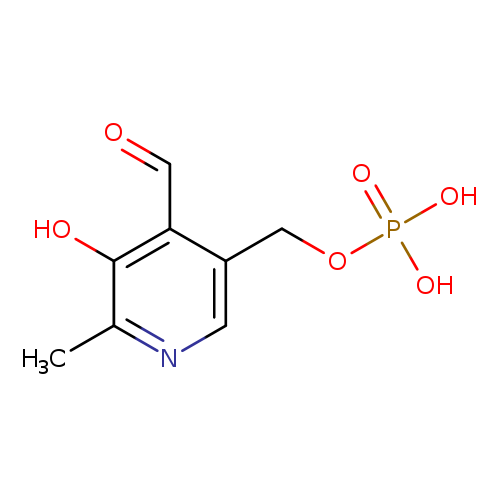
Common NamePyridoxal 5'-phosphate
ClassSmall Molecule
DescriptionThis is the active form of vitamin B6 serving as a coenzyme for synthesis of amino acids, neurotransmitters (serotonin, norepinephrine), sphingolipids, aminolevulinic acid. During transamination of amino acids, pyridoxal phosphate is transiently converted into pyridoxamine phosphate (pyridoxamine). Pyridoxal-phosphate (PLP, pyridoxal-5'-phosphate) is a cofactor of many enzymatic reactions. It is the active form of vitamin B6 which comprises three natural organic compounds, pyridoxal, pyridoxamine and pyridoxine.
Contaminant Sources
  • FooDB Chemicals
  • T3DB toxins
Contaminant Type
  • Animal Toxin
  • Dietary Supplement
  • Drug
  • Ester
  • Food Toxin
  • Metabolite
  • Micronutrient
  • Natural Compound
  • Nutraceutical
  • Organic Compound
  • Supplement
  • Vitamin B Complex
Chemical Structure
Thumb
Synonyms
ValueSource
3-Hydroxy-2-methyl-5-[(phosphonooxy)methyl]-4-pyridinecarboxaldehydeChEBI
3-Hydroxy-5-(hydroxymethyl)-2-methylisonicotinaldehyde 5-phosphateChEBI
CodecarboxylaseChEBI
Phosphoric acid mono-(4-formyl-5-hydroxy-6-methyl-pyridin-3-ylmethyl) esterChEBI
PLPChEBI
Pyridoxal 5'-(dihydrogen phosphate)ChEBI
Pyridoxal 5-monophosphoric acid esterChEBI
Pyridoxal 5-phosphateChEBI
Pyridoxal phosphateChEBI
PYRIDOXAL-5'-phosphATEChEBI
3-Hydroxy-5-(hydroxymethyl)-2-methylisonicotinaldehyde 5-phosphoric acidGenerator
Phosphate mono-(4-formyl-5-hydroxy-6-methyl-pyridin-3-ylmethyl) esterGenerator
Pyridoxal 5'-(dihydrogen phosphoric acid)Generator
Pyridoxal 5-monophosphate esterGenerator
Pyridoxal 5-phosphoric acidGenerator
Pyridoxal phosphoric acidGenerator
PYRIDOXAL-5'-phosphoric acidGenerator
Pyridoxal 5'-phosphoric acidGenerator
Apolon b6HMDB
BiosechsHMDB
Coenzyme b6HMDB
HairoxalHMDB
Hexermin-pHMDB
Hi-pyridoxinHMDB
HiadelonHMDB
HimitanHMDB
PAL-pHMDB
PhosphopyridoxalHMDB
Phosphopyridoxal coenzymeHMDB
PidopidonHMDB
PiodelHMDB
PydoxalHMDB
Pyridoxal pHMDB
Pyridoxal-pHMDB
Pyridoxyl phosphateHMDB
PyromijinHMDB
SechvitanHMDB
Vitahexin-pHMDB
VitazechsHMDB
Phosphate, pyridoxalHMDB
Pyridoxal 5 phosphateHMDB
Chemical FormulaC8H10NO6P
Average Molecular Mass247.142 g/mol
Monoisotopic Mass247.025 g/mol
CAS Registry Number54-47-7
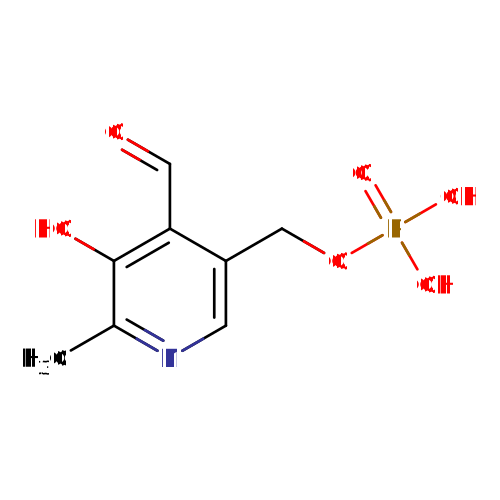
IUPAC Name[(4-formyl-5-hydroxy-6-methylpyridin-3-yl)methoxy]phosphonic acid
Traditional Namepyridoxal phosphate
SMILESCC1=NC=C(COP(O)(O)=O)C(C=O)=C1O
InChI IdentifierInChI=1S/C8H10NO6P/c1-5-8(11)7(3-10)6(2-9-5)4-15-16(12,13)14/h2-3,11H,4H2,1H3,(H2,12,13,14)
InChI KeyNGVDGCNFYWLIFO-UHFFFAOYSA-N
Chemical Taxonomy
Description belongs to the class of organic compounds known as pyridoxals and derivatives. Pyridoxals and derivatives are compounds containing a pyridoxal moiety, which consists of a pyridine ring substituted at positions 2,3,4, and 5 by a methyl group, a hydroxyl group, a carbaldehyde group, and a hydroxymethyl group, respectively.
KingdomOrganic compounds
Super ClassOrganoheterocyclic compounds
ClassPyridines and derivatives
Sub ClassPyridine carboxaldehydes
Direct ParentPyridoxals and derivatives
Alternative Parents
Substituents
  • Pyridoxal
  • Aryl-aldehyde
  • Monoalkyl phosphate
  • Hydroxypyridine
  • Methylpyridine
  • Organic phosphoric acid derivative
  • Phosphoric acid ester
  • Alkyl phosphate
  • Vinylogous acid
  • Heteroaromatic compound
  • Azacycle
  • Organopnictogen compound
  • Aldehyde
  • Organic oxygen compound
  • Organic nitrogen compound
  • Organooxygen compound
  • Organonitrogen compound
  • Hydrocarbon derivative
  • Organic oxide
  • Aromatic heteromonocyclic compound
Molecular FrameworkAromatic heteromonocyclic compounds
External Descriptors
Biological Properties
StatusDetected and Not Quantified
OriginEndogenous
Cellular Locations
  • Membrane
  • Mitochondria
Biofluid LocationsNot Available
Tissue Locations
  • Erythrocyte
  • Kidney
  • Liver
  • Muscle
  • Neuron
Pathways
NameSMPDB LinkKEGG Link
Glucose-Alanine CycleSMP00127 Not Available
Malate-Aspartate ShuttleSMP00129 Not Available
Vitamin B6 MetabolismSMP00017 map00750
HypophosphatasiaSMP00503 Not Available
ApplicationsNot Available
Biological Roles
Chemical Roles
Physical Properties
StateSolid
AppearanceWhite powder.
Experimental Properties
PropertyValue
Melting Point255°C
Boiling PointNot Available
SolubilityAppreciable
Predicted Properties
PropertyValueSource
Water Solubility5.7 g/LALOGPS
logP-0.55ALOGPS
logP-2.1ChemAxon
logS-1.6ALOGPS
pKa (Strongest Acidic)1.68ChemAxon
pKa (Strongest Basic)4.11ChemAxon
Physiological Charge-2ChemAxon
Hydrogen Acceptor Count6ChemAxon
Hydrogen Donor Count3ChemAxon
Polar Surface Area116.95 ŲChemAxon
Rotatable Bond Count4ChemAxon
Refractivity54.75 m³·mol⁻¹ChemAxon
Polarizability20.9 ųChemAxon
Number of Rings1ChemAxon
Bioavailability1ChemAxon
Rule of FiveYesChemAxon
Ghose FilterNoChemAxon
Veber's RuleNoChemAxon
MDDR-like RuleNoChemAxon
Spectra
Spectra
Spectrum TypeDescriptionSplash KeyView
GC-MSGC-MS Spectrum - GC-MS (1 MEOX; 3 TMS)splash10-0gb9-2690000000-c9bacb7e657461e28407Spectrum
GC-MSGC-MS Spectrum - GC-MS (Non-derivatized)splash10-0gb9-2690000000-c9bacb7e657461e28407Spectrum
GC-MSGC-MS Spectrum - GC-EI-TOF (Non-derivatized)splash10-004j-0910000000-0408f3957221fc9882cdSpectrum
GC-MSGC-MS Spectrum - GC-EI-TOF (Non-derivatized)splash10-0gb9-1790000000-b01115fa8b4cfd3612c7Spectrum
Predicted GC-MSPredicted GC-MS Spectrum - GC-MS (Non-derivatized) - 70eV, Positivesplash10-0002-9520000000-bfd574b2e5355694902aSpectrum
Predicted GC-MSPredicted GC-MS Spectrum - GC-MS (1 TMS) - 70eV, Positivesplash10-006t-9152000000-26c9f631195663322986Spectrum
Predicted GC-MSPredicted GC-MS Spectrum - GC-MS (Non-derivatized) - 70eV, PositiveNot AvailableSpectrum
LC-MS/MSLC-MS/MS Spectrum - Quattro_QQQ 10V, Positive (Annotated)splash10-0f6t-0690000000-4aa57f3f28f0bdef9dcfSpectrum
LC-MS/MSLC-MS/MS Spectrum - Quattro_QQQ 25V, Positive (Annotated)splash10-0fxx-8900000000-ee972556340c61650528Spectrum
LC-MS/MSLC-MS/MS Spectrum - Quattro_QQQ 40V, Positive (Annotated)splash10-014l-9100000000-3cc29fb51820adecd59cSpectrum
LC-MS/MSLC-MS/MS Spectrum - LC-ESI-QQ (API3000, Applied Biosystems) 10V, Negativesplash10-0002-0090000000-9b86e80a9dd0de14ab59Spectrum
LC-MS/MSLC-MS/MS Spectrum - LC-ESI-QQ (API3000, Applied Biosystems) 20V, Negativesplash10-03dj-9800000000-9313aa9cbf19bc6311c5Spectrum
LC-MS/MSLC-MS/MS Spectrum - LC-ESI-QQ (API3000, Applied Biosystems) 30V, Negativesplash10-0002-9500000000-7ce120a58879e2214ce5Spectrum
LC-MS/MSLC-MS/MS Spectrum - LC-ESI-QQ (API3000, Applied Biosystems) 40V, Negativesplash10-004j-9200000000-7e6bd8c298613e59fb5dSpectrum
LC-MS/MSLC-MS/MS Spectrum - LC-ESI-QQ (API3000, Applied Biosystems) 50V, Negativesplash10-004i-9000000000-4c05178b1645bf01f3faSpectrum
LC-MS/MSLC-MS/MS Spectrum - LC-ESI-QTOF (UPLC Q-Tof Premier, Waters) , Positivesplash10-0udi-3920000000-6c5e6106f5658d1d6c50Spectrum
LC-MS/MSLC-MS/MS Spectrum - LC-ESI-QTOF (UPLC Q-Tof Premier, Waters) , Positivesplash10-0udi-3920000000-f96097815e6922356131Spectrum
LC-MS/MSLC-MS/MS Spectrum - LC-ESI-QTOF (UPLC Q-Tof Premier, Waters) , Negativesplash10-002b-9000000000-2c4e243699a95e3a0f88Spectrum
LC-MS/MSLC-MS/MS Spectrum - LC-ESI-QTOF (UPLC Q-Tof Premier, Waters) , Negativesplash10-002b-9000000000-8aa111485891af9f0d02Spectrum
LC-MS/MSLC-MS/MS Spectrum - LC-ESI-QQ , negativesplash10-0002-0090000000-9b86e80a9dd0de14ab59Spectrum
LC-MS/MSLC-MS/MS Spectrum - LC-ESI-QQ , negativesplash10-03dj-9800000000-9313aa9cbf19bc6311c5Spectrum
LC-MS/MSLC-MS/MS Spectrum - LC-ESI-QQ , negativesplash10-0002-9500000000-7ce120a58879e2214ce5Spectrum
LC-MS/MSLC-MS/MS Spectrum - LC-ESI-QQ , negativesplash10-004j-9200000000-7e6bd8c298613e59fb5dSpectrum
LC-MS/MSLC-MS/MS Spectrum - LC-ESI-QQ , negativesplash10-004i-9000000000-4c05178b1645bf01f3faSpectrum
LC-MS/MSLC-MS/MS Spectrum - LC-ESI-QTOF , negativesplash10-002b-9000000000-2c4e243699a95e3a0f88Spectrum
LC-MS/MSLC-MS/MS Spectrum - LC-ESI-QTOF , negativesplash10-002b-9000000000-8aa111485891af9f0d02Spectrum
Predicted LC-MS/MSPredicted LC-MS/MS Spectrum - 10V, Positivesplash10-0f6t-1790000000-1dcb07cd1110c71f7005Spectrum
Predicted LC-MS/MSPredicted LC-MS/MS Spectrum - 20V, Positivesplash10-0udi-0900000000-ca6aab7f31a36863a417Spectrum
Predicted LC-MS/MSPredicted LC-MS/MS Spectrum - 40V, Positivesplash10-0udi-9800000000-053802b9c0533d7943eaSpectrum
Predicted LC-MS/MSPredicted LC-MS/MS Spectrum - 10V, Negativesplash10-0002-9080000000-12ca63d34d39d59f6b42Spectrum
Predicted LC-MS/MSPredicted LC-MS/MS Spectrum - 20V, Negativesplash10-004i-9000000000-144099ec201adbbc4684Spectrum
Predicted LC-MS/MSPredicted LC-MS/MS Spectrum - 40V, Negativesplash10-004i-9000000000-70a9559d65e78c488e7eSpectrum
1D NMR1H NMR SpectrumNot AvailableSpectrum
1D NMR13C NMR SpectrumNot AvailableSpectrum
1D NMR1H NMR SpectrumNot AvailableSpectrum
1D NMR13C NMR SpectrumNot AvailableSpectrum
1D NMR1H NMR SpectrumNot AvailableSpectrum
1D NMR13C NMR SpectrumNot AvailableSpectrum
1D NMR1H NMR SpectrumNot AvailableSpectrum
1D NMR13C NMR SpectrumNot AvailableSpectrum
1D NMR1H NMR SpectrumNot AvailableSpectrum
1D NMR13C NMR SpectrumNot AvailableSpectrum
1D NMR1H NMR SpectrumNot AvailableSpectrum
1D NMR13C NMR SpectrumNot AvailableSpectrum
1D NMR1H NMR SpectrumNot AvailableSpectrum
1D NMR13C NMR SpectrumNot AvailableSpectrum
1D NMR1H NMR SpectrumNot AvailableSpectrum
1D NMR13C NMR SpectrumNot AvailableSpectrum
1D NMR1H NMR SpectrumNot AvailableSpectrum
1D NMR13C NMR SpectrumNot AvailableSpectrum
1D NMR1H NMR SpectrumNot AvailableSpectrum
1D NMR13C NMR SpectrumNot AvailableSpectrum
1D NMR1H NMR SpectrumNot AvailableSpectrum
2D NMR[1H,1H] 2D NMR SpectrumNot AvailableSpectrum
2D NMR[1H,13C] 2D NMR SpectrumNot AvailableSpectrum
Toxicity Profile
Route of ExposureNot Available
Mechanism of ToxicityPyridoxal Phosphate is a coenzyme of many enzymatic reactions. It is the active form of vitamin B6 which comprises three natural organic compounds, pyridoxal, pyridoxamine and pyridoxine. Pyridoxal phosphate acts as a coenzyme in all transamination reactions, and in some decarboxylation and deamination reactions of amino acids. The aldehyde group of pyridoxal phosphate forms a Schiff-base linkage with the epsilon-amino group of a specific lysine group of the aminotransferase enzyme. The alpha-amino group of the amino acid substrate displaces the epsilon-amino group of the active-site lysine residue. The resulting aldimine becomes deprotonated to become a quinoid intermediate, which in turn accepts a proton at a different position to become a ketimine. The resulting ketimine is hydrolysed so that the amino group remains on the protein complex.
MetabolismNot Available
Toxicity ValuesNot Available
Lethal DoseNot Available
Carcinogenicity (IARC Classification)No indication of carcinogenicity to humans (not listed by IARC).
Uses/SourcesFor nutritional supplementation and for treating dietary shortage or imbalance.
Minimum Risk LevelNot Available
Health EffectsNot Available
SymptomsNot Available
TreatmentNot Available
Concentrations
Not Available
DrugBank IDDB00114
HMDB IDHMDB0001491
FooDB IDFDB021820
Phenol Explorer IDNot Available
KNApSAcK IDC00007503
BiGG ID33526
BioCyc IDPYRIDOXAL_PHOSPHATE
METLIN ID6275
PDB IDNot Available
Wikipedia LinkPyridoxal_phosphate
Chemspider ID1022
ChEBI ID18405
PubChem Compound ID1051
Kegg Compound IDC00018
YMDB IDYMDB00363
ECMDB IDECMDB01491
References
Synthesis Reference

Robert C. Siegel, “Synthesis of cross-links in the helical domain of collagen using pyridoxal 5-phosphate and copper or iron.” U.S. Patent US4544638, issued June, 1981.

MSDSLink
General References
1. Coburn SP, Mahuren JD, Pauly TA, Ericson KL, Townsend DW: Alkaline phosphatase activity and pyridoxal phosphate concentrations in the milk of various species. J Nutr. 1992 Dec;122(12):2348-53. doi: 10.1093/jn/122.12.2348.
2. Huang YC, Lan PH, Cheng CH, Lee BJ, Kan MN: Vitamin B6 intakes and status of mechanically ventilated critically ill patients in Taiwan. Eur J Clin Nutr. 2002 May;56(5):387-92.
3. Chiang EP, Bagley PJ, Roubenoff R, Nadeau M, Selhub J: Plasma pyridoxal 5'-phosphate concentration is correlated with functional vitamin B-6 indices in patients with rheumatoid arthritis and marginal vitamin B-6 status. J Nutr. 2003 Apr;133(4):1056-9.
4. Chiang EP, Selhub J, Bagley PJ, Dallal G, Roubenoff R: Pyridoxine supplementation corrects vitamin B6 deficiency but does not improve inflammation in patients with rheumatoid arthritis. Arthritis Res Ther. 2005;7(6):R1404-11. Epub 2005 Oct 14.
5. Heiskanen K, Kallio M, Salmenpera L, Siimes MA, Ruokonen I, Perheentupa J: Vitamin B-6 status during childhood: tracking from 2 months to 11 years of age. J Nutr. 1995 Dec;125(12):2985-92.
6. Longhi RC, Fleisher LD, Tallan HH, Gaull GE: Cystathionine beta-synthase deficiency: a qualitative abnormality of the deficient enzyme modified by vitamin B6 therapy. Pediatr Res. 1977 Feb;11(2):100-3.
7. Fonda ML: Vitamin B6 metabolism and binding to proteins in the blood of alcoholic and nonalcoholic men. Alcohol Clin Exp Res. 1993 Dec;17(6):1171-8.
8. Lee BJ, Huang MC, Chung LJ, Cheng CH, Lin KL, Su KH, Huang YC: Folic acid and vitamin B12 are more effective than vitamin B6 in lowering fasting plasma homocysteine concentration in patients with coronary artery disease. Eur J Clin Nutr. 2004 Mar;58(3):481-7.
9. Schuster K, Bailey LB, Cerda JJ, Gregory JF 3rd: Urinary 4-pyridoxic acid excretion in 24-hour versus random urine samples as a measurement of vitamin B6 status in humans. Am J Clin Nutr. 1984 Mar;39(3):466-70.
10. Heiskanen K, Siimes MA, Perheentupa J, Salmenpera L: Reference ranges for erythrocyte pyridoxal 5'-phosphate concentration and the erythrocyte aspartate transaminase stimulation test in lactating mothers and their infants. Am J Clin Nutr. 1994 Jun;59(6):1297-303.
11. Selvaag E, Bohmer T, Benkestock K: Reduced serum concentrations of riboflavine and ascorbic acid, and blood thiamine pyrophosphate and pyridoxal-5-phosphate in geriatric patients with and without pressure sores. J Nutr Health Aging. 2002;6(1):75-7.
12. Iqbal SJ, Plaha DS, Linforth GH, Dalgleish R: Hypophosphatasia: diagnostic application of linked DNA markers in the dominantly inherited adult form. Clin Sci (Lond). 1999 Jul;97(1):73-8.
13. Heiskanen K, Siimes MA, Salmenpera L, Perheentupa J: Low vitamin B6 status associated with slow growth in healthy breast-fed infants. Pediatr Res. 1995 Nov;38(5):740-6.
14. Huang YC, Chang SJ, Chiu YT, Chang HH, Cheng CH: The status of plasma homocysteine and related B-vitamins in healthy young vegetarians and nonvegetarians. Eur J Nutr. 2003 Apr;42(2):84-90.
15. Huang YC, Chang HH, Huang SC, Cheng CH, Lee BJ, Cheng SY, Su KH: Plasma pyridoxal 5'-phosphate is a significant indicator of immune responses in the mechanically ventilated critically ill. Nutrition. 2005 Jul-Aug;21(7-8):779-85.
16. Chiang EP, Bagley PJ, Selhub J, Nadeau M, Roubenoff R: Abnormal vitamin B(6) status is associated with severity of symptoms in patients with rheumatoid arthritis. Am J Med. 2003 Mar;114(4):283-7.
17. Lacour B, Parry C, Drueke T, Touam M, Kreis H, Bailly M, Durand D: Pyridoxal 5'-phosphate deficiency in uremic undialyzed, hemodialyzed, and non-uremic kidney transplant patients. Clin Chim Acta. 1983 Jan 24;127(2):205-15.
18. Seki T: Combination treatment of high-dose pyridoxal phosphate and low-dose ACTH in children with West syndrome and related disorders. Jpn J Psychiatry Neurol. 1990 Jun;44(2):219-37.
19. Akopov MA, Kagan ZS, Berezov TT, Filiptsev PIa: [Kinetics and thermodynamics of heat inactivation of L-threonine-L-serine dehydratase from human liver]. Biokhimiia. 1978 Nov;43(11):2027-32.
20. Descombes E, Hanck AB, Fellay G: Water soluble vitamins in chronic hemodialysis patients and need for supplementation. Kidney Int. 1993 Jun;43(6):1319-28.
21. Stolzenberg-Solomon RZ, Albanes D, Nieto FJ, Hartman TJ, Tangrea JA, Rautalahti M, Sehlub J, Virtamo J, Taylor PR: Pancreatic cancer risk and nutrition-related methyl-group availability indicators in male smokers. J Natl Cancer Inst. 1999 Mar 17;91(6):535-41.
22. https://www.ncbi.nlm.nih.gov/pubmed/?term=14651974
23. https://www.ncbi.nlm.nih.gov/pubmed/?term=16277678
24. https://www.ncbi.nlm.nih.gov/pubmed/?term=18491919
25. https://www.ncbi.nlm.nih.gov/pubmed/?term=6339724
26. https://www.ncbi.nlm.nih.gov/pubmed/?term=7284379
27. https://www.ncbi.nlm.nih.gov/pubmed/?term=9866693