Record Information
Version1.0
Creation Date2014-08-29 06:50:55 UTC
Update Date2026-05-14 18:06:01 UTC
Accession NumberCHEM003358
Identification
Common NameSaccharopine
ClassSmall Molecule
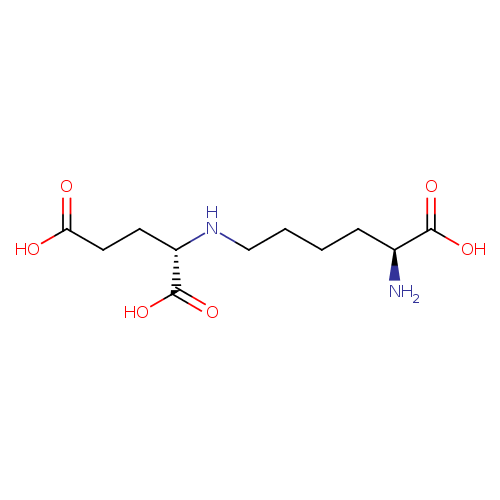
DescriptionSaccharopine is an intermediate in the degradation of lysine, formed by condensation of lysine and alpha-ketoglutarate. The saccharopine pathway is the main route for lysine degradation in mammal and its first two reactions are catalyzed by enzymatic activities known as lysine-oxoglutarate reductase (LOR) and saccharopine dehydrogenase (SDH), which reside on a single bifunctional polypeptide (EC EC 1.5.1.8, LOR/SDH). The reactions involved by saccharopine dehydrogenases have a very strict substrate specificity for L-lysine, 2-oxoglutarate and NADPH. LOR/SDH has been detected in a number of mammalian tissues, mainly in the liver and kidney, contributing not only to the general nitrogen balance in the organism but also to the controlled conversion of lysine into ketone bodies. A tetrameric form has also been observed in human liver and placenta. LOR activity has also been detected in brain mitochondria during embryonic development, and this opens the question of whether the degradation of lysine has any functional significance during brain development and puts a new focus on the nutritional requirements for lysine in gestation and infancy. Finally, LOR and/or SDH deficiencies seem to be involved in a human autosomic genetic disorder known as familial hyperlysinemia, which is characterized by serious defects in the functioning of the nervous system, and characterized by deficiency in lysine-ketoglutarate reductase, saccharopine dehydrogenase, and saccharopine oxidoreductase activities. Saccharopinuria (high amounts of saccharopine in the urine) and saccharopinemia (an excess of saccharopine in the blood) are conditions present in some inherited disorders of lysine degradation. (1, 2, 3, 4).
Contaminant Sources
  • FooDB Chemicals
  • HMDB Contaminants - Urine
  • T3DB toxins
Contaminant Type
  • Amine
  • Animal Toxin
  • Food Toxin
  • Mammal Toxin
  • Metabolite
  • Natural Compound
  • Organic Compound
Chemical Structure
Thumb
Synonyms
ValueSource
epsilon-N-(L-Glutar-2-yl)-L-lysineChEBI
N-[(S)-5-Amino-5-carboxypentyl]-L-glutamic acidChEBI
N6-(L-1,3-Dicarboxypropyl)-L-lysineChEBI
L-SaccharopineKegg
N-[(S)-5-Amino-5-carboxypentyl]-L-glutamateGenerator
(S)-N-(5-Amino-5-carboxypentyl)-L-glutamic acidHMDB
L-N-(5-Amino-5-carboxypentyl)-glutamic acidHMDB
L-SaccharopinHMDB
N(6)-(L-1,3-Dicarboxypropyl)-L-lysineHMDB
N-(5-Amino-5-carboxypentyl)-glutamic acidHMDB
N-(5-Amino-5-carboxypentyl)-L-glutamic acidHMDB
N-[(5S)-5-Amino-5-carboxypentyl]-L-glutamic acidHMDB
SaccharopinHMDB
Chemical FormulaC11H20N2O6
Average Molecular Mass276.286 g/mol
Monoisotopic Mass276.132 g/mol
CAS Registry Number997-68-2
IUPAC Name(2S)-2-{[(5S)-5-amino-5-carboxypentyl]amino}pentanedioic acid
Traditional Namesaccharopine
SMILESN[C@@H](CCCCN[C@@H](CCC(O)=O)C(O)=O)C(O)=O
InChI IdentifierInChI=1S/C11H20N2O6/c12-7(10(16)17)3-1-2-6-13-8(11(18)19)4-5-9(14)15/h7-8,13H,1-6,12H2,(H,14,15)(H,16,17)(H,18,19)/t7-,8-/m0/s1
InChI KeyZDGJAHTZVHVLOT-YUMQZZPRSA-N
Chemical Taxonomy
Description belongs to the class of organic compounds known as glutamic acid and derivatives. Glutamic acid and derivatives are compounds containing glutamic acid or a derivative thereof resulting from reaction of glutamic acid at the amino group or the carboxy group, or from the replacement of any hydrogen of glycine by a heteroatom.
KingdomOrganic compounds
Super ClassOrganic acids and derivatives
ClassCarboxylic acids and derivatives
Sub ClassAmino acids, peptides, and analogues
Direct ParentGlutamic acid and derivatives
Alternative Parents
Substituents
  • Glutamic acid or derivatives
  • Alpha-amino acid
  • L-alpha-amino acid
  • Tricarboxylic acid or derivatives
  • Amino fatty acid
  • Fatty acyl
  • Amino acid
  • Carboxylic acid
  • Secondary aliphatic amine
  • Secondary amine
  • Amine
  • Primary amine
  • Organooxygen compound
  • Organonitrogen compound
  • Primary aliphatic amine
  • Organic nitrogen compound
  • Carbonyl group
  • Organic oxygen compound
  • Organopnictogen compound
  • Organic oxide
  • Hydrocarbon derivative
  • Aliphatic acyclic compound
Molecular FrameworkAliphatic acyclic compounds
External Descriptors
Biological Properties
StatusDetected and Not Quantified
OriginEndogenous
Cellular Locations
  • Membrane
  • Mitochondria
Biofluid LocationsNot Available
Tissue LocationsNot Available
Pathways
NameSMPDB LinkKEGG Link
Lysine DegradationSMP00037 map00310
Hyperlysinemia I, FamilialSMP00527 Not Available
Hyperlysinemia II or SaccharopinuriaSMP00528 Not Available
Saccharopinuria/Hyperlysinemia IISMP00239 Not Available
ApplicationsNot Available
Biological Roles
Chemical RolesNot Available
Physical Properties
StateSolid
AppearanceWhite powder.
Experimental Properties
PropertyValue
Melting Point247 - 250°C
Boiling PointNot Available
SolubilityNot Available
Predicted Properties
PropertyValueSource
Water Solubility5.25 g/LALOGPS
logP-2.8ALOGPS
logP-5.4ChemAxon
logS-1.7ALOGPS
pKa (Strongest Acidic)1.44ChemAxon
pKa (Strongest Basic)10.89ChemAxon
Physiological Charge-1ChemAxon
Hydrogen Acceptor Count8ChemAxon
Hydrogen Donor Count5ChemAxon
Polar Surface Area149.95 ŲChemAxon
Rotatable Bond Count11ChemAxon
Refractivity63.95 m³·mol⁻¹ChemAxon
Polarizability28.14 ųChemAxon
Number of Rings0ChemAxon
Bioavailability1ChemAxon
Rule of FiveYesChemAxon
Ghose FilterNoChemAxon
Veber's RuleNoChemAxon
MDDR-like RuleNoChemAxon
Spectra
Spectra
Spectrum TypeDescriptionSplash KeyView
GC-MSGC-MS Spectrum - GC-EI-TOF (Pegasus III TOF-MS system, Leco; GC 6890, Agilent Technologies) (Non-derivatized)splash10-0a4i-0923000000-1964addb7be546c2a45aSpectrum
GC-MSGC-MS Spectrum - GC-EI-TOF (Pegasus III TOF-MS system, Leco; GC 6890, Agilent Technologies) (Non-derivatized)splash10-0a4j-0913000000-49fae417f545c42253ddSpectrum
GC-MSGC-MS Spectrum - GC-EI-TOF (Non-derivatized)splash10-0a4i-0923000000-1964addb7be546c2a45aSpectrum
GC-MSGC-MS Spectrum - GC-EI-TOF (Non-derivatized)splash10-0a4j-0913000000-49fae417f545c42253ddSpectrum
Predicted GC-MSPredicted GC-MS Spectrum - GC-MS (Non-derivatized) - 70eV, Positivesplash10-001u-6950000000-fed481b3c49c1ab6ccd2Spectrum
Predicted GC-MSPredicted GC-MS Spectrum - GC-MS (3 TMS) - 70eV, Positivesplash10-006x-9220800000-77f63e444994f915feaaSpectrum
Predicted GC-MSPredicted GC-MS Spectrum - GC-MS (Non-derivatized) - 70eV, PositiveNot AvailableSpectrum
Predicted GC-MSPredicted GC-MS Spectrum - GC-MS (TMS_1_1) - 70eV, PositiveNot AvailableSpectrum
Predicted GC-MSPredicted GC-MS Spectrum - GC-MS (TMS_1_2) - 70eV, PositiveNot AvailableSpectrum
Predicted GC-MSPredicted GC-MS Spectrum - GC-MS (TMS_1_3) - 70eV, PositiveNot AvailableSpectrum
Predicted GC-MSPredicted GC-MS Spectrum - GC-MS (TMS_1_4) - 70eV, PositiveNot AvailableSpectrum
Predicted GC-MSPredicted GC-MS Spectrum - GC-MS (TMS_1_5) - 70eV, PositiveNot AvailableSpectrum
Predicted GC-MSPredicted GC-MS Spectrum - GC-MS (TMS_2_1) - 70eV, PositiveNot AvailableSpectrum
Predicted GC-MSPredicted GC-MS Spectrum - GC-MS (TMS_2_2) - 70eV, PositiveNot AvailableSpectrum
Predicted GC-MSPredicted GC-MS Spectrum - GC-MS (TMS_2_3) - 70eV, PositiveNot AvailableSpectrum
Predicted GC-MSPredicted GC-MS Spectrum - GC-MS (TMS_2_4) - 70eV, PositiveNot AvailableSpectrum
Predicted GC-MSPredicted GC-MS Spectrum - GC-MS (TMS_2_5) - 70eV, PositiveNot AvailableSpectrum
Predicted GC-MSPredicted GC-MS Spectrum - GC-MS (TMS_2_6) - 70eV, PositiveNot AvailableSpectrum
Predicted GC-MSPredicted GC-MS Spectrum - GC-MS (TMS_2_7) - 70eV, PositiveNot AvailableSpectrum
Predicted GC-MSPredicted GC-MS Spectrum - GC-MS (TMS_2_8) - 70eV, PositiveNot AvailableSpectrum
Predicted GC-MSPredicted GC-MS Spectrum - GC-MS (TMS_2_9) - 70eV, PositiveNot AvailableSpectrum
Predicted GC-MSPredicted GC-MS Spectrum - GC-MS (TMS_2_10) - 70eV, PositiveNot AvailableSpectrum
Predicted GC-MSPredicted GC-MS Spectrum - GC-MS (TMS_2_11) - 70eV, PositiveNot AvailableSpectrum
Predicted GC-MSPredicted GC-MS Spectrum - GC-MS (TMS_3_2) - 70eV, PositiveNot AvailableSpectrum
Predicted GC-MSPredicted GC-MS Spectrum - GC-MS (TMS_3_3) - 70eV, PositiveNot AvailableSpectrum
LC-MS/MSLC-MS/MS Spectrum - LC-ESI-QTOF (UPLC Q-Tof Premier, Waters) , Positivesplash10-001i-9240000000-d841eea4ebc5da1106f7Spectrum
LC-MS/MSLC-MS/MS Spectrum - LC-ESI-QTOF (UPLC Q-Tof Premier, Waters) , Negativesplash10-0a4i-0290000000-c0b375ed0505ad2eab6cSpectrum
LC-MS/MSLC-MS/MS Spectrum - LC-ESI-QTOF , negativesplash10-0a4i-0290000000-c0b375ed0505ad2eab6cSpectrum
LC-MS/MSLC-MS/MS Spectrum - LC-ESI-QTOF , positivesplash10-001i-9240000000-d841eea4ebc5da1106f7Spectrum
Predicted LC-MS/MSPredicted LC-MS/MS Spectrum - 10V, Positivesplash10-06ur-0190000000-34536967c85ac70477b5Spectrum
Predicted LC-MS/MSPredicted LC-MS/MS Spectrum - 20V, Positivesplash10-01qi-2790000000-ef0279e3d556894509f0Spectrum
Predicted LC-MS/MSPredicted LC-MS/MS Spectrum - 40V, Positivesplash10-0019-6900000000-76748510f1b49f459cafSpectrum
Predicted LC-MS/MSPredicted LC-MS/MS Spectrum - 10V, Negativesplash10-004i-0190000000-417ff61b4b14d1bfe5fcSpectrum
Predicted LC-MS/MSPredicted LC-MS/MS Spectrum - 20V, Negativesplash10-01u9-1490000000-b4e2c5921f08ff4ee977Spectrum
Predicted LC-MS/MSPredicted LC-MS/MS Spectrum - 40V, Negativesplash10-0kms-7920000000-32382165ff3ba15b14d6Spectrum
Predicted LC-MS/MSPredicted LC-MS/MS Spectrum - 10V, Positivesplash10-0059-0190000000-b1accd72c8a2f16e7a71Spectrum
Predicted LC-MS/MSPredicted LC-MS/MS Spectrum - 20V, Positivesplash10-001i-9310000000-56c681de611fbd62d1c7Spectrum
Predicted LC-MS/MSPredicted LC-MS/MS Spectrum - 40V, Positivesplash10-001i-9000000000-f91927cbf4969536ddceSpectrum
Predicted LC-MS/MSPredicted LC-MS/MS Spectrum - 10V, Negativesplash10-0a4i-0090000000-dfdb3652043e0e0c5f80Spectrum
Predicted LC-MS/MSPredicted LC-MS/MS Spectrum - 20V, Negativesplash10-057i-1390000000-910bea675f309038db9aSpectrum
Predicted LC-MS/MSPredicted LC-MS/MS Spectrum - 40V, Negativesplash10-0f95-7900000000-1df925bebb97a29a8080Spectrum
1D NMR1H NMR SpectrumNot AvailableSpectrum
1D NMR13C NMR SpectrumNot AvailableSpectrum
1D NMR1H NMR SpectrumNot AvailableSpectrum
1D NMR13C NMR SpectrumNot AvailableSpectrum
1D NMR1H NMR SpectrumNot AvailableSpectrum
1D NMR13C NMR SpectrumNot AvailableSpectrum
1D NMR1H NMR SpectrumNot AvailableSpectrum
1D NMR13C NMR SpectrumNot AvailableSpectrum
1D NMR1H NMR SpectrumNot AvailableSpectrum
1D NMR13C NMR SpectrumNot AvailableSpectrum
1D NMR1H NMR SpectrumNot AvailableSpectrum
1D NMR13C NMR SpectrumNot AvailableSpectrum
1D NMR1H NMR SpectrumNot AvailableSpectrum
1D NMR13C NMR SpectrumNot AvailableSpectrum
1D NMR1H NMR SpectrumNot AvailableSpectrum
1D NMR13C NMR SpectrumNot AvailableSpectrum
1D NMR1H NMR SpectrumNot AvailableSpectrum
1D NMR13C NMR SpectrumNot AvailableSpectrum
1D NMR1H NMR SpectrumNot AvailableSpectrum
1D NMR13C NMR SpectrumNot AvailableSpectrum
1D NMR1H NMR SpectrumNot AvailableSpectrum
2D NMR[1H,13C] 2D NMR SpectrumNot AvailableSpectrum
Toxicity Profile
Route of ExposureNot Available
Mechanism of ToxicityNot Available
MetabolismNot Available
Toxicity ValuesNot Available
Lethal DoseNot Available
Carcinogenicity (IARC Classification)No indication of carcinogenicity to humans (not listed by IARC).
Uses/SourcesThis is an endogenously produced metabolite found in the human body. It is used in metabolic reactions, catabolic reactions or waste generation.
Minimum Risk LevelNot Available
Health EffectsNot Available
SymptomsNot Available
TreatmentNot Available
Concentrations
Not Available
DrugBank IDDB04207
HMDB IDHMDB0000279
FooDB IDFDB000461
Phenol Explorer IDNot Available
KNApSAcK IDC00007227
BiGG ID1484994
BioCyc IDSACCHAROPINE
METLIN ID383
PDB IDNot Available
Wikipedia LinkSaccharopine
Chemspider ID141086
ChEBI ID16927
PubChem Compound ID160556
Kegg Compound IDC00449
YMDB IDYMDB00019
ECMDB IDECMDB24028
References
Synthesis ReferenceNot Available
MSDSLink
General References
1. Burkard, Ulrike; Walther, Ingrid; Effenberger, Franz. Amino acids. 6. Investigations on the synthesis of L-saccharopin. Liebigs Annalen der Chemie (1986), (6), 1030-43.
2. Burkard, Ulrike; Walther, Ingrid; Effenberger, Franz. Amino acids. 6. Investigations on the synthesis of L-saccharopin. Liebigs Annalen der Chemie (1986), (6), 1030-43.
3. Krieger I, Bachmann C, Gronemeyer WH, Cejka J: Propionic acidemia and hyperlysinemia in a case with ornithine transcarbamylase (OTC) deficiency. J Clin Endocrinol Metab. 1976 Oct;43(4):796-802.
4. Cederbaum SD, Shaw KN, Dancis J, Hutzler J, Blaskovics JC: Hyperlysinemia with saccharopinuria due to combined lysine-ketoglutarate reductase and saccharopine dehydrogenase deficiencies presenting as cystinuria. J Pediatr. 1979 Aug;95(2):234-8.
5. Casey RE, Zaleski WA, Philp M, Mendelson IS, MacKenzie SL: Biochemical and clinical studies of a new case of alpha-aminoadipic aciduria. J Inherit Metab Dis. 1978;1(4):129-35.
6. Dancis J, Hutzler J, Cox RP: Familial hyperlysinemia: enzyme studies, diagnostic methods, comments on terminology. Am J Hum Genet. 1979 May;31(3):290-9.
7. Papes F, Kemper EL, Cord-Neto G, Langone F, Arruda P: Lysine degradation through the saccharopine pathway in mammals: involvement of both bifunctional and monofunctional lysine-degrading enzymes in mouse. Biochem J. 1999 Dec 1;344 Pt 2:555-63.
8. IJlst L, de Kromme I, Oostheim W, Wanders RJ: Molecular cloning and expression of human L-pipecolate oxidase. Biochem Biophys Res Commun. 2000 Apr 21;270(3):1101-5.
9. Fellows FC, Carson NA: Enzyme studies in a patient with saccharopinuria: a defect of lysine metabolism. Pediatr Res. 1974 Jan;8(1):42-9.
10. Elshenawy S, Pinney SE, Stuart T, Doulias PT, Zura G, Parry S, Elovitz MA, Bennett MJ, Bansal A, Strauss JF 3rd, Ischiropoulos H, Simmons RA: The Metabolomic Signature of the Placenta in Spontaneous Preterm Birth. Int J Mol Sci. 2020 Feb 4;21(3). pii: ijms21031043. doi: 10.3390/ijms21031043.
11. https://www.ncbi.nlm.nih.gov/pubmed/?term=22449979
12. https://www.ncbi.nlm.nih.gov/pubmed/?term=22862918