Record Information
Version1.0
Creation Date2014-08-29 06:36:56 UTC
Update Date2026-05-14 18:45:19 UTC
Accession NumberCHEM003336
Identification
Common Name4-Hydroxyphenylpyruvic acid
ClassSmall Molecule
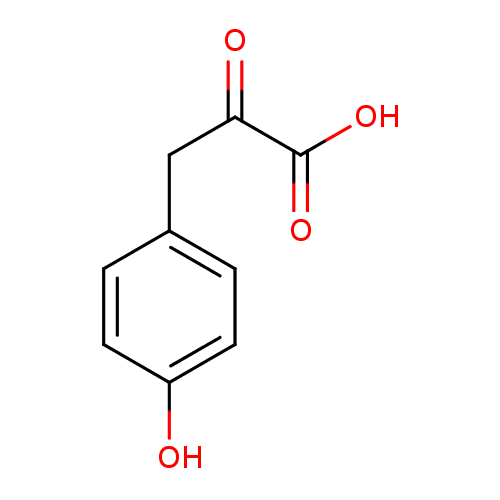
Description4-Hydroxyphenylpyruvic acid (4-HPPA) is a keto acid that is involved in the tyrosine catabolism pathway. It is a product of the enzyme (R)-4-hydroxyphenyllactate dehydrogenase [EC 1.1.1.222] and is formed during tyrosine metabolism. The conversion from tyrosine to 4-HPPA is catalyzed by tyrosine aminotransferase. Additionally, 4-HPPA can be converted to homogentisic acid which is one of the precursors to ochronotic pigment. The enzyme 4-hydroxyphenylpyruvic acid dioxygenase (HPD) catalyzes the reaction that converts 4-hydroxyphenylpyruvic acid to homogentisic acid. A deficiency in the catalytic activity of HPD is known to lead to tyrosinemia type III, an autosomal recessive disorder characterized by elevated levels of blood tyrosine and massive excretion of tyrosine derivatives into urine. It has been shown that hawkinsinuria, an autosomal dominant disorder characterized by the excretion of 'hawkinsin,' may also be a result of HPD deficiency There are two isomers of HPPA, specifically 4HPPA and 3HPPA, of which 4HPPA is the most common. (1).
Contaminant Sources
  • FooDB Chemicals
  • HMDB Contaminants - Urine
  • T3DB toxins
Contaminant Type
  • Animal Toxin
  • Food Toxin
  • Metabolite
  • Natural Compound
  • Organic Compound
Chemical Structure
Thumb
Synonyms
ValueSource
(4-Hydroxyphenyl)pyruvic acidChEBI
(p-Hydroxyphenyl)pyruvic acidChEBI
3-(4-HYDROXY-phenyl)pyruvIC ACIDChEBI
3-(4-Hydroxyphenyl)pyruvic acidChEBI
3-(p-Hydroxyphenyl)-2-oxopropanoic acidChEBI
4-Hydroxy alpha-oxobenzenepropanoic acidChEBI
p-Hydroxyphenylpyruvic acidChEBI
4-HydroxyphenylpyruvateKegg
(4-Hydroxyphenyl)pyruvateGenerator
(p-Hydroxyphenyl)pyruvateGenerator
3-(4-HYDROXY-phenyl)pyruvateGenerator
3-(4-Hydroxyphenyl)pyruvateGenerator
3-(p-Hydroxyphenyl)-2-oxopropanoateGenerator
4-Hydroxy a-oxobenzenepropanoateGenerator
4-Hydroxy a-oxobenzenepropanoic acidGenerator
4-Hydroxy alpha-oxobenzenepropanoateGenerator
4-Hydroxy α-oxobenzenepropanoateGenerator
4-Hydroxy α-oxobenzenepropanoic acidGenerator
p-HydroxyphenylpyruvateGenerator
(p-Hydroxyphenyl)-pyruvateHMDB
(p-Hydroxyphenyl)-pyruvic acidHMDB
3-(4-Hydroxyphenyl)-2-oxo-propanoateHMDB
3-(4-Hydroxyphenyl)-2-oxo-propanoic acidHMDB
3-(4-Hydroxyphenyl)-2-oxopropionateHMDB
3-(4-Hydroxyphenyl)-2-oxopropionic acidHMDB
3-(p-Hydroxyphenyl)-2-oxopropionateHMDB
3-(p-Hydroxyphenyl)-2-oxopropionic acidHMDB
3-(p-Hydroxyphenyl)pyruvateHMDB
3-(p-Hydroxyphenyl)pyruvic acidHMDB
4-Hydroxy-a-oxobenzenepropanoateHMDB
4-Hydroxy-a-oxobenzenepropanoic acidHMDB
4-Hydroxy-alpha-oxobenzenepropanoateHMDB
4-Hydroxy-alpha-oxobenzenepropanoic acidHMDB
4HPPAHMDB
HPPAHMDB
HydroxyphenylpyruvateHMDB
Hydroxyphenylpyruvic acidHMDB
p-HydroxyphenylpyruvicHMDB
TestacidHMDB
4-Hydroxyphenylpyruvic acid, ionHMDB
4-Hydroxyphenylpyruvic acid, sodium saltHMDB
Para-hydroxyphenylpyruvic acidHMDB
Chemical FormulaC9H8O4
Average Molecular Mass180.157 g/mol
Monoisotopic Mass180.042 g/mol
CAS Registry Number156-39-8
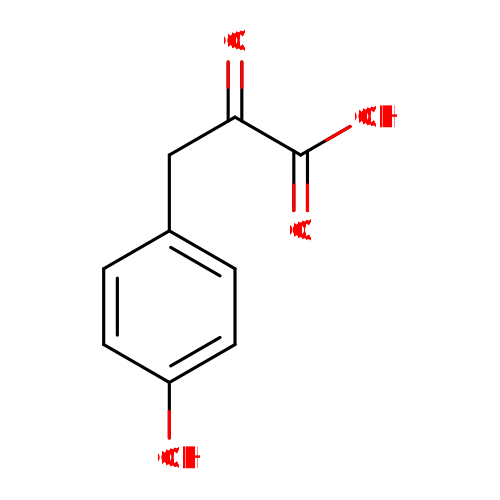
IUPAC Name3-(4-hydroxyphenyl)-2-oxopropanoic acid
Traditional Name4-hydroxyphenylpyruvic acid
SMILESOC(=O)C(=O)CC1=CC=C(O)C=C1
InChI IdentifierInChI=1S/C9H8O4/c10-7-3-1-6(2-4-7)5-8(11)9(12)13/h1-4,10H,5H2,(H,12,13)
InChI KeyKKADPXVIOXHVKN-UHFFFAOYSA-N
Chemical Taxonomy
Description belongs to the class of organic compounds known as phenylpyruvic acid derivatives. Phenylpyruvic acid derivatives are compounds containing a phenylpyruvic acid moiety, which consists of a phenyl group substituted at the second position by an pyruvic acid.
KingdomOrganic compounds
Super ClassBenzenoids
ClassBenzene and substituted derivatives
Sub ClassPhenylpyruvic acid derivatives
Direct ParentPhenylpyruvic acid derivatives
Alternative Parents
Substituents
  • Phenylpyruvate
  • 3-phenylpropanoic-acid
  • 1-hydroxy-2-unsubstituted benzenoid
  • Phenol
  • Alpha-keto acid
  • Keto acid
  • Alpha-hydroxy ketone
  • Ketone
  • Carboxylic acid derivative
  • Carboxylic acid
  • Monocarboxylic acid or derivatives
  • Organic oxide
  • Organic oxygen compound
  • Carbonyl group
  • Hydrocarbon derivative
  • Organooxygen compound
  • Aromatic homomonocyclic compound
Molecular FrameworkAromatic homomonocyclic compounds
External Descriptors
Biological Properties
StatusDetected and Not Quantified
OriginEndogenous
Cellular Locations
  • Cytoplasm
  • Extracellular
  • Mitochondria
Biofluid LocationsNot Available
Tissue Locations
  • Prostate
Pathways
NameSMPDB LinkKEGG Link
Phenylalanine and Tyrosine MetabolismSMP00008 map00360
Tyrosine MetabolismSMP00006 map00350
HawkinsinuriaSMP00190 Not Available
Tyrosinemia, transient, of the newbornSMP00494 Not Available
Tyrosinemia Type 2 (or Richner-Hanhart syndrome)SMP00369 Not Available
ApplicationsNot Available
Biological Roles
Chemical RolesNot Available
Physical Properties
StateSolid
AppearanceWhite powder.
Experimental Properties
PropertyValue
Melting Point219 - 220°C
Boiling PointNot Available
SolubilityNot Available
Predicted Properties
PropertyValueSource
Water Solubility1.49 g/LALOGPS
logP1.12ALOGPS
logP1.6ChemAxon
logS-2.1ALOGPS
pKa (Strongest Acidic)2.91ChemAxon
pKa (Strongest Basic)-6ChemAxon
Physiological Charge-1ChemAxon
Hydrogen Acceptor Count4ChemAxon
Hydrogen Donor Count2ChemAxon
Polar Surface Area74.6 ŲChemAxon
Rotatable Bond Count3ChemAxon
Refractivity44.69 m³·mol⁻¹ChemAxon
Polarizability16.75 ųChemAxon
Number of Rings1ChemAxon
Bioavailability1ChemAxon
Rule of FiveYesChemAxon
Ghose FilterYesChemAxon
Veber's RuleNoChemAxon
MDDR-like RuleNoChemAxon
Spectra
Spectra
Spectrum TypeDescriptionSplash KeyView
GC-MSGC-MS Spectrum - GC-EI-TOF (Pegasus III TOF-MS system, Leco; GC 6890, Agilent Technologies) (Non-derivatized)splash10-002f-1920000000-75b07d9c09371340939fSpectrum
GC-MSGC-MS Spectrum - GC-EI-TOF (Pegasus III TOF-MS system, Leco; GC 6890, Agilent Technologies) (3 TMS)splash10-00xr-9340000000-087aad2497b3493d27c0Spectrum
GC-MSGC-MS Spectrum - GC-MS (1 MEOX; 2 TMS)splash10-002o-5910000000-fd1e55c84c79bfeca559Spectrum
GC-MSGC-MS Spectrum - GC-MS (1 MEOX; 2 TMS)splash10-002f-1941000000-2b4c87544657895fcaf6Spectrum
GC-MSGC-MS Spectrum - GC-MS (1 MEOX; 3 TMS)splash10-014i-3492100000-483bdcea11d60fe4d306Spectrum
GC-MSGC-MS Spectrum - GC-MS (1 MEOX; 3 TMS)splash10-014i-6791000000-ddc0a3b695cd1d0769f2Spectrum
GC-MSGC-MS Spectrum - EI-B (Non-derivatized)splash10-002f-1951000000-ecd071a64b26ca77684cSpectrum
GC-MSGC-MS Spectrum - GC-EI-TOF (Non-derivatized)splash10-002f-1920000000-75b07d9c09371340939fSpectrum
GC-MSGC-MS Spectrum - GC-EI-TOF (Non-derivatized)splash10-00xr-9340000000-087aad2497b3493d27c0Spectrum
GC-MSGC-MS Spectrum - GC-MS (Non-derivatized)splash10-002o-5910000000-fd1e55c84c79bfeca559Spectrum
GC-MSGC-MS Spectrum - GC-MS (Non-derivatized)splash10-002f-1941000000-2b4c87544657895fcaf6Spectrum
GC-MSGC-MS Spectrum - GC-MS (Non-derivatized)splash10-014i-3492100000-483bdcea11d60fe4d306Spectrum
GC-MSGC-MS Spectrum - GC-MS (Non-derivatized)splash10-014i-6791000000-ddc0a3b695cd1d0769f2Spectrum
GC-MSGC-MS Spectrum - GC-EI-TOF (Non-derivatized)splash10-0006-2920000000-469469dfaad745fa78e8Spectrum
GC-MSGC-MS Spectrum - GC-EI-TOF (Non-derivatized)splash10-002o-2910000000-4f336335a2366e7dd6dbSpectrum
Predicted GC-MSPredicted GC-MS Spectrum - GC-MS (Non-derivatized) - 70eV, Positivesplash10-0a4i-6900000000-91bfe3ee54a36877251bSpectrum
Predicted GC-MSPredicted GC-MS Spectrum - GC-MS (2 TMS) - 70eV, Positivesplash10-0adi-6961000000-670161f1542fda9ff1feSpectrum
Predicted GC-MSPredicted GC-MS Spectrum - GC-MS (Non-derivatized) - 70eV, PositiveNot AvailableSpectrum
Predicted GC-MSPredicted GC-MS Spectrum - GC-MS (TMS_1_1) - 70eV, PositiveNot AvailableSpectrum
Predicted GC-MSPredicted GC-MS Spectrum - GC-MS (TMS_1_2) - 70eV, PositiveNot AvailableSpectrum
Predicted GC-MSPredicted GC-MS Spectrum - GC-MS (TMS_1_3) - 70eV, PositiveNot AvailableSpectrum
Predicted GC-MSPredicted GC-MS Spectrum - GC-MS (TMS_2_2) - 70eV, PositiveNot AvailableSpectrum
Predicted GC-MSPredicted GC-MS Spectrum - GC-MS (TMS_2_3) - 70eV, PositiveNot AvailableSpectrum
Predicted GC-MSPredicted GC-MS Spectrum - GC-MS (TBDMS_1_1) - 70eV, PositiveNot AvailableSpectrum
Predicted GC-MSPredicted GC-MS Spectrum - GC-MS (TBDMS_1_2) - 70eV, PositiveNot AvailableSpectrum
LC-MS/MSLC-MS/MS Spectrum - Quattro_QQQ 10V, Negative (Annotated)splash10-0a4i-0900000000-12033042c41b550bed42Spectrum
LC-MS/MSLC-MS/MS Spectrum - Quattro_QQQ 25V, Negative (Annotated)splash10-0a4i-0900000000-6e8a3701c6d254cc824dSpectrum
LC-MS/MSLC-MS/MS Spectrum - Quattro_QQQ 40V, Negative (Annotated)splash10-0560-1900000000-8082c68e259d24234d05Spectrum
LC-MS/MSLC-MS/MS Spectrum - LC-ESI-QQ (API3000, Applied Biosystems) 10V, Negativesplash10-004i-0900000000-2416d7f64101b9473cbbSpectrum
LC-MS/MSLC-MS/MS Spectrum - LC-ESI-QQ (API3000, Applied Biosystems) 20V, Negativesplash10-0a4i-2900000000-b4c21b3d9751b9e56d67Spectrum
LC-MS/MSLC-MS/MS Spectrum - LC-ESI-QQ (API3000, Applied Biosystems) 30V, Negativesplash10-0005-9400000000-708e258e692a0abfbc92Spectrum
LC-MS/MSLC-MS/MS Spectrum - LC-ESI-QQ (API3000, Applied Biosystems) 40V, Negativesplash10-0002-9100000000-7d75e23ae6944c1e9c6dSpectrum
LC-MS/MSLC-MS/MS Spectrum - LC-ESI-QQ (API3000, Applied Biosystems) 50V, Negativesplash10-001m-9000000000-fb80dcbab23323a042afSpectrum
LC-MS/MSLC-MS/MS Spectrum - LC-ESI-QQ , negativesplash10-004i-0900000000-2416d7f64101b9473cbbSpectrum
LC-MS/MSLC-MS/MS Spectrum - LC-ESI-QQ , negativesplash10-0a4i-2900000000-ad1f1fabdf6b1579fff7Spectrum
LC-MS/MSLC-MS/MS Spectrum - LC-ESI-QQ , negativesplash10-0005-9400000000-708e258e692a0abfbc92Spectrum
LC-MS/MSLC-MS/MS Spectrum - LC-ESI-QQ , negativesplash10-0002-9100000000-7d75e23ae6944c1e9c6dSpectrum
LC-MS/MSLC-MS/MS Spectrum - LC-ESI-QQ , negativesplash10-001m-9000000000-fb80dcbab23323a042afSpectrum
LC-MS/MSLC-MS/MS Spectrum - , positivesplash10-001i-1900000000-76ae33b45e4348d50b07Spectrum
LC-MS/MSLC-MS/MS Spectrum - 10V, Negativesplash10-02bf-7900000000-665940e67ad40f759048Spectrum
LC-MS/MSLC-MS/MS Spectrum - 20V, Negativesplash10-053i-9800000000-0f708ba46e75f553e77cSpectrum
LC-MS/MSLC-MS/MS Spectrum - 35V, Negativesplash10-00dl-5900000000-86f6d19bba9a914d22eeSpectrum
LC-MS/MSLC-MS/MS Spectrum - 35V, Positivesplash10-0159-0900000000-a1a6bf5b3a0ac3863c90Spectrum
LC-MS/MSLC-MS/MS Spectrum - 40V, Negativesplash10-06ur-9700000000-18795e8a2dc93ca36a93Spectrum
Predicted LC-MS/MSPredicted LC-MS/MS Spectrum - 10V, Positivesplash10-08gr-0900000000-be3cb913118057f499d1Spectrum
Predicted LC-MS/MSPredicted LC-MS/MS Spectrum - 20V, Positivesplash10-06rj-0900000000-6bebea0fda2ef3a2263bSpectrum
Predicted LC-MS/MSPredicted LC-MS/MS Spectrum - 40V, Positivesplash10-0a6r-6900000000-ede11b81a97e891c66e3Spectrum
Predicted LC-MS/MSPredicted LC-MS/MS Spectrum - 10V, Negativesplash10-004i-0900000000-2584f872c980915c1739Spectrum
Predicted LC-MS/MSPredicted LC-MS/MS Spectrum - 20V, Negativesplash10-01s9-1900000000-249c71cfa9cefe2a8020Spectrum
Predicted LC-MS/MSPredicted LC-MS/MS Spectrum - 40V, Negativesplash10-001l-3900000000-66991d861a91be9b9286Spectrum
MSMass Spectrum (Electron Ionization)splash10-0a59-5900000000-6c003e26816579df31caSpectrum
1D NMR1H NMR SpectrumNot AvailableSpectrum
1D NMR13C NMR SpectrumNot AvailableSpectrum
2D NMR[1H,1H] 2D NMR SpectrumNot AvailableSpectrum
2D NMR[1H,13C] 2D NMR SpectrumNot AvailableSpectrum
Toxicity Profile
Route of ExposureNot Available
Mechanism of ToxicityNot Available
MetabolismNot Available
Toxicity ValuesNot Available
Lethal DoseNot Available
Carcinogenicity (IARC Classification)No indication of carcinogenicity to humans (not listed by IARC).
Uses/SourcesThis is an endogenously produced metabolite found in the human body. It is used in metabolic reactions, catabolic reactions or waste generation.
Minimum Risk LevelNot Available
Health EffectsNot Available
SymptomsNot Available
TreatmentNot Available
Concentrations
Not Available
DrugBank IDDB07718
HMDB IDHMDB0000707
FooDB IDFDB030506
Phenol Explorer IDNot Available
KNApSAcK IDC00007512
BiGG ID37006
BioCyc IDP-HYDROXY-PHENYLPYRUVATE
METLIN ID5675
PDB IDNot Available
Wikipedia Link4-Hydroxyphenylpyruvic_acid
Chemspider ID954
ChEBI ID15999
PubChem Compound ID979
Kegg Compound IDC01179
YMDB IDYMDB00151
ECMDB IDECMDB23008
References
Synthesis ReferenceNot Available
MSDSLink
General References
1. https://www.ncbi.nlm.nih.gov/pubmed/?term=11073718
2. https://www.ncbi.nlm.nih.gov/pubmed/?term=9106023
3. Melzer N, Wittenburg D, Hartwig S, Jakubowski S, Kesting U, Willmitzer L, Lisec J, Reinsch N, Repsilber D: Investigating associations between milk metabolite profiles and milk traits of Holstein cows. J Dairy Sci. 2013 Mar;96(3):1521-34. doi: 10.3168/jds.2012-5743.
4. Xi X, Kwok LY, Wang Y, Ma C, Mi Z, Zhang H: Ultra-performance liquid chromatography-quadrupole-time of flight mass spectrometry MS(E)-based untargeted milk metabolomics in dairy cows with subclinical or clinical mastitis. J Dairy Sci. 2017 Jun;100(6):4884-4896. doi: 10.3168/jds.2016-11939. Epub 2017 Mar 23.
5. Billek, Gerhard. p-Hydroxyphenylpyruvic acid. Organic Syntheses (1963), 43 49-54.
6. Shoda J, Tanaka N, Osuga T, Matsuura K, Miyazaki H: Altered bile acid metabolism in liver disease: concurrent occurrence of C-1 and C-6 hydroxylated bile acid metabolites and their preferential excretion into urine. J Lipid Res. 1990 Feb;31(2):249-59.
7. Wolff JA, Barshop B, Nyhan WL, Leslie J, Seegmiller JE, Gruber H, Garst M, Winter S, Michals K, Matalon R: Effects of ascorbic acid in alkaptonuria: alterations in benzoquinone acetic acid and an ontogenic effect in infancy. Pediatr Res. 1989 Aug;26(2):140-4.
8. Deutsch JC: Determination of p-hydroxyphenylpyruvate, p-hydroxyphenyllactate and tyrosine in normal human plasma by gas chromatography-mass spectrometry isotope-dilution assay. J Chromatogr B Biomed Sci Appl. 1997 Mar 7;690(1-2):1-6.
9. Guneral F, Bachmann C: Age-related reference values for urinary organic acids in a healthy Turkish pediatric population. Clin Chem. 1994 Jun;40(6):862-6.
10. Muskiet FA, Fremouw-Ottevangers DC, Nagel GT, Wolthers BG, de Vries JA: Determination of 3-methoxy-4-hydroxyphenylpyruvic acid, 3,4-dihydroxyphenylethylene glycol, and 3,4-dihydroxyphenylmandelic acid in urine by mass fragmentography, with use of deuterium-labeled internal standards. Clin Chem. 1978 Nov;24(11):2001-8.
11. Endo F, Katoh H, Yamamoto S, Matsuda I: A murine model for type III tyrosinemia: lack of immunologically detectable 4-hydroxyphenylpyruvic acid dioxygenase enzyme protein in a novel mouse strain with hypertyrosinemia. Am J Hum Genet. 1991 Apr;48(4):704-9.
12. Sreekumar A, Poisson LM, Rajendiran TM, Khan AP, Cao Q, Yu J, Laxman B, Mehra R, Lonigro RJ, Li Y, Nyati MK, Ahsan A, Kalyana-Sundaram S, Han B, Cao X, Byun J, Omenn GS, Ghosh D, Pennathur S, Alexander DC, Berger A, Shuster JR, Wei JT, Varambally S, Beecher C, Chinnaiyan AM: Metabolomic profiles delineate potential role for sarcosine in prostate cancer progression. Nature. 2009 Feb 12;457(7231):910-4. doi: 10.1038/nature07762.
13. Tomoeda K, Awata H, Matsuura T, Matsuda I, Ploechl E, Milovac T, Boneh A, Scott CR, Danks DM, Endo F: Mutations in the 4-hydroxyphenylpyruvic acid dioxygenase gene are responsible for tyrosinemia type III and hawkinsinuria. Mol Genet Metab. 2000 Nov;71(3):506-10.
14. Elshenawy S, Pinney SE, Stuart T, Doulias PT, Zura G, Parry S, Elovitz MA, Bennett MJ, Bansal A, Strauss JF 3rd, Ischiropoulos H, Simmons RA: The Metabolomic Signature of the Placenta in Spontaneous Preterm Birth. Int J Mol Sci. 2020 Feb 4;21(3). pii: ijms21031043. doi: 10.3390/ijms21031043.