Record Information
Version1.0
Creation Date2014-08-29 06:35:54 UTC
Update Date2026-05-14 16:24:22 UTC
Accession NumberCHEM003330
Identification
Common NameL-Valine
ClassSmall Molecule
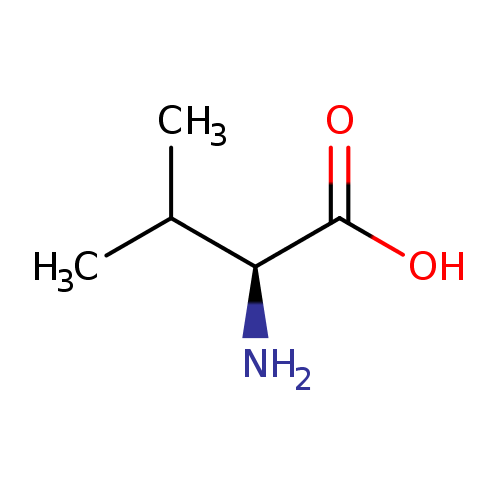
DescriptionValine (abbreviated as Val or V) is an -amino acid with the chemical formula HO2CCH(NH2)CH(CH3)2. It is named after the plant valerian. L-Valine is one of 20 proteinogenic amino acids. Its codons are GUU, GUC, GUA, and GUG. This essential amino acid is classified as nonpolar. Along with leucine and isoleucine, valine is a branched-chain amino acid. Branched chain amino acids (BCAA) are essential amino acids whose carbon structure is marked by a branch point. These three amino acids are critical to human life and are particularly involved in stress, energy and muscle metabolism. BCAA supplementation as therapy, both oral and intravenous, in human health and disease holds great promise. BCAA denotes valine, isoleucine and leucine which are branched chain essential amino acids. Despite their structural similarities, the branched amino acids have different metabolic routes, with valine going solely to carbohydrates, leucine solely to fats and isoleucine to both. The different metabolism accounts for different requirements for these essential amino acids in humans: 12 mg/kg, 14 mg/kg and 16 mg/kg of valine, leucine and isoleucine respectively. Furthermore, these amino acids have different deficiency symptoms. Valine deficiency is marked by neurological defects in the brain, while isoleucine deficiency is marked by muscle tremors. Many types of inborn errors of BCAA metabolism exist, and are marked by various abnormalities. The most common form is the maple syrup urine disease, marked by a characteristic urinary odor. Other abnormalities are associated with a wide range of symptoms, such as mental retardation, ataxia, hypoglycemia, spinal muscle atrophy, rash, vomiting and excessive muscle movement. Most forms of BCAA metabolism errors are corrected by dietary restriction of BCAA and at least one form is correctable by supplementation with 10 mg of biotin daily. BCAA are decreased in patients with liver disease, such as hepatitis, hepatic coma, cirrhosis, extrahepatic biliary atresia or portacaval shunt; aromatic amino acids (AAA) tyrosine, tryptophan and phenylalanine, as well as methionine are increased in these conditions. Valine in particular, has been established as a useful supplemental therapy to the ailing liver. All the BCAA probably compete with AAA for absorption into the brain. Supplemental BCAA with vitamin B6 and zinc help normalize the BCAA:AAA ratio. In sickle-cell disease, valine substitutes for the hydrophilic amino acid glutamic acid in hemoglobin. Because valine is hydrophobic, the hemoglobin does not fold correctly. Valine is an essential amino acid, hence it must be ingested, usually as a component of proteins.
Contaminant Sources
  • Cosmetic Chemicals
  • EAFUS Chemicals
  • FooDB Chemicals
  • HMDB Contaminants - Feces
  • HMDB Contaminants - Urine
  • HPV EPA Chemicals
  • STOFF IDENT Compounds
  • T3DB toxins
Contaminant Type
  • Amine
  • Amino Acid, Essential
  • Animal Toxin
  • Dietary Supplement
  • Drug
  • Food Toxin
  • Metabolite
  • Micronutrient
  • Natural Compound
  • Nutraceutical
  • Organic Compound
Chemical Structure
Thumb
Synonyms
ValueSource
(2S)-2-Amino-3-methylbutanoic acidChEBI
(S)-ValineChEBI
2-Amino-3-methylbutyric acidChEBI
L-(+)-alpha-Aminoisovaleric acidChEBI
L-alpha-Amino-beta-methylbutyric acidChEBI
L-ValinChEBI
VChEBI
ValChEBI
VALINEChEBI
(2S)-2-Amino-3-methylbutanoateGenerator
2-Amino-3-methylbutyrateGenerator
L-(+)-a-AminoisovalerateGenerator
L-(+)-a-Aminoisovaleric acidGenerator
L-(+)-alpha-AminoisovalerateGenerator
L-(+)-Α-aminoisovalerateGenerator
L-(+)-Α-aminoisovaleric acidGenerator
L-a-Amino-b-methylbutyrateGenerator
L-a-Amino-b-methylbutyric acidGenerator
L-alpha-Amino-beta-methylbutyrateGenerator
L-Α-amino-β-methylbutyrateGenerator
L-Α-amino-β-methylbutyric acidGenerator
(S)-2-Amino-3-methyl-butanoateHMDB
(S)-2-Amino-3-methyl-butanoic acidHMDB
(S)-2-Amino-3-methylbutanoateHMDB
(S)-2-Amino-3-methylbutanoic acidHMDB
(S)-2-Amino-3-methylbutyrateHMDB
(S)-2-Amino-3-methylbutyric acidHMDB
(S)-a-Amino-b-methylbutyrateHMDB
(S)-a-Amino-b-methylbutyric acidHMDB
(S)-alpha-Amino-beta-methylbutyrateHMDB
(S)-alpha-Amino-beta-methylbutyric acidHMDB
2-Amino-3-methylbutanoateHMDB
2-Amino-3-methylbutanoic acidHMDB
L ValineHMDB
Chemical FormulaC5H11NO2
Average Molecular Mass117.146 g/mol
Monoisotopic Mass117.079 g/mol
CAS Registry Number72-18-4
IUPAC Name(2S)-2-amino-3-methylbutanoic acid
Traditional NameL-valine
SMILESCC(C)[C@H](N)C(O)=O
InChI IdentifierInChI=1S/C5H11NO2/c1-3(2)4(6)5(7)8/h3-4H,6H2,1-2H3,(H,7,8)/t4-/m0/s1
InChI KeyKZSNJWFQEVHDMF-BYPYZUCNSA-N
Chemical Taxonomy
Description belongs to the class of organic compounds known as valine and derivatives. Valine and derivatives are compounds containing valine or a derivative thereof resulting from reaction of valine at the amino group or the carboxy group, or from the replacement of any hydrogen of glycine by a heteroatom.
KingdomOrganic compounds
Super ClassOrganic acids and derivatives
ClassCarboxylic acids and derivatives
Sub ClassAmino acids, peptides, and analogues
Direct ParentValine and derivatives
Alternative Parents
Substituents
  • Valine or derivatives
  • Alpha-amino acid
  • L-alpha-amino acid
  • Branched fatty acid
  • Methyl-branched fatty acid
  • Fatty acid
  • Fatty acyl
  • Amino acid
  • Monocarboxylic acid or derivatives
  • Carboxylic acid
  • Organic oxide
  • Organopnictogen compound
  • Primary amine
  • Organooxygen compound
  • Organonitrogen compound
  • Primary aliphatic amine
  • Carbonyl group
  • Organic oxygen compound
  • Amine
  • Organic nitrogen compound
  • Hydrocarbon derivative
  • Aliphatic acyclic compound
Molecular FrameworkAliphatic acyclic compounds
External Descriptors
Biological Properties
StatusDetected and Not Quantified
OriginEndogenous
Cellular Locations
  • Cytoplasm
  • Extracellular
  • Mitochondria
Biofluid LocationsNot Available
Tissue Locations
  • Epidermis
  • Fibroblasts
Pathways
NameSMPDB LinkKEGG Link
Propanoate MetabolismSMP00016 map00640
Transcription/TranslationSMP00019 Not Available
Valine, Leucine and Isoleucine DegradationSMP00032 map00280
Hartnup DisorderSMP00189 Not Available
Applications
Biological Roles
Chemical RolesNot Available
Physical Properties
StateSolid
AppearanceWhite powder.
Experimental Properties
PropertyValue
Melting Point315°C
Boiling PointNot Available
Solubility5.85E+004 mg/L (at 25°C)
Predicted Properties
PropertyValueSource
Water Solubility214 g/LALOGPS
logP-2.3ALOGPS
logP-2ChemAxon
logS0.26ALOGPS
pKa (Strongest Acidic)2.72ChemAxon
pKa (Strongest Basic)9.6ChemAxon
Physiological Charge0ChemAxon
Hydrogen Acceptor Count3ChemAxon
Hydrogen Donor Count2ChemAxon
Polar Surface Area63.32 ŲChemAxon
Rotatable Bond Count2ChemAxon
Refractivity29.49 m³·mol⁻¹ChemAxon
Polarizability12.19 ųChemAxon
Number of Rings0ChemAxon
Bioavailability1ChemAxon
Rule of FiveYesChemAxon
Ghose FilterNoChemAxon
Veber's RuleNoChemAxon
MDDR-like RuleNoChemAxon
Spectra
Spectra
Spectrum TypeDescriptionSplash KeyView
GC-MSGC-MS Spectrum - GC-EI-TOF (Pegasus III TOF-MS system, Leco; GC 6890, Agilent Technologies) (2 TMS)splash10-0006-0910000000-23bfcf2795f71f458bdaSpectrum
GC-MSGC-MS Spectrum - GC-EI-TOF (Pegasus III TOF-MS system, Leco; GC 6890, Agilent Technologies) (2 TMS)splash10-0006-0920000000-7892bb9d4d9afcc23410Spectrum
GC-MSGC-MS Spectrum - GC-EI-TOF (Pegasus III TOF-MS system, Leco; GC 6890, Agilent Technologies) (2 TMS)splash10-0006-0910000000-f2491152816b9c5dc7edSpectrum
GC-MSGC-MS Spectrum - GC-EI-TOF (Pegasus III TOF-MS system, Leco; GC 6890, Agilent Technologies) (1 TMS)splash10-0znj-1900000000-7c976d7c11a402db399fSpectrum
GC-MSGC-MS Spectrum - GC-EI-TOF (Pegasus III TOF-MS system, Leco; GC 6890, Agilent Technologies) (2 TMS)splash10-00dl-8910000000-78e8ee971ad7298c23cdSpectrum
GC-MSGC-MS Spectrum - GC-MS (1 TMS)splash10-00di-9200000000-805e6724e5181af78c81Spectrum
GC-MSGC-MS Spectrum - GC-MS (2 TMS)splash10-0006-0910000000-a212771a5ea868139d5aSpectrum
GC-MSGC-MS Spectrum - EI-B (Non-derivatized)splash10-059t-0900000000-7b8e4e98ac9158bf26d9Spectrum
GC-MSGC-MS Spectrum - EI-B (Non-derivatized)splash10-0006-0910000000-9079324093be9a14d47aSpectrum
GC-MSGC-MS Spectrum - GC-EI-TOF (Non-derivatized)splash10-0006-0910000000-23bfcf2795f71f458bdaSpectrum
GC-MSGC-MS Spectrum - GC-EI-TOF (Non-derivatized)splash10-0006-0920000000-7892bb9d4d9afcc23410Spectrum
GC-MSGC-MS Spectrum - GC-EI-TOF (Non-derivatized)splash10-0006-0910000000-f2491152816b9c5dc7edSpectrum
GC-MSGC-MS Spectrum - GC-EI-TOF (Non-derivatized)splash10-0znj-1900000000-7c976d7c11a402db399fSpectrum
GC-MSGC-MS Spectrum - GC-EI-QQ (Non-derivatized)splash10-000i-2920000000-1628d46d5520c5f20de8Spectrum
GC-MSGC-MS Spectrum - GC-EI-TOF (Non-derivatized)splash10-00dl-8910000000-78e8ee971ad7298c23cdSpectrum
GC-MSGC-MS Spectrum - GC-MS (Non-derivatized)splash10-00di-9200000000-805e6724e5181af78c81Spectrum
GC-MSGC-MS Spectrum - GC-MS (Non-derivatized)splash10-0006-0910000000-a212771a5ea868139d5aSpectrum
Predicted GC-MSPredicted GC-MS Spectrum - GC-MS (Non-derivatized) - 70eV, Positivesplash10-00dl-9000000000-602d1e01bc7567493e4cSpectrum
Predicted GC-MSPredicted GC-MS Spectrum - GC-MS (1 TMS) - 70eV, Positivesplash10-00dl-9500000000-a758682a7aafbd0d553eSpectrum
Predicted GC-MSPredicted GC-MS Spectrum - GC-MS (Non-derivatized) - 70eV, PositiveNot AvailableSpectrum
Predicted GC-MSPredicted GC-MS Spectrum - GC-MS (TMS_1_2) - 70eV, PositiveNot AvailableSpectrum
Predicted GC-MSPredicted GC-MS Spectrum - GC-MS (TBDMS_1_1) - 70eV, PositiveNot AvailableSpectrum
Predicted GC-MSPredicted GC-MS Spectrum - GC-MS (TBDMS_1_2) - 70eV, PositiveNot AvailableSpectrum
LC-MS/MSLC-MS/MS Spectrum - Quattro_QQQ 10V, Positive (Annotated)splash10-00di-9000000000-67498a3295a1fe788c4bSpectrum
LC-MS/MSLC-MS/MS Spectrum - Quattro_QQQ 25V, Positive (Annotated)splash10-0a4i-9000000000-fb359f44fcf1b83ee14dSpectrum
LC-MS/MSLC-MS/MS Spectrum - Quattro_QQQ 40V, Positive (Annotated)splash10-0a4i-9000000000-8e5f620c04615765a062Spectrum
LC-MS/MSLC-MS/MS Spectrum - LC-ESI-ITFT (LTQ Orbitrap XL, Thermo Scientfic) , Positivesplash10-014r-0900000000-619d80cc41221405e0bdSpectrum
LC-MS/MSLC-MS/MS Spectrum - LC-ESI-ITFT (LTQ Orbitrap XL, Thermo Scientfic) , Positivesplash10-00di-9000000000-17ab53cec2e6b727c3e9Spectrum
LC-MS/MSLC-MS/MS Spectrum - LC-ESI-ITFT (LTQ Orbitrap XL, Thermo Scientfic) , Positivesplash10-00di-9000000000-0dfbcc85d6423af91edaSpectrum
LC-MS/MSLC-MS/MS Spectrum - LC-ESI-ITFT (LTQ Orbitrap XL, Thermo Scientfic) , Positivesplash10-014l-4900000000-c50d79ba3a5013bcf29fSpectrum
LC-MS/MSLC-MS/MS Spectrum - LC-ESI-ITFT (LTQ Orbitrap XL, Thermo Scientfic) , Positivesplash10-0uxr-0900000000-67a7784963ec75cecaa0Spectrum
LC-MS/MSLC-MS/MS Spectrum - LC-ESI-ITFT (LTQ Orbitrap XL, Thermo Scientfic) , Positivesplash10-00di-9000000000-4569516f23d8a712b434Spectrum
LC-MS/MSLC-MS/MS Spectrum - LC-ESI-ITFT (LTQ Orbitrap XL, Thermo Scientfic) , Positivesplash10-001i-0900000000-d928cac1226f19b8edc3Spectrum
LC-MS/MSLC-MS/MS Spectrum - LC-ESI-ITFT (LTQ Orbitrap XL, Thermo Scientfic) , Positivesplash10-0udi-0900000000-34059351f2cbd94a8accSpectrum
LC-MS/MSLC-MS/MS Spectrum - LC-ESI-QQ (API3000, Applied Biosystems) 10V, Negativesplash10-014i-0900000000-a36d8d68a6705027415fSpectrum
LC-MS/MSLC-MS/MS Spectrum - LC-ESI-QQ (API3000, Applied Biosystems) 20V, Negativesplash10-014i-0900000000-1a5d8f4c1b293de18fedSpectrum
LC-MS/MSLC-MS/MS Spectrum - LC-ESI-QQ (API3000, Applied Biosystems) 30V, Negativesplash10-014i-0900000000-b410df2c18dfc8ab7165Spectrum
LC-MS/MSLC-MS/MS Spectrum - LC-ESI-QQ (API3000, Applied Biosystems) 10V, Positivesplash10-0gi0-6900000000-c87ff036e3a5d15b7670Spectrum
LC-MS/MSLC-MS/MS Spectrum - LC-ESI-QQ (API3000, Applied Biosystems) 20V, Positivesplash10-00di-9000000000-561b3b28fa82e0b10658Spectrum
LC-MS/MSLC-MS/MS Spectrum - LC-ESI-QQ (API3000, Applied Biosystems) 30V, Positivesplash10-05fr-9000000000-11e7c0a3d5cf8e4dedfeSpectrum
LC-MS/MSLC-MS/MS Spectrum - LC-ESI-QQ (API3000, Applied Biosystems) 40V, Positivesplash10-0a4i-9000000000-6a6f8cd9629b0f09469cSpectrum
LC-MS/MSLC-MS/MS Spectrum - LC-ESI-QQ (API3000, Applied Biosystems) 50V, Positivesplash10-0a4i-9000000000-4518f691bbda5739c0f1Spectrum
LC-MS/MSLC-MS/MS Spectrum - CE-ESI-TOF (CE-system connected to 6210 Time-of-Flight MS, Agilent) , Positivesplash10-014i-0900000000-a931cfc8207edac33775Spectrum
LC-MS/MSLC-MS/MS Spectrum - LC-ESI-QTOF (UPLC Q-Tof Premier, Waters) , Positivesplash10-00di-9000000000-430332b13b8c6368136bSpectrum
LC-MS/MSLC-MS/MS Spectrum - LC-ESI-QTOF (UPLC Q-Tof Premier, Waters) , Negativesplash10-014i-0900000000-ffb286a8ae38a0a3e6d2Spectrum
Predicted LC-MS/MSPredicted LC-MS/MS Spectrum - 10V, Positivesplash10-00xr-9500000000-bb54662a5fd1dd142d90Spectrum
Predicted LC-MS/MSPredicted LC-MS/MS Spectrum - 20V, Positivesplash10-00di-9000000000-1f7d9c10db4226a383c1Spectrum
Predicted LC-MS/MSPredicted LC-MS/MS Spectrum - 40V, Positivesplash10-05fu-9000000000-f6d7e45bb3f3436e5eb7Spectrum
MSMass Spectrum (Electron Ionization)splash10-05fr-9000000000-5d10fb7acd70b2f43368Spectrum
1D NMR13C NMR SpectrumNot AvailableSpectrum
1D NMR1H NMR SpectrumNot AvailableSpectrum
1D NMR13C NMR SpectrumNot AvailableSpectrum
1D NMR1H NMR SpectrumNot AvailableSpectrum
1D NMR13C NMR SpectrumNot AvailableSpectrum
1D NMR1H NMR SpectrumNot AvailableSpectrum
1D NMR13C NMR SpectrumNot AvailableSpectrum
1D NMR1H NMR SpectrumNot AvailableSpectrum
1D NMR13C NMR SpectrumNot AvailableSpectrum
1D NMR1H NMR SpectrumNot AvailableSpectrum
1D NMR13C NMR SpectrumNot AvailableSpectrum
1D NMR1H NMR SpectrumNot AvailableSpectrum
1D NMR13C NMR SpectrumNot AvailableSpectrum
1D NMR1H NMR SpectrumNot AvailableSpectrum
1D NMR13C NMR SpectrumNot AvailableSpectrum
1D NMR1H NMR SpectrumNot AvailableSpectrum
1D NMR13C NMR SpectrumNot AvailableSpectrum
1D NMR1H NMR SpectrumNot AvailableSpectrum
1D NMR13C NMR SpectrumNot AvailableSpectrum
1D NMR1H NMR SpectrumNot AvailableSpectrum
1D NMR13C NMR SpectrumNot AvailableSpectrum
1D NMR1H NMR SpectrumNot AvailableSpectrum
1D NMR13C NMR SpectrumNot AvailableSpectrum
2D NMR[1H,1H] 2D NMR SpectrumNot AvailableSpectrum
2D NMR[1H,13C] 2D NMR SpectrumNot AvailableSpectrum
Toxicity Profile
Route of ExposureAbsorbed from the small intestine by a sodium-dependent active-transport process.
Mechanism of Toxicity(Applies to Valine, Leucine and Isoleucine)
This group of essential amino acids are identified as the branched-chain amino acids, BCAAs. Because this arrangement of carbon atoms cannot be made by humans, these amino acids are an essential element in the diet. The catabolism of all three compounds initiates in muscle and yields NADH and FADH2 which can be utilized for ATP generation. The catabolism of all three of these amino acids uses the same enzymes in the first two steps. The first step in each case is a transamination using a single BCAA aminotransferase, with a-ketoglutarate as amine acceptor. As a result, three different a-keto acids are produced and are oxidized using a common branched-chain a-keto acid dehydrogenase, yielding the three different CoA derivatives. Subsequently the metabolic pathways diverge, producing many intermediates.
The principal product from valine is propionylCoA, the glucogenic precursor of succinyl-CoA. Isoleucine catabolism terminates with production of acetylCoA and propionylCoA; thus isoleucine is both glucogenic and ketogenic. Leucine gives rise to acetylCoA and acetoacetylCoA, and is thus classified as strictly ketogenic.
There are a number of genetic diseases associated with faulty catabolism of the BCAAs. The most common defect is in the branched-chain a-keto acid dehydrogenase. Since there is only one dehydrogenase enzyme for all three amino acids, all three a-keto acids accumulate and are excreted in the urine. The disease is known as Maple syrup urine disease because of the characteristic odor of the urine in afflicted individuals. Mental retardation in these cases is extensive. Unfortunately, since these are essential amino acids, they cannot be heavily restricted in the diet; ultimately, the life of afflicted individuals is short and development is abnormal The main neurological problems are due to poor formation of myelin in the CNS.
MetabolismHepatic
Toxicity ValuesNot Available
Lethal DoseNot Available
Carcinogenicity (IARC Classification)No indication of carcinogenicity to humans (not listed by IARC).
Uses/SourcesPromotes mental vigor, muscle coordination, and calm emotions. May also be of use in a minority of patients with hepatic encephalopathy and in some with phenylketonuria.
Minimum Risk LevelNot Available
Health EffectsNot Available
SymptomsSymptoms of hypoglycemia.
TreatmentNot Available
Concentrations
Not Available
DrugBank IDDB00161
HMDB IDHMDB0000883
FooDB IDFDB004905
Phenol Explorer IDNot Available
KNApSAcK IDC00001398
BiGG ID34167
BioCyc IDVAL
METLIN ID5842
PDB IDNot Available
Wikipedia LinkL-valine
Chemspider ID6050
ChEBI ID16414
PubChem Compound ID6287
Kegg Compound IDC00183
YMDB IDYMDB00152
ECMDB IDECMDB00883
References
Synthesis Reference

Hiroshi Matsui, Takayasu Tsuchida, Shigeru Nakamori, “Method for producing L-valine by fermentation.” U.S. Patent US4391907, issued July, 1981.

MSDSLink
General References
1. https://www.ncbi.nlm.nih.gov/pubmed/?term=14608070
2. https://www.ncbi.nlm.nih.gov/pubmed/?term=17670823
3. https://www.ncbi.nlm.nih.gov/pubmed/?term=21706252
4. https://www.ncbi.nlm.nih.gov/pubmed/?term=22138982
5. https://www.ncbi.nlm.nih.gov/pubmed/?term=22287678
6. https://www.ncbi.nlm.nih.gov/pubmed/?term=22585822
7. Kinoshita, Shukuo; Udaka, Shigezo. L-Valine production by fermentation. (1962), 2 pp.
8. Klein MS, Almstetter MF, Schlamberger G, Nurnberger N, Dettmer K, Oefner PJ, Meyer HH, Wiedemann S, Gronwald W: Nuclear magnetic resonance and mass spectrometry-based milk metabolomics in dairy cows during early and late lactation. J Dairy Sci. 2010 Apr;93(4):1539-50. doi: 10.3168/jds.2009-2563.
9. Sundekilde UK, Gustavsson F, Poulsen NA, Glantz M, Paulsson M, Larsen LB, Bertram HC: Association between the bovine milk metabolome and rennet-induced coagulation properties of milk. J Dairy Sci. 2014 Oct;97(10):6076-84. doi: 10.3168/jds.2014-8304. Epub 2014 Jul 30.
10. Buitenhuis AJ, Sundekilde UK, Poulsen NA, Bertram HC, Larsen LB, Sorensen P: Estimation of genetic parameters and detection of quantitative trait loci for metabolites in Danish Holstein milk. J Dairy Sci. 2013 May;96(5):3285-95. doi: 10.3168/jds.2012-5914. Epub 2013 Mar 15.
11. Scano P, Murgia A, Pirisi FM, Caboni P: A gas chromatography-mass spectrometry-based metabolomic approach for the characterization of goat milk compared with cow milk. J Dairy Sci. 2014 Oct;97(10):6057-66. doi: 10.3168/jds.2014-8247. Epub 2014 Aug 6.
12. Mung D, Li L: Development of Chemical Isotope Labeling LC-MS for Milk Metabolomics: Comprehensive and Quantitative Profiling of the Amine/Phenol Submetabolome. Anal Chem. 2017 Apr 18;89(8):4435-4443. doi: 10.1021/acs.analchem.6b03737. Epub 2017 Mar 28.
13. O'Callaghan TF, Vazquez-Fresno R, Serra-Cayuela A, Dong E, Mandal R, Hennessy D, McAuliffe S, Dillon P, Wishart DS, Stanton C, Ross RP: Pasture Feeding Changes the Bovine Rumen and Milk Metabolome. Metabolites. 2018 Apr 6;8(2). pii: metabo8020027. doi: 10.3390/metabo8020027.
14. Mung D, Li L: Applying quantitative metabolomics based on chemical isotope labeling LC-MS for detecting potential milk adulterant in human milk. Anal Chim Acta. 2018 Feb 25;1001:78-85. doi: 10.1016/j.aca.2017.11.019. Epub 2017 Nov 14.
15. Kurt J. Boudonck, Matthew W. Mitchell, Jacob Wulff and John A. Ryals. Characterization of the biochemical variability of bovine milk using metabolomics. Metabolomics (2009) 5:375?386
16. A. Foroutan et al. The Chemical Composition of Commercial Cow's Milk (in preparation)
17. Fooddata+, The Technical University of Denmark (DTU): https://frida.fooddata.dk/QueryFood.php?fn=milk&lang=en
18. Kinoshita, Shukuo; Udaka, Shigezo. L-Valine production by fermentation. (1962), 2 pp.
19. Deng C, Shang C, Hu Y, Zhang X: Rapid diagnosis of phenylketonuria and other aminoacidemias by quantitative analysis of amino acids in neonatal blood spots by gas chromatography-mass spectrometry. J Chromatogr B Analyt Technol Biomed Life Sci. 2002 Jul 25;775(1):115-20.
20. Stickel F, Osterreicher CH, Datz C, Ferenci P, Wolfel M, Norgauer W, Kraus MR, Wrba F, Hellerbrand C, Schuppan D: Prediction of progression to cirrhosis by a glutathione S-transferase P1 polymorphism in subjects with hereditary hemochromatosis. Arch Intern Med. 2005 Sep 12;165(16):1835-40.
21. Peng CT, Wu KH, Lan SJ, Tsai JJ, Tsai FJ, Tsai CH: Amino acid concentrations in cerebrospinal fluid in children with acute lymphoblastic leukemia undergoing chemotherapy. Eur J Cancer. 2005 May;41(8):1158-63. Epub 2005 Apr 14.
22. Wudy SA, Hartmann M, Solleder C, Homoki J: Determination of 17alpha-hydroxypregnenolone in human plasma by routine isotope dilution mass spectrometry using benchtop gas chromatography-mass selective detection. Steroids. 2001 Oct;66(10):759-62.
23. Szpetnar M, Pasternak K, Boguszewska A: Branched chain amino acids (BCAAs) in heart diseases (ischaemic heart disease and myocardial infarction). Ann Univ Mariae Curie Sklodowska Med. 2004;59(2):91-5.
24. Cynober LA: Plasma amino acid levels with a note on membrane transport: characteristics, regulation, and metabolic significance. Nutrition. 2002 Sep;18(9):761-6.
25. Rainesalo S, Keranen T, Palmio J, Peltola J, Oja SS, Saransaari P: Plasma and cerebrospinal fluid amino acids in epileptic patients. Neurochem Res. 2004 Jan;29(1):319-24.
26. Bairaktari E, Katopodis K, Siamopoulos KC, Tsolas O: Paraquat-induced renal injury studied by 1H nuclear magnetic resonance spectroscopy of urine. Clin Chem. 1998 Jun;44(6 Pt 1):1256-61.
27. Hongpaisan J: Inhibition of proliferation of contaminating fibroblasts by D-valine in cultures of smooth muscle cells from human myometrium. Cell Biol Int. 2000;24(1):1-7.
28. Wevers RA, Engelke U, Wendel U, de Jong JG, Gabreels FJ, Heerschap A: Standardized method for high-resolution 1H-NMR of cerebrospinal fluid. Clin Chem. 1995 May;41(5):744-51.
29. Deligezer U, Akisik EE, Dalay N: Homozygosity at the C677T of the MTHFR gene is associated with increased breast cancer risk in the Turkish population. In Vivo. 2005 Sep-Oct;19(5):889-93.
30. Silwood CJ, Lynch E, Claxson AW, Grootveld MC: 1H and (13)C NMR spectroscopic analysis of human saliva. J Dent Res. 2002 Jun;81(6):422-7.
31. Shoemaker JD, Elliott WH: Automated screening of urine samples for carbohydrates, organic and amino acids after treatment with urease. J Chromatogr. 1991 Jan 2;562(1-2):125-38.
32. McInturff JE, Wang SJ, Machleidt T, Lin TR, Oren A, Hertz CJ, Krutzik SR, Hart S, Zeh K, Anderson DH, Gallo RL, Modlin RL, Kim J: Granulysin-derived peptides demonstrate antimicrobial and anti-inflammatory effects against Propionibacterium acnes. J Invest Dermatol. 2005 Aug;125(2):256-63.
33. Nicholson JK, O'Flynn MP, Sadler PJ, Macleod AF, Juul SM, Sonksen PH: Proton-nuclear-magnetic-resonance studies of serum, plasma and urine from fasting normal and diabetic subjects. Biochem J. 1984 Jan 15;217(2):365-75.
34. Jensen PK, Jacobsen NO: Studies of D-amino acid oxidase activity in human epidermis and cultured human epidermal cells. Arch Dermatol Res. 1984;276(1):57-64.
35. Hagenfeldt L, Bjerkenstedt L, Edman G, Sedvall G, Wiesel FA: Amino acids in plasma and CSF and monoamine metabolites in CSF: interrelationship in healthy subjects. J Neurochem. 1984 Mar;42(3):833-7.
36. Kurpad AV, Regan MM, Raj TD, Gnanou JV, Rao VN, Young VR: The daily valine requirement of healthy adult Indians determined by the 24-h indicator amino acid balance approach. Am J Clin Nutr. 2005 Aug;82(2):373-9.