Record Information
Version1.0
Creation Date2014-08-29 06:35:36 UTC
Update Date2026-05-14 16:24:20 UTC
Accession NumberCHEM003328
Identification
Common NameL-Threonine
ClassSmall Molecule
DescriptionThreonine is an essential amino acid in humans. It is abundant in human plasma, particularly in newborns. Severe deficiency of threonine causes neurological dysfunction and lameness in experimental animals. Threonine is an immunostimulant which promotes the growth of thymus gland. It also can probably promote cell immune defense function. This amino acid has been useful in the treatment of genetic spasticity disorders and multiple sclerosis at a dose of 1 gram daily. It is highly concentrated in meat products, cottage cheese and wheat germ. The threonine content of most of the infant formulas currently on the market is approximately 20% higher than the threonine concentration in human milk. Due to this high threonine content the plasma threonine concentrations are up to twice as high in premature infants fed these formulas than in infants fed human milk. The whey proteins which are used for infant formulas are sweet whey proteins. Sweet whey results from cheese production. Threonine catabolism in mammals appears to be due primarily (70-80%) to the activity of threonine dehydrogenase (EC 1.1.1.103) that oxidizes threonine to 2-amino-3-oxobutyrate, which forms glycine and acetyl CoA, whereas threonine dehydratase (EC 4.2.1.16) that catabolizes threonine into 2-oxobutyrate and ammonia, is significantly less active. Increasing the threonine plasma concentrations leads to accumulation of threonine and glycine in the brain. Such accumulation affects the neurotransmitter balance which may have consequences for the brain development during early postnatal life. Thus, excessive threonine intake during infant feeding should be avoided. (1).
Contaminant Sources
  • Cosmetic Chemicals
  • EAFUS Chemicals
  • FooDB Chemicals
  • HMDB Contaminants - Feces
  • HMDB Contaminants - Urine
  • HPV EPA Chemicals
  • STOFF IDENT Compounds
  • T3DB toxins
  • ToxCast & Tox21 Chemicals
Contaminant Type
  • Amine
  • Amino Acid, Essential
  • Animal Toxin
  • Dietary Supplement
  • Drug
  • Food Toxin
  • Household Toxin
  • Metabolite
  • Micronutrient
  • Natural Compound
  • Nutraceutical
  • Organic Compound
  • Supplement
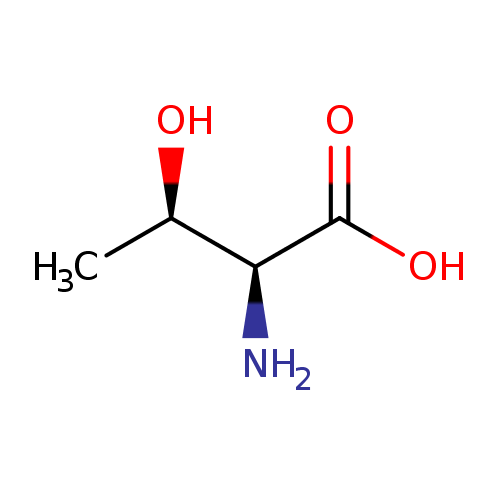
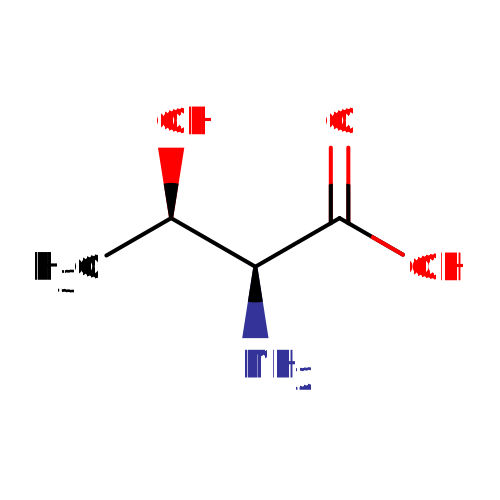
Chemical Structure
Thumb
Synonyms
ValueSource
(2S)-ThreonineChEBI
(2S,3R)-(-)-ThreonineChEBI
(2S,3R)-2-Amino-3-hydroxybutanoic acidChEBI
2-Amino-3-hydroxybutyric acidChEBI
L-(-)-ThreonineChEBI
L-2-Amino-3-hydroxybutyric acidChEBI
L-alpha-Amino-beta-hydroxybutyric acidChEBI
L-ThreoninChEBI
TChEBI
ThrChEBI
THREONINEChEBI
(2S,3R)-2-Amino-3-hydroxybutanoateGenerator
2-Amino-3-hydroxybutyrateGenerator
L-2-Amino-3-hydroxybutyrateGenerator
L-a-Amino-b-hydroxybutyrateGenerator
L-a-Amino-b-hydroxybutyric acidGenerator
L-alpha-Amino-beta-hydroxybutyrateGenerator
L-Α-amino-β-hydroxybutyrateGenerator
L-Α-amino-β-hydroxybutyric acidGenerator
(2S,3R)-2-Amino-3-hydroxybutyrateHMDB
(2S,3R)-2-Amino-3-hydroxybutyric acidHMDB
(R-(R*,s*))-2-amino-3-hydroxybutanoateHMDB
(R-(R*,s*))-2-amino-3-hydroxybutanoic acidHMDB
(S)-ThreonineHMDB
2-Amino-3-hydroxybutanoateHMDB
2-Amino-3-hydroxybutanoic acidHMDB
ThreoninHMDB
[R-(R*,s*)]-2-amino-3-hydroxy-butanoateHMDB
[R-(R*,s*)]-2-amino-3-hydroxy-butanoic acidHMDB
[R-(R*,s*)]-2-amino-3-hydroxybutanoateHMDB
[R-(R*,s*)]-2-amino-3-hydroxybutanoic acidHMDB
L ThreonineHMDB
Chemical FormulaC4H9NO3
Average Molecular Mass119.119 g/mol
Monoisotopic Mass119.058 g/mol
CAS Registry Number72-19-5
IUPAC Name(2S,3R)-2-amino-3-hydroxybutanoic acid
Traditional NameL-threonine
SMILESC[C@@H](O)[C@H](N)C(O)=O
InChI IdentifierInChI=1S/C4H9NO3/c1-2(6)3(5)4(7)8/h2-3,6H,5H2,1H3,(H,7,8)/t2-,3+/m1/s1
InChI KeyAYFVYJQAPQTCCC-GBXIJSLDSA-N
Chemical Taxonomy
Description belongs to the class of organic compounds known as l-alpha-amino acids. These are alpha amino acids which have the L-configuration of the alpha-carbon atom.
KingdomOrganic compounds
Super ClassOrganic acids and derivatives
ClassCarboxylic acids and derivatives
Sub ClassAmino acids, peptides, and analogues
Direct ParentL-alpha-amino acids
Alternative Parents
Substituents
  • L-alpha-amino acid
  • Beta-hydroxy acid
  • Short-chain hydroxy acid
  • Hydroxy acid
  • Fatty acid
  • Amino acid
  • Secondary alcohol
  • Carboxylic acid
  • Monocarboxylic acid or derivatives
  • Alcohol
  • Hydrocarbon derivative
  • Primary amine
  • Organooxygen compound
  • Organonitrogen compound
  • Organic oxide
  • Primary aliphatic amine
  • Organopnictogen compound
  • Organic oxygen compound
  • Carbonyl group
  • Organic nitrogen compound
  • Amine
  • Aliphatic acyclic compound
Molecular FrameworkAliphatic acyclic compounds
External Descriptors
Biological Properties
StatusDetected and Not Quantified
OriginEndogenous
Cellular Locations
  • Cytoplasm
  • Extracellular
  • Membrane
Biofluid LocationsNot Available
Tissue Locations
  • All Tissues
  • Prostate
Pathways
NameSMPDB LinkKEGG Link
Glycine and Serine MetabolismSMP00004 map00260
Threonine and 2-Oxobutanoate DegradationSMP00452 Not Available
Transcription/TranslationSMP00019 Not Available
Hartnup DisorderSMP00189 Not Available
Applications
Biological Roles
Chemical RolesNot Available
Physical Properties
StateSolid
AppearanceWhite powder.
Experimental Properties
PropertyValue
Melting Point256 dec°C
Boiling PointNot Available
Solubility9.7E+004 mg/L (at 25°C)
Predicted Properties
PropertyValueSource
Water Solubility477 g/LALOGPS
logP-3ALOGPS
logP-3.5ChemAxon
logS0.6ALOGPS
pKa (Strongest Acidic)2.21ChemAxon
pKa (Strongest Basic)9ChemAxon
Physiological Charge0ChemAxon
Hydrogen Acceptor Count4ChemAxon
Hydrogen Donor Count3ChemAxon
Polar Surface Area83.55 ŲChemAxon
Rotatable Bond Count2ChemAxon
Refractivity26.46 m³·mol⁻¹ChemAxon
Polarizability11.08 ųChemAxon
Number of Rings0ChemAxon
Bioavailability1ChemAxon
Rule of FiveYesChemAxon
Ghose FilterNoChemAxon
Veber's RuleNoChemAxon
MDDR-like RuleNoChemAxon
Spectra
Spectra
Spectrum TypeDescriptionSplash KeyView
GC-MSGC-MS Spectrum - GC-EI-TOF (Pegasus III TOF-MS system, Leco; GC 6890, Agilent Technologies) (3 TMS)splash10-0gb9-0930000000-045341234639d940688bSpectrum
GC-MSGC-MS Spectrum - GC-EI-TOF (Pegasus III TOF-MS system, Leco; GC 6890, Agilent Technologies) (Non-derivatized)splash10-0gb9-0930000000-08f448150a2533471625Spectrum
GC-MSGC-MS Spectrum - GC-MS (2 TMS)splash10-0159-1910000000-98a39d63665a1a1855ddSpectrum
GC-MSGC-MS Spectrum - GC-MS (3 TMS)splash10-014i-1960000000-82e1bd8ff2e302e6b51bSpectrum
GC-MSGC-MS Spectrum - EI-B (Non-derivatized)splash10-0159-0910000000-d36a7a07f0444e55e38fSpectrum
GC-MSGC-MS Spectrum - EI-B (Non-derivatized)splash10-014i-0980000000-ebba7965f95f804648abSpectrum
GC-MSGC-MS Spectrum - GC-EI-TOF (Non-derivatized)splash10-0gb9-0930000000-045341234639d940688bSpectrum
GC-MSGC-MS Spectrum - GC-EI-TOF (Non-derivatized)splash10-0gb9-0930000000-08f448150a2533471625Spectrum
GC-MSGC-MS Spectrum - GC-EI-QQ (Non-derivatized)splash10-0ffa-3921000000-05359581d7eb97866c8fSpectrum
GC-MSGC-MS Spectrum - GC-MS (Non-derivatized)splash10-0159-1910000000-98a39d63665a1a1855ddSpectrum
GC-MSGC-MS Spectrum - GC-MS (Non-derivatized)splash10-014i-1960000000-82e1bd8ff2e302e6b51bSpectrum
Predicted GC-MSPredicted GC-MS Spectrum - GC-MS (Non-derivatized) - 70eV, Positivesplash10-00dl-9000000000-a05d200d324c3242c239Spectrum
Predicted GC-MSPredicted GC-MS Spectrum - GC-MS (2 TMS) - 70eV, Positivesplash10-0fdk-8930000000-c4701f28963821b700b3Spectrum
Predicted GC-MSPredicted GC-MS Spectrum - GC-MS (Non-derivatized) - 70eV, PositiveNot AvailableSpectrum
Predicted GC-MSPredicted GC-MS Spectrum - GC-MS (TMS_1_1) - 70eV, PositiveNot AvailableSpectrum
Predicted GC-MSPredicted GC-MS Spectrum - GC-MS (TMS_1_2) - 70eV, PositiveNot AvailableSpectrum
Predicted GC-MSPredicted GC-MS Spectrum - GC-MS (TMS_1_3) - 70eV, PositiveNot AvailableSpectrum
Predicted GC-MSPredicted GC-MS Spectrum - GC-MS (TMS_2_2) - 70eV, PositiveNot AvailableSpectrum
Predicted GC-MSPredicted GC-MS Spectrum - GC-MS (TMS_2_3) - 70eV, PositiveNot AvailableSpectrum
Predicted GC-MSPredicted GC-MS Spectrum - GC-MS (TMS_2_4) - 70eV, PositiveNot AvailableSpectrum
Predicted GC-MSPredicted GC-MS Spectrum - GC-MS (TBDMS_1_1) - 70eV, PositiveNot AvailableSpectrum
Predicted GC-MSPredicted GC-MS Spectrum - GC-MS (TBDMS_1_2) - 70eV, PositiveNot AvailableSpectrum
Predicted GC-MSPredicted GC-MS Spectrum - GC-MS (TBDMS_1_3) - 70eV, PositiveNot AvailableSpectrum
Predicted GC-MSPredicted GC-MS Spectrum - GC-MS (TBDMS_2_1) - 70eV, PositiveNot AvailableSpectrum
Predicted GC-MSPredicted GC-MS Spectrum - GC-MS (TBDMS_2_2) - 70eV, PositiveNot AvailableSpectrum
LC-MS/MSLC-MS/MS Spectrum - Quattro_QQQ 10V, Positive (Annotated)splash10-00di-9300000000-85dce837b0f965e73c8aSpectrum
LC-MS/MSLC-MS/MS Spectrum - Quattro_QQQ 25V, Positive (Annotated)splash10-0a4i-9000000000-221510fd551c0b52c362Spectrum
LC-MS/MSLC-MS/MS Spectrum - Quattro_QQQ 40V, Positive (Annotated)splash10-0a4i-9100000000-6ee11649899572cd4867Spectrum
LC-MS/MSLC-MS/MS Spectrum - LC-ESI-ITFT (LTQ Orbitrap XL, Thermo Scientfic) , Positivesplash10-00di-0900000000-fde7ef1951fddff4b817Spectrum
LC-MS/MSLC-MS/MS Spectrum - LC-ESI-ITFT (LTQ Orbitrap XL, Thermo Scientfic) , Positivesplash10-0uk9-8900000000-2d7e5609618437e59272Spectrum
LC-MS/MSLC-MS/MS Spectrum - LC-ESI-ITFT (LTQ Orbitrap XL, Thermo Scientfic) , Positivesplash10-000i-9000000000-4b43567f4a446aed0828Spectrum
LC-MS/MSLC-MS/MS Spectrum - LC-ESI-ITFT (LTQ Orbitrap XL, Thermo Scientfic) , Positivesplash10-014i-4900000000-45382d9abd25be948e5bSpectrum
LC-MS/MSLC-MS/MS Spectrum - LC-ESI-ITFT (LTQ Orbitrap XL, Thermo Scientfic) , Positivesplash10-00di-0900000000-071b61d3ea723715c1c1Spectrum
LC-MS/MSLC-MS/MS Spectrum - LC-ESI-ITFT (LTQ Orbitrap XL, Thermo Scientfic) , Positivesplash10-0a59-9000000000-c8320d0556dbe72049caSpectrum
LC-MS/MSLC-MS/MS Spectrum - LC-ESI-ITFT (LTQ Orbitrap XL, Thermo Scientfic) , Positivesplash10-0uk9-8900000000-9945ecd06408cb733177Spectrum
LC-MS/MSLC-MS/MS Spectrum - LC-ESI-ITFT (LTQ Orbitrap XL, Thermo Scientfic) , Positivesplash10-0ufr-8900000000-c9804e2bfc51ec0e8593Spectrum
LC-MS/MSLC-MS/MS Spectrum - LC-ESI-ITFT (LTQ Orbitrap XL, Thermo Scientfic) , Negativesplash10-02t9-0692200000-f96dba3c74726ede32deSpectrum
LC-MS/MSLC-MS/MS Spectrum - LC-ESI-ITFT (LTQ Orbitrap XL, Thermo Scientfic) , Negativesplash10-00di-9000000000-94eeca12e76e23c1695eSpectrum
LC-MS/MSLC-MS/MS Spectrum - LC-ESI-ITFT (LTQ Orbitrap XL, Thermo Scientfic) , Negativesplash10-014i-0930000000-efff9b10ae39f6ce6095Spectrum
LC-MS/MSLC-MS/MS Spectrum - LC-ESI-ITFT (LTQ Orbitrap XL, Thermo Scientfic) , Negativesplash10-014i-0190000000-74ab3cba7b57b1b1b681Spectrum
LC-MS/MSLC-MS/MS Spectrum - LC-ESI-QQ (API3000, Applied Biosystems) 10V, Negativesplash10-014i-1900000000-d9348197a5df9756d30cSpectrum
LC-MS/MSLC-MS/MS Spectrum - LC-ESI-QQ (API3000, Applied Biosystems) 20V, Negativesplash10-00di-9100000000-9008bb1dfd2806e9f87dSpectrum
LC-MS/MSLC-MS/MS Spectrum - LC-ESI-QQ (API3000, Applied Biosystems) 30V, Negativesplash10-00di-9000000000-47fd01696817c86aecc5Spectrum
LC-MS/MSLC-MS/MS Spectrum - LC-ESI-QQ (API3000, Applied Biosystems) 40V, Negativesplash10-00di-9000000000-ba9cd5b3e37ded5d3764Spectrum
LC-MS/MSLC-MS/MS Spectrum - LC-ESI-QQ (API3000, Applied Biosystems) 10V, Positivesplash10-00di-1900000000-3fa8bd5efd825e5ac3faSpectrum
LC-MS/MSLC-MS/MS Spectrum - LC-ESI-QQ (API3000, Applied Biosystems) 20V, Positivesplash10-0kn9-9200000000-063cffd047551fca9ee6Spectrum
LC-MS/MSLC-MS/MS Spectrum - LC-ESI-QQ (API3000, Applied Biosystems) 30V, Positivesplash10-0a4i-9000000000-8b82bffd35f30875a7c0Spectrum
LC-MS/MSLC-MS/MS Spectrum - LC-ESI-QQ (API3000, Applied Biosystems) 40V, Positivesplash10-0a4i-9000000000-1748dd9a759c98e1c5eeSpectrum
LC-MS/MSLC-MS/MS Spectrum - LC-ESI-QQ (API3000, Applied Biosystems) 50V, Positivesplash10-0a4i-9000000000-e9069de219196460cc61Spectrum
Predicted LC-MS/MSPredicted LC-MS/MS Spectrum - 10V, Positivesplash10-0uk9-6900000000-d30fcc60bda11aeb88b4Spectrum
1D NMR1H NMR SpectrumNot AvailableSpectrum
1D NMR13C NMR SpectrumNot AvailableSpectrum
1D NMR1H NMR SpectrumNot AvailableSpectrum
1D NMR13C NMR SpectrumNot AvailableSpectrum
1D NMR1H NMR SpectrumNot AvailableSpectrum
1D NMR13C NMR SpectrumNot AvailableSpectrum
1D NMR1H NMR SpectrumNot AvailableSpectrum
1D NMR13C NMR SpectrumNot AvailableSpectrum
1D NMR1H NMR SpectrumNot AvailableSpectrum
1D NMR13C NMR SpectrumNot AvailableSpectrum
1D NMR1H NMR SpectrumNot AvailableSpectrum
1D NMR13C NMR SpectrumNot AvailableSpectrum
1D NMR1H NMR SpectrumNot AvailableSpectrum
1D NMR13C NMR SpectrumNot AvailableSpectrum
1D NMR1H NMR SpectrumNot AvailableSpectrum
1D NMR13C NMR SpectrumNot AvailableSpectrum
1D NMR1H NMR SpectrumNot AvailableSpectrum
1D NMR13C NMR SpectrumNot AvailableSpectrum
1D NMR1H NMR SpectrumNot AvailableSpectrum
1D NMR13C NMR SpectrumNot AvailableSpectrum
1D NMR1H NMR SpectrumNot AvailableSpectrum
1D NMR13C NMR SpectrumNot AvailableSpectrum
1D NMR1H NMR SpectrumNot AvailableSpectrum
1D NMR13C NMR SpectrumNot AvailableSpectrum
2D NMR[1H,1H] 2D NMR SpectrumNot AvailableSpectrum
2D NMR[1H,13C] 2D NMR SpectrumNot AvailableSpectrum
Toxicity Profile
Route of ExposureNot Available
Mechanism of ToxicityL-Threonine is a precursor to the amino acids glycine and serine. It acts as a lipotropic in controlling fat build-up in the liver. May help combat mental illness and may be very useful in indigestion and intestinal malfunctions. Also, threonine prevents excessive liver fat. Nutrients are more readily absorbed when threonine is present.
MetabolismHepatic
Toxicity ValuesNot Available
Lethal DoseNot Available
Carcinogenicity (IARC Classification)No indication of carcinogenicity to humans (not listed by IARC).
Uses/SourcesL-Threonine makes up collagen, elastin, and enamel protein. It aids proper fat metabolism in the liver, helps the digestive and intestinal tracts function more smoothly, and assists in metabolism and assimilation.
Minimum Risk LevelNot Available
Health EffectsNot Available
SymptomsNot Available
TreatmentNot Available
Concentrations
Not Available
DrugBank IDDB00156
HMDB IDHMDB0000167
FooDB IDFDB011999
Phenol Explorer IDNot Available
KNApSAcK IDC00001394
BiGG ID34186
BioCyc IDTHR
METLIN ID32
PDB IDNot Available
Wikipedia LinkThreonine
Chemspider ID6051
ChEBI ID16857
PubChem Compound ID6288
Kegg Compound IDC00188
YMDB IDYMDB00214
ECMDB IDECMDB00167
References
Synthesis Reference

Masato Terasawa, Yukie Satoo, Hideaki Yukawa, “Method for production of l-threonine.” U.S. Patent US5019503, issued June, 1967.

MSDSLink
General References
1. Fujita, Chuzo; Nara, Takashi; Samejima, Hirotoshi; Kinoshita, Shukuo. L-Threonine fermentation. I. Microbial conversion of L-homoserine to L-threonine. Nippon Nogei Kagaku Kaishi (1965), 39(6), 2
2. Vold BS, Keith DE Jr, Slavik M: Urine levels of N-[9-(beta-D-ribofuranosyl)purin-6-ylcarbamoyl]-L-threonine, N6-(delta 2-isopentenyl)adenosine, and 2'-O-methylguanosine as determined by radioimmunoassay for normal subjects and cancer patients. Cancer Res. 1982 Dec;42(12):5265-9.
3. Peng CT, Wu KH, Lan SJ, Tsai JJ, Tsai FJ, Tsai CH: Amino acid concentrations in cerebrospinal fluid in children with acute lymphoblastic leukemia undergoing chemotherapy. Eur J Cancer. 2005 May;41(8):1158-63. Epub 2005 Apr 14.
4. Hallgren P, Lundblad A, Svensson S: A new type of carbohydrate-protein linkage in a glycopeptide from normal human urine. J Biol Chem. 1975 Jul 25;250(14):5312-4.
5. Cynober LA: Plasma amino acid levels with a note on membrane transport: characteristics, regulation, and metabolic significance. Nutrition. 2002 Sep;18(9):761-6.
6. Rainesalo S, Keranen T, Palmio J, Peltola J, Oja SS, Saransaari P: Plasma and cerebrospinal fluid amino acids in epileptic patients. Neurochem Res. 2004 Jan;29(1):319-24.
7. Wevers RA, Engelke U, Wendel U, de Jong JG, Gabreels FJ, Heerschap A: Standardized method for high-resolution 1H-NMR of cerebrospinal fluid. Clin Chem. 1995 May;41(5):744-51.
8. Wulf G, Finn G, Suizu F, Lu KP: Phosphorylation-specific prolyl isomerization: is there an underlying theme? Nat Cell Biol. 2005 May;7(5):435-41.
9. Takeda DY, Parvin JD, Dutta A: Degradation of Cdt1 during S phase is Skp2-independent and is required for efficient progression of mammalian cells through S phase. J Biol Chem. 2005 Jun 17;280(24):23416-23. Epub 2005 Apr 25.
10. Nanda N, Bao M, Lin H, Clauser K, Komuves L, Quertermous T, Conley PB, Phillips DR, Hart MJ: Platelet endothelial aggregation receptor 1 (PEAR1), a novel epidermal growth factor repeat-containing transmembrane receptor, participates in platelet contact-induced activation. J Biol Chem. 2005 Jul 1;280(26):24680-9. Epub 2005 Apr 25.
11. Silwood CJ, Lynch E, Claxson AW, Grootveld MC: 1H and (13)C NMR spectroscopic analysis of human saliva. J Dent Res. 2002 Jun;81(6):422-7.
12. Boneh A, Korman SH, Sato K, Kanno J, Matsubara Y, Lerer I, Ben-Neriah Z, Kure S: A single nucleotide substitution that abolishes the initiator methionine codon of the GLDC gene is prevalent among patients with glycine encephalopathy in Jerusalem. J Hum Genet. 2005;50(5):230-4. Epub 2005 Apr 29.
13. Elzinga M, Maron BJ, Adelstein RS: Human heart and platelet actins are products of different genes. Science. 1976 Jan 9;191(4222):94-5.
14. Nicholson JK, O'Flynn MP, Sadler PJ, Macleod AF, Juul SM, Sonksen PH: Proton-nuclear-magnetic-resonance studies of serum, plasma and urine from fasting normal and diabetic subjects. Biochem J. 1984 Jan 15;217(2):365-75.
15. Rodriguez-Soriano J, Vallo A, Perez de Nanclares G, Bilbao JR, Castano L: A founder mutation in the CLCNKB gene causes Bartter syndrome type III in Spain. Pediatr Nephrol. 2005 Jul;20(7):891-6. Epub 2005 May 5.
16. Hagenfeldt L, Bjerkenstedt L, Edman G, Sedvall G, Wiesel FA: Amino acids in plasma and CSF and monoamine metabolites in CSF: interrelationship in healthy subjects. J Neurochem. 1984 Mar;42(3):833-7.
17. Sreekumar A, Poisson LM, Rajendiran TM, Khan AP, Cao Q, Yu J, Laxman B, Mehra R, Lonigro RJ, Li Y, Nyati MK, Ahsan A, Kalyana-Sundaram S, Han B, Cao X, Byun J, Omenn GS, Ghosh D, Pennathur S, Alexander DC, Berger A, Shuster JR, Wei JT, Varambally S, Beecher C, Chinnaiyan AM: Metabolomic profiles delineate potential role for sarcosine in prostate cancer progression. Nature. 2009 Feb 12;457(7231):910-4. doi: 10.1038/nature07762.
18. Boehm G, Cervantes H, Georgi G, Jelinek J, Sawatzki G, Wermuth B, Colombo JP: Effect of increasing dietary threonine intakes on amino acid metabolism of the central nervous system and peripheral tissues in growing rats. Pediatr Res. 1998 Dec;44(6):900-6.
19. Elshenawy S, Pinney SE, Stuart T, Doulias PT, Zura G, Parry S, Elovitz MA, Bennett MJ, Bansal A, Strauss JF 3rd, Ischiropoulos H, Simmons RA: The Metabolomic Signature of the Placenta in Spontaneous Preterm Birth. Int J Mol Sci. 2020 Feb 4;21(3). pii: ijms21031043. doi: 10.3390/ijms21031043.
20. https://www.ncbi.nlm.nih.gov/pubmed/?term=11964235
21. https://www.ncbi.nlm.nih.gov/pubmed/?term=12523390
22. https://www.ncbi.nlm.nih.gov/pubmed/?term=16659349
23. https://www.ncbi.nlm.nih.gov/pubmed/?term=17379183
24. https://www.ncbi.nlm.nih.gov/pubmed/?term=22289691
25. https://www.ncbi.nlm.nih.gov/pubmed/?term=22342587
26. https://www.ncbi.nlm.nih.gov/pubmed/?term=22513921
27. https://www.ncbi.nlm.nih.gov/pubmed/?term=22770225
28. https://www.ncbi.nlm.nih.gov/pubmed/?term=24671569