Record Information
Version1.0
Creation Date2014-08-29 06:34:51 UTC
Update Date2026-05-14 16:24:28 UTC
Accession NumberCHEM003322
Identification
Common NameL-Asparagine
ClassSmall Molecule
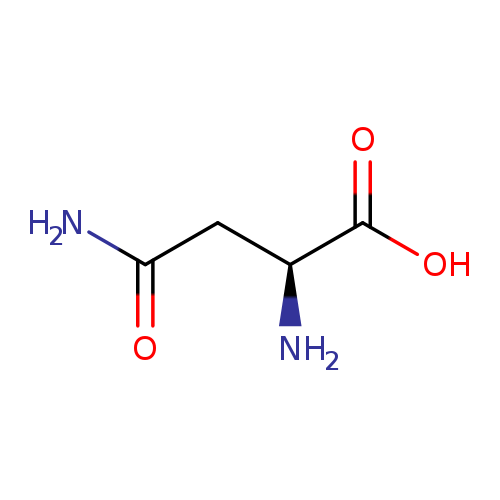
DescriptionAsparagine (Asn) is one of the 20 most common natural amino acids on Earth. It has carboxamide as the side chain's functional group. It is considered a non-essential amino acid. Asparagine is not an essential amino acid, which means that it can be synthesized from central metabolic pathway intermediates in humans and is not required in the diet. The precursor to asparagine is oxaloacetate. Oxaloacetate is converted to aspartate using a transaminase enzyme. The enzyme transfers the amino group from glutamate to oxaloacetate producing alpha-ketoglutarate and aspartate. The enzyme asparagine synthetase produces asparagine, AMP, glutamate, and pyrophosphate from aspartate, glutamine, and ATP. In the asparagine synthetase reaction, ATP is used to activate aspartate, forming beta-aspartyl-AMP. glutamine donates an ammonium group which reacts with beta-aspartyl-AMP to form asparagine and free AMP. Since the asparagine side chain can make efficient hydrogen bond interactions with the peptide backbone, asparagines are often found near the beginning and end of alpha-helices, and in turn motifs in beta sheets. Its role can be thought as capping the hydrogen bond interactions which would otherwise need to be satisfied by the polypeptide backbone. glutamines have an extra methylene group, have more conformational entropy and thus are less useful in this regard. Asparagine also provides key sites for N-linked glycosylation, modification of the protein chain with the addition of carbohydrate chains. A reaction between asparagine and reducing sugars or reactive carbonyls produces acrylamide (acrylic amide) in food when heated to sufficient temperature, i.e. baking. These occur primarily in baked goods such as french fries, potato chips, and roasted coffee. Asparagine was first isolated in 1806 from asparagus juice, in which it is abundant--hence its name--becoming the first amino acid to be isolated. The smell observed in the urine of some individuals after their consumption of asparagus is attributed to a byproduct of the metabolic breakdown of asparagine, asparagine-amino-succinic-acid monoamide. (However, some scientists disagree and implicate other substances in the smell, especially methanethiol). It is biosynthesized from aspartic acid and ammonia by asparagine synthetase.
Contaminant Sources
  • EAFUS Chemicals
  • FooDB Chemicals
  • HMDB Contaminants - Feces
  • HMDB Contaminants - Urine
  • HPV EPA Chemicals
  • My Exposome Chemicals
  • STOFF IDENT Compounds
  • T3DB toxins
Contaminant Type
  • Amine
  • Animal Toxin
  • Dietary Supplement
  • Drug
  • Food Toxin
  • Metabolite
  • Micronutrient
  • Natural Compound
  • Non-Essential Amino Acid
  • Nutraceutical
  • Organic Compound
  • Supplement
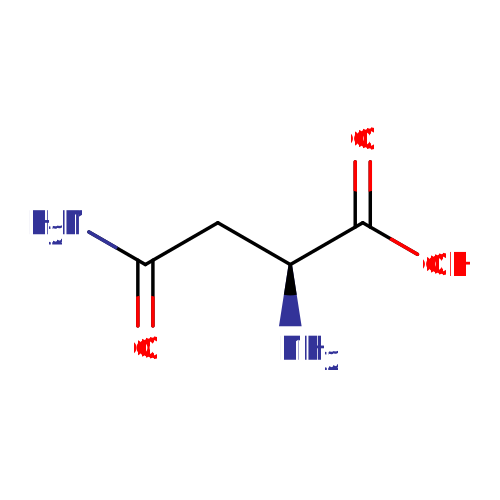
Chemical Structure
Thumb
Synonyms
ValueSource
(2S)-2,4-Diamino-4-oxobutanoic acidChEBI
(2S)-2-Amino-3-carbamoylpropanoic acidChEBI
(S)-2-Amino-3-carbamoylpropanoic acidChEBI
(S)-AsparagineChEBI
2-Aminosuccinamic acidChEBI
alpha-Aminosuccinamic acidChEBI
AsnChEBI
ASPARAGINEChEBI
Aspartamic acidChEBI
L-2-Aminosuccinamic acidChEBI
L-AsparaginChEBI
L-Aspartic acid beta-amideChEBI
NChEBI
(2S)-2,4-Diamino-4-oxobutanoateGenerator
(2S)-2-Amino-3-carbamoylpropanoateGenerator
(S)-2-Amino-3-carbamoylpropanoateGenerator
2-AminosuccinamateGenerator
a-AminosuccinamateGenerator
a-Aminosuccinamic acidGenerator
alpha-AminosuccinamateGenerator
Α-aminosuccinamateGenerator
Α-aminosuccinamic acidGenerator
AspartamateGenerator
L-2-AminosuccinamateGenerator
L-Aspartate b-amideGenerator
L-Aspartate beta-amideGenerator
L-Aspartate β-amideGenerator
L-Aspartic acid b-amideGenerator
L-Aspartic acid β-amideGenerator
(-)-AsparagineHMDB
(S)-2,4-Diamino-4-oxobutanoateHMDB
(S)-2,4-Diamino-4-oxobutanoic acidHMDB
AgedoiteHMDB
alpha AmminosuccinamateHMDB
alpha Amminosuccinamic acidHMDB
AltheineHMDB
Asparagine acidHMDB
AsparamideHMDB
Aspartic acid amideHMDB
Aspartic acid b-amideHMDB
Aspartic acid beta amideHMDB
b2,4-(S)-Diamino-4-oxo-utanoateHMDB
b2,4-(S)-Diamino-4-oxo-utanoic acidHMDB
Crystal VIHMDB
L-2,4-Diamino-4-oxobutanoateHMDB
L-2,4-Diamino-4-oxobutanoic acidHMDB
L-AspartamineHMDB
L-b-AsparagineHMDB
L-beta-AsparagineHMDB
Chemical FormulaC4H8N2O3
Average Molecular Mass132.118 g/mol
Monoisotopic Mass132.053 g/mol
CAS Registry Number70-47-3
IUPAC Name(2S)-2-amino-3-carbamoylpropanoic acid
Traditional NameL-asparagine
SMILESN[C@@H](CC(N)=O)C(O)=O
InChI IdentifierInChI=1S/C4H8N2O3/c5-2(4(8)9)1-3(6)7/h2H,1,5H2,(H2,6,7)(H,8,9)/t2-/m0/s1
InChI KeyDCXYFEDJOCDNAF-REOHCLBHSA-N
Chemical Taxonomy
Description belongs to the class of organic compounds known as asparagine and derivatives. Asparagine and derivatives are compounds containing asparagine or a derivative thereof resulting from reaction of asparagine at the amino group or the carboxy group, or from the replacement of any hydrogen of glycine by a heteroatom.
KingdomOrganic compounds
Super ClassOrganic acids and derivatives
ClassCarboxylic acids and derivatives
Sub ClassAmino acids, peptides, and analogues
Direct ParentAsparagine and derivatives
Alternative Parents
Substituents
  • Asparagine or derivatives
  • Alpha-amino acid
  • L-alpha-amino acid
  • Fatty amide
  • Fatty acyl
  • Fatty acid
  • Carboxamide group
  • Amino acid
  • Primary carboxylic acid amide
  • Carboxylic acid
  • Monocarboxylic acid or derivatives
  • Organic nitrogen compound
  • Primary amine
  • Organooxygen compound
  • Organonitrogen compound
  • Hydrocarbon derivative
  • Primary aliphatic amine
  • Organic oxide
  • Organopnictogen compound
  • Organic oxygen compound
  • Carbonyl group
  • Amine
  • Aliphatic acyclic compound
Molecular FrameworkAliphatic acyclic compounds
External Descriptors
Biological Properties
StatusDetected and Not Quantified
OriginEndogenous
Cellular Locations
  • Cytoplasm
  • Extracellular
  • Membrane
  • Mitochondria
Biofluid LocationsNot Available
Tissue Locations
  • All Tissues
  • Prostate
Pathways
NameSMPDB LinkKEGG Link
Ammonia RecyclingSMP00009 map00910
Aspartate MetabolismSMP00067 map00250
Transcription/TranslationSMP00019 Not Available
Hartnup DisorderSMP00189 Not Available
Applications
Biological Roles
Chemical RolesNot Available
Physical Properties
StateSolid
AppearanceWhite powder.
Experimental Properties
PropertyValue
Melting Point234-235°C
Boiling PointNot Available
Solubility2.94E+004 mg/L (at 25°C)
Predicted Properties
PropertyValueSource
Water Solubility168 g/LALOGPS
logP-3.4ALOGPS
logP-4.3ChemAxon
logS0.1ALOGPS
pKa (Strongest Acidic)2ChemAxon
pKa (Strongest Basic)8.43ChemAxon
Physiological Charge0ChemAxon
Hydrogen Acceptor Count4ChemAxon
Hydrogen Donor Count3ChemAxon
Polar Surface Area106.41 ŲChemAxon
Rotatable Bond Count3ChemAxon
Refractivity28.35 m³·mol⁻¹ChemAxon
Polarizability11.68 ųChemAxon
Number of Rings0ChemAxon
Bioavailability1ChemAxon
Rule of FiveYesChemAxon
Ghose FilterNoChemAxon
Veber's RuleNoChemAxon
MDDR-like RuleNoChemAxon
Spectra
Spectra
Spectrum TypeDescriptionSplash KeyView
GC-MSGC-MS Spectrum - GC-EI-TOF (Pegasus III TOF-MS system, Leco; GC 6890, Agilent Technologies) (3 TMS)splash10-0159-0910000000-bedf57998656ab5ebc16Spectrum
GC-MSGC-MS Spectrum - GC-EI-TOF (Pegasus III TOF-MS system, Leco; GC 6890, Agilent Technologies) (3 TMS)splash10-0159-0910000000-4979c4d028d2dc931263Spectrum
GC-MSGC-MS Spectrum - GC-EI-TOF (Pegasus III TOF-MS system, Leco; GC 6890, Agilent Technologies) (Non-derivatized)splash10-0159-0910000000-b7ea3fef61f3940cbddaSpectrum
GC-MSGC-MS Spectrum - GC-EI-TOF (Pegasus III TOF-MS system, Leco; GC 6890, Agilent Technologies) (3 TMS)splash10-00di-9710000000-6d0afcbcc003347e598eSpectrum
GC-MSGC-MS Spectrum - GC-MS (2 TMS)splash10-0uxr-0910000000-2be567239bd3229b1ca1Spectrum
GC-MSGC-MS Spectrum - GC-MS (Non-derivatized)splash10-02t9-0790000000-b8141f48cbebb90f683eSpectrum
GC-MSGC-MS Spectrum - GC-MS (Non-derivatized)splash10-02t9-1790000000-1d12ed9b4fb2799da766Spectrum
GC-MSGC-MS Spectrum - GC-MS (4 TMS)splash10-014u-0961000000-65a5c0999f17110c9939Spectrum
GC-MSGC-MS Spectrum - GC-MS (4 TMS)splash10-00kr-0940000000-0e0e5c7bdbac5ea0e49eSpectrum
GC-MSGC-MS Spectrum - GC-MS (3 TMS)splash10-00lr-1920000000-7864dbb1f685e64dd1cfSpectrum
GC-MSGC-MS Spectrum - GC-MS (4 TMS)splash10-000i-1940000000-964ea25da2789805985aSpectrum
GC-MSGC-MS Spectrum - EI-B (Non-derivatized)splash10-00lr-0930000000-79a089d9875e092dd7f2Spectrum
GC-MSGC-MS Spectrum - GC-EI-TOF (Non-derivatized)splash10-0159-0910000000-bedf57998656ab5ebc16Spectrum
GC-MSGC-MS Spectrum - GC-EI-TOF (Non-derivatized)splash10-0159-0910000000-4979c4d028d2dc931263Spectrum
GC-MSGC-MS Spectrum - GC-EI-TOF (Non-derivatized)splash10-0159-0910000000-b7ea3fef61f3940cbddaSpectrum
GC-MSGC-MS Spectrum - GC-EI-QQ (Non-derivatized)splash10-00di-4931100000-17f149310ce3a0f748d1Spectrum
GC-MSGC-MS Spectrum - GC-EI-TOF (Non-derivatized)splash10-00di-9710000000-6d0afcbcc003347e598eSpectrum
GC-MSGC-MS Spectrum - GC-MS (Non-derivatized)splash10-0uxr-0910000000-2be567239bd3229b1ca1Spectrum
GC-MSGC-MS Spectrum - GC-MS (Non-derivatized)splash10-02t9-0790000000-b8141f48cbebb90f683eSpectrum
GC-MSGC-MS Spectrum - GC-MS (Non-derivatized)splash10-02t9-1790000000-1d12ed9b4fb2799da766Spectrum
GC-MSGC-MS Spectrum - GC-MS (Non-derivatized)splash10-014u-0961000000-65a5c0999f17110c9939Spectrum
GC-MSGC-MS Spectrum - GC-MS (Non-derivatized)splash10-00kr-0940000000-0e0e5c7bdbac5ea0e49eSpectrum
GC-MSGC-MS Spectrum - GC-MS (Non-derivatized)splash10-00lr-1920000000-7864dbb1f685e64dd1cfSpectrum
GC-MSGC-MS Spectrum - GC-MS (Non-derivatized)splash10-000i-1940000000-964ea25da2789805985aSpectrum
Predicted GC-MSPredicted GC-MS Spectrum - GC-MS (Non-derivatized) - 70eV, Positivesplash10-000f-9100000000-5881591331bd059b7e7dSpectrum
LC-MS/MSLC-MS/MS Spectrum - Quattro_QQQ 10V, Positive (Annotated)splash10-0080-9400000000-e5c7e19f427eea6d71b0Spectrum
LC-MS/MSLC-MS/MS Spectrum - Quattro_QQQ 25V, Positive (Annotated)splash10-00di-9000000000-afc1214100db1168b095Spectrum
LC-MS/MSLC-MS/MS Spectrum - Quattro_QQQ 40V, Positive (Annotated)splash10-00dl-9000000000-57e977cd87e9a86d482bSpectrum
LC-MS/MSLC-MS/MS Spectrum - LC-ESI-ITFT (LTQ Orbitrap XL, Thermo Scientfic) , Positivesplash10-001i-0900000000-6fb96f5aa291359dba29Spectrum
LC-MS/MSLC-MS/MS Spectrum - LC-ESI-ITFT (LTQ Orbitrap XL, Thermo Scientfic) , Positivesplash10-000i-9000000000-76f11e6fe5657c35d15fSpectrum
LC-MS/MSLC-MS/MS Spectrum - LC-ESI-ITFT (LTQ Orbitrap XL, Thermo Scientfic) , Positivesplash10-000i-9000000000-e944486273dbfde4cae4Spectrum
LC-MS/MSLC-MS/MS Spectrum - LC-ESI-ITFT (LTQ Orbitrap XL, Thermo Scientfic) , Positivesplash10-001i-0900000000-27ad91a86be0c4d86c3cSpectrum
LC-MS/MSLC-MS/MS Spectrum - LC-ESI-ITFT (LTQ Orbitrap XL, Thermo Scientfic) , Positivesplash10-001i-0900000000-b8b7a3431b66246ad613Spectrum
LC-MS/MSLC-MS/MS Spectrum - LC-ESI-ITFT (LTQ Orbitrap XL, Thermo Scientfic) , Positivesplash10-000i-9000000000-03fa294ec740e189dd99Spectrum
LC-MS/MSLC-MS/MS Spectrum - LC-ESI-ITFT (LTQ Orbitrap XL, Thermo Scientfic) , Positivesplash10-000i-9000000000-cee2081406fc25ab6169Spectrum
LC-MS/MSLC-MS/MS Spectrum - LC-ESI-ITFT (LTQ Orbitrap XL, Thermo Scientfic) , Positivesplash10-001i-0900000000-cd79afa0c27f65e54adcSpectrum
LC-MS/MSLC-MS/MS Spectrum - LC-ESI-ITFT (LTQ Orbitrap XL, Thermo Scientfic) , Negativesplash10-01q9-0943200000-5a24322ba0ce2f410155Spectrum
LC-MS/MSLC-MS/MS Spectrum - LC-ESI-ITFT (LTQ Orbitrap XL, Thermo Scientfic) , Negativesplash10-03di-0900000000-fc3086cc1bb0c06a4c11Spectrum
LC-MS/MSLC-MS/MS Spectrum - LC-ESI-ITFT (LTQ Orbitrap XL, Thermo Scientfic) , Negativesplash10-03di-3900000000-2d74d8232e7523f3b1c9Spectrum
LC-MS/MSLC-MS/MS Spectrum - LC-ESI-ITFT (LTQ Orbitrap XL, Thermo Scientfic) , Negativesplash10-001i-0900000000-fa61c6fa9a87ce4905bbSpectrum
LC-MS/MSLC-MS/MS Spectrum - LC-ESI-ITFT (LTQ Orbitrap XL, Thermo Scientfic) , Negativesplash10-01q9-0942200000-757da8b3406485c997b0Spectrum
LC-MS/MSLC-MS/MS Spectrum - LC-ESI-ITFT (LTQ Orbitrap XL, Thermo Scientfic) , Negativesplash10-014i-9000000000-eac18512f2d22ab7a7efSpectrum
LC-MS/MSLC-MS/MS Spectrum - LC-ESI-ITFT (LTQ Orbitrap XL, Thermo Scientfic) , Negativesplash10-03di-0900000000-8df6d5b6cf94bf081c89Spectrum
LC-MS/MSLC-MS/MS Spectrum - LC-ESI-ITFT (LTQ Orbitrap XL, Thermo Scientfic) , Negativesplash10-001i-0900000000-18079004a95c252da208Spectrum
LC-MS/MSLC-MS/MS Spectrum - LC-ESI-QQ (API3000, Applied Biosystems) 10V, Negativesplash10-001i-0900000000-e6b1f9b4982e6cdc863dSpectrum
LC-MS/MSLC-MS/MS Spectrum - LC-ESI-QQ (API3000, Applied Biosystems) 20V, Negativesplash10-03di-5900000000-7b9c09b3b6de28972f97Spectrum
LC-MS/MSLC-MS/MS Spectrum - LC-ESI-QQ (API3000, Applied Biosystems) 30V, Negativesplash10-00dl-9100000000-2ea95ead344d62e230a4Spectrum
LC-MS/MSLC-MS/MS Spectrum - LC-ESI-QQ (API3000, Applied Biosystems) 40V, Negativesplash10-0006-9000000000-defacc365589bc4437d7Spectrum
LC-MS/MSLC-MS/MS Spectrum - LC-ESI-QQ (API3000, Applied Biosystems) 50V, Negativesplash10-0006-9000000000-fd60db4d5e35794c45aeSpectrum
LC-MS/MSLC-MS/MS Spectrum - LC-ESI-QQ (API3000, Applied Biosystems) 10V, Positivesplash10-001i-3900000000-fd0f1034b5c1e40435c0Spectrum
1D NMR1H NMR SpectrumNot AvailableSpectrum
1D NMR13C NMR SpectrumNot AvailableSpectrum
1D NMR1H NMR SpectrumNot AvailableSpectrum
1D NMR13C NMR SpectrumNot AvailableSpectrum
1D NMR1H NMR SpectrumNot AvailableSpectrum
1D NMR13C NMR SpectrumNot AvailableSpectrum
1D NMR1H NMR SpectrumNot AvailableSpectrum
1D NMR13C NMR SpectrumNot AvailableSpectrum
1D NMR1H NMR SpectrumNot AvailableSpectrum
1D NMR13C NMR SpectrumNot AvailableSpectrum
1D NMR1H NMR SpectrumNot AvailableSpectrum
1D NMR13C NMR SpectrumNot AvailableSpectrum
1D NMR1H NMR SpectrumNot AvailableSpectrum
1D NMR13C NMR SpectrumNot AvailableSpectrum
1D NMR1H NMR SpectrumNot AvailableSpectrum
1D NMR13C NMR SpectrumNot AvailableSpectrum
1D NMR1H NMR SpectrumNot AvailableSpectrum
1D NMR13C NMR SpectrumNot AvailableSpectrum
1D NMR1H NMR SpectrumNot AvailableSpectrum
1D NMR13C NMR SpectrumNot AvailableSpectrum
1D NMR1H NMR SpectrumNot AvailableSpectrum
1D NMR13C NMR SpectrumNot AvailableSpectrum
1D NMR1H NMR SpectrumNot AvailableSpectrum
1D NMR13C NMR SpectrumNot AvailableSpectrum
1D NMR1H NMR SpectrumNot AvailableSpectrum
2D NMR[1H,1H] 2D NMR SpectrumNot AvailableSpectrum
2D NMR[1H,13C] 2D NMR SpectrumNot AvailableSpectrum
Toxicity Profile
Route of ExposureNot Available
Mechanism of ToxicityAsparagine, a non-essential amino acid is important in the metabolism of toxic ammonia in the body through the action of asparagine synthase which attaches ammonia to aspartic acid in an amidation reaction. Asparagine is also used as a structural component in many proteins.
MetabolismNot Available
Toxicity ValuesNot Available
Lethal DoseNot Available
Carcinogenicity (IARC Classification)No indication of carcinogenicity to humans (not listed by IARC).
Uses/SourcesUsed for nutritional supplementation, also for treating dietary shortage or imbalance.
Minimum Risk LevelNot Available
Health EffectsNot Available
SymptomsNot Available
TreatmentNot Available
Concentrations
Not Available
DrugBank IDDB00174
HMDB IDHMDB0000168
FooDB IDFDB000787
Phenol Explorer IDNot Available
KNApSAcK IDC00001341
BiGG ID34055
BioCyc IDASN
METLIN ID14
PDB IDNot Available
Wikipedia LinkAsparagine
Chemspider ID6031
ChEBI ID17196
PubChem Compound ID6267
Kegg Compound IDC00152
YMDB IDYMDB00226
ECMDB IDECMDB00168
References
Synthesis Reference

Sang C. Park, “Pharmaceutical preparation containing L-aspartate or L-asparagine for preventing ethanol toxicity, and process for preparation thereof.” U.S. Patent US5389359, issued November, 1991.

MSDSLink
General References
1. Wang, Fangda. Preparation of L-b-asparagine. Faming Zhuanli Shenqing Gongkai Shuomingshu (2005), 8 pp.
2. Melzer N, Wittenburg D, Hartwig S, Jakubowski S, Kesting U, Willmitzer L, Lisec J, Reinsch N, Repsilber D: Investigating associations between milk metabolite profiles and milk traits of Holstein cows. J Dairy Sci. 2013 Mar;96(3):1521-34. doi: 10.3168/jds.2012-5743.
3. A. Foroutan et al. The Chemical Composition of Commercial Cow's Milk (in preparation)
4. Wang, Fangda. Preparation of L-b-asparagine. Faming Zhuanli Shenqing Gongkai Shuomingshu (2005), 8 pp.
5. Starczynowski DT, Reynolds JG, Gilmore TD: Mutations of tumor necrosis factor alpha-responsive serine residues within the C-terminal transactivation domain of human transcription factor REL enhance its in vitro transforming ability. Oncogene. 2005 Nov 10;24(49):7355-68.
6. Fischer D, Schroers A, Blumcke I, Urbach H, Zerres K, Mortier W, Vorgerd M, Schroder R: Consequences of a novel caveolin-3 mutation in a large German family. Ann Neurol. 2003 Feb;53(2):233-41.
7. Filho JC, Bergstrom J, Stehle P, Furst P: Simultaneous measurements of free amino acid patterns of plasma, muscle and erythrocytes in healthy human subjects. Clin Nutr. 1997 Dec;16(6):299-305.
8. Peng CT, Wu KH, Lan SJ, Tsai JJ, Tsai FJ, Tsai CH: Amino acid concentrations in cerebrospinal fluid in children with acute lymphoblastic leukemia undergoing chemotherapy. Eur J Cancer. 2005 May;41(8):1158-63. Epub 2005 Apr 14.
9. Sun S, Han J, Ralph WM Jr, Chandrasekaran A, Liu K, Auborn KJ, Carter TH: Endoplasmic reticulum stress as a correlate of cytotoxicity in human tumor cells exposed to diindolylmethane in vitro. Cell Stress Chaperones. 2004 Mar;9(1):76-87.
10. Cynober LA: Plasma amino acid levels with a note on membrane transport: characteristics, regulation, and metabolic significance. Nutrition. 2002 Sep;18(9):761-6.
11. Rainesalo S, Keranen T, Palmio J, Peltola J, Oja SS, Saransaari P: Plasma and cerebrospinal fluid amino acids in epileptic patients. Neurochem Res. 2004 Jan;29(1):319-24.
12. Takamatsu S, Inoue N, Katsumata T, Nakamura K, Fujibayashi Y, Takeuchi M: The relationship between the branch-forming glycosyltransferases and cell surface sugar chain structures. Biochemistry. 2005 Apr 26;44(16):6343-9.
13. Rip JW, Coulter-Mackie MB, Rupar CA, Gordon BA: Purification and structure of human liver aspartylglucosaminidase. Biochem J. 1992 Dec 15;288 ( Pt 3):1005-10.
14. Chiara F, Goumans MJ, Forsberg H, Ahgren A, Rasola A, Aspenstrom P, Wernstedt C, Hellberg C, Heldin CH, Heuchel R: A gain of function mutation in the activation loop of platelet-derived growth factor beta-receptor deregulates its kinase activity. J Biol Chem. 2004 Oct 8;279(41):42516-27. Epub 2004 Jul 28.
15. Xu L, Wang Y, Gillespie D, Meissner G: Two rings of negative charges in the cytosolic vestibule of type-1 ryanodine receptor modulate ion fluxes. Biophys J. 2006 Jan 15;90(2):443-53. Epub 2005 Oct 20.
16. Poon CJ, Plaas AH, Keene DR, McQuillan DJ, Last K, Fosang AJ: N-linked keratan sulfate in the aggrecan interglobular domain potentiates aggrecanase activity. J Biol Chem. 2005 Jun 24;280(25):23615-21. Epub 2005 Apr 22.
17. Ahlman B, Andersson K, Leijonmarck CE, Ljungqvist O, Hedenborg L, Wernerman J: Short-term starvation alters the free amino acid content of the human intestinal mucosa. Clin Sci (Lond). 1994 Jun;86(6):653-62.
18. Avramis VI, Panosyan EH: Pharmacokinetic/pharmacodynamic relationships of asparaginase formulations: the past, the present and recommendations for the future. Clin Pharmacokinet. 2005;44(4):367-93.
19. Mohrmann K, van Eijndhoven MA, Schinkel AH, Schellens JH: Absence of N-linked glycosylation does not affect plasma membrane localization of breast cancer resistance protein (BCRP/ABCG2). Cancer Chemother Pharmacol. 2005 Oct;56(4):344-50. Epub 2005 May 5.
20. Hagenfeldt L, Bjerkenstedt L, Edman G, Sedvall G, Wiesel FA: Amino acids in plasma and CSF and monoamine metabolites in CSF: interrelationship in healthy subjects. J Neurochem. 1984 Mar;42(3):833-7.
21. Sreekumar A, Poisson LM, Rajendiran TM, Khan AP, Cao Q, Yu J, Laxman B, Mehra R, Lonigro RJ, Li Y, Nyati MK, Ahsan A, Kalyana-Sundaram S, Han B, Cao X, Byun J, Omenn GS, Ghosh D, Pennathur S, Alexander DC, Berger A, Shuster JR, Wei JT, Varambally S, Beecher C, Chinnaiyan AM: Metabolomic profiles delineate potential role for sarcosine in prostate cancer progression. Nature. 2009 Feb 12;457(7231):910-4. doi: 10.1038/nature07762.
22. Elshenawy S, Pinney SE, Stuart T, Doulias PT, Zura G, Parry S, Elovitz MA, Bennett MJ, Bansal A, Strauss JF 3rd, Ischiropoulos H, Simmons RA: The Metabolomic Signature of the Placenta in Spontaneous Preterm Birth. Int J Mol Sci. 2020 Feb 4;21(3). pii: ijms21031043. doi: 10.3390/ijms21031043.
23. https://www.ncbi.nlm.nih.gov/pubmed/?term=12142634
24. https://www.ncbi.nlm.nih.gov/pubmed/?term=15907185
25. https://www.ncbi.nlm.nih.gov/pubmed/?term=16190636
26. https://www.ncbi.nlm.nih.gov/pubmed/?term=16368161
27. https://www.ncbi.nlm.nih.gov/pubmed/?term=16668324
28. https://www.ncbi.nlm.nih.gov/pubmed/?term=17497286
29. https://www.ncbi.nlm.nih.gov/pubmed/?term=21800258
30. https://www.ncbi.nlm.nih.gov/pubmed/?term=21854356
31. https://www.ncbi.nlm.nih.gov/pubmed/?term=22513289