Record Information
Version1.0
Creation Date2014-08-29 06:34:37 UTC
Update Date2026-05-20 17:16:59 UTC
Accession NumberCHEM003321
Identification
Common NameGlycogen
ClassSmall Molecule
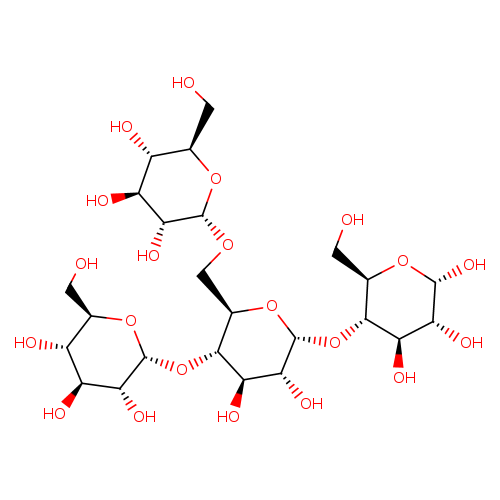
DescriptionGlycogen is a highly-branched polymer of about 30,000 glucose residues and has a molecular weight between 106 and 107 daltons (4.8 million approx.). Most of Glc units are linked by alpha-1,4 glycosidic bonds, approximately 1 in 12 Glc residues also makes -1,6 glycosidic bond with a second Glc which results in the creation of a branch. Glycogen only has one reducing end and a large number of non-reducing ends with a free hydroxyl group at carbon 4. The glycogen granules contain both glycogen and the enzymes of glycogen synthesis (glycogenesis) and degradation (glycogenolysis). The enzymes are nested between the outer branches of the glycogen molecules and act on the non-reducing ends. Therefore, the many non-reducing end-branches of glycogen facilitate its rapid synthesis and breakdown. In hypoglycemia caused by excessive insulin, liver glycogen levels are high, but the high insulin level prevents the glycogenolysis necessary to maintain normal blood sugar levels. Glucagon is a common treatment for this type of hypoglycemia. Glycogen is a polysaccharide that is the principal storage form of glucose (Glc) in animal and human cells. Glycogen is found in the form of granules in the cytosol in many cell types. Hepatocytes (liver cells) have the highest concentration of it - up to 8% of the fresh weight in well fed state, or 100 to 120 g in an adult - giving liver a distinctive, 'starchy taste'. In the muscles, glycogen is found in a much lower concentration (1% of the muscle mass), but the total amount exceeds that in liver. Small amounts of glycogen are found in the kidneys, and even smaller amounts in certain glial cells in the brain and white blood cells.
Contaminant Sources
  • FooDB Chemicals
  • HMDB Contaminants - Urine
  • T3DB toxins
Contaminant Type
  • Animal Toxin
  • Food Toxin
  • Household Toxin
  • Metabolite
  • Natural Compound
  • Organic Compound
Chemical Structure
Thumb
Synonyms
ValueSource
Animal starchHMDB
Liver starchHMDB
LyoglycogenHMDB
PhytoglycogenHMDB
Chemical FormulaC24H42O21
Average Molecular Mass666.578 g/mol
Monoisotopic Mass666.222 g/mol
CAS Registry Number9005-79-2
IUPAC NameNot Available
Traditional Name(2R,3R,4S,5S,6R)-2-{[(2R,3S,4R,5R,6R)-4,5-dihydroxy-6-{[(2R,3S,4R,5R,6S)-4,5,6-trihydroxy-2-(hydroxymethyl)oxan-3-yl]oxy}-2-({[(2S,3R,4S,5S,6R)-3,4,5-trihydroxy-6-(hydroxymethyl)oxan-2-yl]oxy}methyl)oxan-3-yl]oxy}-6-(hydroxymethyl)oxane-3,4,5-triol
SMILESOC[C@H]1O[C@H](OC[C@H]2O[C@H](O[C@H]3[C@H](O)[C@@H](O)[C@@H](O)O[C@@H]3CO)[C@H](O)[C@@H](O)[C@@H]2O[C@H]2O[C@H](CO)[C@@H](O)[C@H](O)[C@H]2O)[C@H](O)[C@@H](O)[C@@H]1O
InChI IdentifierInChI=1S/C24H42O21/c25-1-5-9(28)11(30)16(35)22(41-5)39-4-8-20(45-23-17(36)12(31)10(29)6(2-26)42-23)14(33)18(37)24(43-8)44-19-7(3-27)40-21(38)15(34)13(19)32/h5-38H,1-4H2/t5-,6-,7-,8-,9-,10-,11+,12+,13-,14-,15-,16-,17-,18-,19-,20-,21+,22+,23-,24-/m1/s1
InChI KeyBYSGBSNPRWKUQH-UJDJLXLFSA-N
Chemical Taxonomy
Description belongs to the class of organic compounds known as oligosaccharides. These are carbohydrates made up of 3 to 10 monosaccharide units linked to each other through glycosidic bonds.
KingdomOrganic compounds
Super ClassOrganic oxygen compounds
ClassOrganooxygen compounds
Sub ClassCarbohydrates and carbohydrate conjugates
Direct ParentOligosaccharides
Alternative Parents
Substituents
  • Oligosaccharide
  • O-glycosyl compound
  • Glycosyl compound
  • Oxane
  • Secondary alcohol
  • Hemiacetal
  • Oxacycle
  • Organoheterocyclic compound
  • Polyol
  • Acetal
  • Hydrocarbon derivative
  • Primary alcohol
  • Alcohol
  • Aliphatic heteromonocyclic compound
Molecular FrameworkAliphatic heteromonocyclic compounds
External Descriptors
Biological Properties
StatusDetected and Not Quantified
OriginEndogenous
Cellular Locations
  • Cytoplasm
  • Membrane
Biofluid LocationsNot Available
Tissue Locations
  • Adipose Tissue
  • Adrenal Cortex
  • Adrenal Gland
  • Adrenal Medulla
  • Brain
  • Epidermis
  • Fibroblasts
  • Kidney
  • Liver
  • Muscle
  • Myelin
  • Nerve Cells
  • Neuron
  • Pancreas
  • Placenta
  • Platelet
  • Skeletal Muscle
  • Stratum Corneum
  • Testes
Pathways
NameSMPDB LinkKEGG Link
Starch and Sucrose MetabolismSMP00058 map00500
Glycogen Storage Disease Type 1A (GSD1A) or Von Gierke DiseaseSMP00374 Not Available
Glycogenosis, Type IA. Von gierke diseaseSMP00581 Not Available
Glycogenosis, Type IBSMP00573 Not Available
Glycogenosis, Type ICSMP00574 Not Available
Glycogenosis, Type III. Cori disease, Debrancher glycogenosisSMP00553 Not Available
Glycogenosis, Type IV. Amylopectinosis, Anderson diseaseSMP00554 Not Available
ApplicationsNot Available
Biological RolesNot Available
Chemical RolesNot Available
Physical Properties
StateSolid
AppearanceWhite powder.
Experimental Properties
PropertyValue
Melting Point270 - 280°C
Boiling PointNot Available
SolubilityNot Available
Predicted Properties
PropertyValueSource
Water Solubility343 g/LALOGPS
logP-2.7ALOGPS
logP-8.2ChemAxon
logS-0.29ALOGPS
pKa (Strongest Acidic)11.19ChemAxon
pKa (Strongest Basic)-3.7ChemAxon
Physiological Charge0ChemAxon
Hydrogen Acceptor Count21ChemAxon
Hydrogen Donor Count14ChemAxon
Polar Surface Area347.83 ŲChemAxon
Rotatable Bond Count10ChemAxon
Refractivity133.16 m³·mol⁻¹ChemAxon
Polarizability61.39 ųChemAxon
Number of Rings4ChemAxon
Bioavailability0ChemAxon
Rule of FiveNoChemAxon
Ghose FilterNoChemAxon
Veber's RuleNoChemAxon
MDDR-like RuleYesChemAxon
Spectra
Spectra
Spectrum TypeDescriptionSplash KeyView
Predicted GC-MSPredicted GC-MS Spectrum - GC-MS (TMS_1_1) - 70eV, PositiveNot AvailableSpectrum
Predicted GC-MSPredicted GC-MS Spectrum - GC-MS (TMS_1_2) - 70eV, PositiveNot AvailableSpectrum
Predicted GC-MSPredicted GC-MS Spectrum - GC-MS (TMS_1_3) - 70eV, PositiveNot AvailableSpectrum
Predicted GC-MSPredicted GC-MS Spectrum - GC-MS (TMS_1_4) - 70eV, PositiveNot AvailableSpectrum
Predicted GC-MSPredicted GC-MS Spectrum - GC-MS (TMS_1_5) - 70eV, PositiveNot AvailableSpectrum
Predicted GC-MSPredicted GC-MS Spectrum - GC-MS (TMS_1_6) - 70eV, PositiveNot AvailableSpectrum
Predicted GC-MSPredicted GC-MS Spectrum - GC-MS (TMS_1_7) - 70eV, PositiveNot AvailableSpectrum
Predicted GC-MSPredicted GC-MS Spectrum - GC-MS (TMS_1_8) - 70eV, PositiveNot AvailableSpectrum
Predicted GC-MSPredicted GC-MS Spectrum - GC-MS (TMS_1_9) - 70eV, PositiveNot AvailableSpectrum
Predicted GC-MSPredicted GC-MS Spectrum - GC-MS (TMS_1_10) - 70eV, PositiveNot AvailableSpectrum
Predicted GC-MSPredicted GC-MS Spectrum - GC-MS (TMS_1_11) - 70eV, PositiveNot AvailableSpectrum
Predicted GC-MSPredicted GC-MS Spectrum - GC-MS (TMS_1_12) - 70eV, PositiveNot AvailableSpectrum
Predicted GC-MSPredicted GC-MS Spectrum - GC-MS (TMS_1_13) - 70eV, PositiveNot AvailableSpectrum
Predicted GC-MSPredicted GC-MS Spectrum - GC-MS (TMS_1_14) - 70eV, PositiveNot AvailableSpectrum
Predicted GC-MSPredicted GC-MS Spectrum - GC-MS (TMS_2_1) - 70eV, PositiveNot AvailableSpectrum
Predicted GC-MSPredicted GC-MS Spectrum - GC-MS (TMS_2_2) - 70eV, PositiveNot AvailableSpectrum
Predicted GC-MSPredicted GC-MS Spectrum - GC-MS (TMS_2_3) - 70eV, PositiveNot AvailableSpectrum
Predicted GC-MSPredicted GC-MS Spectrum - GC-MS (TMS_2_4) - 70eV, PositiveNot AvailableSpectrum
Predicted GC-MSPredicted GC-MS Spectrum - GC-MS (TMS_2_5) - 70eV, PositiveNot AvailableSpectrum
Predicted GC-MSPredicted GC-MS Spectrum - GC-MS (TMS_2_6) - 70eV, PositiveNot AvailableSpectrum
Predicted GC-MSPredicted GC-MS Spectrum - GC-MS (TMS_2_7) - 70eV, PositiveNot AvailableSpectrum
Predicted GC-MSPredicted GC-MS Spectrum - GC-MS (TMS_2_8) - 70eV, PositiveNot AvailableSpectrum
Predicted GC-MSPredicted GC-MS Spectrum - GC-MS (TMS_2_9) - 70eV, PositiveNot AvailableSpectrum
Predicted GC-MSPredicted GC-MS Spectrum - GC-MS (TMS_2_10) - 70eV, PositiveNot AvailableSpectrum
Predicted GC-MSPredicted GC-MS Spectrum - GC-MS (TMS_2_11) - 70eV, PositiveNot AvailableSpectrum
Predicted LC-MS/MSPredicted LC-MS/MS Spectrum - 10V, Positivesplash10-000b-0401739000-7d2f2aaa7732e23ef9feSpectrum
Predicted LC-MS/MSPredicted LC-MS/MS Spectrum - 20V, Positivesplash10-000i-0505921000-56fc10eb2d6cb63bc487Spectrum
Predicted LC-MS/MSPredicted LC-MS/MS Spectrum - 40V, Positivesplash10-0043-1906412000-81ae228fd873321b008cSpectrum
Predicted LC-MS/MSPredicted LC-MS/MS Spectrum - 10V, Negativesplash10-0gbj-0400339000-de452d5dddd55d2855ffSpectrum
Predicted LC-MS/MSPredicted LC-MS/MS Spectrum - 20V, Negativesplash10-004s-3901435000-bc5da17144e98986d7b1Spectrum
Predicted LC-MS/MSPredicted LC-MS/MS Spectrum - 40V, Negativesplash10-004i-4839321000-4dfca4172b8470e37b09Spectrum
Predicted LC-MS/MSPredicted LC-MS/MS Spectrum - 10V, Negativesplash10-066r-0100029000-b6e0ee6c4d7da972d403Spectrum
Predicted LC-MS/MSPredicted LC-MS/MS Spectrum - 20V, Negativesplash10-0cfr-8200197000-418a1a524982d51ac37cSpectrum
Predicted LC-MS/MSPredicted LC-MS/MS Spectrum - 40V, Negativesplash10-052o-9112031000-54aa8775ffd121394c79Spectrum
Predicted LC-MS/MSPredicted LC-MS/MS Spectrum - 10V, Positivesplash10-014j-0000219000-3e1e676b7e59ddc5e400Spectrum
Predicted LC-MS/MSPredicted LC-MS/MS Spectrum - 20V, Positivesplash10-0ap1-1202269000-46a5b5753a69d2459f1cSpectrum
Predicted LC-MS/MSPredicted LC-MS/MS Spectrum - 40V, Positivesplash10-00mp-9105250000-f7a96871cd5435e63e92Spectrum
1D NMR1H NMR SpectrumNot AvailableSpectrum
2D NMR[1H,1H] 2D NMR SpectrumNot AvailableSpectrum
2D NMR[1H,13C] 2D NMR SpectrumNot AvailableSpectrum
Toxicity Profile
Route of ExposureNot Available
Mechanism of ToxicityNot Available
MetabolismNot Available
Toxicity ValuesNot Available
Lethal DoseNot Available
Carcinogenicity (IARC Classification)No indication of carcinogenicity to humans (not listed by IARC).
Uses/SourcesThis is an endogenously produced metabolite found in the human body. It is used in metabolic reactions, catabolic reactions or waste generation.
Minimum Risk LevelNot Available
Health EffectsNot Available
SymptomsNot Available
TreatmentNot Available
Concentrations
Not Available
DrugBank IDNot Available
HMDB IDHMDB0000757
FooDB IDFDB022227
Phenol Explorer IDNot Available
KNApSAcK IDNot Available
BiGG IDNot Available
BioCyc IDNot Available
METLIN ID160
PDB IDNot Available
Wikipedia LinkGlycogen
Chemspider ID388322
ChEBI ID28087
PubChem Compound ID439177
Kegg Compound IDC00182
YMDB IDYMDB00881
ECMDB IDECMDB21341
References
Synthesis ReferenceParodi A J; Krisman C R; Mordoh J In vitro synthesis of particulate glycogen from uridine diphosphate glucose. II. Some studies on the growth process. Archives of biochemistry and biophysics (1970), 141(1), 219-27.
MSDSLink
General References
1. Parodi A J; Krisman C R; Mordoh J In vitro synthesis of particulate glycogen from uridine diphosphate glucose. II. Some studies on the growth process. Archives of biochemistry and biophysics (1970), 141(1), 219-27.
2. Parodi A J; Krisman C R; Mordoh J In vitro synthesis of particulate glycogen from uridine diphosphate glucose. II. Some studies on the growth process. Archives of biochemistry and biophysics (1970), 141(1), 219-27.
3. Zderic TW, Schenk S, Davidson CJ, Byerley LO, Coyle EF: Manipulation of dietary carbohydrate and muscle glycogen affects glucose uptake during exercise when fat oxidation is impaired by beta-adrenergic blockade. Am J Physiol Endocrinol Metab. 2004 Dec;287(6):E1195-201. Epub 2004 Aug 17.
4. Schaart G, Hesselink RP, Keizer HA, van Kranenburg G, Drost MR, Hesselink MK: A modified PAS stain combined with immunofluorescence for quantitative analyses of glycogen in muscle sections. Histochem Cell Biol. 2004 Aug;122(2):161-9. Epub 2004 Aug 3.
5. Wee SL, Williams C, Tsintzas K, Boobis L: Ingestion of a high-glycemic index meal increases muscle glycogen storage at rest but augments its utilization during subsequent exercise. J Appl Physiol (1985). 2005 Aug;99(2):707-14. Epub 2005 Apr 14.
6. Zehnder M, Muelli M, Buchli R, Kuehne G, Boutellier U: Further glycogen decrease during early recovery after eccentric exercise despite a high carbohydrate intake. Eur J Nutr. 2004 Jun;43(3):148-59. Epub 2004 Jan 6.
7. Koopman R, Manders RJ, Jonkers RA, Hul GB, Kuipers H, van Loon LJ: Intramyocellular lipid and glycogen content are reduced following resistance exercise in untrained healthy males. Eur J Appl Physiol. 2006 Mar;96(5):525-34. Epub 2005 Dec 21.
8. Jentjens R, Jeukendrup A: Determinants of post-exercise glycogen synthesis during short-term recovery. Sports Med. 2003;33(2):117-44.
9. Ouwens DM, van der Zon GC, Maassen JA: Modulation of insulin-stimulated glycogen synthesis by Src Homology Phosphatase 2. Mol Cell Endocrinol. 2001 Apr 25;175(1-2):131-40.
10. Koppersmith DL, Powers JM, Hennigar GR: Angiomatoid neuroblastoma with cytoplasmic glycogen: a case report and histogenetic considerations. Cancer. 1980 Feb;45(3):553-60.
11. Kohler G, Boutellier U: Glycogen reduction in non-exercising muscle depends on blood lactate concentration. Eur J Appl Physiol. 2004 Aug;92(4-5):548-54.
12. Crosson SM, Khan A, Printen J, Pessin JE, Saltiel AR: PTG gene deletion causes impaired glycogen synthesis and developmental insulin resistance. J Clin Invest. 2003 May;111(9):1423-32.
13. Dube SN, Nayak BB, Das PK: Effect of foot-electroshock stress on cholinergic activity, tissue glycogen and blood sugar in albino rats. Indian J Physiol Pharmacol. 1978 Jan-Mar;22(1):24-32.
14. Chryssanthopoulos C, Williams C, Nowitz A, Bogdanis G: Skeletal muscle glycogen concentration and metabolic responses following a high glycaemic carbohydrate breakfast. J Sports Sci. 2004 Nov-Dec;22(11-12):1065-71.
15. Steinberg GR, Watt MJ, McGee SL, Chan S, Hargreaves M, Febbraio MA, Stapleton D, Kemp BE: Reduced glycogen availability is associated with increased AMPKalpha2 activity, nuclear AMPKalpha2 protein abundance, and GLUT4 mRNA expression in contracting human skeletal muscle. Appl Physiol Nutr Metab. 2006 Jun;31(3):302-12.
16. Hudson ER, Pan DA, James J, Lucocq JM, Hawley SA, Green KA, Baba O, Terashima T, Hardie DG: A novel domain in AMP-activated protein kinase causes glycogen storage bodies similar to those seen in hereditary cardiac arrhythmias. Curr Biol. 2003 May 13;13(10):861-6.
17. van Loon LJ, Murphy R, Oosterlaar AM, Cameron-Smith D, Hargreaves M, Wagenmakers AJ, Snow R: Creatine supplementation increases glycogen storage but not GLUT-4 expression in human skeletal muscle. Clin Sci (Lond). 2004 Jan;106(1):99-106.
18. Tomihira M, Kawasaki E, Nakajima H, Imamura Y, Sato Y, Sata M, Kage M, Sugie H, Nunoi K: Intermittent and recurrent hepatomegaly due to glycogen storage in a patient with type 1 diabetes: genetic analysis of the liver glycogen phosphorylase gene (PYGL). Diabetes Res Clin Pract. 2004 Aug;65(2):175-82.
19. McVie-Wylie AJ, Ding EY, Lawson T, Serra D, Migone FK, Pressley D, Mizutani M, Kikuchi T, Chen YT, Amalfitano A: Multiple muscles in the AMD quail can be "cross-corrected" of pathologic glycogen accumulation after intravenous injection of an [E1-, polymerase-] adenovirus vector encoding human acid-alpha-glucosidase. J Gene Med. 2003 May;5(5):399-406.
20. Price TB, Laurent D, Petersen KF: 13C/31P NMR studies on the role of glucose transport/phosphorylation in human glycogen supercompensation. Int J Sports Med. 2003 May;24(4):238-44.
21. Tanis AA, Rietveld T, Wattimena JL, van den Berg JW, Swart GR: The 13CO2 breath test for liver glycogen oxidation after 3-day labeling of the liver with a naturally 13C-enriched diet. Nutrition. 2003 May;19(5):432-7.
22. Devries MC, Hamadeh MJ, Graham TE, Tarnopolsky MA: 17beta-estradiol supplementation decreases glucose rate of appearance and disappearance with no effect on glycogen utilization during moderate intensity exercise in men. J Clin Endocrinol Metab. 2005 Nov;90(11):6218-25. Epub 2005 Aug 23.