Record Information
Version1.0
Creation Date2014-08-29 06:34:02 UTC
Update Date2026-05-14 17:50:36 UTC
Accession NumberCHEM003319
Identification
Common NameGlutaric acid
ClassSmall Molecule
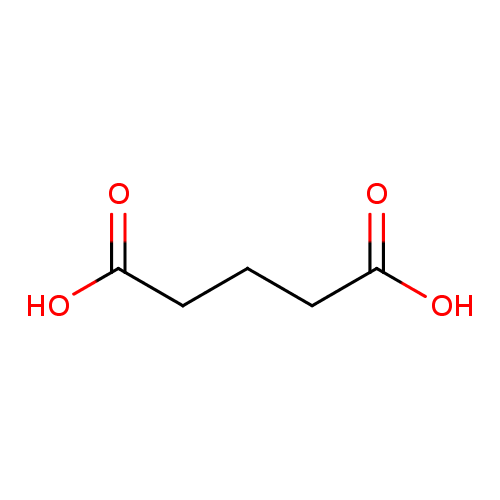
DescriptionGlutaric acid is a simple five-carbon linear dicarboxylic acid. The accumulation of glutaric acid ranging from slightly or intermittently elevated urinary glutaric acid to gross organic aciduria occurs in Glutaric aciduria. Glutaric aciduria type 1 is an autosomal-recessive disorder resulting from a deficiency of mitochondrial glutaryl-CoA dehydrogenase (EC 1.3.99.7, GCDH) which is involved in the metabolism of lysine, hydroxylysine, and tryptophan. Glutaric aciduria type I lead to nonspecific developmental delay, hypotonia, and macrocephaly with cerebral atrophy of prenatal onset. Treatment is mainly based on restriction of lysine intake, supplementation of carnitine, and an intensification of therapy during intercurrent illnesses. The major principle of dietary treatment is to reduce the production of glutaric acid and 3-hydroxyglutaric acid by restriction of natural protein in general and of lysine in particular. (1, 2).
Contaminant Sources
  • FooDB Chemicals
  • HMDB Contaminants - Feces
  • HMDB Contaminants - Urine
  • HPV EPA Chemicals
  • STOFF IDENT Compounds
  • T3DB toxins
  • ToxCast & Tox21 Chemicals
Contaminant Type
  • Animal Toxin
  • Food Toxin
  • Industrial/Workplace Toxin
  • Metabolite
  • Natural Compound
  • Organic Compound
Chemical Structure
Thumb
Synonyms
ValueSource
1,3-Propanedicarboxylic acidChEBI
1,5-Pentanedioic acidChEBI
GlutarsaeureChEBI
Pentanedioic acidChEBI
1,3-PropanedicarboxylateGenerator
1,5-PentanedioateGenerator
PentanedioateGenerator
GlutarateGenerator
PentandioateHMDB
Pentandioic acidHMDB
Chemical FormulaC5H8O4
Average Molecular Mass132.115 g/mol
Monoisotopic Mass132.042 g/mol
CAS Registry Number110-94-1
IUPAC Namepentanedioic acid
Traditional Nameglutaric acid
SMILESOC(=O)CCCC(O)=O
InChI IdentifierInChI=1S/C5H8O4/c6-4(7)2-1-3-5(8)9/h1-3H2,(H,6,7)(H,8,9)
InChI KeyJFCQEDHGNNZCLN-UHFFFAOYSA-N
Chemical Taxonomy
Description belongs to the class of organic compounds known as dicarboxylic acids and derivatives. These are organic compounds containing exactly two carboxylic acid groups.
KingdomOrganic compounds
Super ClassOrganic acids and derivatives
ClassCarboxylic acids and derivatives
Sub ClassDicarboxylic acids and derivatives
Direct ParentDicarboxylic acids and derivatives
Alternative Parents
Substituents
  • Fatty acid
  • Dicarboxylic acid or derivatives
  • Carboxylic acid
  • Organic oxygen compound
  • Organic oxide
  • Hydrocarbon derivative
  • Organooxygen compound
  • Carbonyl group
  • Aliphatic acyclic compound
Molecular FrameworkAliphatic acyclic compounds
External Descriptors
Biological Properties
StatusDetected and Not Quantified
OriginEndogenous
Cellular Locations
  • Cytoplasm
  • Extracellular
Biofluid LocationsNot Available
Tissue Locations
  • Prostate
Pathways
NameSMPDB LinkKEGG Link
Glutaric Aciduria Type ISMP00185 Not Available
Glutaric Aciduria Type IIISMP00186 Not Available
ApplicationsNot Available
Biological Roles
Chemical RolesNot Available
Physical Properties
StateSolid
AppearanceWhite powder.
Experimental Properties
PropertyValue
Melting Point95.8°C
Boiling Point200°C (392°F)
Solubility1600.0 mg/mL
Predicted Properties
PropertyValueSource
logP0.046ChemAxon
pKa (Strongest Acidic)3.76ChemAxon
Physiological Charge-2ChemAxon
Hydrogen Acceptor Count4ChemAxon
Hydrogen Donor Count2ChemAxon
Polar Surface Area74.6 ŲChemAxon
Rotatable Bond Count4ChemAxon
Refractivity28.14 m³·mol⁻¹ChemAxon
Polarizability12.17 ųChemAxon
Number of Rings0ChemAxon
Bioavailability1ChemAxon
Rule of FiveYesChemAxon
Ghose FilterNoChemAxon
Veber's RuleNoChemAxon
MDDR-like RuleNoChemAxon
Spectra
Spectra
Spectrum TypeDescriptionSplash KeyView
GC-MSGC-MS Spectrum - GC-EI-TOF (Pegasus III TOF-MS system, Leco; GC 6890, Agilent Technologies) (2 TMS)splash10-0f6t-2940000000-9f099473c4a6eb94d4beSpectrum
GC-MSGC-MS Spectrum - GC-EI-TOF (Pegasus III TOF-MS system, Leco; GC 6890, Agilent Technologies) (2 TMS)splash10-0002-1920000000-4ade63738a1c00460a63Spectrum
GC-MSGC-MS Spectrum - GC-EI-TOF (Pegasus III TOF-MS system, Leco; GC 6890, Agilent Technologies) (Non-derivatized)splash10-0002-1910000000-743df9571fee7baa3417Spectrum
GC-MSGC-MS Spectrum - GC-EI-TOF (Pegasus III TOF-MS system, Leco; GC 6890, Agilent Technologies) (2 TMS)splash10-00fs-9710000000-ba958e52b1424e5d4840Spectrum
GC-MSGC-MS Spectrum - GC-MS (2 TMS)splash10-0cgj-3930000000-298fe512c6b58220ee33Spectrum
GC-MSGC-MS Spectrum - EI-B (Non-derivatized)splash10-052o-9000000000-663deab1ce6413c4859dSpectrum
GC-MSGC-MS Spectrum - EI-B (Non-derivatized)splash10-0002-0920000000-56bce366cac24cd6773fSpectrum
GC-MSGC-MS Spectrum - GC-EI-TOF (Non-derivatized)splash10-0f6t-2940000000-9f099473c4a6eb94d4beSpectrum
GC-MSGC-MS Spectrum - GC-EI-TOF (Non-derivatized)splash10-0002-1920000000-4ade63738a1c00460a63Spectrum
GC-MSGC-MS Spectrum - GC-EI-TOF (Non-derivatized)splash10-0002-1910000000-743df9571fee7baa3417Spectrum
GC-MSGC-MS Spectrum - GC-EI-TOF (Non-derivatized)splash10-00fs-9710000000-ba958e52b1424e5d4840Spectrum
GC-MSGC-MS Spectrum - GC-MS (Non-derivatized)splash10-0cgj-3930000000-298fe512c6b58220ee33Spectrum
GC-MSGC-MS Spectrum - GC-EI-TOF (Non-derivatized)splash10-0002-0910000000-86fbcf8f1c72fbb2ffd0Spectrum
Predicted GC-MSPredicted GC-MS Spectrum - GC-MS (Non-derivatized) - 70eV, Positivesplash10-01q3-9200000000-fcbc36fd55a7945d3f25Spectrum
Predicted GC-MSPredicted GC-MS Spectrum - GC-MS (2 TMS) - 70eV, Positivesplash10-05g3-9610000000-07394eb05b518a4e3bf4Spectrum
Predicted GC-MSPredicted GC-MS Spectrum - GC-MS (Non-derivatized) - 70eV, PositiveNot AvailableSpectrum
Predicted GC-MSPredicted GC-MS Spectrum - GC-MS (TMS_1_1) - 70eV, PositiveNot AvailableSpectrum
Predicted GC-MSPredicted GC-MS Spectrum - GC-MS (TBDMS_1_1) - 70eV, PositiveNot AvailableSpectrum
Predicted GC-MSPredicted GC-MS Spectrum - GC-MS (TBDMS_2_1) - 70eV, PositiveNot AvailableSpectrum
LC-MS/MSLC-MS/MS Spectrum - Quattro_QQQ 10V, N/A (Annotated)splash10-0019-9500000000-9db56ca3a541f0ce07d1Spectrum
LC-MS/MSLC-MS/MS Spectrum - Quattro_QQQ 25V, N/A (Annotated)splash10-052r-9100000000-991f69d0892976558f85Spectrum
LC-MS/MSLC-MS/MS Spectrum - Quattro_QQQ 40V, N/A (Annotated)splash10-0536-9300000000-20fb2c8dd136e4924acaSpectrum
LC-MS/MSLC-MS/MS Spectrum - EI-B (Unknown) , Positivesplash10-052o-9000000000-663deab1ce6413c4859dSpectrum
LC-MS/MSLC-MS/MS Spectrum - LC-ESI-QQ (API3000, Applied Biosystems) 10V, Negativesplash10-001i-0900000000-8eb90c15915f014713acSpectrum
LC-MS/MSLC-MS/MS Spectrum - LC-ESI-QQ (API3000, Applied Biosystems) 20V, Negativesplash10-000i-9200000000-2ffdc08c49952e135a86Spectrum
LC-MS/MSLC-MS/MS Spectrum - LC-ESI-QQ (API3000, Applied Biosystems) 30V, Negativesplash10-000i-9000000000-8884b857c9582288f35aSpectrum
LC-MS/MSLC-MS/MS Spectrum - LC-ESI-QQ (API3000, Applied Biosystems) 40V, Negativesplash10-052f-9000000000-7d2c0333bdce4dbabbc6Spectrum
LC-MS/MSLC-MS/MS Spectrum - LC-ESI-QQ (API3000, Applied Biosystems) 50V, Negativesplash10-0006-9000000000-9ab2a948083302641628Spectrum
LC-MS/MSLC-MS/MS Spectrum - LC-ESI-QTOF (UPLC Q-Tof Premier, Waters) , Negativesplash10-000i-9400000000-c5ec3115706f6041b868Spectrum
LC-MS/MSLC-MS/MS Spectrum - LC-ESI-QQ , negativesplash10-001i-0900000000-8eb90c15915f014713acSpectrum
LC-MS/MSLC-MS/MS Spectrum - LC-ESI-QQ , negativesplash10-000i-9200000000-2ffdc08c49952e135a86Spectrum
LC-MS/MSLC-MS/MS Spectrum - LC-ESI-QQ , negativesplash10-000i-9000000000-8884b857c9582288f35aSpectrum
LC-MS/MSLC-MS/MS Spectrum - LC-ESI-QQ , negativesplash10-052f-9000000000-7d2c0333bdce4dbabbc6Spectrum
LC-MS/MSLC-MS/MS Spectrum - LC-ESI-QQ , negativesplash10-0006-9000000000-9ab2a948083302641628Spectrum
LC-MS/MSLC-MS/MS Spectrum - LC-ESI-QTOF , negativesplash10-000i-9400000000-c5ec3115706f6041b868Spectrum
LC-MS/MSLC-MS/MS Spectrum - 40V, Negativesplash10-0udi-9000000000-89029b221f83859b721cSpectrum
LC-MS/MSLC-MS/MS Spectrum - 20V, Negativesplash10-014r-9000000000-ec63d377e53acd0b3f82Spectrum
LC-MS/MSLC-MS/MS Spectrum - 35V, Negativesplash10-000i-9000000000-1778c9be6683c7aaea83Spectrum
Predicted LC-MS/MSPredicted LC-MS/MS Spectrum - 10V, Positivesplash10-00lr-3900000000-e068e1a5fced6447f9efSpectrum
Predicted LC-MS/MSPredicted LC-MS/MS Spectrum - 20V, Positivesplash10-01c9-9400000000-ed0953fcaa050d721ed0Spectrum
Predicted LC-MS/MSPredicted LC-MS/MS Spectrum - 40V, Positivesplash10-002f-9000000000-9a285d856528d3c30034Spectrum
Predicted LC-MS/MSPredicted LC-MS/MS Spectrum - 10V, Negativesplash10-001i-1900000000-2ccd8e2a515cf328e787Spectrum
Predicted LC-MS/MSPredicted LC-MS/MS Spectrum - 20V, Negativesplash10-001i-6900000000-0ea4829580fe919d05a0Spectrum
Predicted LC-MS/MSPredicted LC-MS/MS Spectrum - 40V, Negativesplash10-0a4l-9000000000-f1b2458f574a96cbcb83Spectrum
MSMass Spectrum (Electron Ionization)splash10-052o-9000000000-f308daa4e82c16019e0dSpectrum
1D NMR1H NMR SpectrumNot AvailableSpectrum
1D NMR13C NMR SpectrumNot AvailableSpectrum
2D NMR[1H,13C] 2D NMR SpectrumNot AvailableSpectrum
Toxicity Profile
Route of ExposureNot Available
Mechanism of ToxicityAccumulation of glutaric acid in the body has been shown to be toxic. The accumulation of glutaric acid ranging from slightly or intermittently elevated urinary glutaric acid to gross organic aciduria occurs in glutaric aciduria. Glutaric aciduria type 1 is an autosomal-recessive disorder resulting from a deficiency of mitochondrial glutaryl-CoA dehydrogenase which is involved in the metabolism of lysine, hydroxylysine, and tryptophan.
MetabolismNot Available
Toxicity ValuesNot Available
Lethal DoseNot Available
Carcinogenicity (IARC Classification)No indication of carcinogenicity to humans (not listed by IARC).
Uses/SourcesThis is an endogenously produced metabolite found in the human body. It is used in metabolic reactions, catabolic reactions or waste generation.
Minimum Risk LevelNot Available
Health EffectsChronically high levels of glutaric acid are associated with at least 3 inborn errors of metabolism including: Glutaric Aciduria Type I and Glutaric Aciduria Type III.
SymptomsNot Available
TreatmentNot Available
Concentrations
Not Available
DrugBank IDDB03553
HMDB IDHMDB0000661
FooDB IDFDB001477
Phenol Explorer IDNot Available
KNApSAcK IDC00001184
BiGG IDNot Available
BioCyc IDGLUTARATE
METLIN ID3254
PDB IDNot Available
Wikipedia LinkGlutaric_acid
Chemspider ID723
ChEBI ID17859
PubChem Compound ID743
Kegg Compound IDC00489
YMDB IDNot Available
ECMDB IDECMDB21425
References
Synthesis Reference

Guiseppe Gigliotti, Jean-Michel Roul, “Process for the preparation of 3-methyl-3-hydroxy-glutaric acid.” U.S. Patent US4467108, issued June, 1980.

MSDSLink
General References
1. https://www.ncbi.nlm.nih.gov/pubmed/?term=24297153
2. https://www.ncbi.nlm.nih.gov/pubmed/?term=24587932
3. https://www.ncbi.nlm.nih.gov/pubmed/?term=24900967
4. Petrova, E. G.; Kasumova, N. M.; Kagramanova, N. A.; Dadasheva, A. D. Mechanism of glutaric acid synthesis. Issledovaniya v Oblasti Kinetiki, Modelirovaniya i Optimizatsii Khimicheskikh Protsessov (1974), 2 277-89.
5. Petrova, E. G.; Kasumova, N. M.; Kagramanova, N. A.; Dadasheva, A. D. Mechanism of glutaric acid synthesis. Issledovaniya v Oblasti Kinetiki, Modelirovaniya i Optimizatsii Khimicheskikh Protsessov (1974), 2 277-89.
6. Hoffmann GF, Trefz FK, Barth PG, Bohles HJ, Biggemann B, Bremer HJ, Christensen E, Frosch M, Hanefeld F, Hunneman DH, et al.: Glutaryl-coenzyme A dehydrogenase deficiency: a distinct encephalopathy. Pediatrics. 1991 Dec;88(6):1194-203.
7. Baric I, Wagner L, Feyh P, Liesert M, Buckel W, Hoffmann GF: Sensitivity and specificity of free and total glutaric acid and 3-hydroxyglutaric acid measurements by stable-isotope dilution assays for the diagnosis of glutaric aciduria type I. J Inherit Metab Dis. 1999 Dec;22(8):867-81.
8. Goodman SI, Stein DE, Schlesinger S, Christensen E, Schwartz M, Greenberg CR, Elpeleg ON: Glutaryl-CoA dehydrogenase mutations in glutaric acidemia (type I): review and report of thirty novel mutations. Hum Mutat. 1998;12(3):141-4.
9. Guneral F, Bachmann C: Age-related reference values for urinary organic acids in a healthy Turkish pediatric population. Clin Chem. 1994 Jun;40(6):862-6.
10. Goodman SI, Gallegos DA, Pullin CJ, Halpern B, Truscott RJ, Wise G, Wilcken B, Ryan ED, Whelen DT: Antenatal diagnosis of glutaric acidemia. Am J Hum Genet. 1980 Sep;32(5):695-9.
11. Shoemaker JD, Elliott WH: Automated screening of urine samples for carbohydrates, organic and amino acids after treatment with urease. J Chromatogr. 1991 Jan 2;562(1-2):125-38.
12. Jakobs C, Sweetman L, Wadman SK, Duran M, Saudubray JM, Nyhan WL: Prenatal diagnosis of glutaric aciduria type II by direct chemical analysis of dicarboxylic acids in amniotic fluid. Eur J Pediatr. 1984 Jan;141(3):153-7.
13. Whelan DT, Hill R, Ryan ED, Spate M: L-Glutaric acidemia: investigation of a patient and his family. Pediatrics. 1979 Jan;63(1):88-93.
14. Hoffmann GF, Meier-Augenstein W, Stockler S, Surtees R, Rating D, Nyhan WL: Physiology and pathophysiology of organic acids in cerebrospinal fluid. J Inherit Metab Dis. 1993;16(4):648-69.
15. Singh I: Biochemistry of peroxisomes in health and disease. Mol Cell Biochem. 1997 Feb;167(1-2):1-29.
16. Sreekumar A, Poisson LM, Rajendiran TM, Khan AP, Cao Q, Yu J, Laxman B, Mehra R, Lonigro RJ, Li Y, Nyati MK, Ahsan A, Kalyana-Sundaram S, Han B, Cao X, Byun J, Omenn GS, Ghosh D, Pennathur S, Alexander DC, Berger A, Shuster JR, Wei JT, Varambally S, Beecher C, Chinnaiyan AM: Metabolomic profiles delineate potential role for sarcosine in prostate cancer progression. Nature. 2009 Feb 12;457(7231):910-4. doi: 10.1038/nature07762.
17. Bishop FS, Liu JK, McCall TD, Brockmeyer DL: Glutaric aciduria type 1 presenting as bilateral subdural hematomas mimicking nonaccidental trauma. Case report and review of the literature. J Neurosurg. 2007 Mar;106(3 Suppl):222-6.
18. Muller E, Kolker S: Reduction of lysine intake while avoiding malnutrition--major goals and major problems in dietary treatment of glutaryl-CoA dehydrogenase deficiency. J Inherit Metab Dis. 2004;27(6):903-10.
19. Hong YG, Moon YM, Hong JW, No SY, Choi TR, Jung HR, Yang SY, Bhatia SK, Ahn JO, Park KM, Yang YH: Production of glutaric acid from 5-aminovaleric acid using Escherichia coli whole cell bio-catalyst overexpressing GabTD from Bacillus subtilis. Enzyme Microb Technol. 2018 Nov;118:57-65. doi: 10.1016/j.enzmictec.2018.07.002. Epub 2018 Jul 10.
20. Elshenawy S, Pinney SE, Stuart T, Doulias PT, Zura G, Parry S, Elovitz MA, Bennett MJ, Bansal A, Strauss JF 3rd, Ischiropoulos H, Simmons RA: The Metabolomic Signature of the Placenta in Spontaneous Preterm Birth. Int J Mol Sci. 2020 Feb 4;21(3). pii: ijms21031043. doi: 10.3390/ijms21031043.