Record Information
Version1.0
Creation Date2014-08-29 06:33:43 UTC
Update Date2026-05-14 17:20:36 UTC
Accession NumberCHEM003316
Identification
Common NameD-Glucose
ClassSmall Molecule
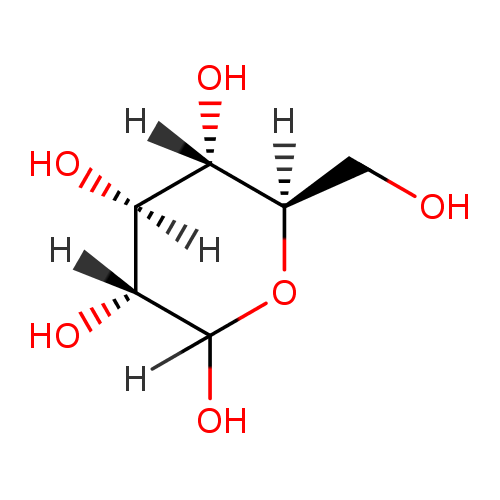
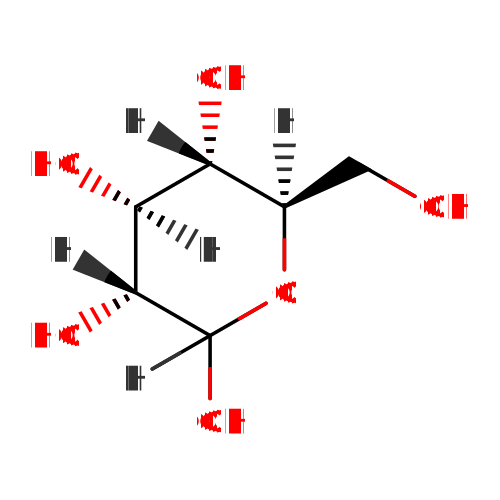
DescriptionGlucose is a monosaccharide containing six carbon atoms and an aldehyde group and is therefore referred to as an aldohexose. The glucose molecule can exist in an open-chain (acyclic) and ring (cyclic) form, the latter being the result of an intramolecular reaction between the aldehyde C atom and the C-5 hydroxyl group to form an intramolecular hemiacetal. In water solution both forms are in equilibrium and at pH 7 the cyclic one is the predominant. Glucose is a primary source of energy for living organisms. It is naturally occurring and is found in fruits and other parts of plants in its free state. In animals glucose arises from the breakdown of glycogen in a process known as glycogenolysis. Glucose is synthesized in the liver and kidneys from non-carbohydrate intermediates, such as pyruvate and glycerol, by a process known as gluconeogenesis.
Contaminant Sources
  • EAFUS Chemicals
  • FooDB Chemicals
  • HMDB Contaminants - Feces
  • HMDB Contaminants - Urine
  • HPV EPA Chemicals
  • STOFF IDENT Compounds
  • T3DB toxins
  • ToxCast & Tox21 Chemicals
Contaminant Type
  • Animal Toxin
  • Food Toxin
  • Household Toxin
  • Human Neurotoxin
  • Metabolite
  • Natural Compound
  • Organic Compound
Chemical Structure
Thumb
Synonyms
ValueSource
D-GLCChEBI
D-GLCPChEBI
DextroseChEBI
GLC-OHChEBI
GlucoseChEBI
Grape sugarChEBI
WURCS=2.0/1,1,0/[a2122h-1x_1-5]/1/ChEBI
Purified glucoseKegg
D-GlucopyranoseKegg
Roferose STHMDB
(+)-GlucoseHMDB
Anhydrous dextroseHMDB, MeSH
CereloseHMDB
Cerelose 2001HMDB
Clearsweet 95HMDB
Clintose LHMDB
Corn sugarHMDB
CPC HydrateHMDB
D(+)-GlucoseHMDB
DextropurHMDB
DextrosolHMDB
GlucodinHMDB
GlucolinHMDB
GoldsugarHMDB
MeritoseHMDB
Staleydex 111HMDB
Staleydex 95mHMDB
Tabfine 097(HS)HMDB
VadexHMDB
D GlucoseMeSH, HMDB
Glucose, (DL)-isomerMeSH, HMDB
Glucose, (L)-isomerMeSH, HMDB
Glucose, (beta-D)-isomerMeSH, HMDB
Glucose monohydrateMeSH, HMDB
Glucose, (alpha-D)-isomerMeSH, HMDB
L GlucoseMeSH, HMDB
L-GlucoseMeSH, HMDB
Dextrose, anhydrousMeSH, HMDB
Monohydrate, glucoseMeSH, HMDB
Chemical FormulaC6H12O6
Average Molecular Mass180.156 g/mol
Monoisotopic Mass180.063 g/mol
CAS Registry Number50-99-7
IUPAC Name(2R,3S,4R,5R)-2,3,4,5,6-pentahydroxyhexanal
Traditional Nameglucose
SMILESOC[C@H]1OC(O)[C@H](O)[C@@H](O)[C@@H]1O
InChI IdentifierInChI=1S/C6H12O6/c7-1-2-3(8)4(9)5(10)6(11)12-2/h2-11H,1H2/t2-,3-,4+,5-,6?/m1/s1
InChI KeyWQZGKKKJIJFFOK-GASJEMHNSA-N
Chemical Taxonomy
Description belongs to the class of organic compounds known as hexoses. These are monosaccharides in which the sugar unit is a is a six-carbon containing moeity.
KingdomOrganic compounds
Super ClassOrganic oxygen compounds
ClassOrganooxygen compounds
Sub ClassCarbohydrates and carbohydrate conjugates
Direct ParentHexoses
Alternative Parents
Substituents
  • Hexose monosaccharide
  • Oxane
  • Secondary alcohol
  • Hemiacetal
  • Oxacycle
  • Organoheterocyclic compound
  • Polyol
  • Hydrocarbon derivative
  • Primary alcohol
  • Alcohol
  • Aliphatic heteromonocyclic compound
Molecular FrameworkAliphatic heteromonocyclic compounds
External Descriptors
Biological Properties
StatusDetected and Not Quantified
OriginEndogenous
Cellular Locations
  • Endoplasmic reticulum
  • Extracellular
  • Golgi apparatus
  • Lysosome
  • Membrane
Biofluid LocationsNot Available
Tissue Locations
  • Adipose Tissue
  • Adrenal Cortex
  • Adrenal Gland
  • Adrenal Medulla
  • Beta Cell
  • Bladder
  • Brain
  • Brain Plaques
  • Epidermis
  • Eye Lens
  • Fetus
  • Fibroblasts
  • Gonads
  • Gut
  • Intestine
  • Kidney
  • Liver
  • Lung
  • Mouth
  • Muscle
  • Myelin
  • Nerve Cells
  • Neuron
  • Pancreas
  • Placenta
  • Prostate
Pathways
NameSMPDB LinkKEGG Link
Galactose MetabolismSMP00043 map00052
GluconeogenesisSMP00128 Not Available
Glucose-Alanine CycleSMP00127 Not Available
GlycolysisSMP00040 Not Available
Lactose DegradationSMP00457 Not Available
Lactose SynthesisSMP00444 Not Available
Transfer of Acetyl Groups into MitochondriaSMP00466 Not Available
Glucose Transporter Defect (SGLT2)SMP00245 Not Available
Isovaleric AciduriaSMP00238 Not Available
Pyruvate Carboxylase DeficiencySMP00350 Not Available
Renal GlucosuriaSMP00184 Not Available
ApplicationsNot Available
Biological Roles
Chemical RolesNot Available
Physical Properties
StateSolid
AppearanceWhite powder.
Experimental Properties
PropertyValue
Melting Point146 - 150°C
Boiling PointNot Available
Solubility1200.0 mg/mL
Predicted Properties
PropertyValueSource
Water Solubility782 g/LALOGPS
logP-2.6ALOGPS
logP-2.9ChemAxon
logS0.64ALOGPS
pKa (Strongest Acidic)11.3ChemAxon
pKa (Strongest Basic)-3ChemAxon
Physiological Charge0ChemAxon
Hydrogen Acceptor Count6ChemAxon
Hydrogen Donor Count5ChemAxon
Polar Surface Area110.38 ŲChemAxon
Rotatable Bond Count1ChemAxon
Refractivity35.92 m³·mol⁻¹ChemAxon
Polarizability16.37 ųChemAxon
Number of Rings1ChemAxon
Bioavailability1ChemAxon
Rule of FiveYesChemAxon
Ghose FilterNoChemAxon
Veber's RuleNoChemAxon
MDDR-like RuleNoChemAxon
Spectra
Spectra
Spectrum TypeDescriptionSplash KeyView
GC-MSGC-MS Spectrum - GC-EI-TOF (Pegasus III TOF-MS system, Leco; GC 6890, Agilent Technologies) (5 TMS)splash10-00kb-1931000000-ec21c3af97621f7bf95aSpectrum
GC-MSGC-MS Spectrum - GC-EI-TOF (Pegasus III TOF-MS system, Leco; GC 6890, Agilent Technologies) (5 TMS)splash10-0fr2-1920000000-f53c5f0d5ad84d32679fSpectrum
GC-MSGC-MS Spectrum - GC-EI-TOF (Pegasus III TOF-MS system, Leco; GC 6890, Agilent Technologies) (5 TMS; 1 MEOX)splash10-00di-9821000000-dbc697213e3b7cc9d4feSpectrum
GC-MSGC-MS Spectrum - GC-EI-TOF (Pegasus III TOF-MS system, Leco; GC 6890, Agilent Technologies) (5 TMS; 1 MEOX)splash10-00di-9621000000-9d1d8057758d3da8cacaSpectrum
GC-MSGC-MS Spectrum - GC-MS (4 TMS)splash10-014i-2490000000-3ed4c4fd34c05bad95f7Spectrum
GC-MSGC-MS Spectrum - GC-MS (1 MEOX; 5 TMS)splash10-066r-1952000000-3378cb724e551e8b0267Spectrum
GC-MSGC-MS Spectrum - GC-MS (5 TMS)splash10-0udl-0690000000-c8fda4276ff69235f30dSpectrum
GC-MSGC-MS Spectrum - GC-MS (1 MEOX; 5 TMS)splash10-0ldi-1942000000-5d531ed23a4e82023d1cSpectrum
GC-MSGC-MS Spectrum - GC-MS (5 TMS)splash10-0udi-0790000000-7ebe75cd633c58d761faSpectrum
GC-MSGC-MS Spectrum - GC-EI-TOF (Non-derivatized)splash10-00kb-1931000000-ec21c3af97621f7bf95aSpectrum
GC-MSGC-MS Spectrum - GC-EI-TOF (Non-derivatized)splash10-0fr2-1920000000-f53c5f0d5ad84d32679fSpectrum
GC-MSGC-MS Spectrum - GC-EI-TOF (Non-derivatized)splash10-00di-9821000000-dbc697213e3b7cc9d4feSpectrum
GC-MSGC-MS Spectrum - GC-EI-TOF (Non-derivatized)splash10-00di-9621000000-9d1d8057758d3da8cacaSpectrum
GC-MSGC-MS Spectrum - GC-MS (Non-derivatized)splash10-014i-2490000000-3ed4c4fd34c05bad95f7Spectrum
GC-MSGC-MS Spectrum - GC-MS (Non-derivatized)splash10-066r-1952000000-3378cb724e551e8b0267Spectrum
GC-MSGC-MS Spectrum - GC-MS (Non-derivatized)splash10-0udl-0690000000-c8fda4276ff69235f30dSpectrum
GC-MSGC-MS Spectrum - GC-MS (Non-derivatized)splash10-0ldi-1942000000-5d531ed23a4e82023d1cSpectrum
GC-MSGC-MS Spectrum - GC-MS (Non-derivatized)splash10-0udi-0790000000-7ebe75cd633c58d761faSpectrum
Predicted GC-MSPredicted GC-MS Spectrum - GC-MS (Non-derivatized) - 70eV, Positivesplash10-0np0-9700000000-e8d638dc817e46b97d7bSpectrum
Predicted GC-MSPredicted GC-MS Spectrum - GC-MS (5 TMS) - 70eV, Positivesplash10-004i-6122690000-eaf6f7adf34ccd0c667bSpectrum
LC-MS/MSLC-MS/MS Spectrum - Quattro_QQQ 10V, N/A (Annotated)splash10-0002-9300000000-839f41cf94a071fcdb37Spectrum
LC-MS/MSLC-MS/MS Spectrum - Quattro_QQQ 25V, N/A (Annotated)splash10-0002-9000000000-807f75d14f3d0b66f5bdSpectrum
LC-MS/MSLC-MS/MS Spectrum - Quattro_QQQ 40V, N/A (Annotated)splash10-000t-9000000000-b89668f86992a8363664Spectrum
LC-MS/MSLC-MS/MS Spectrum - LC-ESI-QQ (API3000, Applied Biosystems) 10V, Negativesplash10-000i-7900000000-9a673c2e4b82ca397421Spectrum
LC-MS/MSLC-MS/MS Spectrum - LC-ESI-QQ (API3000, Applied Biosystems) 20V, Negativesplash10-0a4r-9100000000-b70415588e768ddce5efSpectrum
LC-MS/MSLC-MS/MS Spectrum - LC-ESI-QQ (API3000, Applied Biosystems) 30V, Negativesplash10-0a4i-9000000000-73dc84dd88d8ae69fe02Spectrum
LC-MS/MSLC-MS/MS Spectrum - LC-ESI-QQ (API3000, Applied Biosystems) 40V, Negativesplash10-0a4i-9000000000-ba39d4ed9431a1d01eabSpectrum
LC-MS/MSLC-MS/MS Spectrum - LC-ESI-QQ (API3000, Applied Biosystems) 50V, Negativesplash10-0a4i-9000000000-a61efd1469735758b317Spectrum
LC-MS/MSLC-MS/MS Spectrum - LC-ESI-QQ , negativesplash10-000i-7900000000-9a673c2e4b82ca397421Spectrum
LC-MS/MSLC-MS/MS Spectrum - LC-ESI-QQ , negativesplash10-0a4r-9100000000-9c25b149885d8a48aab5Spectrum
LC-MS/MSLC-MS/MS Spectrum - LC-ESI-QQ , negativesplash10-0a4i-9000000000-76d92ea96364c24ecfb0Spectrum
LC-MS/MSLC-MS/MS Spectrum - LC-ESI-QQ , negativesplash10-0a4i-9000000000-ba39d4ed9431a1d01eabSpectrum
LC-MS/MSLC-MS/MS Spectrum - LC-ESI-QQ , negativesplash10-0a4i-9000000000-a61efd1469735758b317Spectrum
Predicted LC-MS/MSPredicted LC-MS/MS Spectrum - 10V, Positivesplash10-01q9-0900000000-b0bc47623e7b2ca31c02Spectrum
Predicted LC-MS/MSPredicted LC-MS/MS Spectrum - 20V, Positivesplash10-03ea-3900000000-648e1637af29cf2a3518Spectrum
Predicted LC-MS/MSPredicted LC-MS/MS Spectrum - 40V, Positivesplash10-0007-9200000000-9e6f46a1cbf52d6e347aSpectrum
Predicted LC-MS/MSPredicted LC-MS/MS Spectrum - 10V, Negativesplash10-004i-2900000000-a4ec4f0b1e29e360a952Spectrum
Predicted LC-MS/MSPredicted LC-MS/MS Spectrum - 20V, Negativesplash10-01t9-6900000000-7b3ea9c64ecc8d4ac867Spectrum
Predicted LC-MS/MSPredicted LC-MS/MS Spectrum - 40V, Negativesplash10-052f-9100000000-ec2bf4918640a0a36398Spectrum
Predicted LC-MS/MSPredicted LC-MS/MS Spectrum - 10V, Positivesplash10-03di-1900000000-6e953691e4c61d5123d9Spectrum
Predicted LC-MS/MSPredicted LC-MS/MS Spectrum - 20V, Positivesplash10-000j-9200000000-42768e14d42bd5ebe785Spectrum
Predicted LC-MS/MSPredicted LC-MS/MS Spectrum - 40V, Positivesplash10-08ov-9000000000-ee9eba654c17ccffa05fSpectrum
Predicted LC-MS/MSPredicted LC-MS/MS Spectrum - 10V, Negativesplash10-0a6r-9700000000-b92609de9f7db41f6d8fSpectrum
Predicted LC-MS/MSPredicted LC-MS/MS Spectrum - 20V, Negativesplash10-0a4l-9100000000-31314220c313e7443171Spectrum
Predicted LC-MS/MSPredicted LC-MS/MS Spectrum - 40V, Negativesplash10-0a4l-9000000000-2a9c77b5036ec23fe0d4Spectrum
1D NMR1H NMR SpectrumNot AvailableSpectrum
1D NMR13C NMR SpectrumNot AvailableSpectrum
2D NMR[1H,13C] 2D NMR SpectrumNot AvailableSpectrum
Toxicity Profile
Route of ExposureNot Available
Mechanism of ToxicityVery high serum levels of glucose are found in untreated diabetic (type I or type II) patients. Glucose in chronic excess causes toxic effects on the structure and function of many cells and organs, including the pancreas and pancreatic islet cells. Multiple biochemical pathways and mechanisms of action for glucose toxicity have been suggested. These include glyceraldehyde auto-oxidation, protein kinase C activation, methylglyoxal formation and glycation, hexosamine metabolism, sorbitol formation, and oxidative phosphorylation. All these pathways have in common the formation of reactive oxygen species that, in excess and over time, cause chronic oxidative stress, which in turn causes defective insulin gene expression and insulin secretion as well as increased apoptosis. Exposure of endothelial cells to high glucose causes GAPDH inhibition through reactive oxygen species-activated poly(ADP-ribosyl)ation of GAPDH by poly(ADP-ribose) polymerase. Three products from glucose metabolism (glyoxal, methylglyoxal, and 3-deoxyglucosone) form advanced glycation end products (AGEs) by reacting with amino groups on intracellular and extracellular proteins. AGEs play important roles in the pathogenesis of secondary complications of diabetes, especially with regard to microvascular disease in the retina, nerves, and kidney and likely islets. Glycated hemoglobin is a particularly important AGE. A 1% increase in absolute concentrations of glycated hemoglobin is associated with about 10-20% increase in cardiovascular disease risk.
MetabolismNot Available
Toxicity ValuesNot Available
Lethal DoseNot Available
Carcinogenicity (IARC Classification)No indication of carcinogenicity to humans (not listed by IARC).
Uses/SourcesNot Available
Minimum Risk LevelNot Available
Health EffectsHigh blood glucose (>7 mM) produces the symptoms of frequent urination, increased thirst, and increased hunger. Chronic exposure to high blood glucose (i.e. untreated diabetes) can cause many complications. Acute complications include diabetic ketoacidosis (characterized by nausea, vomiting and abdominal pain, the smell of acetone on the breath) and nonketotic hyperosmolar coma. Serious long-term complications include heart disease, stroke, kidney failure, foot ulcers and damage to the eyes. The major long-term complications relate to damage to blood vessels. Diabetes doubles the risk of cardiovascular disease and about 75% of deaths in diabetics are due to coronary artery disease. Other "macrovascular" diseases are stroke, and peripheral vascular disease. The primary microvascular complications of diabetes include damage to the eyes, kidneys, and nerves. Damage to the eyes, known as diabetic retinopathy, is caused by damage to the blood vessels in the retina of the eye, and can result in gradual vision loss and potentially blindness. Damage to the kidneys, known as diabetic nephropathy, can lead to tissue scarring, urine protein loss, and eventually chronic kidney disease, sometimes requiring dialysis or kidney transplant. Damage to the nerves of the body, known as diabetic neuropathy, is the most common complication of diabetes. The symptoms can include numbness, tingling, pain, and altered pain sensation, which can lead to damage to the skin. Diabetes-related foot problems (such as diabetic foot ulcers) may occur, and can be difficult to treat, occasionally requiring amputation. Gestational diabetes can damage the health of the fetus or mother. Risks to the baby include macrosomia (high birth weight), congenital cardiac and central nervous system anomalies, and skeletal muscle malformations. Increased fetal insulin may inhibit fetal surfactant production and cause respiratory distress syndrome. Hyperbilirubinemia may result from red blood cell destruction.
SymptomsNot Available
TreatmentTreatment involves a healthy diet, physical exercise, not using tobacco, and being a normal body weight. Blood pressure control and proper foot care are also important for people with the disease. Type 1 diabetes must be managed with insulin injections. Type 2 diabetes may be treated with medications with or without insulin.
Concentrations
Not Available
DrugBank IDNot Available
HMDB IDHMDB0304632
FooDB IDFDB093715
Phenol Explorer IDNot Available
KNApSAcK IDC00001122
BiGG IDNot Available
BioCyc IDD-Glucose
METLIN IDNot Available
PDB IDNot Available
Wikipedia LinkGlucose
Chemspider ID5589
ChEBI ID4167
PubChem Compound ID5793
Kegg Compound IDC00031
YMDB IDYMDB00286
ECMDB IDECMDB00122
References
Synthesis Reference

Chen Gong, “Method for preparation of 2’-deoxy-2’, 2’-difluoro-beta-cytidine or pharmaceutically acceptable salts thereof by using 1,6-anhydro-beta-D-glucose as raw material.” U.S. Patent US20060003963, issued January 05, 2006.

MSDSNot Available
General References
1. https://www.ncbi.nlm.nih.gov/pubmed/?term=15987845
2. https://www.ncbi.nlm.nih.gov/pubmed/?term=16901854
3. https://www.ncbi.nlm.nih.gov/pubmed/?term=17336832
4. https://www.ncbi.nlm.nih.gov/pubmed/?term=17439666
5. https://www.ncbi.nlm.nih.gov/pubmed/?term=17928662
6. https://www.ncbi.nlm.nih.gov/pubmed/?term=19913595
7. https://www.ncbi.nlm.nih.gov/pubmed/?term=26812026
8. https://www.ncbi.nlm.nih.gov/pubmed/?term=32619908
9. https://www.ncbi.nlm.nih.gov/pubmed/?term=7524207
10. https://www.ncbi.nlm.nih.gov/pubmed/?term=9140037
11. https://www.ncbi.nlm.nih.gov/pubmed/?term=9501190
12. https://www.ncbi.nlm.nih.gov/pubmed/?term=9506998
13. https://www.ncbi.nlm.nih.gov/pubmed/?term=9545565