Record Information
Version1.0
Creation Date2014-08-29 06:32:13 UTC
Update Date2026-05-14 16:24:15 UTC
Accession NumberCHEM003312
Identification
Common NameGlutathione
ClassSmall Molecule
DescriptionGlutathione is a compound synthesized from cysteine, perhaps the most important member of the body's toxic waste disposal team. Like cysteine, glutathione contains the crucial thiol (-SH) group that makes it an effective antioxidant. There are virtually no living organisms on this planet-animal or plant whose cells don't contain some glutathione. Scientists have speculated that glutathione was essential to the very development of life on earth. Glutathione has many roles; in none does it act alone. It is a coenzyme in various enzymatic reactions. The most important of these are redox reactions, in which the thiol grouping on the cysteine portion of cell membranes protects against peroxidation; and conjugation reactions, in which glutathione (especially in the liver) binds with toxic chemicals in order to detoxify them. Glutathione is also important in red and white blood cell formation and throughout the immune system. glutathione's clinical uses include the prevention of oxygen toxicity in hyperbaric oxygen therapy, treatment of lead and other heavy metal poisoning, lowering of the toxicity of chemotherapy and radiation in cancer treatments, and reversal of cataracts. Glutathione participates in leukotriene synthesis and is a cofactor for the enzyme glutathione peroxidase. It is also important as a hydrophilic molecule that is added to lipophilic toxins and waste in the liver during biotransformation before they can become part of the bile. Glutathione is also needed for the detoxification of methylglyoxal, a toxin produced as a by-product of metabolism. This detoxification reaction is carried out by the glyoxalase system. Glyoxalase I (EC 4.4.1.5) catalyzes the conversion of methylglyoxal and reduced glutathione to S-D-Lactoyl-glutathione. Glyoxalase II (EC 3.1.2.6) catalyzes the hydrolysis of S-D-Lactoyl-glutathione to glutathione and D-lactate. GSH is known as a substrate in both conjugation reactions and reduction reactions, catalyzed by glutathione S-transferase enzymes in cytosol, microsomes, and mitochondria. However, it is also capable of participating in non-enzymatic conjugation with some chemicals, as in the case of n-acetyl-p-benzoquinone imine (NAPQI), the reactive cytochrome P450-reactive metabolite formed by acetaminophen, that becomes toxic when GSH is depleted by an overdose (of acetaminophen). Glutathione in this capacity binds to NAPQI as a suicide substrate and in the process detoxifies it, taking the place of cellular protein thiol groups which would otherwise be covalently modified; when all GSH has been spent, NAPQI begins to react with the cellular proteins, killing the cells in the process. The preferred treatment for an overdose of this painkiller is the administration (usually in atomized form) of N-acetylcysteine, which is used by cells to replace spent GSSG and renew the usable GSH pool. It conjugates to drugs to make them more soluble for excretion, is a cofactor for some enzymes, is involved in protein disulfide bond rearrangement and reduces peroxides.
Contaminant Sources
  • Cosmetic Chemicals
  • FooDB Chemicals
  • HMDB Contaminants - Urine
  • HPV EPA Chemicals
  • STOFF IDENT Compounds
  • T3DB toxins
  • ToxCast & Tox21 Chemicals
Contaminant Type
  • Amide
  • Amine
  • Animal Toxin
  • Dietary Supplement
  • Drug
  • Food Toxin
  • Metabolite
  • Micronutrient
  • Natural Compound
  • Nutraceutical
  • Organic Compound
  • Supplement
Chemical Structure
Thumb
Synonyms
ValueSource
5-L-Glutamyl-L-cysteinylglycineChEBI
gamma-L-Glutamyl-L-cysteinyl-glycineChEBI
Glutathione-SHChEBI
GSHChEBI
N-(N-gamma-L-Glutamyl-L-cysteinyl)glycineChEBI
Reduced glutathioneChEBI
Poly(gamma-glutamylcysteine)glycineKegg
(gamma-Glutamylcysteine)N-glycineKegg
TathionKegg
g-L-Glutamyl-L-cysteinyl-glycineGenerator
Γ-L-glutamyl-L-cysteinyl-glycineGenerator
N-(N-g-L-Glutamyl-L-cysteinyl)glycineGenerator
N-(N-Γ-L-glutamyl-L-cysteinyl)glycineGenerator
Poly(g-glutamylcysteine)glycineGenerator
Poly(γ-glutamylcysteine)glycineGenerator
(g-Glutamylcysteine)N-glycineGenerator
(Γ-glutamylcysteine)N-glycineGenerator
Agifutol SHMDB
Bakezyme RXHMDB
CoprenHMDB
DeltathioneHMDB
gamma-GlutamylcysteinylglycineHMDB
gamma-L-Glutamyl-L-cysteinylglycineHMDB
GlutathionHMDB
Glutathione redHMDB
Glutathione reducedHMDB
GlutatiolHMDB
GlutationeHMDB
GlutideHMDB
GlutinalHMDB
IsethionHMDB
L-g-Glutamyl-L-cysteinyl-glycineHMDB
L-gamma-Glutamyl-L-cysteinyl-glycineHMDB
L-gamma-Glutamyl-L-cysteinylglycineHMDB
L-Glutamyl-L-cysteinylglycineHMDB
L-GlutathioneHMDB
L-Glutathione reduceHMDB
LedacHMDB
NeuthionHMDB
Red. glutathioneHMDB
TathioneHMDB
TriptideHMDB
Glutathione, reducedHMDB
gamma L Glu L cys glyHMDB
gamma-L-Glu-L-cys-glyHMDB
gamma L Glutamyl L cysteinylglycineHMDB
Chemical FormulaC10H17N3O6S
Average Molecular Mass307.323 g/mol
Monoisotopic Mass307.084 g/mol
CAS Registry Number70-18-8
IUPAC Name(2S)-2-amino-4-{[(1R)-1-[(carboxymethyl)carbamoyl]-2-sulfanylethyl]carbamoyl}butanoic acid
Traditional Nameglutathione
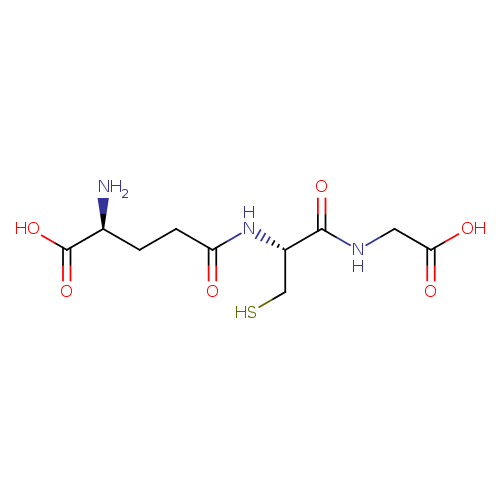
SMILESN[C@@H](CCC(=O)N[C@@H](CS)C(=O)NCC(O)=O)C(O)=O
InChI IdentifierInChI=1S/C10H17N3O6S/c11-5(10(18)19)1-2-7(14)13-6(4-20)9(17)12-3-8(15)16/h5-6,20H,1-4,11H2,(H,12,17)(H,13,14)(H,15,16)(H,18,19)/t5-,6-/m0/s1
InChI KeyRWSXRVCMGQZWBV-WDSKDSINSA-N
Chemical Taxonomy
Description belongs to the class of organic compounds known as peptides. Peptides are compounds containing an amide derived from two or more amino carboxylic acid molecules (the same or different) by formation of a covalent bond from the carbonyl carbon of one to the nitrogen atom of another.
KingdomOrganic compounds
Super ClassOrganic acids and derivatives
ClassCarboxylic acids and derivatives
Sub ClassAmino acids, peptides, and analogues
Direct ParentPeptides
Alternative Parents
Substituents
  • Alpha peptide
  • N-acyl-alpha-amino acid
  • N-acyl-alpha amino acid or derivatives
  • Alpha-amino acid
  • Alpha-amino acid or derivatives
  • L-alpha-amino acid
  • Dicarboxylic acid or derivatives
  • Fatty acid
  • Amino acid or derivatives
  • Amino acid
  • Alkylthiol
  • Carboximidic acid
  • Carboximidic acid derivative
  • Carboxylic acid
  • Organic 1,3-dipolar compound
  • Propargyl-type 1,3-dipolar organic compound
  • Hydrocarbon derivative
  • Primary aliphatic amine
  • Organic oxide
  • Organic oxygen compound
  • Organic nitrogen compound
  • Carbonyl group
  • Amine
  • Organonitrogen compound
  • Organooxygen compound
  • Organosulfur compound
  • Organopnictogen compound
  • Primary amine
  • Aliphatic acyclic compound
Molecular FrameworkAliphatic acyclic compounds
External Descriptors
Biological Properties
StatusDetected and Not Quantified
OriginEndogenous
Cellular Locations
  • Cytoplasm
  • Endoplasmic reticulum
  • Extracellular
  • Membrane
  • Mitochondria
Biofluid LocationsNot Available
Tissue Locations
  • All Tissues
Pathways
NameSMPDB LinkKEGG Link
Arachidonic Acid MetabolismSMP00075 map00590
Glutamate MetabolismSMP00072 map00250
Glutathione MetabolismSMP00015 map00480
Pyruvaldehyde DegradationSMP00459 Not Available
Gamma-Glutamyltransferase DeficiencySMP00183 Not Available
ApplicationsNot Available
Biological Roles
Chemical Roles
Physical Properties
StateSolid
AppearanceWhite powder.
Experimental Properties
PropertyValue
Melting Point195°C
Boiling PointNot Available
Solubility292.5 mg/mL
Predicted Properties
PropertyValueSource
Water Solubility0.88 g/LALOGPS
logP-2.7ALOGPS
logP-4.9ChemAxon
logS-2.5ALOGPS
pKa (Strongest Acidic)1.94ChemAxon
pKa (Strongest Basic)9.22ChemAxon
Physiological Charge-1ChemAxon
Hydrogen Acceptor Count7ChemAxon
Hydrogen Donor Count6ChemAxon
Polar Surface Area158.82 ŲChemAxon
Rotatable Bond Count9ChemAxon
Refractivity69.11 m³·mol⁻¹ChemAxon
Polarizability29.11 ųChemAxon
Number of Rings0ChemAxon
Bioavailability1ChemAxon
Rule of FiveNoChemAxon
Ghose FilterNoChemAxon
Veber's RuleNoChemAxon
MDDR-like RuleNoChemAxon
Spectra
Spectra
Spectrum TypeDescriptionSplash KeyView
GC-MSGC-MS Spectrum - GC-EI-TOF (Pegasus III TOF-MS system, Leco; GC 6890, Agilent Technologies) (x TMS)splash10-0a4i-0900000000-5841845f736f9a667622Spectrum
GC-MSGC-MS Spectrum - GC-EI-TOF (Pegasus III TOF-MS system, Leco; GC 6890, Agilent Technologies) (x TMS)splash10-0a4i-0900000000-bdecde153761cb67852eSpectrum
GC-MSGC-MS Spectrum - GC-EI-TOF (Non-derivatized)splash10-0a4i-0900000000-5841845f736f9a667622Spectrum
GC-MSGC-MS Spectrum - GC-EI-TOF (Non-derivatized)splash10-0a4i-0900000000-bdecde153761cb67852eSpectrum
GC-MSGC-MS Spectrum - GC-EI-TOF (Non-derivatized)splash10-0a4i-1910000000-52bc43dd913b68d74f84Spectrum
GC-MSGC-MS Spectrum - GC-EI-TOF (Non-derivatized)splash10-08fs-3960000000-63ce34def2ae94b95515Spectrum
GC-MSGC-MS Spectrum - GC-EI-TOF (Non-derivatized)splash10-0pb9-0921000000-88168b0a9f5fc5fead3fSpectrum
Predicted GC-MSPredicted GC-MS Spectrum - GC-MS (Non-derivatized) - 70eV, Positivesplash10-0006-7890000000-5853006f66d946dd3d2eSpectrum
Predicted GC-MSPredicted GC-MS Spectrum - GC-MS (2 TMS) - 70eV, Positivesplash10-0596-9112300000-e82cf72540c283d8e323Spectrum
Predicted GC-MSPredicted GC-MS Spectrum - GC-MS (Non-derivatized) - 70eV, PositiveNot AvailableSpectrum
Predicted GC-MSPredicted GC-MS Spectrum - GC-MS (TMS_1_1) - 70eV, PositiveNot AvailableSpectrum
Predicted GC-MSPredicted GC-MS Spectrum - GC-MS (TMS_1_2) - 70eV, PositiveNot AvailableSpectrum
Predicted GC-MSPredicted GC-MS Spectrum - GC-MS (TMS_1_3) - 70eV, PositiveNot AvailableSpectrum
Predicted GC-MSPredicted GC-MS Spectrum - GC-MS (TMS_1_4) - 70eV, PositiveNot AvailableSpectrum
Predicted GC-MSPredicted GC-MS Spectrum - GC-MS (TMS_1_5) - 70eV, PositiveNot AvailableSpectrum
Predicted GC-MSPredicted GC-MS Spectrum - GC-MS (TMS_1_6) - 70eV, PositiveNot AvailableSpectrum
Predicted GC-MSPredicted GC-MS Spectrum - GC-MS (TMS_2_2) - 70eV, PositiveNot AvailableSpectrum
Predicted GC-MSPredicted GC-MS Spectrum - GC-MS (TMS_2_3) - 70eV, PositiveNot AvailableSpectrum
Predicted GC-MSPredicted GC-MS Spectrum - GC-MS (TMS_2_4) - 70eV, PositiveNot AvailableSpectrum
Predicted GC-MSPredicted GC-MS Spectrum - GC-MS (TMS_2_5) - 70eV, PositiveNot AvailableSpectrum
Predicted GC-MSPredicted GC-MS Spectrum - GC-MS (TMS_2_6) - 70eV, PositiveNot AvailableSpectrum
Predicted GC-MSPredicted GC-MS Spectrum - GC-MS (TMS_2_7) - 70eV, PositiveNot AvailableSpectrum
Predicted GC-MSPredicted GC-MS Spectrum - GC-MS (TMS_2_8) - 70eV, PositiveNot AvailableSpectrum
Predicted GC-MSPredicted GC-MS Spectrum - GC-MS (TMS_2_9) - 70eV, PositiveNot AvailableSpectrum
Predicted GC-MSPredicted GC-MS Spectrum - GC-MS (TMS_2_10) - 70eV, PositiveNot AvailableSpectrum
LC-MS/MSLC-MS/MS Spectrum - Quattro_QQQ 10V, Positive (Annotated)splash10-004i-3795000000-d019cd7dcbad1f8a9e78Spectrum
LC-MS/MSLC-MS/MS Spectrum - Quattro_QQQ 25V, Positive (Annotated)splash10-003r-9400000000-a83bf6292d41988256e3Spectrum
LC-MS/MSLC-MS/MS Spectrum - Quattro_QQQ 40V, Positive (Annotated)splash10-001i-9000000000-305a92f8a9ffea58fa0eSpectrum
LC-MS/MSLC-MS/MS Spectrum - LC-ESI-ITFT (LTQ Orbitrap XL, Thermo Scientfic) , Positivesplash10-0a4i-0009000000-e950bfc5867b391c6960Spectrum
LC-MS/MSLC-MS/MS Spectrum - LC-ESI-ITFT (LTQ Orbitrap XL, Thermo Scientfic) , Positivesplash10-004i-0910000000-83f6c079d1112e74ecf4Spectrum
LC-MS/MSLC-MS/MS Spectrum - LC-ESI-ITFT (LTQ Orbitrap XL, Thermo Scientfic) , Positivesplash10-003r-0910000000-5b243cf8bd357ab270b1Spectrum
LC-MS/MSLC-MS/MS Spectrum - LC-ESI-ITFT (LTQ Orbitrap XL, Thermo Scientfic) , Positivesplash10-0a4i-0009000000-29ef335479f56b620d88Spectrum
LC-MS/MSLC-MS/MS Spectrum - LC-ESI-ITFT (LTQ Orbitrap XL, Thermo Scientfic) , Positivesplash10-0a4i-0009001000-d1f5986166efa523d024Spectrum
LC-MS/MSLC-MS/MS Spectrum - LC-ESI-ITFT (LTQ Orbitrap XL, Thermo Scientfic) , Positivesplash10-056s-0495300000-dba7be381fd1ef776527Spectrum
LC-MS/MSLC-MS/MS Spectrum - LC-ESI-ITFT (LTQ Orbitrap XL, Thermo Scientfic) , Positivesplash10-004i-0920000000-de5b8a5a377324599b39Spectrum
LC-MS/MSLC-MS/MS Spectrum - LC-ESI-ITFT (LTQ Orbitrap XL, Thermo Scientfic) , Positivesplash10-053r-0007920000-7500cef211e48c8ea244Spectrum
LC-MS/MSLC-MS/MS Spectrum - LC-ESI-ITFT (LTQ Orbitrap XL, Thermo Scientfic) , Negativesplash10-0a4i-0119003000-4eb7ed4e2a4cf6a83c66Spectrum
LC-MS/MSLC-MS/MS Spectrum - LC-ESI-ITFT (LTQ Orbitrap XL, Thermo Scientfic) , Negativesplash10-0uki-0290000000-6893386899c6eed6a1a6Spectrum
LC-MS/MSLC-MS/MS Spectrum - LC-ESI-ITFT (LTQ Orbitrap XL, Thermo Scientfic) , Negativesplash10-05g0-0190000000-cacc2de4ab18ed59798bSpectrum
LC-MS/MSLC-MS/MS Spectrum - LC-ESI-ITFT (LTQ Orbitrap XL, Thermo Scientfic) , Negativesplash10-0a4i-0009000000-6b4268add43ab66ef015Spectrum
LC-MS/MSLC-MS/MS Spectrum - LC-ESI-ITFT (LTQ Orbitrap XL, Thermo Scientfic) , Negativesplash10-08fr-0015009000-a01bdc13a34d6ce8416fSpectrum
LC-MS/MSLC-MS/MS Spectrum - LC-ESI-ITFT (LTQ Orbitrap XL, Thermo Scientfic) , Negativesplash10-0uki-0290000000-ea94ec8247b4e025adbeSpectrum
LC-MS/MSLC-MS/MS Spectrum - LC-ESI-ITFT (LTQ Orbitrap XL, Thermo Scientfic) , Negativesplash10-0a4i-0039210000-e1f721157a9ea89959d6Spectrum
LC-MS/MSLC-MS/MS Spectrum - LC-ESI-ITFT (LTQ Orbitrap XL, Thermo Scientfic) , Negativesplash10-0a59-0039210000-35ce450ea95922abf0e1Spectrum
LC-MS/MSLC-MS/MS Spectrum - LC-ESI-QQ (API3000, Applied Biosystems) 10V, Negativesplash10-0a4i-0009000000-9b01fba547d1fcde113aSpectrum
LC-MS/MSLC-MS/MS Spectrum - LC-ESI-QQ (API3000, Applied Biosystems) 20V, Negativesplash10-0006-0952000000-4a2a42699cf4aab2c559Spectrum
LC-MS/MSLC-MS/MS Spectrum - LC-ESI-QQ (API3000, Applied Biosystems) 30V, Negativesplash10-002f-2900000000-bd9ba27b48b1322b7618Spectrum
LC-MS/MSLC-MS/MS Spectrum - LC-ESI-QQ (API3000, Applied Biosystems) 40V, Negativesplash10-004m-5900000000-cc7184d5bba50e6e49d0Spectrum
LC-MS/MSLC-MS/MS Spectrum - LC-ESI-QQ (API3000, Applied Biosystems) 50V, Negativesplash10-0a4i-9200000000-aecd0eb18a10c3ffb7abSpectrum
Predicted LC-MS/MSPredicted LC-MS/MS Spectrum - 10V, Positivesplash10-0729-4492000000-78a928563adf9038ba59Spectrum
1D NMR1H NMR SpectrumNot AvailableSpectrum
1D NMR13C NMR SpectrumNot AvailableSpectrum
1D NMR1H NMR SpectrumNot AvailableSpectrum
1D NMR13C NMR SpectrumNot AvailableSpectrum
1D NMR1H NMR SpectrumNot AvailableSpectrum
1D NMR13C NMR SpectrumNot AvailableSpectrum
1D NMR1H NMR SpectrumNot AvailableSpectrum
1D NMR13C NMR SpectrumNot AvailableSpectrum
1D NMR1H NMR SpectrumNot AvailableSpectrum
1D NMR13C NMR SpectrumNot AvailableSpectrum
1D NMR1H NMR SpectrumNot AvailableSpectrum
1D NMR13C NMR SpectrumNot AvailableSpectrum
1D NMR1H NMR SpectrumNot AvailableSpectrum
1D NMR13C NMR SpectrumNot AvailableSpectrum
1D NMR1H NMR SpectrumNot AvailableSpectrum
1D NMR13C NMR SpectrumNot AvailableSpectrum
1D NMR1H NMR SpectrumNot AvailableSpectrum
1D NMR13C NMR SpectrumNot AvailableSpectrum
1D NMR1H NMR SpectrumNot AvailableSpectrum
1D NMR13C NMR SpectrumNot AvailableSpectrum
1D NMR1H NMR SpectrumNot AvailableSpectrum
1D NMR13C NMR SpectrumNot AvailableSpectrum
2D NMR[1H,13C] 2D NMR SpectrumNot AvailableSpectrum
Toxicity Profile
Route of ExposureResearch suggests that glutathione is not orally bioactive, and that very little of oral glutathione tablets or capsules is actually absorbed by the body.
Mechanism of ToxicityGlutathione (GSH) participates in leukotriene synthesis and is a cofactor for the enzyme glutathione peroxidase. It is also important as a hydrophilic molecule that is added to lipophilic toxins and waste in the liver during biotransformation before they can become part of the bile. Glutathione is also needed for the detoxification of methylglyoxal, a toxin produced as a by-product of metabolism. This detoxification reaction is carried out by the glyoxalase system. Glyoxalase I catalyzes the conversion of methylglyoxal and reduced glutathione to S-D-Lactoyl-glutathione. Glyoxalase II catalyzes the conversion of S-D-Lactoyl Glutathione to Reduced Glutathione and D-lactate. GSH is known as a cofactor in both conjugation reactions and reduction reactions, catalyzed by glutathione S-transferase enzymes in cytosol, microsomes, and mitochondria. However, it is capable of participating in non-enzymatic conjugation with some chemicals, as it is hypothesized to do to a significant extent with n-acetyl-p-benzoquinone imine (NAPQI), the reactive cytochrome P450 reactive metabolite formed by toxic overdose of acetaminophen. Glutathione in this capacity binds to NAPQI as a suicide substrate and in the process detoxifies it, taking the place of cellular protein sulfhydryl groups which would otherwise be toxically adducted. The preferred medical treatment to an overdose of this nature, whose efficacy has been consistently supported in literature, is the administration (usually in atomized form) of N-acetylcysteine, which is used by cells to replace spent GSSG and allow a usable GSH pool.
MetabolismNot Available
Toxicity ValuesORL-MUS LD50 5000 mg/kg, IPR-MUS LD50 4020 mg/kg, SCU-MUS LD50 5000 mg/kg, IVN-RBT LD50 > 2000 mg/kg, IMS-MUS LD50 4000 mg/kg
Lethal DoseNot Available
Carcinogenicity (IARC Classification)No indication of carcinogenicity to humans (not listed by IARC).
Uses/SourcesFor nutritional supplementation, also for treating dietary shortage or imbalance
Minimum Risk LevelNot Available
Health EffectsNot Available
SymptomsNot Available
TreatmentNot Available
Concentrations
Not Available
DrugBank IDDB00143
HMDB IDHMDB0000125
FooDB IDFDB001498
Phenol Explorer IDNot Available
KNApSAcK IDC00001518
BiGG ID33669
BioCyc IDGLUTATHIONE
METLIN ID44
PDB IDNot Available
Wikipedia LinkGlutathione
Chemspider ID111188
ChEBI ID16856
PubChem Compound ID124886
Kegg Compound IDC00051
YMDB IDYMDB00160
ECMDB IDECMDB00125
References
Synthesis Reference

Akihiro Mizutani, “Complexes of polysaccharides or derivatives thereof with reduced glutathione and process for preparing said complexes.” U.S. Patent US4009264, issued February, 1971.

MSDSLink
General References
1. Djurhuus R, Segadal K, Svardal AM: Glutathione in blood cells decreases without DNA breaks after a simulated saturation dive to 250 msw. Aviat Space Environ Med. 2006 Jun;77(6):597-604.
2. Bayir H, Kagan VE, Tyurina YY, Tyurin V, Ruppel RA, Adelson PD, Graham SH, Janesko K, Clark RS, Kochanek PM: Assessment of antioxidant reserves and oxidative stress in cerebrospinal fluid after severe traumatic brain injury in infants and children. Pediatr Res. 2002 May;51(5):571-8.
3. Hung CR: Effect of lysozyme chloride on betel quid chewing aggravated gastric oxidative stress and hemorrhagic ulcer in diabetic rats. World J Gastroenterol. 2005 Oct 7;11(37):5853-8.
4. Grattagliano I, Portincasa P, Palmieri VO, Palasciano G: Contribution of canalicular glutathione efflux to bile formation. From cholestasis associated alterations to pharmacological intervention to modify bile flow. Curr Drug Targets Immune Endocr Metabol Disord. 2005 Jun;5(2):153-61.
5. Calvo-Marzal P, Chumbimuni-Torres KY, Hoehr NF, Kubota LT: Determination of glutathione in hemolysed erythrocyte with amperometric sensor based on TTF-TCNQ. Clin Chim Acta. 2006 Sep;371(1-2):152-8. Epub 2006 May 2.
6. Calabrese V, Scapagnini G, Ravagna A, Bella R, Butterfield DA, Calvani M, Pennisi G, Giuffrida Stella AM: Disruption of thiol homeostasis and nitrosative stress in the cerebrospinal fluid of patients with active multiple sclerosis: evidence for a protective role of acetylcarnitine. Neurochem Res. 2003 Sep;28(9):1321-8.
7. Sohlenius-Sternbeck AK, Schmidt S: Impaired glutathione-conjugating capacity by cryopreserved human and rat hepatocytes. Xenobiotica. 2005 Jul;35(7):727-36.
8. Iida M, Yasuhara T, Mochizuki H, Takakura H, Yanagisawa T, Kubo H: Two Japanese brothers with hereditary gamma-glutamyl transpeptidase deficiency. J Inherit Metab Dis. 2005;28(1):49-55.
9. Briz O, Romero MR, Martinez-Becerra P, Macias RI, Perez MJ, Jimenez F, San Martin FG, Marin JJ: OATP8/1B3-mediated cotransport of bile acids and glutathione: an export pathway for organic anions from hepatocytes? J Biol Chem. 2006 Oct 13;281(41):30326-35. Epub 2006 Jul 28.
10. Czeczot H, Scibior D, Skrzycki M, Podsiad M: [Antioxidant barrier in patients with gastric cancer--preliminary study]. Pol Merkur Lekarski. 2005 Oct;19(112):521-5.
11. Nakayama Y, Kinoshita A, Tomita M: Dynamic simulation of red blood cell metabolism and its application to the analysis of a pathological condition. Theor Biol Med Model. 2005 May 9;2:18.
12. Czeczot H, Scibior D, Skrzycki M, Podsiad M: Glutathione and GSH-dependent enzymes in patients with liver cirrhosis and hepatocellular carcinoma. Acta Biochim Pol. 2006;53(1):237-42. Epub 2006 Jan 9.
13. Kawakami Y, Monobe M, Kuwabara K, Fujita T, Maeda M, Fujino O, Kojima S, Fukunaga Y: A comparative study of nitric oxide, glutathione, and glutathione peroxidase activities in cerebrospinal fluid from children with convulsive diseases/children with aseptic meningitis. Brain Dev. 2006 May;28(4):243-6. Epub 2006 Jan 10.
14. Kaynar H, Meral M, Turhan H, Keles M, Celik G, Akcay F: Glutathione peroxidase, glutathione-S-transferase, catalase, xanthine oxidase, Cu-Zn superoxide dismutase activities, total glutathione, nitric oxide, and malondialdehyde levels in erythrocytes of patients with small cell and non-small cell lung cancer. Cancer Lett. 2005 Sep 28;227(2):133-9. Epub 2005 Jan 8.
15. Tsai CC, Chen HS, Chen SL, Ho YP, Ho KY, Wu YM, Hung CC: Lipid peroxidation: a possible role in the induction and progression of chronic periodontitis. J Periodontal Res. 2005 Oct;40(5):378-84.
16. Wielandt AM, Vollrath V, Farias M, Chianale J: Bucillamine induces glutathione biosynthesis via activation of the transcription factor Nrf2. Biochem Pharmacol. 2006 Aug 14;72(4):455-62. Epub 2006 Jun 27.
17. Oztezcan S, Balkan J, Dogru-Abbasoglu S, Cevikbas U, Aykac-Toker G, Uysal M: Resistance of erythrocytes to lipid peroxidation in cirrhotic rats. Arch Med Res. 2005 Sep-Oct;36(5):459-63.
18. Schulpis KH, Papassotiriou I, Parthimos T, Tsakiris T, Tsakiris S: The effect of L-cysteine and glutathione on inhibition of Na+, K+-ATPase activity by aspartame metabolites in human erythrocyte membrane. Eur J Clin Nutr. 2006 May;60(5):593-7.
19. Zamek-Gliszczynski MJ, Hoffmaster KA, Nezasa K, Tallman MN, Brouwer KL: Integration of hepatic drug transporters and phase II metabolizing enzymes: mechanisms of hepatic excretion of sulfate, glucuronide, and glutathione metabolites. Eur J Pharm Sci. 2006 Apr;27(5):447-86. Epub 2006 Feb 10.
20. Iwasaki Y, Hoshi M, Ito R, Saito K, Nakazawa H: Analysis of glutathione and glutathione disulfide in human saliva using hydrophilic interaction chromatography with mass spectrometry. J Chromatogr B Analyt Technol Biomed Life Sci. 2006 Jul 24;839(1-2):74-9. Epub 2006 Apr 18.
21. Witschi A, Reddy S, Stofer B, Lauterburg BH: The systemic availability of oral glutathione. Eur J Clin Pharmacol. 1992;43(6):667-9.
22. Yim CY, Hibbs JB Jr, McGregor JR, Galinsky RE, Samlowski WE: Use of N-acetyl cysteine to increase intracellular glutathione during the induction of antitumor responses by IL-2. J Immunol. 1994 Jun 15;152(12):5796-805.
23. Wu G, Fang YZ, Yang S, Lupton JR, Turner ND: Glutathione metabolism and its implications for health. J Nutr. 2004 Mar;134(3):489-92.
24. Struzynska L, Chalimoniuk M, Sulkowski G: The role of astroglia in Pb-exposed adult rat brain with respect to glutamate toxicity. Toxicology. 2005 Sep 1;212(2-3):185-94.
25. Drevet JR: The antioxidant glutathione peroxidase family and spermatozoa: a complex story. Mol Cell Endocrinol. 2006 May 16;250(1-2):70-9. Epub 2006 Jan 19.
26. Elshenawy S, Pinney SE, Stuart T, Doulias PT, Zura G, Parry S, Elovitz MA, Bennett MJ, Bansal A, Strauss JF 3rd, Ischiropoulos H, Simmons RA: The Metabolomic Signature of the Placenta in Spontaneous Preterm Birth. Int J Mol Sci. 2020 Feb 4;21(3). pii: ijms21031043. doi: 10.3390/ijms21031043.
27. https://www.ncbi.nlm.nih.gov/pubmed/?term=17439666
28. https://www.ncbi.nlm.nih.gov/pubmed/?term=4200890
29. https://www.ncbi.nlm.nih.gov/pubmed/?term=4745654