Record Information
Version1.0
Creation Date2014-08-29 06:30:41 UTC
Update Date2026-04-06 04:22:16 UTC
Accession NumberCHEM003305
Identification
Common NameD-Fructose
ClassSmall Molecule
DescriptionFructose, or fruit sugar, is a simple monosaccharide found in many plants, where it is often covalently linked to glucose to form the disaccharide sucrose. Fructose is one of three common dietary monosaccharides, along with glucose and galactose, that are absorbed directly into the bloodstream during digestion. Fructose is found naturally in many fruits and vegetables and honey. It is frequently derived from sugar cane, sugar beets, and corn. High-fructose corn syrup (HFCS), which is widely used as a sweetener in beverages and foods, is a mixture of glucose and fructose. The primary reason that fructose is used commercially in foods and beverages is because of its low cost and is its high relative sweetness. It is the sweetest of all naturally occurring carbohydrates being 1.73 times as sweet as sucrose. Fructose consumption in the U.S. has more than doubled in the past 30 years. Americans' fructose intake climbed from 15 grams per day in the early 1900s to 55 grams per day in 1994. This increase is largely due to an increase in soft drink consumption.
Contaminant Sources
  • FooDB Chemicals
  • HMDB Contaminants - Feces
  • HMDB Contaminants - Urine
  • T3DB toxins
  • ToxCast & Tox21 Chemicals
Contaminant Type
  • Animal Toxin
  • Metabolite
  • Natural Compound
  • Organic Compound
Chemical Structure
Thumb
Synonyms
ValueSource
beta-D-Arabino-hexuloseChEBI
beta-D-FructoseChEBI
beta-Fruit sugarChEBI
beta-LevuloseChEBI
FRUCTOSEChEBI
b-D-Arabino-hexuloseGenerator
Β-D-arabino-hexuloseGenerator
b-D-FructoseGenerator
Β-D-fructoseGenerator
b-Fruit sugarGenerator
Β-fruit sugarGenerator
b-LevuloseGenerator
Β-levuloseGenerator
beta-D-FructofuranoseHMDB
beta-delta-Arabino-hexuloseHMDB
beta-delta-FructofuranoseHMDB
beta-delta-FructoseHMDB
D-(-)-FructoseHMDB
delta-(-)-FructoseHMDB
delta-FructoseHMDB
FRUHMDB
FructonHMDB
LevuloseHMDB
Braun brand OF fructoseHMDB
Fleboplast levulosaHMDB
Fresenius kabi brand OF fructoseHMDB
Instituto farmacologico brand OF fructoseHMDB
LevulosaHMDB
Levulosa ifeHMDB
Grifols brand OF fructoseHMDB
Levulosa baxterHMDB
Levulosado braunHMDB
Ern brand OF fructoseHMDB
Levulosa grifolsHMDB
Levulosa meinHMDB
Levulosado vituliaHMDB
Apir levulosaHMDB
Baxter brand OF fructoseHMDB
Bieffe brand OF fructoseHMDB
Levulosa braunHMDB
Levulosa ibysHMDB
Levulosa, apirHMDB
Levulosa, fleboplastHMDB
Levulosado bieffe meditHMDB
Plast apyr levulosa meinHMDB
Chemical FormulaC6H12O6
Average Molecular Mass180.156 g/mol
Monoisotopic Mass180.063 g/mol
CAS Registry Number53188-23-1
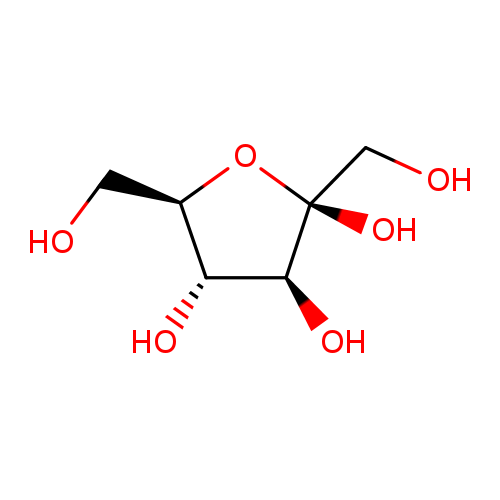
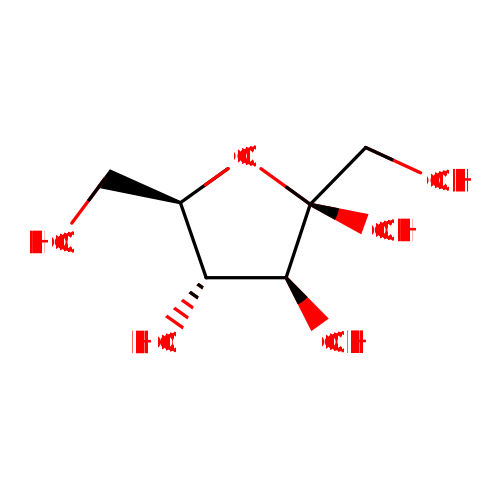
IUPAC Name(2R,3S,4S,5R)-2,5-bis(hydroxymethyl)oxolane-2,3,4-triol
Traditional Namefructose
SMILESOC[C@H]1O[C@](O)(CO)[C@@H](O)[C@@H]1O
InChI IdentifierInChI=1S/C6H12O6/c7-1-3-4(9)5(10)6(11,2-8)12-3/h3-5,7-11H,1-2H2/t3-,4-,5+,6-/m1/s1
InChI KeyRFSUNEUAIZKAJO-ARQDHWQXSA-N
Chemical Taxonomy
Description belongs to the class of organic compounds known as c-glycosyl compounds. These are glycoside in which a sugar group is bonded through one carbon to another group via a C-glycosidic bond.
KingdomOrganic compounds
Super ClassOrganic oxygen compounds
ClassOrganooxygen compounds
Sub ClassCarbohydrates and carbohydrate conjugates
Direct ParentC-glycosyl compounds
Alternative Parents
Substituents
  • C-glycosyl compound
  • Pentose monosaccharide
  • Monosaccharide
  • Tetrahydrofuran
  • Secondary alcohol
  • Hemiacetal
  • Oxacycle
  • Organoheterocyclic compound
  • Polyol
  • Hydrocarbon derivative
  • Primary alcohol
  • Alcohol
  • Aliphatic heteromonocyclic compound
Molecular FrameworkAliphatic heteromonocyclic compounds
External Descriptors
Biological Properties
StatusDetected and Not Quantified
OriginExogenous
Cellular Locations
  • Extracellular
Biofluid LocationsNot Available
Tissue Locations
  • All Tissues
Pathways
NameSMPDB LinkKEGG Link
Amino Sugar MetabolismSMP00045 map00520
Fructose and Mannose DegradationSMP00064 map00051
Galactose MetabolismSMP00043 map00052
Starch and Sucrose MetabolismSMP00058 map00500
Fructose intolerance, hereditarySMP00725 Not Available
FructosuriaSMP00561 Not Available
ApplicationsNot Available
Biological RolesNot Available
Chemical RolesNot Available
Physical Properties
StateSolid
AppearanceWhite crystals
Experimental Properties
PropertyValue
Melting Point103°C
Boiling Point440°C
Solubility778 mg/mL at 20°C
Predicted Properties
PropertyValueSource
Water Solubility1110 g/LALOGPS
logP-2.4ALOGPS
logP-2.8ChemAxon
logS0.79ALOGPS
pKa (Strongest Acidic)10.28ChemAxon
pKa (Strongest Basic)-3ChemAxon
Physiological Charge0ChemAxon
Hydrogen Acceptor Count6ChemAxon
Hydrogen Donor Count5ChemAxon
Polar Surface Area110.38 ŲChemAxon
Rotatable Bond Count2ChemAxon
Refractivity36.36 m³·mol⁻¹ChemAxon
Polarizability16.26 ųChemAxon
Number of Rings1ChemAxon
Bioavailability1ChemAxon
Rule of FiveYesChemAxon
Ghose FilterNoChemAxon
Veber's RuleNoChemAxon
MDDR-like RuleNoChemAxon
Spectra
Spectra
Spectrum TypeDescriptionSplash KeyView
Predicted GC-MSPredicted GC-MS Spectrum - GC-MS (Non-derivatized) - 70eV, Positivesplash10-076r-9600000000-f2c06850d0c3db9ec103Spectrum
Predicted GC-MSPredicted GC-MS Spectrum - GC-MS (5 TMS) - 70eV, Positivesplash10-0fb9-5614950000-6ef14e948d063026f7eeSpectrum
Predicted GC-MSPredicted GC-MS Spectrum - GC-MS (Non-derivatized) - 70eV, PositiveNot AvailableSpectrum
Predicted GC-MSPredicted GC-MS Spectrum - GC-MS (TMS_1_1) - 70eV, PositiveNot AvailableSpectrum
Predicted GC-MSPredicted GC-MS Spectrum - GC-MS (TMS_1_2) - 70eV, PositiveNot AvailableSpectrum
Predicted GC-MSPredicted GC-MS Spectrum - GC-MS (TMS_1_3) - 70eV, PositiveNot AvailableSpectrum
Predicted GC-MSPredicted GC-MS Spectrum - GC-MS (TMS_1_4) - 70eV, PositiveNot AvailableSpectrum
Predicted GC-MSPredicted GC-MS Spectrum - GC-MS (TMS_1_5) - 70eV, PositiveNot AvailableSpectrum
Predicted GC-MSPredicted GC-MS Spectrum - GC-MS (TMS_2_1) - 70eV, PositiveNot AvailableSpectrum
Predicted GC-MSPredicted GC-MS Spectrum - GC-MS (TMS_2_2) - 70eV, PositiveNot AvailableSpectrum
Predicted GC-MSPredicted GC-MS Spectrum - GC-MS (TMS_2_3) - 70eV, PositiveNot AvailableSpectrum
Predicted GC-MSPredicted GC-MS Spectrum - GC-MS (TMS_2_4) - 70eV, PositiveNot AvailableSpectrum
Predicted GC-MSPredicted GC-MS Spectrum - GC-MS (TMS_2_5) - 70eV, PositiveNot AvailableSpectrum
Predicted GC-MSPredicted GC-MS Spectrum - GC-MS (TMS_2_6) - 70eV, PositiveNot AvailableSpectrum
Predicted GC-MSPredicted GC-MS Spectrum - GC-MS (TMS_2_7) - 70eV, PositiveNot AvailableSpectrum
Predicted GC-MSPredicted GC-MS Spectrum - GC-MS (TMS_2_8) - 70eV, PositiveNot AvailableSpectrum
Predicted GC-MSPredicted GC-MS Spectrum - GC-MS (TMS_2_9) - 70eV, PositiveNot AvailableSpectrum
Predicted GC-MSPredicted GC-MS Spectrum - GC-MS (TMS_2_10) - 70eV, PositiveNot AvailableSpectrum
Predicted GC-MSPredicted GC-MS Spectrum - GC-MS (TMS_3_1) - 70eV, PositiveNot AvailableSpectrum
Predicted GC-MSPredicted GC-MS Spectrum - GC-MS (TMS_3_2) - 70eV, PositiveNot AvailableSpectrum
Predicted GC-MSPredicted GC-MS Spectrum - GC-MS (TMS_3_3) - 70eV, PositiveNot AvailableSpectrum
Predicted GC-MSPredicted GC-MS Spectrum - GC-MS (TMS_3_4) - 70eV, PositiveNot AvailableSpectrum
Predicted GC-MSPredicted GC-MS Spectrum - GC-MS (TMS_3_5) - 70eV, PositiveNot AvailableSpectrum
Predicted GC-MSPredicted GC-MS Spectrum - GC-MS (TMS_3_6) - 70eV, PositiveNot AvailableSpectrum
LC-MS/MSLC-MS/MS Spectrum - Quattro_QQQ 10V, Positive (Annotated)splash10-0002-0900000000-2ce9036c30158be73d60Spectrum
LC-MS/MSLC-MS/MS Spectrum - Quattro_QQQ 25V, Positive (Annotated)splash10-00ri-9600000000-a826b29724713036f579Spectrum
LC-MS/MSLC-MS/MS Spectrum - Quattro_QQQ 40V, Positive (Annotated)splash10-007a-9200000000-7621d8d96132cc999f4cSpectrum
LC-MS/MSLC-MS/MS Spectrum - LC-ESI-QTOF 10V, negativesplash10-000i-9000000000-f40ae4502b6a2e3ac882Spectrum
LC-MS/MSLC-MS/MS Spectrum - LC-ESI-QTOF 20V, negativesplash10-00di-9000000000-a6de82c4270a43535ef4Spectrum
LC-MS/MSLC-MS/MS Spectrum - LC-ESI-QTOF 40V, negativesplash10-00di-9000000000-f9fa2c446096028a62b8Spectrum
LC-MS/MSLC-MS/MS Spectrum - 10V, Negativesplash10-000i-9000000000-f40ae4502b6a2e3ac882Spectrum
LC-MS/MSLC-MS/MS Spectrum - 20V, Negativesplash10-00di-9000000000-a6de82c4270a43535ef4Spectrum
LC-MS/MSLC-MS/MS Spectrum - 40V, Negativesplash10-00di-9000000000-f9fa2c446096028a62b8Spectrum
Predicted LC-MS/MSPredicted LC-MS/MS Spectrum - 10V, Positivesplash10-001i-0900000000-2afc98a319bf6041adf0Spectrum
Predicted LC-MS/MSPredicted LC-MS/MS Spectrum - 20V, Positivesplash10-03ea-3900000000-1dd0cdea93f529e6ccb2Spectrum
Predicted LC-MS/MSPredicted LC-MS/MS Spectrum - 40V, Positivesplash10-0007-9100000000-d0f08ad6c9dee008067aSpectrum
Predicted LC-MS/MSPredicted LC-MS/MS Spectrum - 10V, Negativesplash10-004i-2900000000-74b62c8ea3678afcff8aSpectrum
Predicted LC-MS/MSPredicted LC-MS/MS Spectrum - 20V, Negativesplash10-01ta-1900000000-5a0f3f01ddf8c11c6370Spectrum
Predicted LC-MS/MSPredicted LC-MS/MS Spectrum - 40V, Negativesplash10-0006-9000000000-93c2b00aa44481aa8630Spectrum
Predicted LC-MS/MSPredicted LC-MS/MS Spectrum - 10V, Negativesplash10-056r-9800000000-b033c19e1db6b17bf7cfSpectrum
Predicted LC-MS/MSPredicted LC-MS/MS Spectrum - 20V, Negativesplash10-0a4i-9500000000-01306ef5e3c5a271dfb2Spectrum
Predicted LC-MS/MSPredicted LC-MS/MS Spectrum - 40V, Negativesplash10-0a4l-9000000000-4e87bfc49b1664133053Spectrum
Predicted LC-MS/MSPredicted LC-MS/MS Spectrum - 10V, Positivesplash10-001i-0900000000-6aefe19f3e63c1b3fbefSpectrum
Predicted LC-MS/MSPredicted LC-MS/MS Spectrum - 20V, Positivesplash10-03gm-9500000000-d2f178dbda765758ef3dSpectrum
Predicted LC-MS/MSPredicted LC-MS/MS Spectrum - 40V, Positivesplash10-0btd-9000000000-62631cc26542b523e7d7Spectrum
1D NMR13C NMR SpectrumNot AvailableSpectrum
1D NMR1H NMR SpectrumNot AvailableSpectrum
1D NMR13C NMR SpectrumNot AvailableSpectrum
1D NMR1H NMR SpectrumNot AvailableSpectrum
1D NMR13C NMR SpectrumNot AvailableSpectrum
1D NMR1H NMR SpectrumNot AvailableSpectrum
1D NMR13C NMR SpectrumNot AvailableSpectrum
1D NMR1H NMR SpectrumNot AvailableSpectrum
1D NMR13C NMR SpectrumNot AvailableSpectrum
1D NMR1H NMR SpectrumNot AvailableSpectrum
1D NMR13C NMR SpectrumNot AvailableSpectrum
1D NMR1H NMR SpectrumNot AvailableSpectrum
1D NMR13C NMR SpectrumNot AvailableSpectrum
1D NMR1H NMR SpectrumNot AvailableSpectrum
1D NMR13C NMR SpectrumNot AvailableSpectrum
1D NMR1H NMR SpectrumNot AvailableSpectrum
1D NMR13C NMR SpectrumNot AvailableSpectrum
1D NMR1H NMR SpectrumNot AvailableSpectrum
1D NMR13C NMR SpectrumNot AvailableSpectrum
1D NMR1H NMR SpectrumNot AvailableSpectrum
1D NMR13C NMR SpectrumNot AvailableSpectrum
1D NMR1H NMR SpectrumNot AvailableSpectrum
1D NMR13C NMR SpectrumNot AvailableSpectrum
2D NMR[1H,1H] 2D NMR SpectrumNot AvailableSpectrum
2D NMR[1H,13C] 2D NMR SpectrumNot AvailableSpectrum
Toxicity Profile
Route of ExposureIngestion
Mechanism of ToxicityFructose is distinct from other sugars in its ability to cause intracellular ATP depletion, nucleotide turnover, and the generation of uric acid. Uric acid is generated via fructose due to its rapid phosphorylation (to fructose-1-phosphate) in the liver, leading to a rapid drop in free phosphate and ATP. This drop in ATP leads to the stimulation of adenosine monophosphate (AMP) deaminase which deaminates AMP to produce IMP, which is subsequently converted to uric acid (10). Uric acid is normally an anti-oxidant but without sufficient amounts of ascorbic acid (vitamin C) present in the plasma, it functions as a pro-oxidant. Because many soft drinks and foods that are sweetened with high fructose corn syrup do not contain vitamin C, the resulting uric acid can lead to a number of harmful effects, including gout, chronic inflammation, hypertension, increased adiposity, fatty liver disease and obesity (10). Many studies have shown that elevated uric acid levels are associated with several metabolic and cardiovascular conditions, including diabetes and coronary artery disease (10). Elevated serum uric acid has also been shown to be the most reliable predictor for the development of hypertension and incident renal disease (11) as well as fatty liver disease (12). Fructose-induced uric acid generation also causes mitochondrial oxidative stress that stimulates fat accumulation independent of excessive caloric intake (13). Several studies have demonstrated that oxidative stress is one of the earliest phenomena observed in vascular, renal, liver cells and adipocytes exposed to uric acid (11). High fructose consumption is also associated with more severe depletion of liver ATP, which may impair liver "energy balance”. High-fructose beverages have also been shown to lead to lower circulating insulin and leptin levels, and higher ghrelin levels. Since leptin and insulin decrease appetite and ghrelin increases appetite, some researchers suspect that eating large amounts of fructose increases the likelihood of weight gain.
MetabolismFree fructose is absorbed directly by the intestine. When fructose is consumed in the form of sucrose, it is digested (broken down) and then absorbed as free fructose. Fructose absorption occurs on the mucosal membrane via facilitated transport involving GLUT5 and GLUT2 transport proteins. Fructose is phosphorylated in the liver by fructokinase (Km= 0.5 mM). Fructokinase initially produces fructose 1-phosphate, which is split by aldolase B to produce the trioses dihydroxyacetone phosphate (DHAP) and glyceraldehyde. DHAP is then converted to glycerol-3-phophate which stimulates production of triglycerides. Nearly half (45%) of all pure fructose consumed is used up within 3-6 hours by the body for energy. If fructose is consumed with glucose (as it typically is in nature), up to 66% of it is used for energy within the same time frame. Roughly a third (29%) to a half (54%) of all fructose consumed is converted to glucose. Less than 1% of fructose appears to be directly converted to triglycerides.
Toxicity ValuesConsuming more than 100 g a day of pure fructose may lead to a modest but statistically significant rise in body weight of 0.44 kg a week. Consuming 100 g or more of fructose a day also significantly increases fasting levels of serum triglycerides. LD50: 15000 mg/kg (intravenous, rabbit)
Lethal DoseNot Available
Carcinogenicity (IARC Classification)No indication of carcinogenicity to humans (not listed by IARC).
Uses/SourcesNot Available
Minimum Risk LevelNot Available
Health EffectsAcute consumption of fructose or high fructose corn syrup is essentially non-toxic. Chronic, excess fructose consumption has been shown to be a cause (or indirect cause) of gout, insulin resistance, hypertension, obesity, fatty liver disease, elevated LDL cholesterol and elevated triglycerides, leading to metabolic syndrome. In Wistar rats, a laboratory model of diabetes, 10% fructose feeding as opposed to 10% glucose feeding was found to increase blood triglyceride levels by 86%, whereas the same amount of glucose had no effect on triglycerides. A 2008 study found a substantial risk of incident gout associated with the consumption of fructose or fructose-rich foods. It is suspected that the fructose found in soft drinks (e.g., carbonated beverages) and other sweetened drinks is the primary reason for this increased incidence.
SymptomsNot Available
TreatmentNot Available
Concentrations
Not Available
DrugBank IDNot Available
HMDB IDHMDB0000660
FooDB IDFDB031286
Phenol Explorer IDNot Available
KNApSAcK IDC00001117
BiGG ID33835
BioCyc IDBETA-D-FRUCTOSE
METLIN ID135
PDB IDFRU
Wikipedia LinkFructose
Chemspider ID388775
ChEBI ID28645
PubChem Compound ID439709
Kegg Compound IDC02336
YMDB IDNot Available
ECMDB IDECMDB00660
References
Synthesis Reference

Larry W. Peckous, “Integrated process for producing crystalline fructose and a high-fructose, liquid phase sweetener.” U.S. Patent US5656094, issued 0000.

MSDSLink
General References
1. Liu, Hong; Han, Dong; Meng, Xiang-bao; Li, Zhong-jun. Improved synthesis of fructose-derived 1,3,4-oxadiazole as novel antitumor agents. Journal of Chinese Pharmaceutical Sciences (2005), 14(4), 209-212.
2. Scano P, Murgia A, Pirisi FM, Caboni P: A gas chromatography-mass spectrometry-based metabolomic approach for the characterization of goat milk compared with cow milk. J Dairy Sci. 2014 Oct;97(10):6057-66. doi: 10.3168/jds.2014-8247. Epub 2014 Aug 6.
3. A. Foroutan et al. The Chemical Composition of Commercial Cow's Milk (in preparation)
4. Liu, Hong; Han, Dong; Meng, Xiang-bao; Li, Zhong-jun. Improved synthesis of fructose-derived 1,3,4-oxadiazole as novel antitumor agents. Journal of Chinese Pharmaceutical Sciences (2005), 14(4), 209-212.
5. Vicari E, La Vignera S, Castiglione R, Calogero AE: Sperm parameter abnormalities, low seminal fructose and reactive oxygen species overproduction do not discriminate patients with unilateral or bilateral post-infectious inflammatory prostato-vesiculo-epididymitis. J Endocrinol Invest. 2006 Jan;29(1):18-25.
6. Bar A: Characteristics and significance of D-tagatose-induced liver enlargement in rats: An interpretative review. Regul Toxicol Pharmacol. 1999 Apr;29(2 Pt 2):S83-93.
7. Andrade-Rocha FT: Semen analysis in an infertile man with seminal vesicles cysts associated with ipsilateral renal agenesis. Int Urol Nephrol. 2006;38(1):101-3.
8. Andrade-Rocha FT: Seminal fructose levels in male infertility: relationship with sperm characteristics. Int Urol Nephrol. 1999;31(1):107-11.
9. Gonzales GF, Villena A: True corrected seminal fructose level: a better marker of the function of seminal vesicles in infertile men. Int J Androl. 2001 Oct;24(5):255-60.
10. Buemann B, Gesmar H, Astrup A, Quistorff B: Effects of oral D-tagatose, a stereoisomer of D-fructose, on liver metabolism in man as examined by 31P-magnetic resonance spectroscopy. Metabolism. 2000 Oct;49(10):1335-9.
11. Koca Y, Ozdal OL, Celik M, Unal S, Balaban N: Antioxidant activity of seminal plasma in fertile and infertile men. Arch Androl. 2003 Sep-Oct;49(5):355-9.
12. Williams AC, Ford WC: The role of glucose in supporting motility and capacitation in human spermatozoa. J Androl. 2001 Jul-Aug;22(4):680-95.
13. Sreekumar A, Poisson LM, Rajendiran TM, Khan AP, Cao Q, Yu J, Laxman B, Mehra R, Lonigro RJ, Li Y, Nyati MK, Ahsan A, Kalyana-Sundaram S, Han B, Cao X, Byun J, Omenn GS, Ghosh D, Pennathur S, Alexander DC, Berger A, Shuster JR, Wei JT, Varambally S, Beecher C, Chinnaiyan AM: Metabolomic profiles delineate potential role for sarcosine in prostate cancer progression. Nature. 2009 Feb 12;457(7231):910-4. doi: 10.1038/nature07762.
14. Elshenawy S, Pinney SE, Stuart T, Doulias PT, Zura G, Parry S, Elovitz MA, Bennett MJ, Bansal A, Strauss JF 3rd, Ischiropoulos H, Simmons RA: The Metabolomic Signature of the Placenta in Spontaneous Preterm Birth. Int J Mol Sci. 2020 Feb 4;21(3). pii: ijms21031043. doi: 10.3390/ijms21031043.