Record Information
Version1.0
Creation Date2014-08-29 06:29:26 UTC
Update Date2026-04-06 11:34:12 UTC
Accession NumberCHEM003298
Identification
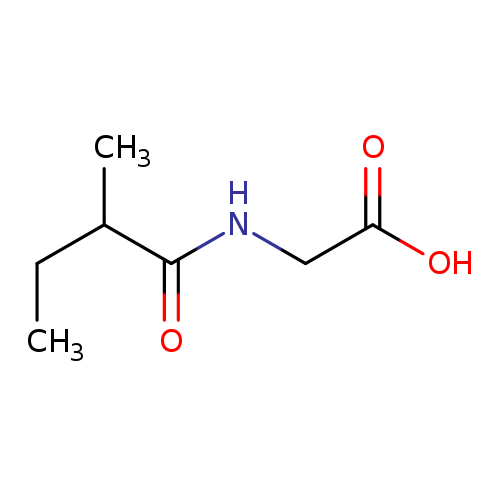
Common Name2-Methylbutyrylglycine
ClassSmall Molecule
Description2-Methylbutyrylglycine is an acyl glycine. Acyl glycines are normally minor metabolites of fatty acids. However, the excretion of certain acyl glycines is increased in several inborn errors of metabolism. In certain cases the measurement of these metabolites in body fluids can be used to diagnose disorders associated with mitochondrial fatty acid beta-oxidation. Acyl glycines are produced through the action of glycine N-acyltransferase (EC 2.3.1.13) which is an enzyme that catalyzes the chemical reaction:. acyl-CoA + glycine < -- > CoA + N-acylglycine. The isolated excretion of high levels of 2-methylbutyrylglycine (2-MBG) is the hallmark of short/branched-chain acyl-CoA dehydrogenase deficiency or SBCADD The disorder is also called 2-methylbutyryl-CoA dehydrogenase deficiency and has been associated with autism and mental retardation. SBCADD is a recently described autosomal recessive disorder caused by a defect in the degradation pathway of L- isoleucine leading to increased urinary excretion of 2-methylbutyryl glycine. The enzymatic defect results from disruption of the SBCAD gene. Deficiency of SBCAD leads to accumulation of its substrate, 2-methylbutyryl-CoA within the mitochondrion. This substance is transesterified with glycine by the mitochondrial enzyme acyl-CoA glycine-N-acyltransferase (glycine-N-acylase) to form 2-methylbutyryl glycine. Affected patients can be divided into two categories. The first category consists of infants detected by newborn screening programmes. These infants are treated with diet and remain without clinical symptoms. In the second category affected patients are diagnosed because they presented clinically with seizures and psychomotor delay and have increased urinary excretion of 2-methylbutyryl glycine 2-methylbutyrylglycine has also been found in the urine of patients with propionyl-CoA carboxylase deficiency after consuming isoleucine. 2-methylbutyrylglycine is also elevated in the urine of patients with glutaric aciduria II and ethylmalonic encephalopathy. (1, 2, 2, 3).
Contaminant Sources
  • FooDB Chemicals
  • HMDB Contaminants - Urine
  • T3DB toxins
Contaminant Type
  • Animal Toxin
  • Food Toxin
  • Metabolite
  • Natural Compound
  • Organic Compound
Chemical Structure
Thumb
Synonyms
ValueSource
alpha-MethylbutyrylglycineChEBI
a-MethylbutyrylglycineGenerator
Α-methylbutyrylglycineGenerator
(2-Methyl-butyrylamino)-acetateHMDB
(2-Methyl-butyrylamino)-acetic acidHMDB
2-MBGHMDB
2-Methylbutyryl glycineHMDB
N-(2-Methylbutyryl)glycineHMDB
N-Sec-valerylglycineHMDB
2-MethylbutyrylglycineChEBI
Chemical FormulaC7H13NO3
Average Molecular Mass159.183 g/mol
Monoisotopic Mass159.090 g/mol
CAS Registry Number52320-67-9
IUPAC NameNot Available
Traditional Name2-methylbutyrylglycine
SMILESCCC(C)C(=O)NCC(O)=O
InChI IdentifierInChI=1S/C7H13NO3/c1-3-5(2)7(11)8-4-6(9)10/h5H,3-4H2,1-2H3,(H,8,11)(H,9,10)
InChI KeyHOACIBQKYRHBOW-UHFFFAOYSA-N
Chemical Taxonomy
Description belongs to the class of organic compounds known as n-acyl-alpha amino acids. N-acyl-alpha amino acids are compounds containing an alpha amino acid which bears an acyl group at its terminal nitrogen atom.
KingdomOrganic compounds
Super ClassOrganic acids and derivatives
ClassCarboxylic acids and derivatives
Sub ClassAmino acids, peptides, and analogues
Direct ParentN-acyl-alpha amino acids
Alternative Parents
Substituents
  • N-acyl-alpha-amino acid
  • Carboximidic acid
  • Carboximidic acid derivative
  • Carboxylic acid
  • Monocarboxylic acid or derivatives
  • Organic 1,3-dipolar compound
  • Propargyl-type 1,3-dipolar organic compound
  • Carbonyl group
  • Organooxygen compound
  • Organonitrogen compound
  • Hydrocarbon derivative
  • Organic oxide
  • Organopnictogen compound
  • Organic oxygen compound
  • Organic nitrogen compound
  • Aliphatic acyclic compound
Molecular FrameworkAliphatic acyclic compounds
External Descriptors
Biological Properties
StatusDetected and Not Quantified
OriginEndogenous
Cellular Locations
  • Cytoplasm
  • Extracellular
Biofluid LocationsNot Available
Tissue LocationsNot Available
Pathways
NameSMPDB LinkKEGG Link
Ethylmalonic EncephalopathySMP00181 Not Available
ApplicationsNot Available
Biological RolesNot Available
Chemical RolesNot Available
Physical Properties
StateSolid
AppearanceWhite powder.
Experimental Properties
PropertyValue
Melting PointNot Available
Boiling PointNot Available
SolubilityNot Available
Predicted Properties
PropertyValueSource
Water Solubility9 g/LALOGPS
logP0.41ALOGPS
logP0.36ChemAxon
logS-1.2ALOGPS
pKa (Strongest Acidic)4.17ChemAxon
pKa (Strongest Basic)-1.6ChemAxon
Physiological Charge-1ChemAxon
Hydrogen Acceptor Count3ChemAxon
Hydrogen Donor Count2ChemAxon
Polar Surface Area66.4 ŲChemAxon
Rotatable Bond Count4ChemAxon
Refractivity39.25 m³·mol⁻¹ChemAxon
Polarizability16.55 ųChemAxon
Number of Rings0ChemAxon
Bioavailability1ChemAxon
Rule of FiveYesChemAxon
Ghose FilterNoChemAxon
Veber's RuleNoChemAxon
MDDR-like RuleNoChemAxon
Spectra
Spectra
Spectrum TypeDescriptionSplash KeyView
Predicted GC-MSPredicted GC-MS Spectrum - GC-MS (Non-derivatized) - 70eV, Positivesplash10-0a4r-9200000000-037c365f69a94a2795e3Spectrum
Predicted GC-MSPredicted GC-MS Spectrum - GC-MS (1 TMS) - 70eV, Positivesplash10-00di-9100000000-e433d3dc8126ab0a8a11Spectrum
Predicted GC-MSPredicted GC-MS Spectrum - GC-MS (Non-derivatized) - 70eV, PositiveNot AvailableSpectrum
Predicted GC-MSPredicted GC-MS Spectrum - GC-MS (TMS_1_2) - 70eV, PositiveNot AvailableSpectrum
Predicted GC-MSPredicted GC-MS Spectrum - GC-MS (TBDMS_1_1) - 70eV, PositiveNot AvailableSpectrum
Predicted GC-MSPredicted GC-MS Spectrum - GC-MS (TBDMS_1_2) - 70eV, PositiveNot AvailableSpectrum
LC-MS/MSLC-MS/MS Spectrum - Quattro_QQQ 10V, Positive (Annotated)splash10-0a70-9000000000-677b36115959d21d1f09Spectrum
LC-MS/MSLC-MS/MS Spectrum - Quattro_QQQ 25V, Positive (Annotated)splash10-0a4i-9000000000-8acb9e6da8ae025a1f8dSpectrum
LC-MS/MSLC-MS/MS Spectrum - Quattro_QQQ 40V, Positive (Annotated)splash10-0a4l-9000000000-e9d59f38263024d831c0Spectrum
LC-MS/MSLC-MS/MS Spectrum - 20V, Positivesplash10-0a4i-9000000000-5b8594d1ae20d3cefd30Spectrum
LC-MS/MSLC-MS/MS Spectrum - 20V, Negativesplash10-00di-9100000000-5616d01ed9501db46e06Spectrum
LC-MS/MSLC-MS/MS Spectrum - 40V, Positivesplash10-052f-9000000000-dc3a1247ae093f314b43Spectrum
LC-MS/MSLC-MS/MS Spectrum - 10V, Positivesplash10-0a4i-9000000000-3dfb1ee5e780367552f0Spectrum
LC-MS/MSLC-MS/MS Spectrum - 10V, Negativesplash10-05fr-8900000000-1ee8e7b73ae88fd1ef8fSpectrum
LC-MS/MSLC-MS/MS Spectrum - 40V, Negativesplash10-00di-9000000000-d2b9a5139d838d79d4ccSpectrum
Predicted LC-MS/MSPredicted LC-MS/MS Spectrum - 10V, Positivesplash10-03dr-5900000000-0b42996566d3baf8c66bSpectrum
Predicted LC-MS/MSPredicted LC-MS/MS Spectrum - 20V, Positivesplash10-06ri-9400000000-711387fe57829069d6f3Spectrum
Predicted LC-MS/MSPredicted LC-MS/MS Spectrum - 40V, Positivesplash10-0a4i-9000000000-6fc57261ee60bbc3af11Spectrum
Predicted LC-MS/MSPredicted LC-MS/MS Spectrum - 10V, Negativesplash10-0a4i-0900000000-1fa66530dedcfabf00e7Spectrum
Predicted LC-MS/MSPredicted LC-MS/MS Spectrum - 20V, Negativesplash10-0a4i-2900000000-975416bc76e2d0f660c1Spectrum
Predicted LC-MS/MSPredicted LC-MS/MS Spectrum - 40V, Negativesplash10-0ab9-9000000000-d1bb15a1be690ed64b19Spectrum
Predicted LC-MS/MSPredicted LC-MS/MS Spectrum - 10V, Positivesplash10-0bt9-9400000000-c1ffbc1b6124d8ccd7f3Spectrum
Predicted LC-MS/MSPredicted LC-MS/MS Spectrum - 20V, Positivesplash10-0a4i-9000000000-d49a18704d3772cb3e92Spectrum
Predicted LC-MS/MSPredicted LC-MS/MS Spectrum - 40V, Positivesplash10-0a4i-9000000000-5f02bb141e31e9a67e6aSpectrum
Predicted LC-MS/MSPredicted LC-MS/MS Spectrum - 10V, Negativesplash10-0006-1900000000-7a07dd16a49c33b82c5cSpectrum
Predicted LC-MS/MSPredicted LC-MS/MS Spectrum - 20V, Negativesplash10-05fu-9600000000-2a213e61a98edbd8d71aSpectrum
Predicted LC-MS/MSPredicted LC-MS/MS Spectrum - 40V, Negativesplash10-05fu-9000000000-8a65567da0b6dd8bfb83Spectrum
1D NMR1H NMR SpectrumNot AvailableSpectrum
1D NMR13C NMR SpectrumNot AvailableSpectrum
1D NMR1H NMR SpectrumNot AvailableSpectrum
1D NMR13C NMR SpectrumNot AvailableSpectrum
1D NMR1H NMR SpectrumNot AvailableSpectrum
1D NMR13C NMR SpectrumNot AvailableSpectrum
1D NMR1H NMR SpectrumNot AvailableSpectrum
1D NMR13C NMR SpectrumNot AvailableSpectrum
1D NMR1H NMR SpectrumNot AvailableSpectrum
1D NMR13C NMR SpectrumNot AvailableSpectrum
1D NMR1H NMR SpectrumNot AvailableSpectrum
1D NMR13C NMR SpectrumNot AvailableSpectrum
1D NMR1H NMR SpectrumNot AvailableSpectrum
1D NMR13C NMR SpectrumNot AvailableSpectrum
1D NMR1H NMR SpectrumNot AvailableSpectrum
1D NMR13C NMR SpectrumNot AvailableSpectrum
1D NMR1H NMR SpectrumNot AvailableSpectrum
1D NMR13C NMR SpectrumNot AvailableSpectrum
1D NMR1H NMR SpectrumNot AvailableSpectrum
1D NMR13C NMR SpectrumNot AvailableSpectrum
1D NMR1H NMR SpectrumNot AvailableSpectrum
2D NMR[1H,13C] 2D NMR SpectrumNot AvailableSpectrum
Toxicity Profile
Route of ExposureNot Available
Mechanism of ToxicityNot Available
MetabolismNot Available
Toxicity ValuesNot Available
Lethal DoseNot Available
Carcinogenicity (IARC Classification)No indication of carcinogenicity to humans (not listed by IARC).
Uses/SourcesThis is an endogenously produced metabolite found in the human body. It is used in metabolic reactions, catabolic reactions or waste generation.
Minimum Risk LevelNot Available
Health EffectsNot Available
SymptomsNot Available
TreatmentNot Available
Concentrations
Not Available
DrugBank IDNot Available
HMDB IDHMDB0000339
FooDB IDFDB021963
Phenol Explorer IDNot Available
KNApSAcK IDNot Available
BiGG IDNot Available
BioCyc IDNot Available
METLIN ID5328
PDB IDNot Available
Wikipedia LinkNot Available
Chemspider ID168243
ChEBI ID86366
PubChem Compound ID193872
Kegg Compound IDNot Available
YMDB IDNot Available
ECMDB IDNot Available
References
Synthesis ReferenceKorman, Stanley H.; Andresen, Brage S.; Zeharia, Avraham; Gutman, Alisa; Boneh, Avihu; Pitt, James J. 2-Ethylhydracrylic aciduria in short/branched-chain acyl-CoA dehydrogenase deficiency: application to diagnosis and implications for the R-pathway of isoleucine oxidation. Clinical Chemistry (Washington, DC, United States) (2005), 51(3), 610-617.
MSDSNot Available
General References
1. Korman, Stanley H.; Andresen, Brage S.; Zeharia, Avraham; Gutman, Alisa; Boneh, Avihu; Pitt, James J. 2-Ethylhydracrylic aciduria in short/branched-chain acyl-CoA dehydrogenase deficiency: application to diagnosis and implications for the R-pathway of isoleucine oxidation. Clinical Chemistry (Washington, DC, United States) (2005), 51(3), 610-617.
2. Tein I, Haslam RH, Rhead WJ, Bennett MJ, Becker LE, Vockley J: Short-chain acyl-CoA dehydrogenase deficiency: a cause of ophthalmoplegia and multicore myopathy. Neurology. 1999 Jan 15;52(2):366-72.
3. Korman SH, Andresen BS, Zeharia A, Gutman A, Boneh A, Pitt JJ: 2-ethylhydracrylic aciduria in short/branched-chain acyl-CoA dehydrogenase deficiency: application to diagnosis and implications for the R-pathway of isoleucine oxidation. Clin Chem. 2005 Mar;51(3):610-7. Epub 2004 Dec 22.
4. Sweetman L, Weyler W, Nyhan WL, de Cespedes C, Loria AR, Estrada Y: Abnormal metabolites of isoleucine in a patient with propionyl-CoA carboxylase deficiency. Biomed Mass Spectrom. 1978 Mar;5(3):198-207.
5. Kanavin OJ, Woldseth B, Jellum E, Tvedt B, Andresen BS, Stromme P: 2-methylbutyryl-CoA dehydrogenase deficiency associated with autism and mental retardation: a case report. J Med Case Rep. 2007 Sep 20;1:98.
6. https://www.ncbi.nlm.nih.gov/pubmed/?term=24023812