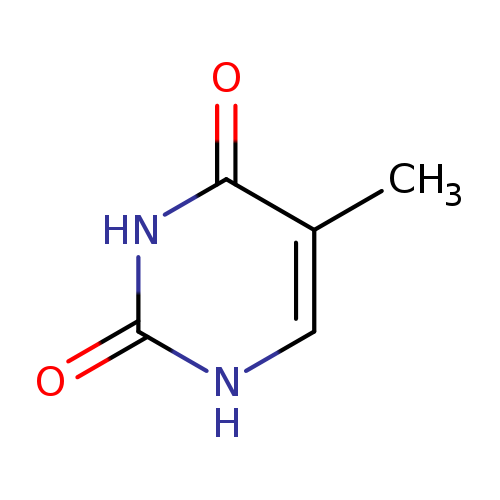
Record Information
Version1.0
Creation Date2014-08-29 06:28:53 UTC
Update Date2026-05-14 17:50:11 UTC
Accession NumberCHEM003294
Identification
Common NameThymine
ClassSmall Molecule
DescriptionOne of the pyrimidine bases of living matter. Derivation: Hydrolysis of deoxyribonucleic acid, from methylcyanoacetylurea by catalytic reduction. Use: Biochemical research. (Hawley's Condensed Chemical Dictionary). Thymine is a pyrimidine nucleobase. As the name implies, thymine may be derived by methylation of uracil at the 5th carbon. Thymine is found in the nucleic acid DNA. In RNA thymine is replaced with uracil in most cases. In DNA, thymine binds to adenine via two hydrogen bonds to assist in stabilizing the nucleic acid structures.
Contaminant Sources
  • FooDB Chemicals
  • HMDB Contaminants - Feces
  • HMDB Contaminants - Urine
  • HPV EPA Chemicals
  • STOFF IDENT Compounds
  • T3DB toxins
  • ToxCast & Tox21 Chemicals
Contaminant Type
  • Animal Toxin
  • Food Toxin
  • Metabolite
  • Natural Compound
  • Organic Compound
Chemical Structure
Thumb
Synonyms
ValueSource
2,4-Dihydroxy-5-methylpyrimidineChEBI
5-Methyl-2,4(1H,3H)-pyrimidinedioneChEBI
5-Methylpyrimidine-2,4(1H,3H)-dioneChEBI
5-MethyluracilChEBI
TChEBI
ThyChEBI
ThyminChEBI
4-Hydroxy-5-methylpyrimidin-2(1H)-oneHMDB
5-Methyl-1,2,3,4-tetrahydropyrimidine-2,4-dioneHMDB
5-Methyl-2,4-dihydroxypyrimidineHMDB
5-Methylpyrimidine-2,4-dioneHMDB
5 MethyluracilHMDB
Chemical FormulaC5H6N2O2
Average Molecular Mass126.113 g/mol
Monoisotopic Mass126.043 g/mol
CAS Registry Number65-71-4
IUPAC Name5-methyl-1,2,3,4-tetrahydropyrimidine-2,4-dione
Traditional Namethymine
SMILESCC1=CNC(=O)NC1=O
InChI IdentifierInChI=1S/C5H6N2O2/c1-3-2-6-5(9)7-4(3)8/h2H,1H3,(H2,6,7,8,9)
InChI KeyRWQNBRDOKXIBIV-UHFFFAOYSA-N
Chemical Taxonomy
Description belongs to the class of organic compounds known as hydroxypyrimidines. These are organic compounds containing a hydroxyl group attached to a pyrimidine ring. Pyrimidine is a 6-membered ring consisting of four carbon atoms and two nitrogen centers at the 1- and 3- ring positions.
KingdomOrganic compounds
Super ClassOrganoheterocyclic compounds
ClassDiazines
Sub ClassPyrimidines and pyrimidine derivatives
Direct ParentHydroxypyrimidines
Alternative Parents
Substituents
  • Hydroxypyrimidine
  • Heteroaromatic compound
  • Azacycle
  • Organic nitrogen compound
  • Organic oxygen compound
  • Organopnictogen compound
  • Hydrocarbon derivative
  • Organooxygen compound
  • Organonitrogen compound
  • Aromatic heteromonocyclic compound
Molecular FrameworkAromatic heteromonocyclic compounds
External Descriptors
Biological Properties
StatusDetected and Not Quantified
OriginEndogenous
Cellular Locations
  • Cytoplasm
  • Extracellular
Biofluid LocationsNot Available
Tissue Locations
  • Fibroblasts
  • Prostate
  • Skin
Pathways
NameSMPDB LinkKEGG Link
Pyrimidine MetabolismSMP00046 map00240
Dihydropyrimidinase DeficiencySMP00178 Not Available
Dihydropyrimidine Dehydrogenase Deficiency (DHPD)SMP00179 Not Available
ApplicationsNot Available
Biological Roles
Chemical RolesNot Available
Physical Properties
StateSolid
AppearanceWhite powder.
Experimental Properties
PropertyValue
Melting Point320°C
Boiling PointNot Available
Solubility3.82 mg/mL
Predicted Properties
PropertyValueSource
Water Solubility10.8 g/LALOGPS
logP-0.99ALOGPS
logP-0.46ChemAxon
logS-1.1ALOGPS
pKa (Strongest Acidic)9.06ChemAxon
pKa (Strongest Basic)-5ChemAxon
Physiological Charge0ChemAxon
Hydrogen Acceptor Count2ChemAxon
Hydrogen Donor Count2ChemAxon
Polar Surface Area58.2 ŲChemAxon
Rotatable Bond Count0ChemAxon
Refractivity30.33 m³·mol⁻¹ChemAxon
Polarizability11.42 ųChemAxon
Number of Rings1ChemAxon
Bioavailability1ChemAxon
Rule of FiveYesChemAxon
Ghose FilterNoChemAxon
Veber's RuleNoChemAxon
MDDR-like RuleNoChemAxon
Spectra
Spectra
Spectrum TypeDescriptionSplash KeyView
GC-MSGC-MS Spectrum - GC-EI-TOF (Pegasus III TOF-MS system, Leco; GC 6890, Agilent Technologies) (2 TMS)splash10-0bt9-0960000000-50722d1f64f22b69e207Spectrum
GC-MSGC-MS Spectrum - GC-EI-TOF (Pegasus III TOF-MS system, Leco; GC 6890, Agilent Technologies) (Non-derivatized)splash10-0bta-0940000000-ff59d40c1a93e04954abSpectrum
GC-MSGC-MS Spectrum - GC-EI-TOF (Pegasus III TOF-MS system, Leco; GC 6890, Agilent Technologies) (2 TMS)splash10-05fr-7940000000-a0ebb190eba32aceac56Spectrum
GC-MSGC-MS Spectrum - GC-MS (2 TMS)splash10-0ab9-1980000000-5b95ad97f31d8176a0c6Spectrum
GC-MSGC-MS Spectrum - EI-B (Non-derivatized)splash10-004i-9500000000-74b6d7909610070d30d0Spectrum
GC-MSGC-MS Spectrum - GC-EI-TOF (Non-derivatized)splash10-0bt9-0960000000-50722d1f64f22b69e207Spectrum
GC-MSGC-MS Spectrum - GC-EI-TOF (Non-derivatized)splash10-0bta-0940000000-ff59d40c1a93e04954abSpectrum
GC-MSGC-MS Spectrum - GC-EI-TOF (Non-derivatized)splash10-05fr-7940000000-a0ebb190eba32aceac56Spectrum
GC-MSGC-MS Spectrum - GC-MS (Non-derivatized)splash10-0ab9-1980000000-5b95ad97f31d8176a0c6Spectrum
GC-MSGC-MS Spectrum - GC-EI-TOF (Non-derivatized)splash10-0bta-0930000000-a2d3bc738d3f9e60aeb7Spectrum
Predicted GC-MSPredicted GC-MS Spectrum - GC-MS (Non-derivatized) - 70eV, Positivesplash10-004i-9500000000-33bb743c9a1a77fe4e47Spectrum
Predicted GC-MSPredicted GC-MS Spectrum - GC-MS (Non-derivatized) - 70eV, PositiveNot AvailableSpectrum
LC-MS/MSLC-MS/MS Spectrum - Quattro_QQQ 10V, Positive (Annotated)splash10-004i-0900000000-a3779faac812139c6333Spectrum
LC-MS/MSLC-MS/MS Spectrum - Quattro_QQQ 25V, Positive (Annotated)splash10-004i-0900000000-a3779faac812139c6333Spectrum
LC-MS/MSLC-MS/MS Spectrum - Quattro_QQQ 40V, Positive (Annotated)splash10-0udi-9200000000-0e7d9466530de47896d9Spectrum
LC-MS/MSLC-MS/MS Spectrum - EI-B (HITACHI M-80) , Positivesplash10-004i-9400000000-7ff00d5a94e12e6e1701Spectrum
LC-MS/MSLC-MS/MS Spectrum - LC-ESI-QQ (API3000, Applied Biosystems) 10V, Negativesplash10-004i-9100000000-1e96fdb2525aace8b29dSpectrum
LC-MS/MSLC-MS/MS Spectrum - LC-ESI-QQ (API3000, Applied Biosystems) 20V, Negativesplash10-0a6r-9000000000-34edf89b8a99493ed897Spectrum
LC-MS/MSLC-MS/MS Spectrum - LC-ESI-QQ (API3000, Applied Biosystems) 30V, Negativesplash10-0a4i-9000000000-7d381bc0d559ed8150e9Spectrum
LC-MS/MSLC-MS/MS Spectrum - LC-ESI-QQ (API3000, Applied Biosystems) 40V, Negativesplash10-0a4i-9000000000-90f8edce6ae2b6f83347Spectrum
LC-MS/MSLC-MS/MS Spectrum - LC-ESI-QQ (API3000, Applied Biosystems) 50V, Negativesplash10-0a4l-9000000000-445d07aed275008cfe2dSpectrum
LC-MS/MSLC-MS/MS Spectrum - LC-ESI-QQ (API3000, Applied Biosystems) 10V, Positivesplash10-056r-8900000000-96370e30b48d3270abaaSpectrum
LC-MS/MSLC-MS/MS Spectrum - LC-ESI-QQ (API3000, Applied Biosystems) 20V, Positivesplash10-0bwc-9600000000-b988fb9252c409b19c33Spectrum
LC-MS/MSLC-MS/MS Spectrum - LC-ESI-QQ (API3000, Applied Biosystems) 30V, Positivesplash10-01q9-9100000000-8c82d68e9ec8594b1fffSpectrum
LC-MS/MSLC-MS/MS Spectrum - LC-ESI-QQ (API3000, Applied Biosystems) 40V, Positivesplash10-001i-9000000000-f69c5d963b845f8b3cfbSpectrum
LC-MS/MSLC-MS/MS Spectrum - LC-ESI-QQ (API3000, Applied Biosystems) 50V, Positivesplash10-0a4i-0900000000-3a9af2cf67d3f113fa7fSpectrum
LC-MS/MSLC-MS/MS Spectrum - LC-ESI-QTOF (UPLC Q-Tof Premier, Waters) , Positivesplash10-004i-0900000000-97549ff58b84351d860cSpectrum
LC-MS/MSLC-MS/MS Spectrum - LC-ESI-QTOF (UPLC Q-Tof Premier, Waters) 30V, Positivesplash10-01q9-7900000000-5804e303580e1273f1a2Spectrum
LC-MS/MSLC-MS/MS Spectrum - LC-ESI-QTOF (UPLC Q-Tof Premier, Waters) , Negativesplash10-004i-0900000000-deb5e6830bc01a0c870eSpectrum
LC-MS/MSLC-MS/MS Spectrum - LC-ESI-QQ , negativesplash10-004i-9100000000-1e96fdb2525aace8b29dSpectrum
LC-MS/MSLC-MS/MS Spectrum - LC-ESI-QQ , negativesplash10-0a6r-9000000000-34edf89b8a99493ed897Spectrum
Predicted LC-MS/MSPredicted LC-MS/MS Spectrum - 10V, Positivesplash10-004i-1900000000-7f378c898bdb1944116eSpectrum
Predicted LC-MS/MSPredicted LC-MS/MS Spectrum - 20V, Positivesplash10-057i-9400000000-df8e4d4b901c8d1334fcSpectrum
Predicted LC-MS/MSPredicted LC-MS/MS Spectrum - 40V, Positivesplash10-0zfr-9000000000-629132689aa512d344b2Spectrum
Predicted LC-MS/MSPredicted LC-MS/MS Spectrum - 10V, Negativesplash10-004i-2900000000-878180774da717dee4aeSpectrum
Predicted LC-MS/MSPredicted LC-MS/MS Spectrum - 20V, Negativesplash10-005c-9400000000-2bf425b661913858b12aSpectrum
Predicted LC-MS/MSPredicted LC-MS/MS Spectrum - 40V, Negativesplash10-0006-9000000000-87ca2758dbf67661c671Spectrum
MSMass Spectrum (Electron Ionization)splash10-056r-9400000000-5dd0bc0194a302d8ee95Spectrum
1D NMR13C NMR SpectrumNot AvailableSpectrum
1D NMR1H NMR SpectrumNot AvailableSpectrum
1D NMR13C NMR SpectrumNot AvailableSpectrum
1D NMR1H NMR SpectrumNot AvailableSpectrum
1D NMR13C NMR SpectrumNot AvailableSpectrum
1D NMR1H NMR SpectrumNot AvailableSpectrum
1D NMR13C NMR SpectrumNot AvailableSpectrum
1D NMR1H NMR SpectrumNot AvailableSpectrum
1D NMR13C NMR SpectrumNot AvailableSpectrum
1D NMR1H NMR SpectrumNot AvailableSpectrum
1D NMR13C NMR SpectrumNot AvailableSpectrum
1D NMR1H NMR SpectrumNot AvailableSpectrum
1D NMR13C NMR SpectrumNot AvailableSpectrum
1D NMR1H NMR SpectrumNot AvailableSpectrum
1D NMR13C NMR SpectrumNot AvailableSpectrum
1D NMR1H NMR SpectrumNot AvailableSpectrum
1D NMR13C NMR SpectrumNot AvailableSpectrum
1D NMR1H NMR SpectrumNot AvailableSpectrum
1D NMR13C NMR SpectrumNot AvailableSpectrum
1D NMR1H NMR SpectrumNot AvailableSpectrum
1D NMR13C NMR SpectrumNot AvailableSpectrum
1D NMR1H NMR SpectrumNot AvailableSpectrum
1D NMR13C NMR SpectrumNot AvailableSpectrum
2D NMR[1H,13C] 2D NMR SpectrumNot AvailableSpectrum
Toxicity Profile
Route of ExposureNot Available
Mechanism of ToxicityNot Available
MetabolismNot Available
Toxicity ValuesNot Available
Lethal DoseNot Available
Carcinogenicity (IARC Classification)No indication of carcinogenicity to humans (not listed by IARC).
Uses/SourcesThis is an endogenously produced metabolite found in the human body. It is used in metabolic reactions, catabolic reactions or waste generation.
Minimum Risk LevelNot Available
Health EffectsNot Available
SymptomsNot Available
TreatmentNot Available
Concentrations
Not Available
DrugBank IDDB03462
HMDB IDHMDB0000262
FooDB IDFDB021922
Phenol Explorer IDNot Available
KNApSAcK IDC00001511
BiGG ID34151
BioCyc IDTHYMINE
METLIN ID290
PDB IDNot Available
Wikipedia LinkThymine
Chemspider ID1103
ChEBI ID17821
PubChem Compound ID1135
Kegg Compound IDC00178
YMDB IDYMDB00885
ECMDB IDECMDB00262
References
Synthesis Reference

Charles W. Murtiashaw, “Process for the production of O.sup. 2,2’-anhydro-1-(.beta.-D-arabinofuranosyl)thymine.” U.S. Patent US5008384, issued February, 1988.

MSDSLink
General References
1. https://www.ncbi.nlm.nih.gov/pubmed/?term=23237383
2. Zhang, Shi-Ying; Wu, Da-Jun; Zhang, Yan-Ping. Synthesis of thymine. Zhongguo Yiyao Gongye Zazhi (1999), 30(7), 325.
3. Melzer N, Wittenburg D, Hartwig S, Jakubowski S, Kesting U, Willmitzer L, Lisec J, Reinsch N, Repsilber D: Investigating associations between milk metabolite profiles and milk traits of Holstein cows. J Dairy Sci. 2013 Mar;96(3):1521-34. doi: 10.3168/jds.2012-5743.
4. Pan L, Yu J, Mi Z, Mo L, Jin H, Yao C, Ren D, Menghe B: A Metabolomics Approach Uncovers Differences between Traditional and Commercial Dairy Products in Buryatia (Russian Federation). Molecules. 2018 Mar 22;23(4). pii: molecules23040735. doi: 10.3390/molecules23040735.
5. Zhang, Shi-Ying; Wu, Da-Jun; Zhang, Yan-Ping. Synthesis of thymine. Zhongguo Yiyao Gongye Zazhi (1999), 30(7), 325.
6. Goukassian D, Gad F, Yaar M, Eller MS, Nehal US, Gilchrest BA: Mechanisms and implications of the age-associated decrease in DNA repair capacity. FASEB J. 2000 Jul;14(10):1325-34.
7. Wassberg C, Backvall H, Diffey B, Ponten F, Berne B: Enhanced epidermal ultraviolet responses in chronically sun-exposed skin are dependent on previous sun exposure. Acta Derm Venereol. 2003;83(4):254-61.
8. Schilsky RL, O'Laughlin K, Ratain MJ: Phase I clinical and pharmacological study of thymidine (NSC 21548) and cis-diamminedichloroplatinum(II) in patients with advanced cancer. Cancer Res. 1986 Aug;46(8):4184-8.
9. Maskell R, Okubadejo OA, Payne RH, Pead L: Human infections with thymine-requiring bacteria. J Med Microbiol. 1978 Feb;11(1):33-45.
10. Hofmann U, Schwab M, Seefried S, Marx C, Zanger UM, Eichelbaum M, Murdter TE: Sensitive method for the quantification of urinary pyrimidine metabolites in healthy adults by gas chromatography-tandem mass spectrometry. J Chromatogr B Analyt Technol Biomed Life Sci. 2003 Jul 5;791(1-2):371-80.
11. Ling G, Chadwick CA, Berne B, Potten CS, Ponten J, Ponten F: Epidermal p53 response and repair of thymine dimers in human skin after a single dose of ultraviolet radiation: effects of photoprotection. Acta Derm Venereol. 2001 May;81(2):81-6.
12. Young AR, Sheehan JM, Chadwick CA, Potten CS: Protection by ultraviolet A and B sunscreens against in situ dipyrimidine photolesions in human epidermis is comparable to protection against sunburn. J Invest Dermatol. 2000 Jul;115(1):37-41.
13. Maskell R, Okubadejo OA, Payne RH: Thymine-requiring bacteria associated with co-trimoxazole therapy. Lancet. 1976 Apr 17;1(7964):834-5.
14. Courdavault S, Baudouin C, Sauvaigo S, Mouret S, Candeias S, Charveron M, Favier A, Cadet J, Douki T: Unrepaired cyclobutane pyrimidine dimers do not prevent proliferation of UV-B-irradiated cultured human fibroblasts. Photochem Photobiol. 2004 Feb;79(2):145-51.
15. Alsarra IA, Alarifi MN: Validated liquid chromatographic determination of 5-fluorouracil in human plasma. J Chromatogr B Analyt Technol Biomed Life Sci. 2004 May 25;804(2):435-9.
16. van Lenthe H, van Kuilenburg AB, Ito T, Bootsma AH, van Cruchten A, Wada Y, van Gennip AH: Defects in pyrimidine degradation identified by HPLC-electrospray tandem mass spectrometry of urine specimens or urine-soaked filter paper strips. Clin Chem. 2000 Dec;46(12):1916-22.
17. Castro-Gago M, Camina F, Lojo S, Rodriguez-Segade S, Rodriguez-Nunez A: Concentrations of purine nucleotides and purine and pyrimidine bases in cerebrospinal fluid of neurologically healthy children. Eur J Clin Chem Clin Biochem. 1992 Nov;30(11):761-5.
18. Placzek M, Gaube S, Kerkmann U, Gilbertz KP, Herzinger T, Haen E, Przybilla B: Ultraviolet B-induced DNA damage in human epidermis is modified by the antioxidants ascorbic acid and D-alpha-tocopherol. J Invest Dermatol. 2005 Feb;124(2):304-7.
19. Eells JT, Spector R: Purine and pyrimidine base and nucleoside concentrations in human cerebrospinal fluid and plasma. Neurochem Res. 1983 Nov;8(11):1451-7.
20. Thienpont LM, Van Landuyt KG, Stockl D, Saeyens W, De Keukeleire D, De Leenheer AP: Evaluation of 2-iminoimidazolidin-4-one and thymine as respective internal standards for normal-phase and reversed-phase high-performance liquid chromatographic determination of creatinine in human serum. J Chromatogr B Biomed Appl. 1995 Mar 10;665(1):63-9.
21. Allgayer H, Kolb M, Stuber V, Kruis W: Effects of bile acids on base hydroxylation in a model of human colonic mucosal DNA. Cancer Detect Prev. 2002;26(1):85-9.
22. Rodriguez Ortner E, Hayes RB, Weissfeld J, Gelmann EP: Effect of homeodomain protein NKX3.1 R52C polymorphism on prostate gland size. Urology. 2006 Feb;67(2):311-5. Epub 2006 Jan 25.
23. Antille C, Tran C, Sorg O, Carraux P, Didierjean L, Saurat JH: Vitamin A exerts a photoprotective action in skin by absorbing ultraviolet B radiation. J Invest Dermatol. 2003 Nov;121(5):1163-7.
24. Sreekumar A, Poisson LM, Rajendiran TM, Khan AP, Cao Q, Yu J, Laxman B, Mehra R, Lonigro RJ, Li Y, Nyati MK, Ahsan A, Kalyana-Sundaram S, Han B, Cao X, Byun J, Omenn GS, Ghosh D, Pennathur S, Alexander DC, Berger A, Shuster JR, Wei JT, Varambally S, Beecher C, Chinnaiyan AM: Metabolomic profiles delineate potential role for sarcosine in prostate cancer progression. Nature. 2009 Feb 12;457(7231):910-4. doi: 10.1038/nature07762.