Record Information
Version1.0
Creation Date2014-08-29 06:28:37 UTC
Update Date2026-04-02 23:54:27 UTC
Accession NumberCHEM003292
Identification
Common NameDihydrothymine
ClassSmall Molecule
DescriptionDihydrothymine is an intermediate breakdown product of thymine. Dihydropyrimidine dehydrogenase catalyzes the reduction of thymine to 5, 6-dihydrothymine then dihydropyrimidinase hydrolyzes 5, 6-dihydrothymine to N-carbamyl-b-alanine. Finally, beta-ureidopropionase catalyzes the conversion of N-carbamyl-b-alanine to beta-alanine. Patients with dihydropyrimidinase deficiency exhibit highly increased concentrations of 5, 6-dihydrouracil and 5, 6-dihydrothymine and moderately increased concentrations of uracil and thymine can be detected in urine.
Contaminant Sources
  • FooDB Chemicals
  • HMDB Contaminants - Urine
  • T3DB toxins
Contaminant Type
  • Animal Toxin
  • Food Toxin
  • Metabolite
  • Natural Compound
  • Organic Compound
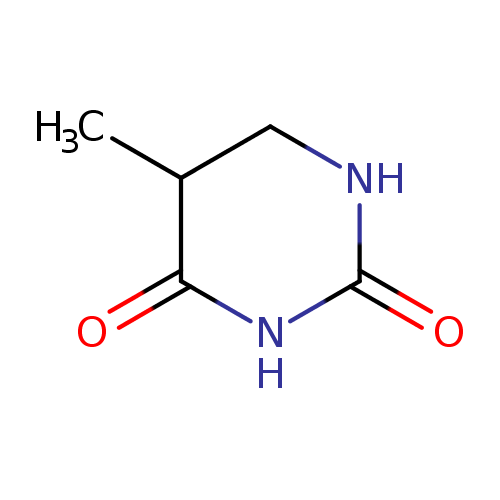
Chemical Structure
Thumb
Synonyms
ValueSource
5,6-Dihydro-5-methyluracilChEBI
5-Methyl-5,6-dihydrouracilChEBI
5,6-DihydrothymineHMDB, MeSH
5-Methyl-hydrouracilHMDB
5-Methyldihydropyrimidine-2,4(1H,3H)-dioneHMDB
dihydro-5-Methyl-2,4(1H,3H)-pyrimidinedioneHMDB
5-MethyldihydrouracilMeSH, HMDB
5,6-Dihydrothymine, (S)-isomerMeSH, HMDB
Chemical FormulaC5H8N2O2
Average Molecular Mass128.129 g/mol
Monoisotopic Mass128.059 g/mol
CAS Registry Number696-04-8
IUPAC Name5-methyl-1,3-diazinane-2,4-dione
Traditional Namedihydrothymine
SMILESCC1CNC(=O)NC1=O
InChI IdentifierInChI=1S/C5H8N2O2/c1-3-2-6-5(9)7-4(3)8/h3H,2H2,1H3,(H2,6,7,8,9)
InChI KeyNBAKTGXDIBVZOO-UHFFFAOYSA-N
Chemical Taxonomy
Description belongs to the class of organic compounds known as hydropyrimidines. Hydropyrimidines are compounds containing a hydrogenated pyrimidine ring (i.e. containing less than the maximum number of double bonds.).
KingdomOrganic compounds
Super ClassOrganoheterocyclic compounds
ClassDiazines
Sub ClassPyrimidines and pyrimidine derivatives
Direct ParentHydropyrimidines
Alternative Parents
Substituents
  • 5,6-dihydropyrimidine
  • Hydropyrimidine
  • Azacycle
  • Organic 1,3-dipolar compound
  • Propargyl-type 1,3-dipolar organic compound
  • Organic nitrogen compound
  • Organic oxygen compound
  • Organopnictogen compound
  • Hydrocarbon derivative
  • Organooxygen compound
  • Organonitrogen compound
  • Aliphatic heteromonocyclic compound
Molecular FrameworkAliphatic heteromonocyclic compounds
External Descriptors
Biological Properties
StatusDetected and Not Quantified
OriginEndogenous
Cellular Locations
  • Cytoplasm
  • Extracellular
Biofluid LocationsNot Available
Tissue Locations
  • Prostate
Pathways
NameSMPDB LinkKEGG Link
Pyrimidine MetabolismSMP00046 map00240
Dihydropyrimidinase DeficiencySMP00178 Not Available
ApplicationsNot Available
Biological Roles
Chemical RolesNot Available
Physical Properties
StateSolid
AppearanceWhite powder.
Experimental Properties
PropertyValue
Melting PointNot Available
Boiling PointNot Available
SolubilityNot Available
Predicted Properties
PropertyValueSource
Water Solubility18.7 g/LALOGPS
logP-0.8ALOGPS
logP-0.67ChemAxon
logS-0.84ALOGPS
pKa (Strongest Acidic)11.7ChemAxon
pKa (Strongest Basic)-7.4ChemAxon
Physiological Charge0ChemAxon
Hydrogen Acceptor Count2ChemAxon
Hydrogen Donor Count2ChemAxon
Polar Surface Area58.2 ŲChemAxon
Rotatable Bond Count0ChemAxon
Refractivity30.32 m³·mol⁻¹ChemAxon
Polarizability12.03 ųChemAxon
Number of Rings1ChemAxon
Bioavailability1ChemAxon
Rule of FiveYesChemAxon
Ghose FilterNoChemAxon
Veber's RuleNoChemAxon
MDDR-like RuleNoChemAxon
Spectra
Spectra
Spectrum TypeDescriptionSplash KeyView
GC-MSGC-MS Spectrum - GC-MS (1 TMS)splash10-000i-5900000000-0b84b9786838d29e07abSpectrum
GC-MSGC-MS Spectrum - GC-MS (2 TMS)splash10-0zmi-8980000000-d75d30c6e5fdb4643aa5Spectrum
GC-MSGC-MS Spectrum - GC-MS (Non-derivatized)splash10-000i-5900000000-0b84b9786838d29e07abSpectrum
GC-MSGC-MS Spectrum - GC-MS (Non-derivatized)splash10-0zmi-8980000000-d75d30c6e5fdb4643aa5Spectrum
Predicted GC-MSPredicted GC-MS Spectrum - GC-MS (Non-derivatized) - 70eV, Positivesplash10-004i-9300000000-05ab95b9effabc03847dSpectrum
LC-MS/MSLC-MS/MS Spectrum - Quattro_QQQ 10V, Positive (Annotated)splash10-004i-8900000000-db662635cbae4d48204bSpectrum
LC-MS/MSLC-MS/MS Spectrum - Quattro_QQQ 25V, Positive (Annotated)splash10-0006-9000000000-c3960ffe99d74c617000Spectrum
LC-MS/MSLC-MS/MS Spectrum - Quattro_QQQ 40V, Positive (Annotated)splash10-0006-9000000000-9a6c2715f931ff084157Spectrum
Predicted LC-MS/MSPredicted LC-MS/MS Spectrum - 10V, Positivesplash10-004i-0900000000-b0b2721bf2e4a74bbba2Spectrum
Predicted LC-MS/MSPredicted LC-MS/MS Spectrum - 20V, Positivesplash10-0a4l-9100000000-b89dfebf5db699f3651cSpectrum
Predicted LC-MS/MSPredicted LC-MS/MS Spectrum - 40V, Positivesplash10-052f-9000000000-97f152f0bbe6fb600c5cSpectrum
Predicted LC-MS/MSPredicted LC-MS/MS Spectrum - 10V, Negativesplash10-004i-3900000000-98c26fdc1559c4c1afc2Spectrum
Predicted LC-MS/MSPredicted LC-MS/MS Spectrum - 20V, Negativesplash10-0006-9000000000-320f4c88705757a63b75Spectrum
Predicted LC-MS/MSPredicted LC-MS/MS Spectrum - 40V, Negativesplash10-0006-9000000000-76fbb95e0354defdb94eSpectrum
Predicted LC-MS/MSPredicted LC-MS/MS Spectrum - 10V, Positivesplash10-004i-0900000000-7c6c3743140aa087d39cSpectrum
Predicted LC-MS/MSPredicted LC-MS/MS Spectrum - 20V, Positivesplash10-004i-4900000000-70eb9f3b90f3b230f593Spectrum
Predicted LC-MS/MSPredicted LC-MS/MS Spectrum - 40V, Positivesplash10-0a4l-9000000000-e84dd91c5dd8c38010f7Spectrum
Predicted LC-MS/MSPredicted LC-MS/MS Spectrum - 10V, Negativesplash10-004i-3900000000-b1b06bf61dca14c34015Spectrum
Predicted LC-MS/MSPredicted LC-MS/MS Spectrum - 20V, Negativesplash10-0006-9200000000-a8831b6e3dbc59c56963Spectrum
Predicted LC-MS/MSPredicted LC-MS/MS Spectrum - 40V, Negativesplash10-0006-9000000000-90726b17dc36e29c5299Spectrum
MSMass Spectrum (Electron Ionization)splash10-004l-9200000000-873ae62dcdf602237ec1Spectrum
1D NMR1H NMR SpectrumNot AvailableSpectrum
1D NMR13C NMR SpectrumNot AvailableSpectrum
2D NMR[1H,13C] 2D NMR SpectrumNot AvailableSpectrum
Toxicity Profile
Route of ExposureNot Available
Mechanism of ToxicityDihydropyrimidine dehydrogenase catalyzes the reduction of thymine to 5, 6-dihydrothymine then dihydropyrimidinase hydrolyzes 5, 6-dihydrothymine to N-carbamyl-b-alanine. Finally, beta-ureidopropionase catalyzes the conversion of N-carbamyl-b-alanine to beta-alanine. Accumulation of dihydrothymine in the body has been shown to be toxic.
MetabolismNot Available
Toxicity ValuesNot Available
Lethal DoseNot Available
Carcinogenicity (IARC Classification)No indication of carcinogenicity to humans (not listed by IARC).
Uses/SourcesThis is an endogenously produced metabolite found in the human body. It is used in metabolic reactions, catabolic reactions or waste generation.
Minimum Risk LevelNot Available
Health EffectsNot Available
SymptomsNot Available
TreatmentNot Available
Concentrations
Not Available
DrugBank IDNot Available
HMDB IDHMDB0304210
FooDB IDFDB030555
Phenol Explorer IDNot Available
KNApSAcK IDC00052265
BiGG IDNot Available
BioCyc IDNot Available
METLIN IDNot Available
PDB IDNot Available
Wikipedia LinkNot Available
Chemspider ID84456
ChEBI ID27468
PubChem Compound IDNot Available
Kegg Compound IDC00906
YMDB IDNot Available
ECMDB IDECMDB00079
References
Synthesis ReferenceYamane, Tetsuo; Wyluda, Benjamin J.; Shulman, Robert G. Dihydrothymine from ultraviolet-irradiated DNA. Proceedings of the National Academy of Sciences of the United States of America (1967), 58(2), 439-42.
MSDSLink
General References
1. https://www.ncbi.nlm.nih.gov/pubmed/?term=12798197
2. https://www.ncbi.nlm.nih.gov/pubmed/?term=20509700
3. https://www.ncbi.nlm.nih.gov/pubmed/?term=2669952