Record Information
Version1.0
Creation Date2014-08-29 06:27:34 UTC
Update Date2026-04-02 23:59:27 UTC
Accession NumberCHEM003287
Identification
Common NameL-Homocystine
ClassSmall Molecule
DescriptionHomocystine is the double-bonded form of homocysteine, but it occurs only transiently before being converted to the harmless cystathionine via a vitamin B6-dependent enzyme. Homocystine and homocysteine-cysteine mixed disulfide account for >98% of total homocysteine in plasma from healthy individuals. Oxidation of low-density lipoprotein (LDL) is thought to be a major factor in the pathophysiology of atherosclerosis. Elevated plasma homocysteine is an accepted risk factor for atherosclerosis, and may act through LDL oxidation, although this is controversial. However, the major thiol in plasma is cysteine, which is present at concentrations approximately 10 times greater than homocysteine; therefore homocystine in plasma is insignificant, and consequently homocystine is unlikely to influence LDL oxidation in vivo. Increasing evidence supports a role for an elevation of homocysteine in schizophrenia. It has been demonstrated that neural tube defects are related to a genetic defect in homocysteine metabolism. Sufficient intake of folic acid is believed to reduce this risk by enhancing methylation of homocysteine and its conversion to methionine, thereby compensating for this genetic defect. Plasma homocysteine levels are elevated when folate levels are in the lower half of the normal range. (1, 2, 3).
Contaminant Sources
  • FooDB Chemicals
  • HMDB Contaminants - Urine
  • T3DB toxins
Contaminant Type
  • Amine
  • Animal Toxin
  • Food Toxin
  • Metabolite
  • Natural Compound
  • Organic Compound
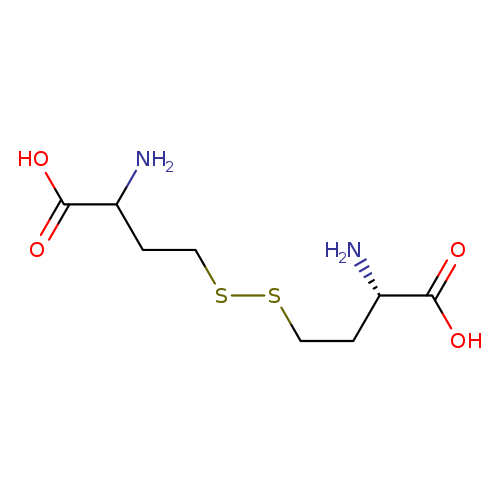
Chemical Structure
Thumb
Synonyms
ValueSource
4,4'-Dithiobis(2-aminobutyric acid)HMDB
4,4'-Dithiobis-2-amino-L-butyrateHMDB
4,4'-Dithiobis-2-amino-L-butyric acidHMDB
[S-(R*,r*)]-4,4'-dithiobis-2-amino-butanoateHMDB
[S-(R*,r*)]-4,4'-dithiobis-2-amino-butanoic acidHMDB
2-Amino-4-{[(3S)-3-amino-3-carboxypropyl]disulfanyl}butanoateHMDB
2-Amino-4-{[(3S)-3-amino-3-carboxypropyl]disulphanyl}butanoateHMDB
2-Amino-4-{[(3S)-3-amino-3-carboxypropyl]disulphanyl}butanoic acidHMDB
Chemical FormulaC8H16N2O4S2
Average Molecular Mass268.354 g/mol
Monoisotopic Mass268.055 g/mol
CAS Registry Number626-72-2
IUPAC NameNot Available
Traditional Name2-amino-4-{[(3S)-3-amino-3-carboxypropyl]disulfanyl}butanoic acid
SMILESNC(CCSSCC[C@H](N)C(O)=O)C(O)=O
InChI IdentifierInChI=1S/C8H16N2O4S2/c9-5(7(11)12)1-3-15-16-4-2-6(10)8(13)14/h5-6H,1-4,9-10H2,(H,11,12)(H,13,14)/t5-,6?/m0/s1
InChI KeyZTVZLYBCZNMWCF-ZBHICJROSA-N
Chemical Taxonomy
Description belongs to the class of organic compounds known as l-alpha-amino acids. These are alpha amino acids which have the L-configuration of the alpha-carbon atom.
KingdomOrganic compounds
Super ClassOrganic acids and derivatives
ClassCarboxylic acids and derivatives
Sub ClassAmino acids, peptides, and analogues
Direct ParentL-alpha-amino acids
Alternative Parents
Substituents
  • L-alpha-amino acid
  • Thia fatty acid
  • Dicarboxylic acid or derivatives
  • Fatty acyl
  • Fatty acid
  • Amino acid
  • Organic disulfide
  • Dialkyldisulfide
  • Carboxylic acid
  • Sulfenyl compound
  • Organic oxygen compound
  • Organic nitrogen compound
  • Primary amine
  • Organosulfur compound
  • Organooxygen compound
  • Organonitrogen compound
  • Hydrocarbon derivative
  • Primary aliphatic amine
  • Organic oxide
  • Organopnictogen compound
  • Carbonyl group
  • Amine
  • Aliphatic acyclic compound
Molecular FrameworkAliphatic acyclic compounds
External DescriptorsNot Available
Biological Properties
StatusDetected and Not Quantified
OriginEndogenous
Cellular Locations
  • Cytoplasm
  • Membrane
Biofluid LocationsNot Available
Tissue LocationsNot Available
Pathways
NameSMPDB LinkKEGG Link
Cystathionine Beta-Synthase DeficiencySMP00177 Not Available
ApplicationsNot Available
Biological RolesNot Available
Chemical RolesNot Available
Physical Properties
StateSolid
AppearanceWhite powder.
Experimental Properties
PropertyValue
Melting Point300°C
Boiling PointNot Available
Solubility0.2 mg/mL at 25°C
Predicted Properties
PropertyValueSource
Water Solubility4.5 g/LALOGPS
logP-4.2ALOGPS
logP-5.3ChemAxon
logS-1.8ALOGPS
pKa (Strongest Acidic)1.8ChemAxon
pKa (Strongest Basic)9.8ChemAxon
Physiological Charge0ChemAxon
Hydrogen Acceptor Count6ChemAxon
Hydrogen Donor Count4ChemAxon
Polar Surface Area126.64 ŲChemAxon
Rotatable Bond Count9ChemAxon
Refractivity64.38 m³·mol⁻¹ChemAxon
Polarizability26.92 ųChemAxon
Number of Rings0ChemAxon
Bioavailability1ChemAxon
Rule of FiveYesChemAxon
Ghose FilterNoChemAxon
Veber's RuleNoChemAxon
MDDR-like RuleNoChemAxon
Spectra
Spectra
Spectrum TypeDescriptionSplash KeyView
GC-MSGC-MS Spectrum - GC-EI-TOF (Non-derivatized)splash10-004i-0910000000-965ac587d29ef8ef887eSpectrum
GC-MSGC-MS Spectrum - GC-EI-TOF (Non-derivatized)splash10-004i-1910000000-f9e93d28a230da8e9833Spectrum
GC-MSGC-MS Spectrum - GC-EI-TOF (Non-derivatized)splash10-004i-0910000000-965ac587d29ef8ef887eSpectrum
GC-MSGC-MS Spectrum - GC-EI-TOF (Non-derivatized)splash10-004i-1910000000-f9e93d28a230da8e9833Spectrum
Predicted GC-MSPredicted GC-MS Spectrum - GC-MS (Non-derivatized) - 70eV, Positivesplash10-0fdo-9610000000-e10491cf3224336e3f4aSpectrum
Predicted GC-MSPredicted GC-MS Spectrum - GC-MS (2 TMS) - 70eV, Positivesplash10-00dl-9322000000-c71d91c4e21c8dc7e38bSpectrum
Predicted GC-MSPredicted GC-MS Spectrum - GC-MS (Non-derivatized) - 70eV, PositiveNot AvailableSpectrum
Predicted GC-MSPredicted GC-MS Spectrum - GC-MS (TMS_1_1) - 70eV, PositiveNot AvailableSpectrum
Predicted GC-MSPredicted GC-MS Spectrum - GC-MS (TMS_1_2) - 70eV, PositiveNot AvailableSpectrum
Predicted GC-MSPredicted GC-MS Spectrum - GC-MS (TMS_1_3) - 70eV, PositiveNot AvailableSpectrum
Predicted GC-MSPredicted GC-MS Spectrum - GC-MS (TMS_1_4) - 70eV, PositiveNot AvailableSpectrum
Predicted GC-MSPredicted GC-MS Spectrum - GC-MS (TMS_2_2) - 70eV, PositiveNot AvailableSpectrum
Predicted GC-MSPredicted GC-MS Spectrum - GC-MS (TMS_2_3) - 70eV, PositiveNot AvailableSpectrum
Predicted GC-MSPredicted GC-MS Spectrum - GC-MS (TMS_2_4) - 70eV, PositiveNot AvailableSpectrum
Predicted GC-MSPredicted GC-MS Spectrum - GC-MS (TMS_2_5) - 70eV, PositiveNot AvailableSpectrum
Predicted GC-MSPredicted GC-MS Spectrum - GC-MS (TMS_2_6) - 70eV, PositiveNot AvailableSpectrum
Predicted GC-MSPredicted GC-MS Spectrum - GC-MS (TMS_2_7) - 70eV, PositiveNot AvailableSpectrum
Predicted GC-MSPredicted GC-MS Spectrum - GC-MS (TMS_2_8) - 70eV, PositiveNot AvailableSpectrum
Predicted GC-MSPredicted GC-MS Spectrum - GC-MS (TBDMS_1_1) - 70eV, PositiveNot AvailableSpectrum
Predicted GC-MSPredicted GC-MS Spectrum - GC-MS (TBDMS_1_2) - 70eV, PositiveNot AvailableSpectrum
Predicted GC-MSPredicted GC-MS Spectrum - GC-MS (TBDMS_1_3) - 70eV, PositiveNot AvailableSpectrum
Predicted GC-MSPredicted GC-MS Spectrum - GC-MS (TBDMS_1_4) - 70eV, PositiveNot AvailableSpectrum
Predicted GC-MSPredicted GC-MS Spectrum - GC-MS (TBDMS_2_1) - 70eV, PositiveNot AvailableSpectrum
Predicted GC-MSPredicted GC-MS Spectrum - GC-MS (TBDMS_2_2) - 70eV, PositiveNot AvailableSpectrum
Predicted GC-MSPredicted GC-MS Spectrum - GC-MS (TBDMS_2_3) - 70eV, PositiveNot AvailableSpectrum
LC-MS/MSLC-MS/MS Spectrum - Quattro_QQQ 10V, Positive (Annotated)splash10-000i-0900000000-eed9e6a87dcd87f2429aSpectrum
LC-MS/MSLC-MS/MS Spectrum - Quattro_QQQ 25V, Positive (Annotated)splash10-000i-9200000000-ff66e8130cc84f2f9307Spectrum
LC-MS/MSLC-MS/MS Spectrum - Quattro_QQQ 40V, Positive (Annotated)splash10-000i-9000000000-c290f653e9d9de756e61Spectrum
Predicted LC-MS/MSPredicted LC-MS/MS Spectrum - 10V, Positivesplash10-0gi0-0290000000-0d5b5e0ed113894b2134Spectrum
Predicted LC-MS/MSPredicted LC-MS/MS Spectrum - 20V, Positivesplash10-0adi-4940000000-fe801a7a155db92879a5Spectrum
Predicted LC-MS/MSPredicted LC-MS/MS Spectrum - 40V, Positivesplash10-000i-9600000000-fa16bd387fed9ef4ae35Spectrum
Predicted LC-MS/MSPredicted LC-MS/MS Spectrum - 10V, Negativesplash10-014i-0590000000-079299cfa664ba6bb1b7Spectrum
Predicted LC-MS/MSPredicted LC-MS/MS Spectrum - 20V, Negativesplash10-00lr-2920000000-b1d40f0689b373431812Spectrum
Predicted LC-MS/MSPredicted LC-MS/MS Spectrum - 40V, Negativesplash10-01bi-9600000000-d4d8be33875dbb26d641Spectrum
Predicted LC-MS/MSPredicted LC-MS/MS Spectrum - 10V, Positivesplash10-014i-1490000000-14633966e3aac1b76927Spectrum
Predicted LC-MS/MSPredicted LC-MS/MS Spectrum - 20V, Positivesplash10-001r-3900000000-5e78746bf82c4b74e2daSpectrum
Predicted LC-MS/MSPredicted LC-MS/MS Spectrum - 40V, Positivesplash10-0a4r-9100000000-cf211c8a88522ecadb5fSpectrum
Predicted LC-MS/MSPredicted LC-MS/MS Spectrum - 10V, Negativesplash10-02t9-3920000000-03ece081c0f32738cbb4Spectrum
Predicted LC-MS/MSPredicted LC-MS/MS Spectrum - 20V, Negativesplash10-001i-4900000000-612a915c1fc3a29beb9eSpectrum
Predicted LC-MS/MSPredicted LC-MS/MS Spectrum - 40V, Negativesplash10-001i-9100000000-f378c8e7860863830ce2Spectrum
1D NMR1H NMR SpectrumNot AvailableSpectrum
1D NMR13C NMR SpectrumNot AvailableSpectrum
1D NMR1H NMR SpectrumNot AvailableSpectrum
1D NMR13C NMR SpectrumNot AvailableSpectrum
1D NMR1H NMR SpectrumNot AvailableSpectrum
1D NMR13C NMR SpectrumNot AvailableSpectrum
1D NMR1H NMR SpectrumNot AvailableSpectrum
1D NMR13C NMR SpectrumNot AvailableSpectrum
1D NMR1H NMR SpectrumNot AvailableSpectrum
1D NMR13C NMR SpectrumNot AvailableSpectrum
1D NMR1H NMR SpectrumNot AvailableSpectrum
1D NMR13C NMR SpectrumNot AvailableSpectrum
1D NMR1H NMR SpectrumNot AvailableSpectrum
1D NMR13C NMR SpectrumNot AvailableSpectrum
1D NMR1H NMR SpectrumNot AvailableSpectrum
1D NMR13C NMR SpectrumNot AvailableSpectrum
1D NMR1H NMR SpectrumNot AvailableSpectrum
1D NMR13C NMR SpectrumNot AvailableSpectrum
1D NMR1H NMR SpectrumNot AvailableSpectrum
1D NMR13C NMR SpectrumNot AvailableSpectrum
1D NMR1H NMR SpectrumNot AvailableSpectrum
2D NMR[1H,13C] 2D NMR SpectrumNot AvailableSpectrum
Toxicity Profile
Route of ExposureNot Available
Mechanism of ToxicityNot Available
MetabolismNot Available
Toxicity ValuesNot Available
Lethal DoseNot Available
Carcinogenicity (IARC Classification)No indication of carcinogenicity to humans (not listed by IARC).
Uses/SourcesThis is an endogenously produced metabolite found in the human body. It is used in metabolic reactions, catabolic reactions or waste generation.
Minimum Risk LevelNot Available
Health EffectsNot Available
SymptomsNot Available
TreatmentNot Available
Concentrations
Not Available
DrugBank IDNot Available
HMDB IDHMDB0000676
FooDB IDFDB022176
Phenol Explorer IDNot Available
KNApSAcK IDNot Available
BiGG IDNot Available
BioCyc IDNot Available
METLIN IDNot Available
PDB IDNot Available
Wikipedia LinkHomocystine
Chemspider ID62590
ChEBI ID89698
PubChem Compound ID69382
Kegg Compound IDC01817
YMDB IDNot Available
ECMDB IDNot Available
References
Synthesis ReferenceNot Available
MSDSLink
General References
1. Tomaiuolo M, Vecchione G, Grandone E, Cocomazzi N, Casetta B, Di Minno G, Margaglione M: A new method for determination of plasma homocystine by isotope dilution and electrospray tandem mass spectrometry. J Chromatogr B Analyt Technol Biomed Life Sci. 2006 Sep 14;842(1):64-9. Epub 2006 Jun 19.
2. Dudman NP, Guo XW, Crooks R, Xie L, Silberberg JS: Assay of plasma homocysteine: light sensitivity of the fluorescent 7-benzo-2-oxa-1, 3-diazole-4-sulfonic acid derivative, and use of appropriate calibrators. Clin Chem. 1996 Dec;42(12):2028-32.
3. Kurczynski TW, Muir WA, Fleisher LD, Palomaki JF, Gaull GE, Rassin DK, Abramowsky C: Maternal homocystinuria: studies of an untreated mother and fetus. Arch Dis Child. 1980 Sep;55(9):721-3.
4. Magera MJ, Lacey JM, Casetta B, Rinaldo P: Method for the determination of total homocysteine in plasma and urine by stable isotope dilution and electrospray tandem mass spectrometry. Clin Chem. 1999 Sep;45(9):1517-22.
5. Haurani FI, Hall CA, Rubin R: Megaloblastic anemia as a result of an abnormal transcobalamin II (Cardeza). J Clin Invest. 1979 Nov;64(5):1253-9.
6. Sengupta S, Wehbe C, Majors AK, Ketterer ME, DiBello PM, Jacobsen DW: Relative roles of albumin and ceruloplasmin in the formation of homocystine, homocysteine-cysteine-mixed disulfide, and cystine in circulation. J Biol Chem. 2001 Dec 14;276(50):46896-904. Epub 2001 Oct 9.
7. Nakano E, Williamson MP, Williams NH, Powers HJ: Copper-mediated LDL oxidation by homocysteine and related compounds depends largely on copper ligation. Biochim Biophys Acta. 2004 Jan 20;1688(1):33-42.
8. Brown AS, Susser ES: Homocysteine and schizophrenia: from prenatal to adult life. Prog Neuropsychopharmacol Biol Psychiatry. 2005 Sep;29(7):1175-80.
9. Heydrick SJ, Weiss N, Thomas SR, Cap AP, Pimentel DR, Loscalzo J, Keaney JF Jr: L-Homocysteine and L-homocystine stereospecifically induce endothelial nitric oxide synthase-dependent lipid peroxidation in endothelial cells. Free Radic Biol Med. 2004 Mar 1;36(5):632-40. doi: 10.1016/j.freeradbiomed.2003.12.001.
10. Wilcken B, Turner B: Homocystinuria. Reduced folate levels during pyridoxine treatment. Arch Dis Child. 1973 Jan;48(1):58-62. doi: 10.1136/adc.48.1.58.