Record Information
Version1.0
Creation Date2014-08-29 06:17:38 UTC
Update Date2026-04-06 10:16:39 UTC
Accession NumberCHEM003265
Identification
Common Name2-Hydroxybutyric acid
ClassSmall Molecule
Description2-Hydroxybutyric acid (alpha-hydroxybutyrate) is an organic acid derived from alpha-ketobutyrate. Alpha-ketobutyrate is produced by amino acid catabolism (threonine and methionine) and glutathione anabolism (cysteine formation pathway) and is metabolized to propionyl-CoA and carbon dioxide 2-Hydroxybutyric acid is formed as a by-product during the formation of Alpha-ketobutyrate via a reaction catalyzed by lactate dehydrogenase (LDH) or alpha-hydroxybutyrate dehydrogenase (alpha-HBDH). Alpha-hydroxybutyric acid is primarily produced in mammalian hepatic tissues that catabolize L-threonine or synthesize glutathione. Oxidative stress or detoxification of xenobiotics in the liver can dramatically increase the rate of hepatic glutathione synthesis. Under such metabolic stress conditions, supplies of L-cysteine for glutathione synthesis become limiting, so homocysteine is diverted from the transmethylation pathway (which forms methionine) into the transsulfuration pathway (which forms cystathionine). 2-Hydroxybutyrate is released as a byproduct when cystathionine is cleaved to cysteine that is incorporated into glutathione. Chronic shifts in the rate of glutathione synthesis may be reflected by urinary excretion of 2-hydroxybutyrate. 2-hydroxybutyrate is an early marker for both insulin resistance and impaired glucose regulation that appears to arise due to increased lipid oxidation and oxidative stress 2-Hydroxybutyric acid is often found in the urine of patients suffering from lactic acidosis and ketoacidosis. 2-Hydroxybutyric acid generally appears at high concentrations in situations related to deficient energy metabolism (e.g., birth asphyxia) and also in inherited metabolic diseases affecting the central nervous system during neonatal development, such as cerebral lactic acidosis, glutaric aciduria type II, dihydrolipoyl dehydrogenase (E3) deficiency, and propionic acidemia. More recently it has been noted that elevated levels of alpha-hydroxybutyrate in the plasma is a good marker for early stage type II diabetes It was concluded from studies done in the mid 1970's that an increased NADH2/NAD ratio was the most important factor for the production of 2-hydorxybutyric acid (1, 1, 2, 3).
Contaminant Sources
  • FooDB Chemicals
  • HMDB Contaminants - Urine
  • T3DB toxins
Contaminant Type
  • Animal Toxin
  • Food Toxin
  • Industrial/Workplace Toxin
  • Mammal Toxin
  • Metabolite
  • Natural Compound
  • Organic Compound
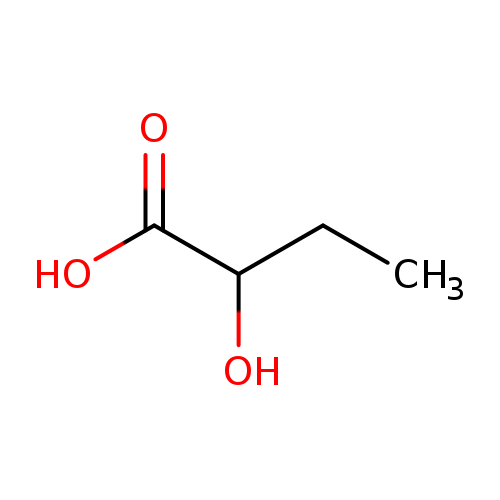
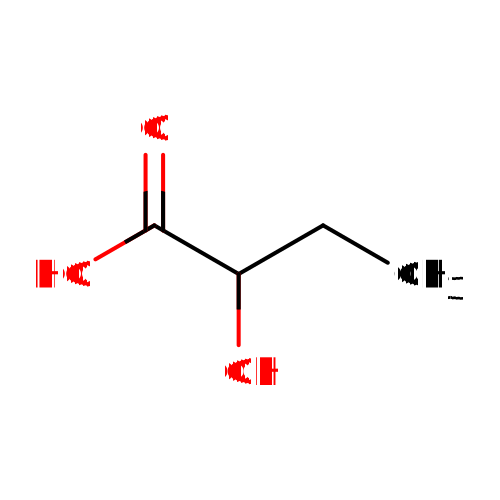
Chemical Structure
Thumb
Synonyms
ValueSource
2-Hydroxybutanoic acidChEBI
alpha-Hydroxybutanoic acidChEBI
alpha-Hydroxybutyric acidChEBI
2-HydroxybutanoateGenerator
a-HydroxybutanoateGenerator
a-Hydroxybutanoic acidGenerator
alpha-HydroxybutanoateGenerator
Α-hydroxybutanoateGenerator
Α-hydroxybutanoic acidGenerator
a-HydroxybutyrateGenerator
a-Hydroxybutyric acidGenerator
alpha-HydroxybutyrateGenerator
Α-hydroxybutyrateGenerator
Α-hydroxybutyric acidGenerator
2-HydroxybutyrateGenerator
(RS)-2-HydroxybutyrateHMDB
(RS)-2-Hydroxybutyric acidHMDB
2-Hydroxy-butanoateHMDB
2-Hydroxy-butanoic acidHMDB
2-Hydroxy-DL-butyrateHMDB
2-Hydroxy-DL-butyric acidHMDB
2-Hydroxy-N-butyrateHMDB
2-Hydroxy-N-butyric acidHMDB
a-Hydroxy-N-butyrateHMDB
a-Hydroxy-N-butyric acidHMDB
alpha-Hydroxy-N-butyrateHMDB
alpha-Hydroxy-N-butyric acidHMDB
DL-2-HydroxybutanoateHMDB
DL-2-Hydroxybutanoic acidHMDB
DL-a-HydroxybutyrateHMDB
DL-a-Hydroxybutyric acidHMDB
DL-alpha-HydroxybutyrateHMDB
DL-alpha-Hydroxybutyric acidHMDB
2-Hydroxybutyric acid, (R)-isomerHMDB
2-Hydroxybutyric acid, monosodium saltHMDB
2-Hydroxybutyric acid, (+-)-isomerHMDB
2-Hydroxybutyric acid, monosodium salt, (+-)-isomerHMDB
(+/-)a-hydoxy butyrateHMDB
(+/-)a-hydoxy butyric acidHMDB
(+/-)alpha-hydoxy butyrateHMDB
(+/-)α-hydoxy butyrateHMDB
(+/-)α-hydoxy butyric acidHMDB
2-Hydroxybutyric acidMeSH
Chemical FormulaC4H8O3
Average Molecular Mass104.105 g/mol
Monoisotopic Mass104.047 g/mol
CAS Registry Number600-15-7
IUPAC NameNot Available
Traditional Nameα-hydroxybutyric acid
SMILESCCC(O)C(O)=O
InChI IdentifierInChI=1S/C4H8O3/c1-2-3(5)4(6)7/h3,5H,2H2,1H3,(H,6,7)
InChI KeyAFENDNXGAFYKQO-UHFFFAOYSA-N
Chemical Taxonomy
Description belongs to the class of organic compounds known as alpha hydroxy acids and derivatives. These are organic compounds containing a carboxylic acid substituted with a hydroxyl group on the adjacent carbon.
KingdomOrganic compounds
Super ClassOrganic acids and derivatives
ClassHydroxy acids and derivatives
Sub ClassAlpha hydroxy acids and derivatives
Direct ParentAlpha hydroxy acids and derivatives
Alternative Parents
Substituents
  • Fatty acid
  • Alpha-hydroxy acid
  • Secondary alcohol
  • Monocarboxylic acid or derivatives
  • Carboxylic acid
  • Carboxylic acid derivative
  • Organic oxygen compound
  • Organic oxide
  • Hydrocarbon derivative
  • Organooxygen compound
  • Carbonyl group
  • Alcohol
  • Aliphatic acyclic compound
Molecular FrameworkAliphatic acyclic compounds
External Descriptors
Biological Properties
StatusDetected and Not Quantified
OriginEndogenous
Cellular Locations
  • Cytoplasm
  • Extracellular
Biofluid LocationsNot Available
Tissue Locations
  • Prostate
Pathways
NameSMPDB LinkKEGG Link
Biotinidase DeficiencySMP00174 Not Available
ApplicationsNot Available
Biological Roles
Chemical RolesNot Available
Physical Properties
StateSolid
AppearanceWhite powder.
Experimental Properties
PropertyValue
Melting Point44.2°C
Boiling PointNot Available
SolubilityNot Available
Predicted Properties
PropertyValueSource
Water Solubility484 g/LALOGPS
logP-0.16ALOGPS
logP0.051ChemAxon
logS0.67ALOGPS
pKa (Strongest Acidic)3.99ChemAxon
pKa (Strongest Basic)-3.8ChemAxon
Physiological Charge-1ChemAxon
Hydrogen Acceptor Count3ChemAxon
Hydrogen Donor Count2ChemAxon
Polar Surface Area57.53 ŲChemAxon
Rotatable Bond Count2ChemAxon
Refractivity23.36 m³·mol⁻¹ChemAxon
Polarizability9.98 ųChemAxon
Number of Rings0ChemAxon
Bioavailability1ChemAxon
Rule of FiveYesChemAxon
Ghose FilterNoChemAxon
Veber's RuleNoChemAxon
MDDR-like RuleNoChemAxon
Spectra
Spectra
Spectrum TypeDescriptionSplash KeyView
GC-MSGC-MS Spectrum - GC-EI-TOF (Pegasus III TOF-MS system, Leco; GC 6890, Agilent Technologies) (Non-derivatized)splash10-001j-0900000000-44dd1bf8072e5731bac4Spectrum
GC-MSGC-MS Spectrum - GC-EI-TOF (Pegasus III TOF-MS system, Leco; GC 6890, Agilent Technologies) (2 TMS)splash10-00e9-9700000000-93eba027d5343e3d6ce1Spectrum
GC-MSGC-MS Spectrum - GC-MS (2 TMS)splash10-001i-1910000000-3bc9898b26df33cad244Spectrum
GC-MSGC-MS Spectrum - EI-B (Non-derivatized)splash10-0a4i-9000000000-4d935da8e593ec61fd96Spectrum
GC-MSGC-MS Spectrum - GC-EI-TOF (Non-derivatized)splash10-001j-0900000000-44dd1bf8072e5731bac4Spectrum
GC-MSGC-MS Spectrum - GC-EI-TOF (Non-derivatized)splash10-00e9-9700000000-93eba027d5343e3d6ce1Spectrum
GC-MSGC-MS Spectrum - GC-MS (Non-derivatized)splash10-001i-1910000000-3bc9898b26df33cad244Spectrum
Predicted GC-MSPredicted GC-MS Spectrum - GC-MS (Non-derivatized) - 70eV, Positivesplash10-0a6u-9000000000-0d95c1179b1b00650601Spectrum
Predicted GC-MSPredicted GC-MS Spectrum - GC-MS (2 TMS) - 70eV, Positivesplash10-00v0-9520000000-598a2bd61c303327bd8fSpectrum
LC-MS/MSLC-MS/MS Spectrum - Quattro_QQQ 10V, Negative (Annotated)splash10-0zfr-9600000000-f688c3e6fdeb5f0270c5Spectrum
LC-MS/MSLC-MS/MS Spectrum - Quattro_QQQ 25V, Negative (Annotated)splash10-0a4j-9200000000-e3b371c29b9ebed3199bSpectrum
LC-MS/MSLC-MS/MS Spectrum - Quattro_QQQ 40V, Negative (Annotated)splash10-0zfs-9700000000-bccfada2c97e04d34417Spectrum
LC-MS/MSLC-MS/MS Spectrum - EI-B (HITACHI RMU-7M) , Positivesplash10-0a4i-9000000000-4d935da8e593ec61fd96Spectrum
LC-MS/MSLC-MS/MS Spectrum - LC-ESI-IT , negativesplash10-0udi-2900000000-3c7915ea71886873f024Spectrum
LC-MS/MSLC-MS/MS Spectrum - , negativesplash10-0zfr-7900000000-d91c840306a06d4ea513Spectrum
Predicted LC-MS/MSPredicted LC-MS/MS Spectrum - 10V, Positivesplash10-0a4i-9500000000-8f04a5941997004743d2Spectrum
Predicted LC-MS/MSPredicted LC-MS/MS Spectrum - 20V, Positivesplash10-0a4i-9100000000-cef703dc6f30af7834a8Spectrum
Predicted LC-MS/MSPredicted LC-MS/MS Spectrum - 40V, Positivesplash10-052f-9000000000-1e7e6e8a895c4c1d51dbSpectrum
Predicted LC-MS/MSPredicted LC-MS/MS Spectrum - 10V, Negativesplash10-0udi-4900000000-d0907a0b08e0d829cecaSpectrum
Predicted LC-MS/MSPredicted LC-MS/MS Spectrum - 20V, Negativesplash10-0pb9-9200000000-d826b54f814ac185b4dbSpectrum
Predicted LC-MS/MSPredicted LC-MS/MS Spectrum - 40V, Negativesplash10-0a4l-9000000000-3727124ed618f038b514Spectrum
1D NMR1H NMR SpectrumNot AvailableSpectrum
1D NMR13C NMR SpectrumNot AvailableSpectrum
2D NMR[1H,13C] 2D NMR SpectrumNot AvailableSpectrum
Toxicity Profile
Route of ExposureNot Available
Mechanism of ToxicityNot Available
MetabolismNot Available
Toxicity ValuesNot Available
Lethal DoseNot Available
Carcinogenicity (IARC Classification)No indication of carcinogenicity to humans (not listed by IARC).
Uses/SourcesThis is an endogenously produced metabolite found in the human body. It is used in metabolic reactions, catabolic reactions or waste generation.
Minimum Risk LevelNot Available
Health EffectsNot Available
SymptomsNot Available
TreatmentNot Available
Concentrations
Not Available
DrugBank IDNot Available
HMDB IDHMDB0000008
FooDB IDFDB021867
Phenol Explorer IDNot Available
KNApSAcK IDNot Available
BiGG ID47130
BioCyc IDNot Available
METLIN ID3783
PDB IDNot Available
Wikipedia Link2-Hydroxybutyric_acid
Chemspider ID10792
ChEBI ID1148
PubChem Compound ID11266
Kegg Compound IDC05984
YMDB IDYMDB00441
ECMDB IDECMDB24007
References
Synthesis ReferenceCarlier, J. P.; Henry, C.; Lorin, V.; Rouffignat, K. Conversion of DL-threonine, D-threonine and 2-oxobutyrate into propionate and 2-hydroxybutyrate by Fusobacterium species. Letters in Applied Microbiology (1997), 25(5), 371-374.
MSDSLink
General References
1. https://www.ncbi.nlm.nih.gov/pubmed/?term=15749359
2. https://www.ncbi.nlm.nih.gov/pubmed/?term=164303
3. https://www.ncbi.nlm.nih.gov/pubmed/?term=168632
4. Carlier, J. P.; Henry, C.; Lorin, V.; Rouffignat, K. Conversion of DL-threonine, D-threonine and 2-oxobutyrate into propionate and 2-hydroxybutyrate by Fusobacterium species. Letters in Applied Microbiology (1997), 25(5), 371-374.
5. Melzer N, Wittenburg D, Hartwig S, Jakubowski S, Kesting U, Willmitzer L, Lisec J, Reinsch N, Repsilber D: Investigating associations between milk metabolite profiles and milk traits of Holstein cows. J Dairy Sci. 2013 Mar;96(3):1521-34. doi: 10.3168/jds.2012-5743.
6. Sun HZ, Shi K, Wu XH, Xue MY, Wei ZH, Liu JX, Liu HY: Lactation-related metabolic mechanism investigated based on mammary gland metabolomics and 4 biofluids' metabolomics relationships in dairy cows. BMC Genomics. 2017 Dec 2;18(1):936. doi: 10.1186/s12864-017-4314-1.
7. Carlier, J. P.; Henry, C.; Lorin, V.; Rouffignat, K. Conversion of DL-threonine, D-threonine and 2-oxobutyrate into propionate and 2-hydroxybutyrate by Fusobacterium species. Letters in Applied Microbiology (1997), 25(5), 371-374.
8. Sweatman BC, Farrant RD, Holmes E, Ghauri FY, Nicholson JK, Lindon JC: 600 MHz 1H-NMR spectroscopy of human cerebrospinal fluid: effects of sample manipulation and assignment of resonances. J Pharm Biomed Anal. 1993 Aug;11(8):651-64.
9. Landaas S, Pettersen JE: Clinical conditions associated with urinary excretion of 2-hydroxybutyric acid. Scand J Clin Lab Invest. 1975 May;35(3):259-66.
10. Sreekumar A, Poisson LM, Rajendiran TM, Khan AP, Cao Q, Yu J, Laxman B, Mehra R, Lonigro RJ, Li Y, Nyati MK, Ahsan A, Kalyana-Sundaram S, Han B, Cao X, Byun J, Omenn GS, Ghosh D, Pennathur S, Alexander DC, Berger A, Shuster JR, Wei JT, Varambally S, Beecher C, Chinnaiyan AM: Metabolomic profiles delineate potential role for sarcosine in prostate cancer progression. Nature. 2009 Feb 12;457(7231):910-4. doi: 10.1038/nature07762.
11. Li X, Xu Z, Lu X, Yang X, Yin P, Kong H, Yu Y, Xu G: Comprehensive two-dimensional gas chromatography/time-of-flight mass spectrometry for metabonomics: Biomarker discovery for diabetes mellitus. Anal Chim Acta. 2009 Feb 9;633(2):257-62. doi: 10.1016/j.aca.2008.11.058. Epub 2008 Dec 3.
12. Gall WE, Beebe K, Lawton KA, Adam KP, Mitchell MW, Nakhle PJ, Ryals JA, Milburn MV, Nannipieri M, Camastra S, Natali A, Ferrannini E: alpha-hydroxybutyrate is an early biomarker of insulin resistance and glucose intolerance in a nondiabetic population. PLoS One. 2010 May 28;5(5):e10883. doi: 10.1371/journal.pone.0010883.
13. Aldrich Library of FT-IR Spectra, 1st edn., 1985, 1, 548D
14. Mori, K. et al., Tetrahedron, 1979, 35, 1601
15. Levene, P.A. et al., J. Biol. Chem., 1941, 141, 391
16. Duvillier, E., Ann. Chim. Phys., 1879, 17, 532
17. Chenault, H.K. et al., J.O.C., 1987, 52, 2608
18. Aldrich Library of 13C and 1H FT NMR Spectra, 1992, 1, 854B
19. Horn, D.H.S. et al., J.C.S., 1954, 1460
20. Wong, C.H. et al., J.O.C., 1985, 50, 1992