Record Information
Version1.0
Creation Date2014-08-29 06:16:32 UTC
Update Date2026-04-02 23:52:12 UTC
Accession NumberCHEM003254
Identification
Common NameArgininosuccinic acid
ClassSmall Molecule
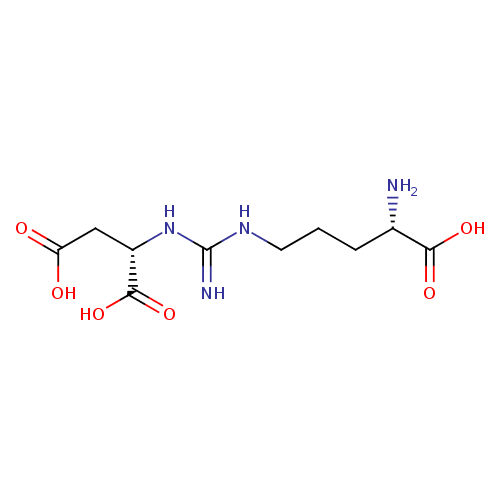
DescriptionArginosuccinic acid is a basic amino acid. Some cells synthesize it from citrulline, aspartic acid and use it as a precursor for arginine in the urea cycle or Citrulline-NO cycle. The enzyme that catalyzes the reaction is argininosuccinate synthetase. Argininosuccinic acid is a precursor to fumarate in the citric acid cycle via argininosuccinate lyase. Defects in the arginosuccinate lyase enzyme can lead to arginosuccinate lyase deficiency. Argininosuccinate (ASA) lyase deficiency results in defective cleavage of ASA. This leads to an accumulation of ASA in cells and an excessive excretion of ASA in urine (arginosuccinic aciduria). In virtually all respects, this disorder shares the characteristics of other urea cycle defects. The most important characteristic of ASA lyase deficiency is its propensity to cause hyperammonemia in affected individuals. ASA in affected individuals is excreted by the kidney at a rate practically equivalent to the glomerular filtration rate (GFR). Whether ASA itself causes a degree of toxicity due to hepatocellular accumulation is unknown; such an effect could help explain hyperammonemia development in affected individuals. Regardless, the name of the disease is derived from the rapid clearance of ASA in urine, although elevated levels of ASA can be found in plasma. ASA lyase deficiency is associated with high mortality and morbidity rates. Symptoms of ASA lyase deficiency include anorexia, irritability rapid breathing, lethargy and vomiting. Extreme symptoms include coma and cerebral edema.
Contaminant Sources
  • FooDB Chemicals
  • HMDB Contaminants - Urine
  • T3DB toxins
Contaminant Type
  • Amide
  • Amine
  • Animal Toxin
  • Food Toxin
  • Metabolite
  • Natural Compound
  • Organic Compound
Chemical Structure
Thumb
Synonyms
ValueSource
2-(Nomega-L-arginino)succinateKegg
L-ArgininosuccinateKegg
L-Argininosuccinic acidKegg
L-Arginosuccinic acidKegg
2-(Nomega-L-arginino)succinic acidGenerator
L-ArginosuccinateGenerator
ArgininosuccinateGenerator
2-(N(Omega)-L-arginine)succinateHMDB
2-(N(Omega)-L-arginine)succinic acidHMDB
2-(N(Omega)-L-arginino)succinateHMDB
2-(N(Omega)-L-arginino)succinic acidHMDB
2-(Nw-l-arginino)butanedioateHMDB
2-(Nw-l-arginino)butanedioic acidHMDB
ArginosuccinateHMDB
Arginosuccinic acidHMDB
ASAHMDB
N(Omega)-(L-arginino)succinateHMDB
N(Omega)-(L-arginino)succinic acidHMDB
N-(((4-Amino-4-carboxybutyl)amino)iminomethyl)-L-aspartateHMDB
N-(((4-Amino-4-carboxybutyl)amino)iminomethyl)-L-aspartic acidHMDB
N-(L-Arginino) succinateHMDB
N-(L-Arginino) succinic acidHMDB
N-(L-Arginino)succinateHMDB
N-(L-Arginino)succinic acidHMDB
N-[(4-Amino-4-carboxybutyl)amidino]-L-aspartateHMDB
N-[(4-Amino-4-carboxybutyl)amidino]-L-aspartic acidHMDB
N-[[(4-Amino-4-carboxybutyl)amino]iminomethyl]-L-aspartateHMDB
N-[[(4-Amino-4-carboxybutyl)amino]iminomethyl]-L-aspartic acidHMDB
Acid, argininosuccinicHMDB
N-(4-Amino-4-carboxybutyl)amidino-L-aspartic acidHMDB
Chemical FormulaC10H18N4O6
Average Molecular Mass290.273 g/mol
Monoisotopic Mass290.123 g/mol
CAS Registry Number2387-71-5
IUPAC Name(2S)-2-{N'-[(4S)-4-amino-4-carboxybutyl]carbamimidamido}butanedioic acid
Traditional Nameargininosuccinic acid
SMILESN[C@@H](CCCNC(=N)N[C@@H](CC(O)=O)C(O)=O)C(O)=O
InChI IdentifierInChI=1S/C10H18N4O6/c11-5(8(17)18)2-1-3-13-10(12)14-6(9(19)20)4-7(15)16/h5-6H,1-4,11H2,(H,15,16)(H,17,18)(H,19,20)(H3,12,13,14)/t5-,6-/m0/s1
InChI KeyKDZOASGQNOPSCU-WDSKDSINSA-N
Chemical Taxonomy
Description belongs to the class of organic compounds known as aspartic acid and derivatives. Aspartic acid and derivatives are compounds containing an aspartic acid or a derivative thereof resulting from reaction of aspartic acid at the amino group or the carboxy group, or from the replacement of any hydrogen of glycine by a heteroatom.
KingdomOrganic compounds
Super ClassOrganic acids and derivatives
ClassCarboxylic acids and derivatives
Sub ClassAmino acids, peptides, and analogues
Direct ParentAspartic acid and derivatives
Alternative Parents
Substituents
  • Aspartic acid or derivatives
  • Alpha-amino acid
  • L-alpha-amino acid
  • Tricarboxylic acid or derivatives
  • Guanidine
  • Amino acid
  • Organic 1,3-dipolar compound
  • Propargyl-type 1,3-dipolar organic compound
  • Carboximidamide
  • Carboxylic acid
  • Hydrocarbon derivative
  • Organopnictogen compound
  • Organic oxygen compound
  • Primary amine
  • Organooxygen compound
  • Organonitrogen compound
  • Primary aliphatic amine
  • Carbonyl group
  • Amine
  • Organic nitrogen compound
  • Organic oxide
  • Aliphatic acyclic compound
Molecular FrameworkAliphatic acyclic compounds
External Descriptors
Biological Properties
StatusDetected and Not Quantified
OriginEndogenous
Cellular Locations
  • Cytoplasm
  • Membrane
Biofluid LocationsNot Available
Tissue Locations
  • Kidney
  • Prostate
Pathways
NameSMPDB LinkKEGG Link
Arginine and Proline MetabolismSMP00020 map00330
Aspartate MetabolismSMP00067 map00250
Urea CycleSMP00059 Not Available
ArgininemiaSMP00357 Not Available
Argininosuccinic AciduriaSMP00003 Not Available
ApplicationsNot Available
Biological RolesNot Available
Chemical RolesNot Available
Physical Properties
StateSolid
AppearanceWhite powder.
Experimental Properties
PropertyValue
Melting PointNot Available
Boiling PointNot Available
SolubilityNot Available
Predicted Properties
PropertyValueSource
Water Solubility0.46 g/LALOGPS
logP-3.2ALOGPS
logP-5.8ChemAxon
logS-2.8ALOGPS
pKa (Strongest Acidic)2.14ChemAxon
pKa (Strongest Basic)12.39ChemAxon
Physiological Charge-1ChemAxon
Hydrogen Acceptor Count10ChemAxon
Hydrogen Donor Count7ChemAxon
Polar Surface Area185.83 ŲChemAxon
Rotatable Bond Count9ChemAxon
Refractivity75.31 m³·mol⁻¹ChemAxon
Polarizability27.6 ųChemAxon
Number of Rings0ChemAxon
Bioavailability1ChemAxon
Rule of FiveNoChemAxon
Ghose FilterNoChemAxon
Veber's RuleNoChemAxon
MDDR-like RuleNoChemAxon
Spectra
Spectra
Spectrum TypeDescriptionSplash KeyView
GC-MSGC-MS Spectrum - GC-EI-TOF (Pegasus III TOF-MS system, Leco; GC 6890, Agilent Technologies) (Non-derivatized)splash10-0007-0921100000-638b5887a29712423afdSpectrum
Predicted GC-MSPredicted GC-MS Spectrum - GC-MS (Non-derivatized) - 70eV, Positivesplash10-0007-8790000000-bc8aa39ecc71a1589298Spectrum
Predicted GC-MSPredicted GC-MS Spectrum - GC-MS (3 TMS) - 70eV, Positivesplash10-0006-4101900000-c606d87ec7ffb8ef2cfaSpectrum
Predicted GC-MSPredicted GC-MS Spectrum - GC-MS (Non-derivatized) - 70eV, PositiveNot AvailableSpectrum
Predicted GC-MSPredicted GC-MS Spectrum - GC-MS (TMS_1_1) - 70eV, PositiveNot AvailableSpectrum
Predicted GC-MSPredicted GC-MS Spectrum - GC-MS (TMS_1_2) - 70eV, PositiveNot AvailableSpectrum
Predicted GC-MSPredicted GC-MS Spectrum - GC-MS (TMS_1_3) - 70eV, PositiveNot AvailableSpectrum
Predicted GC-MSPredicted GC-MS Spectrum - GC-MS (TMS_1_4) - 70eV, PositiveNot AvailableSpectrum
Predicted GC-MSPredicted GC-MS Spectrum - GC-MS (TMS_1_5) - 70eV, PositiveNot AvailableSpectrum
Predicted GC-MSPredicted GC-MS Spectrum - GC-MS (TMS_1_6) - 70eV, PositiveNot AvailableSpectrum
Predicted GC-MSPredicted GC-MS Spectrum - GC-MS (TMS_1_7) - 70eV, PositiveNot AvailableSpectrum
Predicted GC-MSPredicted GC-MS Spectrum - GC-MS (TMS_2_1) - 70eV, PositiveNot AvailableSpectrum
Predicted GC-MSPredicted GC-MS Spectrum - GC-MS (TMS_2_2) - 70eV, PositiveNot AvailableSpectrum
Predicted GC-MSPredicted GC-MS Spectrum - GC-MS (TMS_2_3) - 70eV, PositiveNot AvailableSpectrum
Predicted GC-MSPredicted GC-MS Spectrum - GC-MS (TMS_2_4) - 70eV, PositiveNot AvailableSpectrum
Predicted GC-MSPredicted GC-MS Spectrum - GC-MS (TMS_2_5) - 70eV, PositiveNot AvailableSpectrum
Predicted GC-MSPredicted GC-MS Spectrum - GC-MS (TMS_2_6) - 70eV, PositiveNot AvailableSpectrum
Predicted GC-MSPredicted GC-MS Spectrum - GC-MS (TMS_2_7) - 70eV, PositiveNot AvailableSpectrum
Predicted GC-MSPredicted GC-MS Spectrum - GC-MS (TMS_2_8) - 70eV, PositiveNot AvailableSpectrum
Predicted GC-MSPredicted GC-MS Spectrum - GC-MS (TMS_2_9) - 70eV, PositiveNot AvailableSpectrum
Predicted GC-MSPredicted GC-MS Spectrum - GC-MS (TMS_2_10) - 70eV, PositiveNot AvailableSpectrum
Predicted GC-MSPredicted GC-MS Spectrum - GC-MS (TMS_2_11) - 70eV, PositiveNot AvailableSpectrum
Predicted GC-MSPredicted GC-MS Spectrum - GC-MS (TMS_2_12) - 70eV, PositiveNot AvailableSpectrum
Predicted GC-MSPredicted GC-MS Spectrum - GC-MS (TMS_2_13) - 70eV, PositiveNot AvailableSpectrum
LC-MS/MSLC-MS/MS Spectrum - LC-ESI-QQ (API3000, Applied Biosystems) 10V, Negativesplash10-000i-0090000000-27e7b2225bca7ed0bfefSpectrum
LC-MS/MSLC-MS/MS Spectrum - LC-ESI-QQ (API3000, Applied Biosystems) 20V, Negativesplash10-00di-0390000000-b66871354ad66743ff5fSpectrum
LC-MS/MSLC-MS/MS Spectrum - LC-ESI-QQ (API3000, Applied Biosystems) 30V, Negativesplash10-001i-1910000000-777b6f2263b573f38bcaSpectrum
LC-MS/MSLC-MS/MS Spectrum - LC-ESI-QQ (API3000, Applied Biosystems) 40V, Negativesplash10-001i-3900000000-26d6466903550c40fde6Spectrum
LC-MS/MSLC-MS/MS Spectrum - LC-ESI-QQ (API3000, Applied Biosystems) 50V, Negativesplash10-001r-8900000000-4e5455a5af85574ac9dfSpectrum
LC-MS/MSLC-MS/MS Spectrum - LC-ESI-QQ (API3000, Applied Biosystems) 10V, Positivesplash10-0006-0090000000-79b7ca9043632dc877e1Spectrum
LC-MS/MSLC-MS/MS Spectrum - LC-ESI-QQ (API3000, Applied Biosystems) 20V, Positivesplash10-0006-0590000000-8fb4f4625f241d387e92Spectrum
LC-MS/MSLC-MS/MS Spectrum - LC-ESI-QQ (API3000, Applied Biosystems) 30V, Positivesplash10-06di-3910000000-55530a4477a3fde8c1c1Spectrum
LC-MS/MSLC-MS/MS Spectrum - LC-ESI-QQ (API3000, Applied Biosystems) 40V, Positivesplash10-00di-9200000000-413c3029964c0386047aSpectrum
LC-MS/MSLC-MS/MS Spectrum - LC-ESI-QQ (API3000, Applied Biosystems) 50V, Positivesplash10-00di-9000000000-6ffc3b2b5da5f69de80bSpectrum
LC-MS/MSLC-MS/MS Spectrum - LC-ESI-IT (LC/MSD Trap XCT, Agilent Technologies) , Positivesplash10-060r-0950000000-129ee81e1370707d975dSpectrum
LC-MS/MSLC-MS/MS Spectrum - LC-ESI-IT (LC/MSD Trap XCT, Agilent Technologies) , Positivesplash10-0a4i-0910000000-62431d9967ced6c96b28Spectrum
LC-MS/MSLC-MS/MS Spectrum - LC-ESI-IT (LC/MSD Trap XCT, Agilent Technologies) , Positivesplash10-03di-1980000000-27b5f442d411115ebaabSpectrum
LC-MS/MSLC-MS/MS Spectrum - LC-ESI-IT (LC/MSD Trap XCT, Agilent Technologies) , Positivesplash10-0a4i-1900000000-b57bcbf0c07e921767afSpectrum
LC-MS/MSLC-MS/MS Spectrum - LC-ESI-IT (LC/MSD Trap XCT, Agilent Technologies) , Positivesplash10-0006-3900000000-1fce5114c61349fc9065Spectrum
LC-MS/MSLC-MS/MS Spectrum - LC-ESI-IT (LC/MSD Trap XCT, Agilent Technologies) , Positivesplash10-014i-0900000000-25c094a4a18cfe463b6bSpectrum
LC-MS/MSLC-MS/MS Spectrum - LC-ESI-IT (LC/MSD Trap XCT, Agilent Technologies) , Positivesplash10-00di-9200000000-e518e242f12e95bbddf9Spectrum
LC-MS/MSLC-MS/MS Spectrum - LC-ESI-IT (LC/MSD Trap XCT, Agilent Technologies) , Positivesplash10-00di-9000000000-932dfd009a8e5c41ec38Spectrum
LC-MS/MSLC-MS/MS Spectrum - LC-ESI-QQ , negativesplash10-000i-0090000000-27e7b2225bca7ed0bfefSpectrum
Predicted LC-MS/MSPredicted LC-MS/MS Spectrum - 10V, Positivesplash10-00dj-0190000000-8ba86e35661de03d1049Spectrum
Predicted LC-MS/MSPredicted LC-MS/MS Spectrum - 20V, Positivesplash10-0092-2890000000-966d24fb4f820888318eSpectrum
Predicted LC-MS/MSPredicted LC-MS/MS Spectrum - 40V, Positivesplash10-004i-4900000000-5200a801423dd1a4b7a6Spectrum
Predicted LC-MS/MSPredicted LC-MS/MS Spectrum - 10V, Negativesplash10-00ds-0290000000-a3397e8c303fc7e6bd83Spectrum
Predicted LC-MS/MSPredicted LC-MS/MS Spectrum - 20V, Negativesplash10-00e9-0940000000-a964172e915808d27899Spectrum
Predicted LC-MS/MSPredicted LC-MS/MS Spectrum - 40V, Negativesplash10-0ac3-8900000000-d4ac87f770202453bb7aSpectrum
1D NMR1H NMR SpectrumNot AvailableSpectrum
1D NMR13C NMR SpectrumNot AvailableSpectrum
1D NMR1H NMR SpectrumNot AvailableSpectrum
1D NMR13C NMR SpectrumNot AvailableSpectrum
1D NMR1H NMR SpectrumNot AvailableSpectrum
1D NMR13C NMR SpectrumNot AvailableSpectrum
1D NMR1H NMR SpectrumNot AvailableSpectrum
1D NMR13C NMR SpectrumNot AvailableSpectrum
1D NMR1H NMR SpectrumNot AvailableSpectrum
1D NMR13C NMR SpectrumNot AvailableSpectrum
1D NMR1H NMR SpectrumNot AvailableSpectrum
1D NMR13C NMR SpectrumNot AvailableSpectrum
1D NMR1H NMR SpectrumNot AvailableSpectrum
1D NMR13C NMR SpectrumNot AvailableSpectrum
1D NMR1H NMR SpectrumNot AvailableSpectrum
1D NMR13C NMR SpectrumNot AvailableSpectrum
1D NMR1H NMR SpectrumNot AvailableSpectrum
1D NMR13C NMR SpectrumNot AvailableSpectrum
1D NMR1H NMR SpectrumNot AvailableSpectrum
1D NMR13C NMR SpectrumNot AvailableSpectrum
1D NMR1H NMR SpectrumNot AvailableSpectrum
2D NMR[1H,13C] 2D NMR SpectrumNot AvailableSpectrum
Toxicity Profile
Route of ExposureNot Available
Mechanism of ToxicityNot Available
MetabolismNot Available
Toxicity ValuesNot Available
Lethal DoseNot Available
Carcinogenicity (IARC Classification)No indication of carcinogenicity to humans (not listed by IARC).
Uses/SourcesThis is an endogenously produced metabolite found in the human body. It is used in metabolic reactions, catabolic reactions or waste generation.
Minimum Risk LevelNot Available
Health EffectsNot Available
SymptomsNot Available
TreatmentNot Available
Concentrations
Not Available
DrugBank IDNot Available
HMDB IDHMDB0000052
FooDB IDFDB021885
Phenol Explorer IDNot Available
KNApSAcK IDC00019688
BiGG ID41790
BioCyc IDL-ARGININO-SUCCINATE
METLIN ID5115
PDB IDNot Available
Wikipedia LinkArgininosuccinic acid
Chemspider ID16059
ChEBI ID15682
PubChem Compound ID16950
Kegg Compound IDC03406
YMDB IDYMDB00052
ECMDB IDECMDB01006
References
Synthesis Reference

Steven S. Gross, Owen W. Griffith, “Preventing conversion of citrulline to argininosuccinate to limit pathological nitric oxide overproduction.” U.S. Patent US5545625, issued January, 1995.

MSDSLink
General References
1. Hagino, Koji; Nakanishi, Toshihide. Fermentative production of L-arginosuccinic acid. Jpn. Kokai Tokkyo Koho (1980), 3 pp.
2. Michels VV, Beaudet AL: Arginase deficiency in multiple tissues in argininemia. Clin Genet. 1978 Jan;13(1):61-7.
3. Glick NR, Snodgrass PJ, Schafer IA: Neonatal argininosuccinic aciduria with normal brain and kidney but absent liver argininosuccinate lyase activity. Am J Hum Genet. 1976 Jan;28(1):22-30.
4. Pelli N, Fensom AH, Slade C, Boa F, Mieli-Vergani G, Vergani D: Argininosuccinate lyase: a new autoantigen in liver disease. Clin Exp Immunol. 1998 Dec;114(3):455-61.
5. Scaglia F, Brunetti-Pierri N, Kleppe S, Marini J, Carter S, Garlick P, Jahoor F, O'Brien W, Lee B: Clinical consequences of urea cycle enzyme deficiencies and potential links to arginine and nitric oxide metabolism. J Nutr. 2004 Oct;134(10 Suppl):2775S-2782S; discussion 2796S-2797S.
6. Cohen BD: Methyl group deficiency and guanidino production in uremia. Mol Cell Biochem. 2003 Feb;244(1-2):31-6.
7. Au WL, Lim TC, Seow DC, Koh PL, Loh NK, Lim MS, Tan IK, Yee WC: Serial diffusion-weighted magnetic resonance imaging in adult-onset citrullinaemia. J Neurol Sci. 2003 May 15;209(1-2):101-4.
8. Wasant P, Srisomsap C, Liammongkolkul S, Svasti J: Urea cycle disorders in Thai infants: a report of 5 cases. J Med Assoc Thai. 2002 Aug;85 Suppl 2:S720-31.
9. Reid Sutton V, Pan Y, Davis EC, Craigen WJ: A mouse model of argininosuccinic aciduria: biochemical characterization. Mol Genet Metab. 2003 Jan;78(1):11-6.
10. Kleijer WJ, Garritsen VH, Linnebank M, Mooyer P, Huijmans JG, Mustonen A, Simola KO, Arslan-Kirchner M, Battini R, Briones P, Cardo E, Mandel H, Tschiedel E, Wanders RJ, Koch HG: Clinical, enzymatic, and molecular genetic characterization of a biochemical variant type of argininosuccinic aciduria: prenatal and postnatal diagnosis in five unrelated families. J Inherit Metab Dis. 2002 Sep;25(5):399-410.
11. Fleisher LD, Rassin DK, Desnick RJ, Salwen HR, Rogers P, Bean M, Gaull GE: Argininosuccinic aciduria: prenatal studies in a family at risk. Am J Hum Genet. 1979 Jul;31(4):439-45.
12. Sreekumar A, Poisson LM, Rajendiran TM, Khan AP, Cao Q, Yu J, Laxman B, Mehra R, Lonigro RJ, Li Y, Nyati MK, Ahsan A, Kalyana-Sundaram S, Han B, Cao X, Byun J, Omenn GS, Ghosh D, Pennathur S, Alexander DC, Berger A, Shuster JR, Wei JT, Varambally S, Beecher C, Chinnaiyan AM: Metabolomic profiles delineate potential role for sarcosine in prostate cancer progression. Nature. 2009 Feb 12;457(7231):910-4. doi: 10.1038/nature07762.