Record Information
Version1.0
Creation Date2014-08-29 06:16:18 UTC
Update Date2026-05-14 17:32:45 UTC
Accession NumberCHEM003252
Identification
Common NameOrotic acid
ClassSmall Molecule
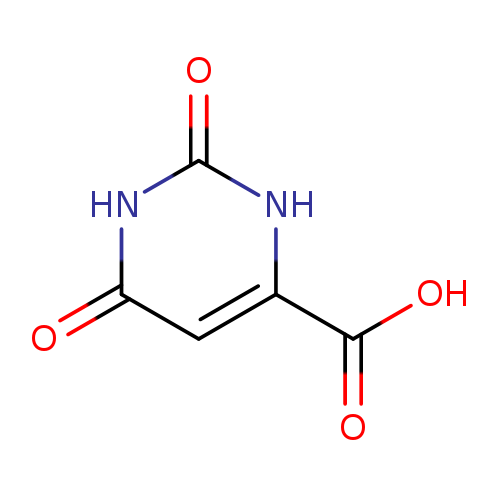
DescriptionOrotic acid is a minor dietary constituent. Indeed, until it was realized that it could be synthesized by humans, orotic acid was known as vitamin B-13. The richest dietary sources are cow's milk and other dairy products as well as root vegetables such as carrots and beets. Dietary intake probably contributes to a basal rate of orotic acid excretion in urine because fasting decreases excretion by ~50%. However, it is now apparent that most urinary orotic acid is synthesized in the body, where it arises as an intermediate in the pathway for the synthesis of pyrimidine nucleotides. Orotic acid is converted to UMP by UMP synthase, a multifunctional protein with both orotate phosphoribosyltransferase and orotidylate decarboxylase activity. The most frequently observed inborn error of pyrimidine nucleotide synthesis is a mutation of the multifunctional protein UMP synthase. This disorder prevents the conversion of orotic acid to UMP and thus to other pyrimidines. As a result, plasma orotic acid accumulates to high concentrations, and increased quantities appear in the urine. Indeed, urinary orotic acid is so markedly increased in individuals harboring a mutation in UMP synthase that orotic acid crystals can form in the urine. The urinary concentration of orotic acid in homozygotes can be of the order of millimoles per millimole creatinine. By comparison, the urinary level in unaffected individuals is ~ 1 umol/mmol creatinine. (1).
Contaminant Sources
  • FooDB Chemicals
  • HMDB Contaminants - Urine
  • STOFF IDENT Compounds
  • T3DB toxins
  • ToxCast & Tox21 Chemicals
Contaminant Type
  • Animal Toxin
  • Ester
  • Food Toxin
  • Metabolite
  • Natural Compound
  • Organic Compound
Chemical Structure
Thumb
Synonyms
ValueSource
OrotsaeureChEBI
Uracil-6-carboxylic acidChEBI
Uracil-6-carboxylateGenerator
OrotateGenerator
1,2,3,6-Tetrahydro-2,6-dioxo-4-pyrimidecarboxylic acidHMDB
1,2,3,6-Tetrahydro-2,6-dioxo-4-pyrimidinecarboxylic acidHMDB
1,2,3,6-Tetrahydro-2,6-dioxopyrimidin-4-carbonsaeureHMDB
2,6-Dihydroxy-4-pyrimidinecarboxylic acidHMDB
2,6-Dihydroxypyrimidine-4-carboxylic acidHMDB
2,6-Dioxo-1,2,3,6-tetrahydro-pyrimidine-4-carboxylic acidHMDB
2,6-Dioxo-1,2,3,6-tetrahydropyrimidine-4-carboxylic acidHMDB
6-Carboxy-2,4-dihydroxypyrimidineHMDB
6-CarboxyuracilHMDB
6-Uracilcarboxylic acidHMDB
Acide orotiqueHMDB
Acido oroticoHMDB
Acidum oroticumHMDB
Animal galactose factorHMDB
LactiniumHMDB
MolkensaeureHMDB
OROHMDB
OrodinHMDB
OropurHMDB
OrotoninHMDB
OrotonsanHMDB
OrotsaureHMDB
OroturicHMDB
OrotylHMDB
Uracil-6-carbosaeureHMDB
Vitamin b13HMDB
Whey factorHMDB
Zinc orotateHMDB
Orotate, zincHMDB
Acid, oroticHMDB
Orotate, potassiumHMDB
Potassium orotateHMDB
Orotate, sodiumHMDB
Sodium orotateHMDB
Chemical FormulaC5H4N2O4
Average Molecular Mass156.096 g/mol
Monoisotopic Mass156.017 g/mol
CAS Registry Number65-86-1
IUPAC Name2,6-dioxo-1,2,3,6-tetrahydropyrimidine-4-carboxylic acid
Traditional Nameorotic acid
SMILESOC(=O)C1=CC(=O)NC(=O)N1
InChI IdentifierInChI=1S/C5H4N2O4/c8-3-1-2(4(9)10)6-5(11)7-3/h1H,(H,9,10)(H2,6,7,8,11)
InChI KeyPXQPEWDEAKTCGB-UHFFFAOYSA-N
Chemical Taxonomy
Description belongs to the class of organic compounds known as pyrimidinecarboxylic acids. These are pyrimidines with a structure containing a carboxyl group attached to the pyrimidine ring.
KingdomOrganic compounds
Super ClassOrganoheterocyclic compounds
ClassDiazines
Sub ClassPyrimidines and pyrimidine derivatives
Direct ParentPyrimidinecarboxylic acids
Alternative Parents
Substituents
  • Pyrimidine-6-carboxylic acid
  • Hydropyrimidine carboxylic acid derivative
  • Pyrimidone
  • Hydropyrimidine
  • Heteroaromatic compound
  • Vinylogous amide
  • Urea
  • Lactam
  • Azacycle
  • Monocarboxylic acid or derivatives
  • Carboxylic acid
  • Carboxylic acid derivative
  • Organic nitrogen compound
  • Organic oxygen compound
  • Organopnictogen compound
  • Organic oxide
  • Hydrocarbon derivative
  • Organooxygen compound
  • Organonitrogen compound
  • Aromatic heteromonocyclic compound
Molecular FrameworkAromatic heteromonocyclic compounds
External Descriptors
Biological Properties
StatusDetected and Not Quantified
OriginEndogenous
Cellular Locations
  • Cytoplasm
  • Extracellular
Biofluid LocationsNot Available
Tissue Locations
  • Liver
  • Pancreas
Pathways
NameSMPDB LinkKEGG Link
Pyrimidine MetabolismSMP00046 map00240
ArgininemiaSMP00357 Not Available
Citrullinemia Type ISMP00001 Not Available
Purine Nucleoside Phosphorylase DeficiencySMP00210 Not Available
UMP Synthase Deiciency (Orotic Aciduria)SMP00219 Not Available
ApplicationsNot Available
Biological Roles
Chemical RolesNot Available
Physical Properties
StateSolid
AppearanceWhite powder.
Experimental Properties
PropertyValue
Melting Point345.5°C
Boiling PointNot Available
Solubility1.82 mg/mL at 18°C
Predicted Properties
PropertyValueSource
Water Solubility4.51 g/LALOGPS
logP-0.89ALOGPS
logP-1.2ChemAxon
logS-1.5ALOGPS
pKa (Strongest Acidic)2.83ChemAxon
pKa (Strongest Basic)-6ChemAxon
Physiological Charge-1ChemAxon
Hydrogen Acceptor Count4ChemAxon
Hydrogen Donor Count3ChemAxon
Polar Surface Area95.5 ŲChemAxon
Rotatable Bond Count1ChemAxon
Refractivity33.27 m³·mol⁻¹ChemAxon
Polarizability12.46 ųChemAxon
Number of Rings1ChemAxon
Bioavailability1ChemAxon
Rule of FiveYesChemAxon
Ghose FilterNoChemAxon
Veber's RuleNoChemAxon
MDDR-like RuleNoChemAxon
Spectra
Spectra
Spectrum TypeDescriptionSplash KeyView
GC-MSGC-MS Spectrum - GC-EI-TOF (Pegasus III TOF-MS system, Leco; GC 6890, Agilent Technologies) (Non-derivatized)splash10-0udi-1982000000-b20f2ec9a2f1acc84ae1Spectrum
GC-MSGC-MS Spectrum - GC-MS (3 TMS)splash10-0zfr-2693000000-07bf11b5177412647d9bSpectrum
GC-MSGC-MS Spectrum - GC-EI-TOF (Non-derivatized)splash10-0udi-1982000000-b20f2ec9a2f1acc84ae1Spectrum
GC-MSGC-MS Spectrum - GC-MS (Non-derivatized)splash10-0zfr-2693000000-07bf11b5177412647d9bSpectrum
GC-MSGC-MS Spectrum - GC-EI-TOF (Non-derivatized)splash10-0udi-1972000000-c04fb7381d3ca07c9b0aSpectrum
Predicted GC-MSPredicted GC-MS Spectrum - GC-MS (Non-derivatized) - 70eV, Positivesplash10-06ri-6900000000-4ba5fde1f8f62c4a2ba2Spectrum
Predicted GC-MSPredicted GC-MS Spectrum - GC-MS (1 TMS) - 70eV, Positivesplash10-0229-9850000000-8164142820eb5162e753Spectrum
Predicted GC-MSPredicted GC-MS Spectrum - GC-MS (Non-derivatized) - 70eV, PositiveNot AvailableSpectrum
Predicted GC-MSPredicted GC-MS Spectrum - GC-MS (TMS_1_2) - 70eV, PositiveNot AvailableSpectrum
Predicted GC-MSPredicted GC-MS Spectrum - GC-MS (TMS_1_3) - 70eV, PositiveNot AvailableSpectrum
Predicted GC-MSPredicted GC-MS Spectrum - GC-MS (TBDMS_1_1) - 70eV, PositiveNot AvailableSpectrum
Predicted GC-MSPredicted GC-MS Spectrum - GC-MS (TBDMS_1_2) - 70eV, PositiveNot AvailableSpectrum
Predicted GC-MSPredicted GC-MS Spectrum - GC-MS (TBDMS_1_3) - 70eV, PositiveNot AvailableSpectrum
LC-MS/MSLC-MS/MS Spectrum - Quattro_QQQ 10V, Negative (Annotated)splash10-03di-0900000000-81d73aed73c250fff3aeSpectrum
LC-MS/MSLC-MS/MS Spectrum - Quattro_QQQ 25V, Negative (Annotated)splash10-0006-9300000000-ecb08d1854a2789480d1Spectrum
LC-MS/MSLC-MS/MS Spectrum - Quattro_QQQ 40V, Negative (Annotated)splash10-0006-9100000000-15748a4c13636c42f4f9Spectrum
LC-MS/MSLC-MS/MS Spectrum - LC-ESI-QTOF (UPLC Q-Tof Premier, Waters) , Positivesplash10-02ti-4900000000-6fd6312d81f94faaaf11Spectrum
LC-MS/MSLC-MS/MS Spectrum - LC-ESI-QTOF (UPLC Q-Tof Premier, Waters) , Negativesplash10-03di-0900000000-1b7abf52e4a01cb85541Spectrum
LC-MS/MSLC-MS/MS Spectrum - LC-ESI-QTOF , negativesplash10-03di-0900000000-1b7abf52e4a01cb85541Spectrum
LC-MS/MSLC-MS/MS Spectrum - , negativesplash10-03di-0900000000-3dff3caa5c10aff8ce46Spectrum
LC-MS/MSLC-MS/MS Spectrum - LC-ESI-QTOF , positivesplash10-02ti-4900000000-6fd6312d81f94faaaf11Spectrum
LC-MS/MSLC-MS/MS Spectrum - 10V, Positivesplash10-004i-9000000000-351f585d58b38f6132deSpectrum
LC-MS/MSLC-MS/MS Spectrum - 10V, Positivesplash10-0a4r-0900000000-4e46209ca236b470bf7fSpectrum
LC-MS/MSLC-MS/MS Spectrum - 20V, Positivesplash10-014i-9300000000-aa9cd31d715d134ee8ddSpectrum
LC-MS/MSLC-MS/MS Spectrum - 40V, Positivesplash10-014i-9000000000-cdd01e740b6f9d1a909aSpectrum
LC-MS/MSLC-MS/MS Spectrum - 10V, Negativesplash10-03di-1900000000-baf39ad8ab6f08fb1a7bSpectrum
Predicted LC-MS/MSPredicted LC-MS/MS Spectrum - 10V, Positivesplash10-0bt9-0900000000-1ad59feda583f2247b21Spectrum
Predicted LC-MS/MSPredicted LC-MS/MS Spectrum - 20V, Positivesplash10-03di-2900000000-0d0d27215e9f39a2a15bSpectrum
Predicted LC-MS/MSPredicted LC-MS/MS Spectrum - 40V, Positivesplash10-0006-9100000000-918a38777f5d4e049697Spectrum
Predicted LC-MS/MSPredicted LC-MS/MS Spectrum - 10V, Negativesplash10-0a4i-0900000000-d7bbee7f2dc7bb0c6a83Spectrum
Predicted LC-MS/MSPredicted LC-MS/MS Spectrum - 20V, Negativesplash10-03dl-7900000000-303fe3e06e98f518a2eeSpectrum
Predicted LC-MS/MSPredicted LC-MS/MS Spectrum - 40V, Negativesplash10-0006-9000000000-b2c02975bbba65c2f1c6Spectrum
Predicted LC-MS/MSPredicted LC-MS/MS Spectrum - 10V, Positivesplash10-0bt9-0900000000-1ad59feda583f2247b21Spectrum
Predicted LC-MS/MSPredicted LC-MS/MS Spectrum - 20V, Positivesplash10-03di-2900000000-0d0d27215e9f39a2a15bSpectrum
Predicted LC-MS/MSPredicted LC-MS/MS Spectrum - 40V, Positivesplash10-0006-9100000000-918a38777f5d4e049697Spectrum
Predicted LC-MS/MSPredicted LC-MS/MS Spectrum - 10V, Negativesplash10-0a4i-0900000000-d7bbee7f2dc7bb0c6a83Spectrum
Predicted LC-MS/MSPredicted LC-MS/MS Spectrum - 20V, Negativesplash10-03dl-7900000000-303fe3e06e98f518a2eeSpectrum
Predicted LC-MS/MSPredicted LC-MS/MS Spectrum - 40V, Negativesplash10-0006-9000000000-b2c02975bbba65c2f1c6Spectrum
MSMass Spectrum (Electron Ionization)splash10-066r-9300000000-e5c3ef3304f93a38628cSpectrum
1D NMR1H NMR SpectrumNot AvailableSpectrum
1D NMR13C NMR SpectrumNot AvailableSpectrum
1D NMR1H NMR SpectrumNot AvailableSpectrum
1D NMR13C NMR SpectrumNot AvailableSpectrum
1D NMR1H NMR SpectrumNot AvailableSpectrum
1D NMR13C NMR SpectrumNot AvailableSpectrum
1D NMR1H NMR SpectrumNot AvailableSpectrum
1D NMR13C NMR SpectrumNot AvailableSpectrum
1D NMR1H NMR SpectrumNot AvailableSpectrum
1D NMR13C NMR SpectrumNot AvailableSpectrum
1D NMR1H NMR SpectrumNot AvailableSpectrum
1D NMR13C NMR SpectrumNot AvailableSpectrum
1D NMR1H NMR SpectrumNot AvailableSpectrum
1D NMR13C NMR SpectrumNot AvailableSpectrum
1D NMR1H NMR SpectrumNot AvailableSpectrum
1D NMR13C NMR SpectrumNot AvailableSpectrum
1D NMR1H NMR SpectrumNot AvailableSpectrum
1D NMR13C NMR SpectrumNot AvailableSpectrum
1D NMR1H NMR SpectrumNot AvailableSpectrum
1D NMR13C NMR SpectrumNot AvailableSpectrum
2D NMR[1H,1H] 2D NMR SpectrumNot AvailableSpectrum
2D NMR[1H,13C] 2D NMR SpectrumNot AvailableSpectrum
Toxicity Profile
Route of ExposureNot Available
Mechanism of ToxicityNot Available
MetabolismNot Available
Toxicity ValuesNot Available
Lethal DoseNot Available
Carcinogenicity (IARC Classification)No indication of carcinogenicity to humans (not listed by IARC).
Uses/SourcesThis is an endogenously produced metabolite found in the human body. It is used in metabolic reactions, catabolic reactions or waste generation.
Minimum Risk LevelNot Available
Health EffectsChronically high levels of orotic acid are associated with at least 4 inborn errors of metabolism including: Argininemia, Citrullinemia Type I, Purine nucleoside phosphorylase deficiency and Orotic Aciduria.
SymptomsNot Available
TreatmentNot Available
Concentrations
Not Available
DrugBank IDDB02262
HMDB IDHMDB0000226
FooDB IDFDB031072
Phenol Explorer IDNot Available
KNApSAcK IDC00019689
BiGG ID34527
BioCyc IDOROTATE
METLIN ID318
PDB IDNot Available
Wikipedia LinkOrotic_acid
Chemspider ID942
ChEBI ID16742
PubChem Compound ID967
Kegg Compound IDC00295
YMDB IDYMDB00405
ECMDB IDECMDB00226
References
Synthesis Reference

Paul Rambacher, Siegfried Make, “Process for preparing orotic acid.” U.S. Patent US4062847, issued November, 1960.

MSDSLink
General References
1. https://www.ncbi.nlm.nih.gov/pubmed/?term=11059538
2. https://www.ncbi.nlm.nih.gov/pubmed/?term=22019295
3. https://www.ncbi.nlm.nih.gov/pubmed/?term=22285839
4. https://www.ncbi.nlm.nih.gov/pubmed/?term=22307261
5. https://www.ncbi.nlm.nih.gov/pubmed/?term=22371390
6. https://www.ncbi.nlm.nih.gov/pubmed/?term=22634191
7. https://www.ncbi.nlm.nih.gov/pubmed/?term=22707164
8. https://www.ncbi.nlm.nih.gov/pubmed/?term=22770225
9. https://www.ncbi.nlm.nih.gov/pubmed/?term=22863860
10. https://www.ncbi.nlm.nih.gov/pubmed/?term=7264771
11. Mitchell, Herschel K.; Nyc, Joseph F. Intermediates in the synthesis of orotic acid from oxalacetic ester and urea. Journal of the American Chemical Society (1947), 69 674-7.
12. Motyl T, Krzeminski J, Podgurniak M, Witeszczak C, Zochowski P: Variability of orotic acid concentration in cow's milk. Endocr Regul. 1991 Jun;25(1-2):79-82.
13. Motyl T, Barej W, Leontowicz H: The orotic acid concentration in the blood, milk, and urine of dairy cows fed with urea supplemented diet. Arch Tierernahr. 1986 Jun;36(6):551-6.
14. Tiemeyer W, Stohrer M, Giesecke D: Metabolites of nucleic acids in bovine milk. J Dairy Sci. 1984 Apr;67(4):723-8. doi: 10.3168/jds.S0022-0302(84)81361-2.
15. Robinson JL, Dombrowski DB, Clark JH, Shanks RD: Orotate in milk and urine of dairy cows with a partial deficiency of uridine monophosphate synthase. J Dairy Sci. 1984 May;67(5):1024-9. doi: 10.3168/jds.S0022-0302(84)81401-0.
16. Gil A, Sanchez-Medina F: Acid-soluble nucleotides of cow's, goat's and sheep's milks, at different stages of lactation. J Dairy Res. 1981 Feb;48(1):35-44.
17. Indyk HE, Woollard DC: Determination of orotic acid, uric acid, and creatinine in milk by liquid chromatography. J AOAC Int. 2004 Jan-Feb;87(1):116-22.
18. Karatas F, Aydin S, Kaygusuzoglu E, Yildiz H, Erulas FA, Ozkan Y: Ghrelin and orotic acid increased in subclinical mastitis. Arch Physiol Biochem. 2008 Jul;114(3):178-82. doi: 10.1080/13813450802180940 .
19. Klein MS, Buttchereit N, Miemczyk SP, Immervoll AK, Louis C, Wiedemann S, Junge W, Thaller G, Oefner PJ, Gronwald W: NMR metabolomic analysis of dairy cows reveals milk glycerophosphocholine to phosphocholine ratio as prognostic biomarker for risk of ketosis. J Proteome Res. 2012 Feb 3;11(2):1373-81. doi: 10.1021/pr201017n. Epub 2011 Dec 9.
20. Melzer N, Wittenburg D, Hartwig S, Jakubowski S, Kesting U, Willmitzer L, Lisec J, Reinsch N, Repsilber D: Investigating associations between milk metabolite profiles and milk traits of Holstein cows. J Dairy Sci. 2013 Mar;96(3):1521-34. doi: 10.3168/jds.2012-5743.
21. Sundekilde UK, Poulsen NA, Larsen LB, Bertram HC: Nuclear magnetic resonance metabonomics reveals strong association between milk metabolites and somatic cell count in bovine milk. J Dairy Sci. 2013 Jan;96(1):290-9. doi: 10.3168/jds.2012-5819. Epub 2012 Nov 22.
22. Sundekilde UK, Gustavsson F, Poulsen NA, Glantz M, Paulsson M, Larsen LB, Bertram HC: Association between the bovine milk metabolome and rennet-induced coagulation properties of milk. J Dairy Sci. 2014 Oct;97(10):6076-84. doi: 10.3168/jds.2014-8304. Epub 2014 Jul 30.
23. Buitenhuis AJ, Sundekilde UK, Poulsen NA, Bertram HC, Larsen LB, Sorensen P: Estimation of genetic parameters and detection of quantitative trait loci for metabolites in Danish Holstein milk. J Dairy Sci. 2013 May;96(5):3285-95. doi: 10.3168/jds.2012-5914. Epub 2013 Mar 15.
24. Maher AD, Hayes B, Cocks B, Marett L, Wales WJ, Rochfort SJ: Latent biochemical relationships in the blood-milk metabolic axis of dairy cows revealed by statistical integration of 1H NMR spectroscopic data. J Proteome Res. 2013 Mar 1;12(3):1428-35. doi: 10.1021/pr301056q. Epub 2013 Feb 21.
25. O'Callaghan TF, Vazquez-Fresno R, Serra-Cayuela A, Dong E, Mandal R, Hennessy D, McAuliffe S, Dillon P, Wishart DS, Stanton C, Ross RP: Pasture Feeding Changes the Bovine Rumen and Milk Metabolome. Metabolites. 2018 Apr 6;8(2). pii: metabo8020027. doi: 10.3390/metabo8020027.
26. Antunes-Fernandes EC, van Gastelen S, Dijkstra J, Hettinga KA, Vervoort J: Milk metabolome relates enteric methane emission to milk synthesis and energy metabolism pathways. J Dairy Sci. 2016 Aug;99(8):6251-6262. doi: 10.3168/jds.2015-10248. Epub 2016 May 26.
27. Carbohydrate Polymers 37 (1998) 225-229
28. A. Foroutan et al. The Chemical Composition of Commercial Cow's Milk (in preparation)
29. Mitchell, Herschel K.; Nyc, Joseph F. Intermediates in the synthesis of orotic acid from oxalacetic ester and urea. Journal of the American Chemical Society (1947), 69 674-7.
30. Zieve L: Conditional deficiencies of ornithine or arginine. J Am Coll Nutr. 1986;5(2):167-76.
31. Visek WJ: Ammonia: its effects on biological systems, metabolic hormones, and reproduction. J Dairy Sci. 1984 Mar;67(3):481-98.
32. Arranz JA, Riudor E, Rodes M, Roig M, Climent C, Rubio V, Sentis M, Burlina A: Optimization of allopurinol challenge: sample purification, protein intake control, and the use of orotidine response as a discriminative variable improve performance of the test for diagnosing ornithine carbamoyltransferase deficiency. Clin Chem. 1999 Jul;45(7):995-1001.
33. Sugio K, Gazdar AF, Albores-Saavedra J, Kokkinakis DM: High yields of K-ras mutations in intraductal papillary mucinous tumors and invasive adenocarcinomas induced by N-nitroso(2-hydroxypropyl)(2-oxopropyl)amine in the pancreas of female Syrian hamsters. Carcinogenesis. 1996 Feb;17(2):303-9.
34. Shoemaker JD, Elliott WH: Automated screening of urine samples for carbohydrates, organic and amino acids after treatment with urease. J Chromatogr. 1991 Jan 2;562(1-2):125-38.
35. Finkelstein JE, Hauser ER, Leonard CO, Brusilow SW: Late-onset ornithine transcarbamylase deficiency in male patients. J Pediatr. 1990 Dec;117(6):897-902.
36. Harris ML, Oberholzer VG: Conditions affecting the colorimetry of orotic acid and orotidine in urine. Clin Chem. 1980 Mar;26(3):473-9.
37. Jakobs C, Sweetman L, Nyhan WL, Gruenke L, Craig JC, Wadman SK: Stable isotope dilution analysis of orotic acid and uracil in amniotic fluid. Clin Chim Acta. 1984 Nov 15;143(2):123-33.
38. Visek WJ: Arginine and disease states. J Nutr. 1985 Apr;115(4):532-41.
39. Mizutani Y, Wada H, Fukushima M, Yoshida O, Nakanishi H, Li YN, Miki T: Prognostic significance of orotate phosphoribosyltransferase activity in bladder carcinoma. Cancer. 2004 Feb 15;100(4):723-31.
40. Valik D, Sedova Z, Starha J, Zeman J, Hruba E, Dvorakova L: Acute hyperammonaemic encephalopathy in a female newborn caused by a novel, de novo mutation in the ornithine transcarbamylase gene. Acta Paediatr. 2004 May;93(5):710-1.
41. Mills GC, Schmalstieg FC, Newkirk KE, Goldblum RM: Cytosine and orotic acid in urine of immunodeficient children. Clin Chem. 1979 Mar;25(3):419-24.
42. Paradis D, Giguere R, Auray-Blais C, Draper P, Lemieux B: An automated method for the determination of orotic acid in the urine of children being screened for metabolic disorders. Clin Biochem. 1980 Aug;13(4):160-3.
43. Potter M, Hammond JW, Sim KG, Green AK, Wilcken B: Ornithine carbamoyltransferase deficiency: improved sensitivity of testing for protein tolerance in the diagnosis of heterozygotes. J Inherit Metab Dis. 2001 Feb;24(1):5-14.
44. van Kuilenburg AB, van Lenthe H, Loffler M, van Gennip AH: Analysis of pyrimidine synthesis "de novo" intermediates in urine and dried urine filter- paper strips with HPLC-electrospray tandem mass spectrometry. Clin Chem. 2004 Nov;50(11):2117-24. Epub 2004 Sep 16.
45. Brosnan ME, Brosnan JT: Orotic acid excretion and arginine metabolism. J Nutr. 2007 Jun;137(6 Suppl 2):1656S-1661S.
46. Elshenawy S, Pinney SE, Stuart T, Doulias PT, Zura G, Parry S, Elovitz MA, Bennett MJ, Bansal A, Strauss JF 3rd, Ischiropoulos H, Simmons RA: The Metabolomic Signature of the Placenta in Spontaneous Preterm Birth. Int J Mol Sci. 2020 Feb 4;21(3). pii: ijms21031043. doi: 10.3390/ijms21031043.