Record Information
Version1.0
Creation Date2014-08-29 06:15:57 UTC
Update Date2026-05-14 16:24:06 UTC
Accession NumberCHEM003249
Identification
Common NameL-Arginine
ClassSmall Molecule
DescriptionArginine is an essential amino acid that is physiologically active in the L-form. In mammals, arginine is formally classified as a semiessential or conditionally essential amino acid, depending on the developmental stage and health status of the individual. Infants are unable to effectively synthesize arginine, making it nutritionally essential for infants. Adults, however, are able to synthesize arginine in the urea cycle. Arginine can be considered to be a basic amino acid as the part of the side chain nearest to the backbone is long, carbon-containing and hydrophobic, whereas the end of the side chain is a complex guanidinium group. With a pKa of 12.48, the guanidinium group is positively charged in neutral, acidic and even most basic environments. Because of the conjugation between the double bond and the nitrogen lone pairs, the positive charge is delocalized. This group is able to form multiple H-bonds. L-arginine is an amino acid that has numerous functions in the body. It helps dispose of ammonia, is used to make compounds such as nitric oxide, creatine, L-glutamate, L-proline, and it can be converted to glucose and glycogen if needed. In large doses, L-arginine also stimulates the release of hormones growth hormone and prolactin. Arginine is a known inducer of mTOR (mammalian target of rapamycin) and is responsible for inducing protein synthesis through the mTOR pathway. mTOR inhibition by rapamycin partially reduces arginine-induced protein synthesis (18). Catabolic disease states such as sepsis, injury, and cancer cause an increase in arginine utilization, which can exceed normal body production, leading to arginine depletion. Arginine also activates AMP kinase (AMPK) which then stimulates skeletal muscle fatty acid oxidation and muscle glucose uptake, thereby increasing insulin secretion by pancreatic beta-cells (19). Arginine is found in plant and animal proteins, such as dairy products, meat, poultry, fish, and nuts. The ratio of L-arginine to lysine is also important - soy and other plant proteins have more L-arginine than animal sources of protein.
Contaminant Sources
  • Cosmetic Chemicals
  • EAFUS Chemicals
  • FooDB Chemicals
  • HMDB Contaminants - Feces
  • HMDB Contaminants - Urine
  • HPV EPA Chemicals
  • STOFF IDENT Compounds
  • T3DB toxins
  • ToxCast & Tox21 Chemicals
Contaminant Type
  • Amide
  • Amine
  • Animal Toxin
  • Conditionally Essential Amino Acid
  • Dietary Supplement
  • Drug
  • Food Toxin
  • Household Toxin
  • Metabolite
  • Micronutrient
  • Natural Compound
  • Nutraceutical
  • Organic Compound
  • Supplement
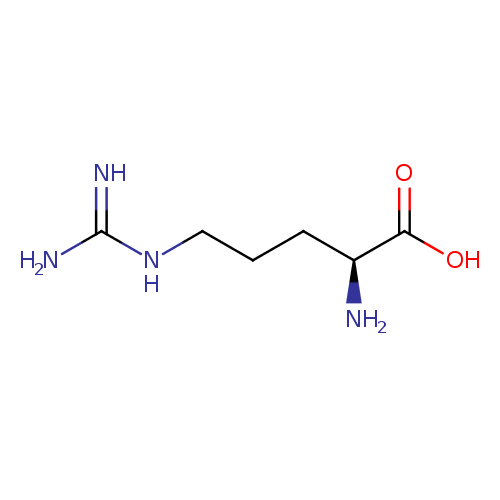
Chemical Structure
Thumb
Synonyms
ValueSource
(2S)-2-Amino-5-(carbamimidamido)pentanoic acidChEBI
(2S)-2-Amino-5-guanidinopentanoic acidChEBI
(S)-2-Amino-5-guanidinopentanoic acidChEBI
(S)-2-Amino-5-guanidinovaleric acidChEBI
ArgChEBI
ArginineChEBI
L-(+)-ArginineChEBI
L-ArgChEBI
L-ArgininChEBI
RChEBI
(2S)-2-Amino-5-(carbamimidamido)pentanoateGenerator
(2S)-2-Amino-5-guanidinopentanoateGenerator
(S)-2-Amino-5-guanidinopentanoateGenerator
(S)-2-Amino-5-guanidinovalerateGenerator
(S)-2-Amino-5-[(aminoiminomethyl)amino]-pentanoateHMDB
(S)-2-Amino-5-[(aminoiminomethyl)amino]-pentanoic acidHMDB
(S)-2-Amino-5-[(aminoiminomethyl)amino]pentanoateHMDB
(S)-2-Amino-5-[(aminoiminomethyl)amino]pentanoic acidHMDB
2-Amino-5-guanidinovalerateHMDB
2-Amino-5-guanidinovaleric acidHMDB
5-[(Aminoiminomethyl)amino]-L-norvalineHMDB
L-a-Amino-D-guanidinovalerateHMDB
L-a-Amino-D-guanidinovaleric acidHMDB
L-alpha-Amino-delta-guanidinovalerateHMDB
L-alpha-Amino-delta-guanidinovaleric acidHMDB
N5-(Aminoiminomethyl)-L-ornithineHMDB
DL-Arginine acetate, monohydrateHMDB
L-Isomer arginineHMDB
Monohydrate DL-arginine acetateHMDB
L ArginineHMDB
Arginine, L isomerHMDB
Arginine, L-isomerHMDB
Hydrochloride, arginineHMDB
Arginine hydrochlorideHMDB
DL Arginine acetate, monohydrateHMDB
Chemical FormulaC6H14N4O2
Average Molecular Mass174.201 g/mol
Monoisotopic Mass174.112 g/mol
CAS Registry Number74-79-3
IUPAC Name(2S)-2-amino-5-carbamimidamidopentanoic acid
Traditional NameL-arginine
SMILESN[C@@H](CCCNC(N)=N)C(O)=O
InChI IdentifierInChI=1S/C6H14N4O2/c7-4(5(11)12)2-1-3-10-6(8)9/h4H,1-3,7H2,(H,11,12)(H4,8,9,10)/t4-/m0/s1
InChI KeyODKSFYDXXFIFQN-BYPYZUCNSA-N
Chemical Taxonomy
Description belongs to the class of organic compounds known as l-alpha-amino acids. These are alpha amino acids which have the L-configuration of the alpha-carbon atom.
KingdomOrganic compounds
Super ClassOrganic acids and derivatives
ClassCarboxylic acids and derivatives
Sub ClassAmino acids, peptides, and analogues
Direct ParentL-alpha-amino acids
Alternative Parents
Substituents
  • L-alpha-amino acid
  • Fatty acid
  • Guanidine
  • Amino acid
  • Carboxylic acid
  • Monocarboxylic acid or derivatives
  • Carboximidamide
  • Propargyl-type 1,3-dipolar organic compound
  • Organic 1,3-dipolar compound
  • Amine
  • Hydrocarbon derivative
  • Organic oxide
  • Primary amine
  • Organooxygen compound
  • Organonitrogen compound
  • Organopnictogen compound
  • Primary aliphatic amine
  • Organic oxygen compound
  • Organic nitrogen compound
  • Carbonyl group
  • Aliphatic acyclic compound
Molecular FrameworkAliphatic acyclic compounds
External Descriptors
Biological Properties
StatusDetected and Not Quantified
OriginEndogenous
Cellular Locations
  • Cytoplasm
  • Extracellular
  • Membrane
  • Mitochondria
Biofluid LocationsNot Available
Tissue Locations
  • Adipose Tissue
  • Adrenal Cortex
  • Bladder
  • Epidermis
  • Fibroblasts
  • Gonads
  • Intestine
  • Kidney
  • Liver
  • Muscle
  • Myelin
  • Nerve Cells
  • Neuron
  • Pancreas
  • Placenta
  • Platelet
  • Prostate
  • Skeletal Muscle
  • Spleen
  • Stratum Corneum
  • Testes
Pathways
NameSMPDB LinkKEGG Link
Arginine and Proline MetabolismSMP00020 map00330
Glycine and Serine MetabolismSMP00004 map00260
Transcription/TranslationSMP00019 Not Available
Urea CycleSMP00059 Not Available
ArgininemiaSMP00357 Not Available
Argininosuccinic AciduriaSMP00003 Not Available
Hyperornithinemia with gyrate atrophy (HOGA)SMP00505 Not Available
Lysinuric Protein IntoleranceSMP00197 Not Available
Applications
Biological Roles
Chemical RolesNot Available
Physical Properties
StateSolid
AppearanceWhite powder.
Experimental Properties
PropertyValue
Melting Point244 dec°C
Boiling PointNot Available
Solubility1.82E+005 mg/L (at 25°C)
Predicted Properties
PropertyValueSource
Water Solubility2.28 g/LALOGPS
logP-3.5ALOGPS
logP-3.2ChemAxon
logS-1.9ALOGPS
pKa (Strongest Acidic)2.41ChemAxon
pKa (Strongest Basic)12.41ChemAxon
Physiological Charge1ChemAxon
Hydrogen Acceptor Count6ChemAxon
Hydrogen Donor Count5ChemAxon
Polar Surface Area125.22 ŲChemAxon
Rotatable Bond Count5ChemAxon
Refractivity53.92 m³·mol⁻¹ChemAxon
Polarizability17.8 ųChemAxon
Number of Rings0ChemAxon
Bioavailability1ChemAxon
Rule of FiveYesChemAxon
Ghose FilterNoChemAxon
Veber's RuleNoChemAxon
MDDR-like RuleNoChemAxon
Spectra
Spectra
Spectrum TypeDescriptionSplash KeyView
GC-MSGC-MS Spectrum - GC-EI-TOF (Pegasus III TOF-MS system, Leco; GC 6890, Agilent Technologies) (3 TMS)splash10-0a4i-1910000000-0191c1a63652c493660bSpectrum
GC-MSGC-MS Spectrum - GC-EI-TOF (Pegasus III TOF-MS system, Leco; GC 6890, Agilent Technologies) (3 TMS)splash10-00di-9810000000-eb6eb73302b678cf0a24Spectrum
GC-MSGC-MS Spectrum - GC-MS (2 TMS)splash10-00di-9700000000-e47b41cff0e873f53932Spectrum
GC-MSGC-MS Spectrum - GC-MS (3 TMS)splash10-0a4i-1920000000-8ae5af11398835d26bedSpectrum
GC-MSGC-MS Spectrum - GC-EI-TOF (Non-derivatized)splash10-0a4i-1910000000-0191c1a63652c493660bSpectrum
GC-MSGC-MS Spectrum - GC-EI-TOF (Non-derivatized)splash10-00di-9810000000-eb6eb73302b678cf0a24Spectrum
GC-MSGC-MS Spectrum - GC-MS (Non-derivatized)splash10-00di-9700000000-e47b41cff0e873f53932Spectrum
GC-MSGC-MS Spectrum - GC-MS (Non-derivatized)splash10-0a4i-1920000000-8ae5af11398835d26bedSpectrum
GC-MSGC-MS Spectrum - GC-EI-TOF (Non-derivatized)splash10-0udi-0900000000-afc3ca93f8fbf54ec9f4Spectrum
Predicted GC-MSPredicted GC-MS Spectrum - GC-MS (Non-derivatized) - 70eV, Positivesplash10-00dl-9100000000-60db59de76b9a9b5bfc8Spectrum
Predicted GC-MSPredicted GC-MS Spectrum - GC-MS (1 TMS) - 70eV, Positivesplash10-004i-8900000000-f47c4f9480612fdbc962Spectrum
Predicted GC-MSPredicted GC-MS Spectrum - GC-MS (Non-derivatized) - 70eV, PositiveNot AvailableSpectrum
Predicted GC-MSPredicted GC-MS Spectrum - GC-MS (TMS_1_2) - 70eV, PositiveNot AvailableSpectrum
Predicted GC-MSPredicted GC-MS Spectrum - GC-MS (TMS_1_3) - 70eV, PositiveNot AvailableSpectrum
Predicted GC-MSPredicted GC-MS Spectrum - GC-MS (TMS_1_4) - 70eV, PositiveNot AvailableSpectrum
Predicted GC-MSPredicted GC-MS Spectrum - GC-MS (TMS_1_5) - 70eV, PositiveNot AvailableSpectrum
Predicted GC-MSPredicted GC-MS Spectrum - GC-MS (TBDMS_1_1) - 70eV, PositiveNot AvailableSpectrum
Predicted GC-MSPredicted GC-MS Spectrum - GC-MS (TBDMS_1_2) - 70eV, PositiveNot AvailableSpectrum
Predicted GC-MSPredicted GC-MS Spectrum - GC-MS (TBDMS_1_3) - 70eV, PositiveNot AvailableSpectrum
Predicted GC-MSPredicted GC-MS Spectrum - GC-MS (TBDMS_1_4) - 70eV, PositiveNot AvailableSpectrum
Predicted GC-MSPredicted GC-MS Spectrum - GC-MS (TBDMS_1_5) - 70eV, PositiveNot AvailableSpectrum
LC-MS/MSLC-MS/MS Spectrum - Quattro_QQQ 10V, Positive (Annotated)splash10-00di-3900000000-8c82418f7b35a97fb9b3Spectrum
LC-MS/MSLC-MS/MS Spectrum - Quattro_QQQ 25V, Positive (Annotated)splash10-00di-9000000000-19b62da79866318c52ddSpectrum
LC-MS/MSLC-MS/MS Spectrum - Quattro_QQQ 40V, Positive (Annotated)splash10-00di-9000000000-64b046d21bdcbb8d5923Spectrum
LC-MS/MSLC-MS/MS Spectrum - LC-ESI-ITFT (LTQ Orbitrap XL, Thermo Scientfic) , Positivesplash10-004i-0900000000-e07b937b6867d1f62293Spectrum
LC-MS/MSLC-MS/MS Spectrum - LC-ESI-ITFT (LTQ Orbitrap XL, Thermo Scientfic) , Positivesplash10-0a4i-0900000000-87ab853583aab2973cfbSpectrum
LC-MS/MSLC-MS/MS Spectrum - LC-ESI-ITFT (LTQ Orbitrap XL, Thermo Scientfic) , Positivesplash10-0a4i-2900000000-28814246b728a51e761cSpectrum
LC-MS/MSLC-MS/MS Spectrum - LC-ESI-ITFT (LTQ Orbitrap XL, Thermo Scientfic) , Positivesplash10-0a4i-2900000000-cfe7e406be2172e94fbaSpectrum
LC-MS/MSLC-MS/MS Spectrum - LC-ESI-ITFT (LTQ Orbitrap XL, Thermo Scientfic) , Positivesplash10-004i-0910000000-478a8345915bc15d85b5Spectrum
LC-MS/MSLC-MS/MS Spectrum - LC-ESI-ITFT (LTQ Orbitrap XL, Thermo Scientfic) , Positivesplash10-0a4i-2900000000-c930c47ecbe6975a00fcSpectrum
LC-MS/MSLC-MS/MS Spectrum - LC-ESI-ITFT (LTQ Orbitrap XL, Thermo Scientfic) , Positivesplash10-0a4i-2900000000-fa6be0f9ce4ee4c30738Spectrum
LC-MS/MSLC-MS/MS Spectrum - LC-ESI-ITFT (LTQ Orbitrap XL, Thermo Scientfic) , Positivesplash10-004i-0900000000-3425ee9829935182c0d5Spectrum
LC-MS/MSLC-MS/MS Spectrum - LC-ESI-ITFT (LTQ Orbitrap XL, Thermo Scientfic) , Negativesplash10-0fk9-0946231100-3d57d2304dcb33feab3fSpectrum
LC-MS/MSLC-MS/MS Spectrum - LC-ESI-ITFT (LTQ Orbitrap XL, Thermo Scientfic) , Negativesplash10-000i-0900000000-5b6dd6fb263ea09289fcSpectrum
LC-MS/MSLC-MS/MS Spectrum - LC-ESI-ITFT (LTQ Orbitrap XL, Thermo Scientfic) , Negativesplash10-001i-0900000000-dfe35b3438d19320d8cbSpectrum
LC-MS/MSLC-MS/MS Spectrum - LC-ESI-ITFT (LTQ Orbitrap XL, Thermo Scientfic) , Negativesplash10-00di-0900000000-f666ab7e5354bce67a2eSpectrum
LC-MS/MSLC-MS/MS Spectrum - LC-ESI-ITFT (LTQ Orbitrap XL, Thermo Scientfic) , Negativesplash10-03kd-0977452210-046c4b70bd0ec351c41dSpectrum
LC-MS/MSLC-MS/MS Spectrum - LC-ESI-ITFT (LTQ Orbitrap XL, Thermo Scientfic) , Negativesplash10-014i-9000000000-2f51e43e530976d63633Spectrum
LC-MS/MSLC-MS/MS Spectrum - LC-ESI-ITFT (LTQ Orbitrap XL, Thermo Scientfic) , Negativesplash10-001i-0900000000-b9ebb7ebccee1a313888Spectrum
LC-MS/MSLC-MS/MS Spectrum - LC-ESI-ITFT (LTQ Orbitrap XL, Thermo Scientfic) , Negativesplash10-00di-0900000000-5379b6fb6ea2313101f9Spectrum
LC-MS/MSLC-MS/MS Spectrum - CE-ESI-TOF (CE-system connected to 6210 Time-of-Flight MS, Agilent) , Positivesplash10-004i-0900000000-02b2bc83599dc6944f2eSpectrum
LC-MS/MSLC-MS/MS Spectrum - LC-ESI-QTOF (UPLC Q-Tof Premier, Waters) , Positivesplash10-00fr-7900000000-b7cd48e0aca6a6256968Spectrum
LC-MS/MSLC-MS/MS Spectrum - LC-ESI-QTOF (UPLC Q-Tof Premier, Waters) 30V, Positivesplash10-00fr-7900000000-b7cd48e0aca6a6256968Spectrum
LC-MS/MSLC-MS/MS Spectrum - LC-ESI-QTOF (UPLC Q-Tof Premier, Waters) , Positivesplash10-00fr-7900000000-4e69a6ce7b97433937eeSpectrum
LC-MS/MSLC-MS/MS Spectrum - LC-ESI-QTOF (UPLC Q-Tof Premier, Waters) , Negativesplash10-001i-0900000000-835751d54af24bd337e7Spectrum
LC-MS/MSLC-MS/MS Spectrum - LC-ESI-QTOF (UPLC Q-Tof Premier, Waters) , Negativesplash10-001i-0900000000-2d2b5fd7617ccb227bb1Spectrum
1D NMR13C NMR SpectrumNot AvailableSpectrum
1D NMR1H NMR SpectrumNot AvailableSpectrum
1D NMR13C NMR SpectrumNot AvailableSpectrum
1D NMR1H NMR SpectrumNot AvailableSpectrum
1D NMR13C NMR SpectrumNot AvailableSpectrum
1D NMR1H NMR SpectrumNot AvailableSpectrum
1D NMR13C NMR SpectrumNot AvailableSpectrum
1D NMR1H NMR SpectrumNot AvailableSpectrum
1D NMR13C NMR SpectrumNot AvailableSpectrum
1D NMR1H NMR SpectrumNot AvailableSpectrum
1D NMR13C NMR SpectrumNot AvailableSpectrum
1D NMR1H NMR SpectrumNot AvailableSpectrum
1D NMR13C NMR SpectrumNot AvailableSpectrum
1D NMR1H NMR SpectrumNot AvailableSpectrum
1D NMR13C NMR SpectrumNot AvailableSpectrum
1D NMR1H NMR SpectrumNot AvailableSpectrum
1D NMR13C NMR SpectrumNot AvailableSpectrum
1D NMR1H NMR SpectrumNot AvailableSpectrum
1D NMR13C NMR SpectrumNot AvailableSpectrum
1D NMR1H NMR SpectrumNot AvailableSpectrum
1D NMR13C NMR SpectrumNot AvailableSpectrum
1D NMR1H NMR SpectrumNot AvailableSpectrum
1D NMR13C NMR SpectrumNot AvailableSpectrum
2D NMR[1H,1H] 2D NMR SpectrumNot AvailableSpectrum
2D NMR[1H,13C] 2D NMR SpectrumNot AvailableSpectrum
Toxicity Profile
Route of ExposureAbsorbed from the lumen of the small intestine into the enterocytes. Absorption is efficient and occurs by an active transport mechanism.
Mechanism of ToxicityMany of supplemental L-arginine's activities, including its possible anti-atherogenic actions, may be accounted for by its role as the precursor to nitric oxide or NO. NO is produced by all tissues of the body and plays very important roles in the cardiovascular system, immune system and nervous system. NO is formed from L-arginine via the enzyme nitric oxide synthase or synthetase (NOS), and the effects of NO are mainly mediated by 3,'5' -cyclic guanylate or cyclic GMP. NO activates the enzyme guanylate cyclase, which catalyzes the synthesis of cyclic GMP from guanosine triphosphate or GTP. Cyclic GMP is converted to guanylic acid via the enzyme cyclic GMP phosphodiesterase. NOS is a heme-containing enzyme with some sequences similar to cytochrome P-450 reductase. Several isoforms of NOS exist, two of which are constitutive and one of which is inducible by immunological stimuli. The constitutive NOS found in the vascular endothelium is designated eNOS and that present in the brain, spinal cord and peripheral nervous system is designated nNOS. The form of NOS induced by immunological or inflammatory stimuli is known as iNOS. iNOS may be expressed constitutively in select tissues such as lung epithelium. All the nitric oxide synthases use NADPH (reduced nicotinamide adenine dinucleotide phosphate) and oxygen (O2) as cosubstrates, as well as the cofactors FAD (flavin adenine dinucleotide), FMN (flavin mononucleotide), tetrahydrobiopterin and heme. Interestingly, ascorbic acid appears to enhance NOS activity by increasing intracellular tetrahydrobiopterin. eNOS and nNOS synthesize NO in response to an increased concentration of calcium ions or in some cases in response to calcium-independent stimuli, such as shear stress. In vitro studies of NOS indicate that the Km of the enzyme for L-arginine is in the micromolar range. The concentration of L-arginine in endothelial cells, as well as in other cells, and in plasma is in the millimolar range. What this means is that, under physiological conditions, NOS is saturated with its L-arginine substrate. In other words, L-arginine would not be expected to be rate-limiting for the enzyme, and it would not appear that supraphysiological levels of L-arginine which could occur with oral supplementation of the amino acid^would make any difference with regard to NO production. The reaction would appear to have reached its maximum level. However, in vivo studies have demonstrated that, under certain conditions, e.g. hypercholesterolemia, supplemental L-arginine could enhance endothelial-dependent vasodilation and NO production.
MetabolismSome metabolism of L-arginine takes place in the enterocytes. L-arginine not metabolized in the enterocytes enters the portal circulation from whence it is transported to the liver, where again some portion of the amino acid is metabolized.
Toxicity ValuesNot Available
Lethal DoseNot Available
Carcinogenicity (IARC Classification)No indication of carcinogenicity to humans (not listed by IARC).
Uses/SourcesUsed for nutritional supplementation, also for treating dietary shortage or imbalance.
Minimum Risk LevelNot Available
Health EffectsNot Available
SymptomsNot Available
TreatmentNot Available
Concentrations
Not Available
DrugBank IDDB00125
HMDB IDHMDB0000517
FooDB IDFDB002257
Phenol Explorer IDNot Available
KNApSAcK IDC00001340
BiGG ID33707
BioCyc IDARG
METLIN ID5502
PDB IDNot Available
Wikipedia LinkL-arginine
Chemspider ID6082
ChEBI ID16467
PubChem Compound ID6322
Kegg Compound IDC00062
YMDB IDYMDB00592
ECMDB IDECMDB00517
References
Synthesis Reference

Kiyoshi Nakayama, Kazumi Araki, Hajime Yoshida, “Process for the production of L-arginine by fermentation.” U.S. Patent US4086137, issued May, 1973.

MSDSLink
General References
1. Meyer, Helmut E.; Swiderek, Kristine; Hoffmann-Posorske, Edeltraut; Korte, Horst; Heilmeyer, Ludwig M. G., Jr. Quantitative determination of phosphoserine by high-performance liquid chromatography as the phenylthiocarbamyl-S-ethylcysteine. Application to
2. Melzer N, Wittenburg D, Hartwig S, Jakubowski S, Kesting U, Willmitzer L, Lisec J, Reinsch N, Repsilber D: Investigating associations between milk metabolite profiles and milk traits of Holstein cows. J Dairy Sci. 2013 Mar;96(3):1521-34. doi: 10.3168/jds.2012-5743.
3. Mung D, Li L: Development of Chemical Isotope Labeling LC-MS for Milk Metabolomics: Comprehensive and Quantitative Profiling of the Amine/Phenol Submetabolome. Anal Chem. 2017 Apr 18;89(8):4435-4443. doi: 10.1021/acs.analchem.6b03737. Epub 2017 Mar 28.
4. Mung D, Li L: Applying quantitative metabolomics based on chemical isotope labeling LC-MS for detecting potential milk adulterant in human milk. Anal Chim Acta. 2018 Feb 25;1001:78-85. doi: 10.1016/j.aca.2017.11.019. Epub 2017 Nov 14.
5. A. Foroutan et al. The Chemical Composition of Commercial Cow's Milk (in preparation)
6. Fooddata+, The Technical University of Denmark (DTU): https://frida.fooddata.dk/QueryFood.php?fn=milk&lang=en
7. Meyer, Helmut E.; Swiderek, Kristine; Hoffmann-Posorske, Edeltraut; Korte, Horst; Heilmeyer, Ludwig M. G., Jr. Quantitative determination of phosphoserine by high-performance liquid chromatography as the phenylthiocarbamyl-S-ethylcysteine. Application to
8. Mori A, Watanabe Y, Fujimoto N: Fluorometrical analysis of guanidino compounds in human cerebrospinal fluid. J Neurochem. 1982 Feb;38(2):448-50.
9. Peng CT, Wu KH, Lan SJ, Tsai JJ, Tsai FJ, Tsai CH: Amino acid concentrations in cerebrospinal fluid in children with acute lymphoblastic leukemia undergoing chemotherapy. Eur J Cancer. 2005 May;41(8):1158-63. Epub 2005 Apr 14.
10. Haas W, Grabe K, Geis C, Pach T, Stoll K, Fuchs M, Haberl B, Loy C: Recognition and invasion of human skin by Schistosoma mansoni cercariae: the key-role of L-arginine. Parasitology. 2002 Feb;124(Pt 2):153-67.
11. Cynober LA: Plasma amino acid levels with a note on membrane transport: characteristics, regulation, and metabolic significance. Nutrition. 2002 Sep;18(9):761-6.
12. Martens-Lobenhoffer J, Bode-Boger SM: Measurement of asymmetric dimethylarginine (ADMA) in human plasma: from liquid chromatography estimation to liquid chromatography-mass spectrometry quantification. Eur J Clin Pharmacol. 2006 Feb;62(Supplement 13):61-68.
13. Stothers L, Laher I, Christ GT: A review of the L-arginine - nitric oxide - guanylate cyclase pathway as a mediator of lower urinary tract physiology and symptoms. Can J Urol. 2003 Oct;10(5):1971-80.
14. Avogaro A, Toffolo G, Kiwanuka E, de Kreutzenberg SV, Tessari P, Cobelli C: L-arginine-nitric oxide kinetics in normal and type 2 diabetic subjects: a stable-labelled 15N arginine approach. Diabetes. 2003 Mar;52(3):795-802.
15. Kotikoski H, Moilanen E, Vapaatalo H, Aine E: Biochemical markers of the L-arginine-nitric oxide pathway in the aqueous humour in glaucoma patients. Acta Ophthalmol Scand. 2002 Apr;80(2):191-5.
16. Noris M, Todeschini M, Cassis P, Pasta F, Cappellini A, Bonazzola S, Macconi D, Maucci R, Porrati F, Benigni A, Picciolo C, Remuzzi G: L-arginine depletion in preeclampsia orients nitric oxide synthase toward oxidant species. Hypertension. 2004 Mar;43(3):614-22. Epub 2004 Jan 26.
17. Kirkeby HJ, Svane D, Poulsen J, Tottrup A, Forman A, Andersson KE: Role of the L-arginine/nitric oxide pathway in relaxation of isolated human penile cavernous tissue and circumflex veins. Acta Physiol Scand. 1993 Nov;149(3):385-92.
18. Mizutani N, Hayakawa C, Ohya Y, Watanabe K, Watanabe Y, Mori A: Guanidino compounds in hyperargininemia. Tohoku J Exp Med. 1987 Nov;153(3):197-205.
19. Engelborghs S, Marescau B, De Deyn PP: Amino acids and biogenic amines in cerebrospinal fluid of patients with Parkinson's disease. Neurochem Res. 2003 Aug;28(8):1145-50.
20. Crenn P, Coudray-Lucas C, Thuillier F, Cynober L, Messing B: Postabsorptive plasma citrulline concentration is a marker of absorptive enterocyte mass and intestinal failure in humans. Gastroenterology. 2000 Dec;119(6):1496-505.
21. Hagenfeldt L, Bjerkenstedt L, Edman G, Sedvall G, Wiesel FA: Amino acids in plasma and CSF and monoamine metabolites in CSF: interrelationship in healthy subjects. J Neurochem. 1984 Mar;42(3):833-7.
22. Sreekumar A, Poisson LM, Rajendiran TM, Khan AP, Cao Q, Yu J, Laxman B, Mehra R, Lonigro RJ, Li Y, Nyati MK, Ahsan A, Kalyana-Sundaram S, Han B, Cao X, Byun J, Omenn GS, Ghosh D, Pennathur S, Alexander DC, Berger A, Shuster JR, Wei JT, Varambally S, Beecher C, Chinnaiyan AM: Metabolomic profiles delineate potential role for sarcosine in prostate cancer progression. Nature. 2009 Feb 12;457(7231):910-4. doi: 10.1038/nature07762.
23. Bauchart-Thevret C, Cui L, Wu G, Burrin DG: Arginine-induced stimulation of protein synthesis and survival in IPEC-J2 cells is mediated by mTOR but not nitric oxide. Am J Physiol Endocrinol Metab. 2010 Dec;299(6):E899-909. doi: 10.1152/ajpendo.00068.2010. Epub 2010 Sep 14.
24. Linden KC, Wadley GD, Garnham AP, McConell GK: Effect of l-arginine infusion on glucose disposal during exercise in humans. Med Sci Sports Exerc. 2011 Sep;43(9):1626-34. doi: 10.1249/MSS.0b013e318212a317.
25. Elshenawy S, Pinney SE, Stuart T, Doulias PT, Zura G, Parry S, Elovitz MA, Bennett MJ, Bansal A, Strauss JF 3rd, Ischiropoulos H, Simmons RA: The Metabolomic Signature of the Placenta in Spontaneous Preterm Birth. Int J Mol Sci. 2020 Feb 4;21(3). pii: ijms21031043. doi: 10.3390/ijms21031043.
26. https://www.ncbi.nlm.nih.gov/pubmed/?term=10848923
27. https://www.ncbi.nlm.nih.gov/pubmed/?term=11139824
28. https://www.ncbi.nlm.nih.gov/pubmed/?term=11300497
29. https://www.ncbi.nlm.nih.gov/pubmed/?term=11898853
30. https://www.ncbi.nlm.nih.gov/pubmed/?term=12812828
31. https://www.ncbi.nlm.nih.gov/pubmed/?term=15016745
32. https://www.ncbi.nlm.nih.gov/pubmed/?term=15465805
33. https://www.ncbi.nlm.nih.gov/pubmed/?term=16056256
34. https://www.ncbi.nlm.nih.gov/pubmed/?term=16416365
35. https://www.ncbi.nlm.nih.gov/pubmed/?term=17168727
36. https://www.ncbi.nlm.nih.gov/pubmed/?term=17439666
37. https://www.ncbi.nlm.nih.gov/pubmed/?term=19030957
38. https://www.ncbi.nlm.nih.gov/pubmed/?term=21600268
39. https://www.ncbi.nlm.nih.gov/pubmed/?term=21814794
40. https://www.ncbi.nlm.nih.gov/pubmed/?term=22179117
41. https://www.ncbi.nlm.nih.gov/pubmed/?term=22243793
42. https://www.ncbi.nlm.nih.gov/pubmed/?term=22251130
43. https://www.ncbi.nlm.nih.gov/pubmed/?term=22361732
44. https://www.ncbi.nlm.nih.gov/pubmed/?term=22425811
45. https://www.ncbi.nlm.nih.gov/pubmed/?term=22428068
46. https://www.ncbi.nlm.nih.gov/pubmed/?term=22439203
47. https://www.ncbi.nlm.nih.gov/pubmed/?term=22553931
48. https://www.ncbi.nlm.nih.gov/pubmed/?term=22619480
49. https://www.ncbi.nlm.nih.gov/pubmed/?term=22626826
50. https://www.ncbi.nlm.nih.gov/pubmed/?term=22652429
51. https://www.ncbi.nlm.nih.gov/pubmed/?term=22667467
52. https://www.ncbi.nlm.nih.gov/pubmed/?term=22709481
53. https://www.ncbi.nlm.nih.gov/pubmed/?term=8070089