Record Information
Version1.0
Creation Date2014-08-29 06:15:25 UTC
Update Date2026-04-17 17:22:27 UTC
Accession NumberCHEM003246
Identification
Common NameHexacosanoic acid
ClassSmall Molecule
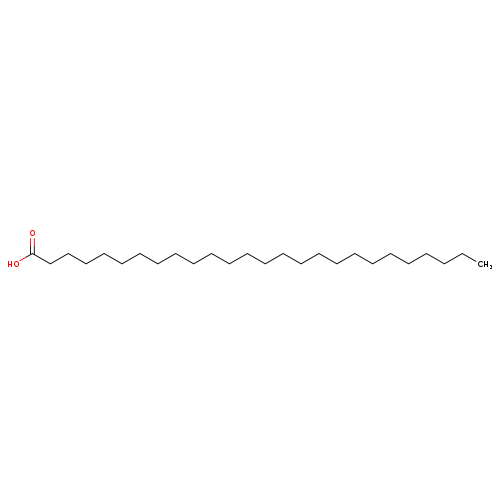
DescriptionHexacosanoic acid, or cerotic acid, is a 26-carbon long-chain saturated fatty acid with the chemical formula CH3(CH2)24COOH. It is most commonly found in beeswax and carnauba wax, and is a white crystalline solid. (Wikipedia) X-linked adrenoleukodystrophy (X-ALD) is a peroxisomal disorder biochemically characterized by the accumulation of very long chain fatty acids (VLCFA), particularly hexacosanoic acid (C(26:0)) and tetracosanoic acid (C(24:0)), in tissues and biological fluids. (1)
Contaminant Sources
  • FooDB Chemicals
  • T3DB toxins
Contaminant Type
  • Animal Toxin
  • Food Toxin
  • Metabolite
  • Natural Compound
  • Organic Compound
Chemical Structure
Thumb
Synonyms
ValueSource
C26:0ChEBI
Ceratinic acidChEBI
Ceric acidChEBI
Cerinic acidChEBI
Cerotic acidChEBI
Cerotinic acidChEBI
Cerylic acidChEBI
CH3-[CH2]24-COOHChEBI
HexacosansaeureChEBI
Hexacosoic acidChEBI
Hexaeicosanoic acidChEBI
N-C26:0ChEBI
N-Hexacosanoic acidChEBI
CeratinateGenerator
CerateGenerator
CerinateGenerator
CerotateGenerator
CerotinateGenerator
CerylateGenerator
HexacosoateGenerator
HexaeicosanoateGenerator
N-HexacosanoateGenerator
HexacosanoateGenerator
Hexacosanoate (N-C26:0)HMDB
Hexacosanoic acidPhytoBank
FA(26:0)PhytoBank
Chemical FormulaC26H52O2
Average Molecular Mass396.690 g/mol
Monoisotopic Mass396.397 g/mol
CAS Registry Number506-46-7
IUPAC Namehexacosanoic acid
Traditional Namehexacosanoic acid
SMILESCCCCCCCCCCCCCCCCCCCCCCCCCC(O)=O
InChI IdentifierInChI=1S/C26H52O2/c1-2-3-4-5-6-7-8-9-10-11-12-13-14-15-16-17-18-19-20-21-22-23-24-25-26(27)28/h2-25H2,1H3,(H,27,28)
InChI KeyXMHIUKTWLZUKEX-UHFFFAOYSA-N
Chemical Taxonomy
Description belongs to the class of organic compounds known as very long-chain fatty acids. These are fatty acids with an aliphatic tail that contains at least 22 carbon atoms.
KingdomOrganic compounds
Super ClassLipids and lipid-like molecules
ClassFatty Acyls
Sub ClassFatty acids and conjugates
Direct ParentVery long-chain fatty acids
Alternative Parents
Substituents
  • Very long-chain fatty acid
  • Straight chain fatty acid
  • Monocarboxylic acid or derivatives
  • Carboxylic acid
  • Carboxylic acid derivative
  • Organic oxygen compound
  • Organic oxide
  • Hydrocarbon derivative
  • Organooxygen compound
  • Carbonyl group
  • Aliphatic acyclic compound
Molecular FrameworkAliphatic acyclic compounds
External Descriptors
Biological Properties
StatusDetected and Not Quantified
OriginEndogenous
Cellular Locations
  • Cytoplasm
  • Extracellular
  • Membrane
Biofluid LocationsNot Available
Tissue Locations
  • Adrenal Gland
  • Fibroblasts
Pathways
NameSMPDB LinkKEGG Link
Beta Oxidation of Very Long Chain Fatty AcidsSMP00052 map01040
Adrenoleukodystrophy, X-linkedSMP00516 Not Available
ApplicationsNot Available
Biological RolesNot Available
Chemical RolesNot Available
Physical Properties
StateSolid
AppearanceWhite crystalline solid.
Experimental Properties
PropertyValue
Melting Point88.5°C
Boiling PointNot Available
SolubilityNot Available
Predicted Properties
PropertyValueSource
Water Solubility1.8e-05 g/LALOGPS
logP9.87ALOGPS
logP10.7ChemAxon
logS-7.3ALOGPS
pKa (Strongest Acidic)4.95ChemAxon
Physiological Charge-1ChemAxon
Hydrogen Acceptor Count2ChemAxon
Hydrogen Donor Count1ChemAxon
Polar Surface Area37.3 ŲChemAxon
Rotatable Bond Count24ChemAxon
Refractivity123.09 m³·mol⁻¹ChemAxon
Polarizability55.83 ųChemAxon
Number of Rings0ChemAxon
Bioavailability0ChemAxon
Rule of FiveNoChemAxon
Ghose FilterNoChemAxon
Veber's RuleNoChemAxon
MDDR-like RuleNoChemAxon
Spectra
Spectra
Spectrum TypeDescriptionSplash KeyView
GC-MSGC-MS Spectrum - GC-MS (1 TMS)splash10-0159-2900100000-dc0324482e5853e76290Spectrum
GC-MSGC-MS Spectrum - GC-MS (Non-derivatized)splash10-0159-2900100000-dc0324482e5853e76290Spectrum
GC-MSGC-MS Spectrum - GC-EI-TOF (Non-derivatized)splash10-0159-1900000000-9d83fa08f63878dd9794Spectrum
Predicted GC-MSPredicted GC-MS Spectrum - GC-MS (Non-derivatized) - 70eV, Positivesplash10-0006-8890000000-a358b076f9e4d3b08976Spectrum
Predicted GC-MSPredicted GC-MS Spectrum - GC-MS (1 TMS) - 70eV, Positivesplash10-0fmr-9550000000-f90d4cc6a83ff8e16245Spectrum
Predicted GC-MSPredicted GC-MS Spectrum - GC-MS (Non-derivatized) - 70eV, PositiveNot AvailableSpectrum
LC-MS/MSLC-MS/MS Spectrum - Quattro_QQQ 10V, Positive (Annotated)splash10-0a4j-0109000000-bc2c74027165503fd92fSpectrum
LC-MS/MSLC-MS/MS Spectrum - Quattro_QQQ 25V, Positive (Annotated)splash10-0pb9-2193000000-cf0ac4a96f99022c7b3aSpectrum
LC-MS/MSLC-MS/MS Spectrum - Quattro_QQQ 40V, Positive (Annotated)splash10-0w30-6096000000-65025824de97c5fb5ff7Spectrum
LC-MS/MSLC-MS/MS Spectrum - n/a 27V, negativesplash10-00lr-0009000000-998e2947790abd467bc7Spectrum
Predicted LC-MS/MSPredicted LC-MS/MS Spectrum - 10V, Positivesplash10-002b-0009000000-bd3c909a0431684b20e7Spectrum
Predicted LC-MS/MSPredicted LC-MS/MS Spectrum - 20V, Positivesplash10-0ug1-3439000000-ca5336c838aa14069626Spectrum
Predicted LC-MS/MSPredicted LC-MS/MS Spectrum - 40V, Positivesplash10-000f-6974000000-93ebd8f603ed3f48dd9dSpectrum
Predicted LC-MS/MSPredicted LC-MS/MS Spectrum - 10V, Negativesplash10-0002-0009000000-50e9c7751bdac41b78c8Spectrum
Predicted LC-MS/MSPredicted LC-MS/MS Spectrum - 20V, Negativesplash10-0f6t-0009000000-fdc9aa019c323235312eSpectrum
Predicted LC-MS/MSPredicted LC-MS/MS Spectrum - 40V, Negativesplash10-0a4l-9113000000-af814ec2317a697df1a0Spectrum
Predicted LC-MS/MSPredicted LC-MS/MS Spectrum - 10V, Negativesplash10-0002-0009000000-87ff11014d638fb7aeddSpectrum
Predicted LC-MS/MSPredicted LC-MS/MS Spectrum - 20V, Negativesplash10-002b-1009000000-28b98f74e9fa6d052c38Spectrum
Predicted LC-MS/MSPredicted LC-MS/MS Spectrum - 40V, Negativesplash10-0006-9003000000-9b4d6e9900769e9411a5Spectrum
Predicted LC-MS/MSPredicted LC-MS/MS Spectrum - 10V, Positivesplash10-002b-2009000000-459e9bac675c0081de3dSpectrum
Predicted LC-MS/MSPredicted LC-MS/MS Spectrum - 20V, Positivesplash10-056s-7039000000-16142145274003e6395dSpectrum
Predicted LC-MS/MSPredicted LC-MS/MS Spectrum - 40V, Positivesplash10-0a4l-9010000000-33f6f730f4cbdee5a975Spectrum
MSMass Spectrum (Electron Ionization)splash10-0597-9201000000-41113a5b904c5db7332dSpectrum
1D NMR1H NMR SpectrumNot AvailableSpectrum
1D NMR13C NMR SpectrumNot AvailableSpectrum
2D NMR[1H,13C] 2D NMR SpectrumNot AvailableSpectrum
Toxicity Profile
Route of ExposureIngestion
Mechanism of ToxicityAdrenoleukodystrophy (ALD) is caused by mutations in ABCD1, a gene located on the X chromosome that codes for ALD, a peroxisomal membrane transporter protein. The exact mechanism of the pathogenesis of the various forms of ALD is not known. Biochemically, individuals with ALD show very high levels of unbranched, saturated, very long chain fatty acids, particularly cerotic acid (26:0). The level of cerotic acid in plasma does not correlate with clinical presentation. (Wikipedia)
MetabolismNot Available
Toxicity ValuesNot Available
Lethal DoseNot Available
Carcinogenicity (IARC Classification)No indication of carcinogenicity to humans (not listed by IARC).
Uses/SourcesHexacosanoic acid is most commonly found in beeswax and carnauba wax (Wikipedia). It is also an endogenously produced metabolite found in the human body.
Minimum Risk LevelNot Available
Health EffectsHexacosanoic acid, or cerotic acid, is associated with adrenoleukodystrophy (also known as X-linked adrenoleukodystrophy, ALD, X-ALD, adrenomyeloneuropathy, AMN, Siemerling–Creutzfeldt disease or bronze Schilder disease) is a disorder of peroxisomal fatty acid beta oxidation which results in the accumulation of very-long chain fatty acids in tissues throughout the body. The most severely affected tissues are the myelin in the central nervous system, the adrenal cortex and the Leydig cells in the testes. (Wikipedia)
SymptomsClinically, adrenoleukodystrophy (ALD) is a heterogenous disorder, presenting with several distinct phenotypes, and no clear pattern of genotype-phenotype correlation. As an X-linked disorder, ALD presents most commonly in males, however approximately 50% of heterozygote females show some symptoms later in life. Approximately two-thirds of ALD patients will present with the childhood cerebral form of the disease, which is the most severe form. It is characterized by normal development in early childhood, followed by rapid degeneration to a vegetative state. The other forms of ALD vary in terms of onset and clinical severity, ranging from adrenal insufficiency to progressive paraparesis in early adulthood (this form of the disease is typically known as adrenomyeloneuropathy). (Wikipedia)
TreatmentTreatment options for adrenoleukodystrophy (ALD) are limited. Dietary treatment is with Lorenzo's oil. For the childhood cerebral form, stem cell transplant and gene therapy are options if the disease is detected early in the clinical course. Adrenal insufficiency in ALD patients can be successfully treated. (Wikipedia)
Concentrations
Not Available
DrugBank IDNot Available
HMDB IDHMDB0002356
FooDB IDFDB004035
Phenol Explorer IDNot Available
KNApSAcK IDC00035114
BiGG ID1459812
BioCyc IDNot Available
METLIN ID6642
PDB IDNot Available
Wikipedia LinkCerotic acid
Chemspider ID10037
ChEBI ID31009
PubChem Compound ID10469
Kegg Compound IDNot Available
YMDB IDYMDB00785
ECMDB IDNot Available
References
Synthesis ReferenceTsuji S; Sano T; Ariga T; Miyatake T Increased synthesis of hexacosanoic acid (C23:0) by cultured skin fibroblasts from patients with adrenoleukodystrophy (ALD) and adrenomyeloneuropathy (AMN). Journal of biochemistry (1981), 90(4), 1233-6.
MSDSLink
General References
1. Tsuji S; Sano T; Ariga T; Miyatake T Increased synthesis of hexacosanoic acid (C23:0) by cultured skin fibroblasts from patients with adrenoleukodystrophy (ALD) and adrenomyeloneuropathy (AMN). Journal of biochemistry (1981), 90(4), 1233-6.
2. Tsuji S; Sano T; Ariga T; Miyatake T Increased synthesis of hexacosanoic acid (C23:0) by cultured skin fibroblasts from patients with adrenoleukodystrophy (ALD) and adrenomyeloneuropathy (AMN). Journal of biochemistry (1981), 90(4), 1233-6.
3. Moser HW, Moser AB, Powers JM, Nitowsky HM, Schaumburg HH, Norum RA, Migeon BR: The prenatal diagnosis of adrenoleukodystrophy. Demonstration of increased hexacosanoic acid levels in cultured amniocytes and fetal adrenal gland. Pediatr Res. 1982 Mar;16(3):172-5.
4. Dhaunsi GS, Kaur J, Alsaeid K, Turner RB, Bitar MS: Very long chain fatty acids activate NADPH oxidase in human dermal fibroblasts. Cell Biochem Funct. 2005 Jan-Feb;23(1):65-8.
5. Deon M, Wajner M, Sirtori LR, Fitarelli D, Coelho DM, Sitta A, Barschak AG, Ferreira GC, Haeser A, Giugliani R, Vargas CR: The effect of Lorenzo's oil on oxidative stress in X-linked adrenoleukodystrophy. J Neurol Sci. 2006 Sep 25;247(2):157-64. Epub 2006 Jun 5.
6. Thiele I, Swainston N, Fleming RM, Hoppe A, Sahoo S, Aurich MK, Haraldsdottir H, Mo ML, Rolfsson O, Stobbe MD, Thorleifsson SG, Agren R, Bolling C, Bordel S, Chavali AK, Dobson P, Dunn WB, Endler L, Hala D, Hucka M, Hull D, Jameson D, Jamshidi N, Jonsson JJ, Juty N, Keating S, Nookaew I, Le Novere N, Malys N, Mazein A, Papin JA, Price ND, Selkov E Sr, Sigurdsson MI, Simeonidis E, Sonnenschein N, Smallbone K, Sorokin A, van Beek JH, Weichart D, Goryanin I, Nielsen J, Westerhoff HV, Kell DB, Mendes P, Palsson BO: A community-driven global reconstruction of human metabolism. Nat Biotechnol. 2013 May;31(5):419-25. doi: 10.1038/nbt.2488. Epub 2013 Mar 3.
7. Brunk E, Sahoo S, Zielinski DC, Altunkaya A, Drager A, Mih N, Gatto F, Nilsson A, Preciat Gonzalez GA, Aurich MK, Prlic A, Sastry A, Danielsdottir AD, Heinken A, Noronha A, Rose PW, Burley SK, Fleming RMT, Nielsen J, Thiele I, Palsson BO: Recon3D enables a three-dimensional view of gene variation in human metabolism. Nat Biotechnol. 2018 Mar;36(3):272-281. doi: 10.1038/nbt.4072. Epub 2018 Feb 19.
8. https://www.ncbi.nlm.nih.gov/pubmed/?term=1911873
9. https://www.ncbi.nlm.nih.gov/pubmed/?term=19135040