Record Information
Version1.0
Creation Date2014-08-29 06:12:53 UTC
Update Date2026-05-14 17:48:44 UTC
Accession NumberCHEM003238
Identification
Common NameDeoxyadenosine triphosphate
ClassSmall Molecule
DescriptionDeoxyadenosine triphosphate (dATP) is a purine nucleoside triphosphate used in cells for DNA synthesis. A nucleoside triphosphate is a molecule type that contains a nucleoside with three phosphates bound to it. dATP contains the sugar deoxyribose, a precursor in DNA synthesis whereby the two existing phosphate groups are cleaved with the remaining deoxyadenosine monophosphate being incorporated into DNA during replication. Due to its enzymatic incorporation into DNA, photoreactive dATP analogs such as N6-[4-azidobenzoyl-(2-aminoethyl)]-2'-deoxyadenosine-5'-triphosphate (AB-dATP) and N6-[4-[3-(trifluoromethyl)-diazirin-3-yl]benzoyl-(2-aminoethyl)]-2'-deoxyadenosine-5'-triphosphate (DB-dATP) have been used for DNA photoaffinity labeling.
Contaminant Sources
  • FooDB Chemicals
  • T3DB toxins
Contaminant Type
  • Amine
  • Animal Toxin
  • Ether
  • Food Toxin
  • Metabolite
  • Natural Compound
  • Organic Compound
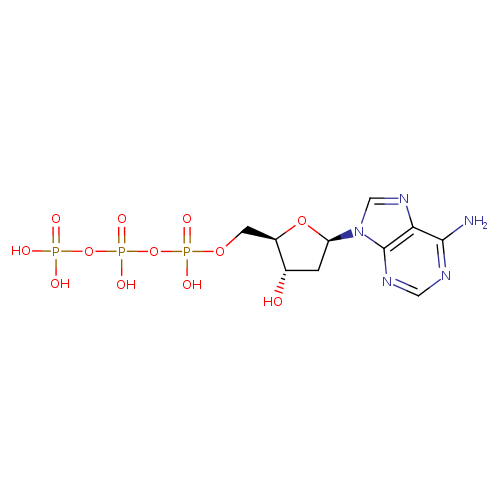
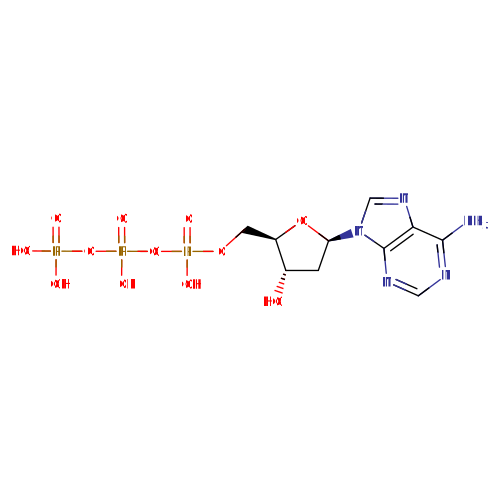
Chemical Structure
Thumb
Synonyms
ValueSource
2'-Deoxyadenosine 5'-triphosphateChEBI
Deoxyadenosine 5'-triphosphateChEBI
2'-Deoxyadenosine 5'-triphosphoric acidGenerator
Deoxyadenosine 5'-triphosphoric acidGenerator
Deoxyadenosine triphosphoric acidGenerator
2'-Deoxy-5'-ATPHMDB
2'-Deoxy-ATPHMDB
2'-Deoxyadenosine triphosphateHMDB
dATPHMDB
Deoxy-ATPHMDB
Deoxyadenosine-triphosphateHMDB
2'-Deoxyadenosine triphosphate, 14C-labeledHMDB
2'-Deoxyadenosine triphosphate, monomagnesium saltHMDB
2'-Deoxyadenosine triphosphate, trisodium saltHMDB
2'-Deoxyadenosine triphosphate, p'-(32)p-labeledHMDB
dATP CPDHMDB
Chemical FormulaC10H16N5O12P3
Average Molecular Mass491.182 g/mol
Monoisotopic Mass491.001 g/mol
CAS Registry Number1927-31-7
IUPAC Name({[({[(2R,3S,5R)-5-(6-amino-9H-purin-9-yl)-3-hydroxyoxolan-2-yl]methoxy}(hydroxy)phosphoryl)oxy](hydroxy)phosphoryl}oxy)phosphonic acid
Traditional NamedATP
SMILESNC1=NC=NC2=C1N=CN2[C@H]1C[C@H](O)[C@@H](COP(O)(=O)OP(O)(=O)OP(O)(O)=O)O1
InChI IdentifierInChI=1S/C10H16N5O12P3/c11-9-8-10(13-3-12-9)15(4-14-8)7-1-5(16)6(25-7)2-24-29(20,21)27-30(22,23)26-28(17,18)19/h3-7,16H,1-2H2,(H,20,21)(H,22,23)(H2,11,12,13)(H2,17,18,19)/t5-,6+,7+/m0/s1
InChI KeySUYVUBYJARFZHO-RRKCRQDMSA-N
Chemical Taxonomy
Description belongs to the class of organic compounds known as purine 2'-deoxyribonucleoside triphosphates. These are purine nucleotides with triphosphate group linked to the ribose moiety lacking a hydroxyl group at position 2.
KingdomOrganic compounds
Super ClassNucleosides, nucleotides, and analogues
ClassPurine nucleotides
Sub ClassPurine deoxyribonucleotides
Direct ParentPurine 2'-deoxyribonucleoside triphosphates
Alternative Parents
Substituents
  • Purine 2'-deoxyribonucleoside triphosphate
  • 6-aminopurine
  • Imidazopyrimidine
  • Purine
  • Aminopyrimidine
  • Monoalkyl phosphate
  • N-substituted imidazole
  • Organic phosphoric acid derivative
  • Phosphoric acid ester
  • Pyrimidine
  • Imidolactam
  • Alkyl phosphate
  • Azole
  • Imidazole
  • Heteroaromatic compound
  • Tetrahydrofuran
  • Secondary alcohol
  • Azacycle
  • Oxacycle
  • Organoheterocyclic compound
  • Organic oxygen compound
  • Primary amine
  • Organooxygen compound
  • Organonitrogen compound
  • Amine
  • Organic nitrogen compound
  • Organic oxide
  • Organopnictogen compound
  • Alcohol
  • Hydrocarbon derivative
  • Aromatic heteropolycyclic compound
Molecular FrameworkAromatic heteropolycyclic compounds
External Descriptors
Biological Properties
StatusDetected and Not Quantified
OriginEndogenous
Cellular Locations
  • Membrane
  • Mitochondria
  • Nucleus
Biofluid LocationsNot Available
Tissue Locations
  • Erythrocyte
  • Lymphocyte
  • T-Lymphocyte
Pathways
NameSMPDB LinkKEGG Link
Purine MetabolismSMP00050 map00230
Adenosine Deaminase DeficiencySMP00144 Not Available
ApplicationsNot Available
Biological RolesNot Available
Chemical RolesNot Available
Physical Properties
StateSolid
AppearanceWhite powder.
Experimental Properties
PropertyValue
Melting PointNot Available
Boiling PointNot Available
SolubilityNot Available
Predicted Properties
PropertyValueSource
Water Solubility3.83 g/LALOGPS
logP-0.66ALOGPS
logP-4.9ChemAxon
logS-2.1ALOGPS
pKa (Strongest Acidic)0.9ChemAxon
pKa (Strongest Basic)4.03ChemAxon
Physiological Charge-3ChemAxon
Hydrogen Acceptor Count13ChemAxon
Hydrogen Donor Count6ChemAxon
Polar Surface Area258.9 ŲChemAxon
Rotatable Bond Count8ChemAxon
Refractivity94.3 m³·mol⁻¹ChemAxon
Polarizability38.06 ųChemAxon
Number of Rings3ChemAxon
Bioavailability0ChemAxon
Rule of FiveNoChemAxon
Ghose FilterNoChemAxon
Veber's RuleNoChemAxon
MDDR-like RuleYesChemAxon
Spectra
Spectra
Spectrum TypeDescriptionSplash KeyView
Predicted GC-MSPredicted GC-MS Spectrum - GC-MS (Non-derivatized) - 70eV, Positivesplash10-002e-9843300000-a8d959008963a6e8a26cSpectrum
Predicted GC-MSPredicted GC-MS Spectrum - GC-MS (1 TMS) - 70eV, Positivesplash10-007p-9218120000-4918f13056a529d12752Spectrum
Predicted GC-MSPredicted GC-MS Spectrum - GC-MS (Non-derivatized) - 70eV, PositiveNot AvailableSpectrum
LC-MS/MSLC-MS/MS Spectrum - Quattro_QQQ 10V, Positive (Annotated)splash10-000f-0800900000-fa3d4e7a131ac1b4c8e7Spectrum
LC-MS/MSLC-MS/MS Spectrum - Quattro_QQQ 25V, Positive (Annotated)splash10-000i-1900000000-91f17c669f5b4e231613Spectrum
LC-MS/MSLC-MS/MS Spectrum - Quattro_QQQ 40V, Positive (Annotated)splash10-000i-2900000000-66cc97431dd4c6ef5edbSpectrum
LC-MS/MSLC-MS/MS Spectrum - 20V, Negativesplash10-0a4r-1914800000-a1027d5e4feaa6e70b54Spectrum
LC-MS/MSLC-MS/MS Spectrum - 10V, Negativesplash10-000i-0100900000-53e4238ba311a2bd32bfSpectrum
LC-MS/MSLC-MS/MS Spectrum - 40V, Negativesplash10-0a6r-5910000000-b8a47704262fccc007c0Spectrum
Predicted LC-MS/MSPredicted LC-MS/MS Spectrum - 10V, Positivesplash10-000i-0911200000-81436267b4eed8c39c3fSpectrum
Predicted LC-MS/MSPredicted LC-MS/MS Spectrum - 20V, Positivesplash10-000i-0900000000-dad0a3294356131635d0Spectrum
Predicted LC-MS/MSPredicted LC-MS/MS Spectrum - 40V, Positivesplash10-000i-1900000000-a1b841f4410b13c0280fSpectrum
Predicted LC-MS/MSPredicted LC-MS/MS Spectrum - 10V, Negativesplash10-000i-0220900000-5fd893f07f0f264099fdSpectrum
Predicted LC-MS/MSPredicted LC-MS/MS Spectrum - 20V, Negativesplash10-003r-5950100000-3901292643e421d47188Spectrum
Predicted LC-MS/MSPredicted LC-MS/MS Spectrum - 40V, Negativesplash10-004i-9200000000-c3a099b6927fdfbe3098Spectrum
Predicted LC-MS/MSPredicted LC-MS/MS Spectrum - 10V, Negativesplash10-000i-0000900000-be4507fb31a2c98dc9edSpectrum
Predicted LC-MS/MSPredicted LC-MS/MS Spectrum - 20V, Negativesplash10-0570-7900600000-3df5f7dd826575e2717fSpectrum
Predicted LC-MS/MSPredicted LC-MS/MS Spectrum - 40V, Negativesplash10-004i-9000000000-e1f5b79920ef4f1ff109Spectrum
Predicted LC-MS/MSPredicted LC-MS/MS Spectrum - 10V, Positivesplash10-000l-0900500000-1ef5399a134e840e1033Spectrum
Predicted LC-MS/MSPredicted LC-MS/MS Spectrum - 20V, Positivesplash10-000i-0900000000-3a76b30592d0f0552de6Spectrum
Predicted LC-MS/MSPredicted LC-MS/MS Spectrum - 40V, Positivesplash10-001c-0921000000-b0230592c2387afe5f4dSpectrum
1D NMR1H NMR SpectrumNot AvailableSpectrum
1D NMR13C NMR SpectrumNot AvailableSpectrum
1D NMR1H NMR SpectrumNot AvailableSpectrum
1D NMR13C NMR SpectrumNot AvailableSpectrum
1D NMR1H NMR SpectrumNot AvailableSpectrum
1D NMR13C NMR SpectrumNot AvailableSpectrum
1D NMR1H NMR SpectrumNot AvailableSpectrum
1D NMR13C NMR SpectrumNot AvailableSpectrum
1D NMR1H NMR SpectrumNot AvailableSpectrum
1D NMR13C NMR SpectrumNot AvailableSpectrum
1D NMR1H NMR SpectrumNot AvailableSpectrum
1D NMR13C NMR SpectrumNot AvailableSpectrum
1D NMR1H NMR SpectrumNot AvailableSpectrum
1D NMR13C NMR SpectrumNot AvailableSpectrum
1D NMR1H NMR SpectrumNot AvailableSpectrum
1D NMR13C NMR SpectrumNot AvailableSpectrum
1D NMR1H NMR SpectrumNot AvailableSpectrum
1D NMR13C NMR SpectrumNot AvailableSpectrum
1D NMR1H NMR SpectrumNot AvailableSpectrum
1D NMR13C NMR SpectrumNot AvailableSpectrum
1D NMR1H NMR SpectrumNot AvailableSpectrum
2D NMR[1H,13C] 2D NMR SpectrumNot AvailableSpectrum
Toxicity Profile
Route of ExposureNot Available
Mechanism of ToxicityNot Available
MetabolismMetabolism of organophosphates occurs principally by oxidation, by hydrolysis via esterases and by reaction with glutathione. Demethylation and glucuronidation may also occur. Oxidation of organophosphorus pesticides may result in moderately toxic products. In general, phosphorothioates are not directly toxic but require oxidative metabolism to the proximal toxin. The glutathione transferase reactions produce products that are, in most cases, of low toxicity. Paraoxonase (PON1) is a key enzyme in the metabolism of organophosphates. PON1 can inactivate some organophosphates through hydrolysis. PON1 hydrolyzes the active metabolites in several organophosphates insecticides as well as, nerve agents such as soman, sarin, and VX. The presence of PON1 polymorphisms causes there to be different enzyme levels and catalytic efficiency of this esterase, which in turn suggests that different individuals may be more susceptible to the toxic effect of organophosphate exposure.
Toxicity ValuesNot Available
Lethal DoseNot Available
Carcinogenicity (IARC Classification)No indication of carcinogenicity to humans (not listed by IARC).
Uses/SourcesThis is an endogenously produced metabolite found in the human body. It is used in metabolic reactions, catabolic reactions or waste generation.
Minimum Risk LevelNot Available
Health EffectsChronically high levels of deoxyadenosine triphosphate are associated with Adenosine Deaminase Deficiency.
SymptomsNot Available
TreatmentNot Available
Concentrations
Not Available
DrugBank IDDB03222
HMDB IDHMDB0001532
FooDB IDFDB022674
Phenol Explorer IDNot Available
KNApSAcK IDNot Available
BiGG ID33969
BioCyc IDDATP
METLIN ID6303
PDB IDNot Available
Wikipedia LinkDeoxyadenosine triphosphate
Chemspider ID15194
ChEBI ID16284
PubChem Compound ID15993
Kegg Compound IDC00131
YMDB IDYMDB00700
ECMDB IDECMDB01532
References
Synthesis ReferenceNot Available
MSDSLink
General References
1. Munch-Petersen, Agnete. Formation in vitro of deoxyadenosine triphosphate from deoxyadenosine in Ehrlich ascites cells. Biochemical and Biophysical Research Communications (1960), 3 392-6.
2. Nespoli L, Porta F, Locatelli F, Aversa F, Carotti A, Lanfranchi A, Gibardi A, Marchesi ME, Abate L, Martelli MF, et al.: Successful lectin-separated bone marrow transplantation in adenosine deaminase deficiency-related severe immunodeficiency. Haematologica. 1990 Nov-Dec;75(6):546-50.
3. Hoffbrand AV, Ganeshaguru K, Hooton JW, Tattersall MH: Effect of iron deficiency and desferrioxamine on DNA synthesis in human cells. Br J Haematol. 1976 Aug;33(4):517-26.
4. Waddell D, Ullman B: Characterization of a cultured human T-cell line with genetically altered ribonucleotide reductase activity. Model for immunodeficiency. J Biol Chem. 1983 Apr 10;258(7):4226-31.
5. Bory C, Boulieu R, Souillet G, Chantin C, Guibaud P, Hershfield MS: Effect of polyethylene glycol-modified adenosine deaminase (PEG-ADA) therapy in two ADA-deficient children: measurement of erythrocyte deoxyadenosine triphosphate as a useful tool. Adv Exp Med Biol. 1991;309A:173-6.
6. Dang-Vu AP, Olsen EA, Vollmer RT, Greenberg ML, Hershfield MS: Treatment of cutaneous T cell lymphoma with 2'-deoxycoformycin (pentostatin). J Am Acad Dermatol. 1988 Oct;19(4):692-8.
7. Donofrio J, Coleman MS, Hutton JJ, Daoud A, Lampkin B, Dyminski J: Overproduction of adenine deoxynucleosides and deoxynucletides in adenosine deaminase deficiency with severe combined immunodeficiency disease. J Clin Invest. 1978 Oct;62(4):884-7.
8. Cowan MJ, Shannon KM, Wara DW, Ammann AJ: Rejection of bone marrow transplant and resistance of alloantigen reactive cells to in vivo deoxyadenosine in adenosine deaminase deficiency. Clin Immunol Immunopathol. 1988 Nov;49(2):242-50.
9. Grever MR, Siaw MF, Jacob WF, Neidhart JA, Miser JS, Coleman MS, Hutton JJ, Balcerzak SP: The biochemical and clinical consequences of 2'-deoxycoformycin in refractory lymphoproliferative malignancy. Blood. 1981 Mar;57(3):406-17.
10. Simmonds HA, Fairbanks LD, Morris GS, Webster DR, Harley EH: Altered erythrocyte nucleotide patterns are characteristic of inherited disorders of purine or pyrimidine metabolism. Clin Chim Acta. 1988 Feb 15;171(2-3):197-210.
11. Hirschhorn R, Roegner V, Rubinstein A, Papageorgiou P: Plasma deoxyadenosine, adenosine, and erythrocyte deoxyATP are elevated at birth in an adenosine deaminase-deficient child. J Clin Invest. 1980 Mar;65(3):768-71.
12. Schmalstieg FC, Mills GC, Tsuda H, Goldman AS: Severe combined immunodeficiency in a child with a healthy adenosine deaminase deficient mother. Pediatr Res. 1983 Dec;17(12):935-40.
13. Simmonds HA, Webster DR, Perrett D, Reiter S, Levinsky RJ: Formation and degradation of deoxyadenosine nucleotides in inherited adenosine deaminase deficiency. Biosci Rep. 1982 May;2(5):303-14.
14. Simmonds HA, Sahota A, Potter CF, Perrett D, Hugh-Jones K, Watson JG: Purine metabolism in adenosine deaminase deficiency. Ciba Found Symp. 1978;(68):255-62.
15. Hirschhorn R, Roegner-Maniscalco V, Kuritsky L, Rosen FS: Bone marrow transplantation only partially restores purine metabolites to normal in adenosine deaminase-deficient patients. J Clin Invest. 1981 Dec;68(6):1387-93.
16. Goday A, Simmonds HA, Webster DR, Levinsky RJ, Watson AR, Hoffbrand AV: Importance of platelet-free preparations for evaluating lymphocyte nucleotide levels in inherited or acquired immunodeficiency syndromes. Clin Sci (Lond). 1983 Dec;65(6):635-43.
17. Chen SH, Ochs HD, Scott CR, Giblett ER, Tingle AJ: Adenosine deaminase deficiency: disappearance of adenine deoxynucleotides from a patient's erythrocytes after successful marrow transplantation. J Clin Invest. 1978 Dec;62(6):1386-9.
18. Gruber HE, Cohen AH, Firestein GS, Redelman D, Bluestein HG: Deoxy-ATP accumulation in adenosine deaminase-inhibited human B and T lymphocytes. Adv Exp Med Biol. 1986;195 Pt A:503-7.
19. Bory C, Boulieu R, Souillet G, Chantin C, Rolland MO, Mathieu M, Hershfield M: Comparison of red cell transfusion and polyethylene glycol-modified adenosine deaminase therapy in an adenosine deaminase-deficient child: measurement of erythrocyte deoxyadenosine triphosphate as a useful tool. Pediatr Res. 1990 Aug;28(2):127-30.
20. Peters GJ, De Abreu RA, Oosterhof A, Veerkamp JH: Concentration of nucleotides and deoxynucleotides in peripheral and phytohemagglutinin-stimulated mammalian lymphocytes. Effects of adenosine and deoxyadenosine. Biochim Biophys Acta. 1983 Aug 23;759(1-2):7-15.
21. Morgan G, Levinsky RJ, Hugh-Jones K, Fairbanks LD, Morris GS, Simmonds HA: Heterogeneity of biochemical, clinical and immunological parameters in severe combined immunodeficiency due to adenosine deaminase deficiency. Clin Exp Immunol. 1987 Dec;70(3):491-9.
22. Zofall M, Bartholomew B: Two novel dATP analogs for DNA photoaffinity labeling. Nucleic Acids Res. 2000 Nov 1;28(21):4382-90.