Record Information
Version1.0
Creation Date2014-08-29 06:09:43 UTC
Update Date2026-04-14 20:14:43 UTC
Accession NumberCHEM003223
Identification
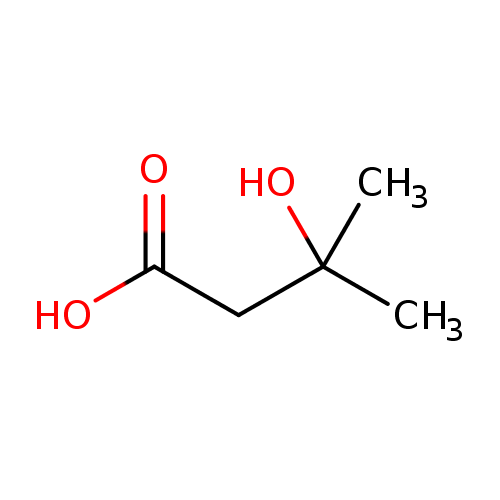
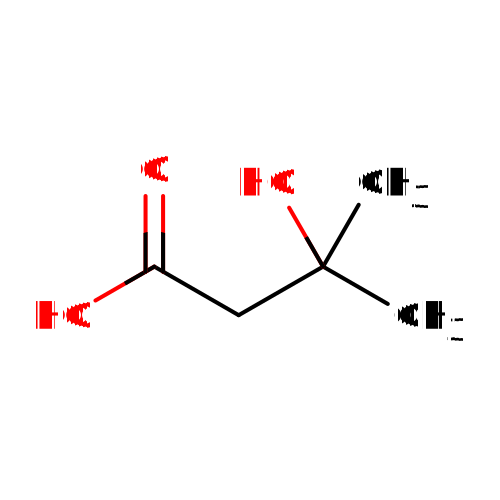
Common Name3-Hydroxyisovaleric acid
ClassSmall Molecule
Description3-Hydroxyisovaleric acid is a normal human metabolite excreted in the urine. Elevated levels of this compound are found in several inherited disorders such as Dihydrolipoamide dehydrogenase Deficiency, 3-Methylcrotonyl-CoA carboxylase 1 deficiency, 3-Hydroxy-3-methylglutaryl-CoA lyase deficiency (3-hydroxy-3-methylglutaryl -CoA lyase Deficiency, Biotinidase deficiency multiple carboxylase deficiency late-onset , Late onset multiple carboxylase deficiency, HolMcarboxylase synthetase deficiency, 3-Methylcrotonyl-CoA carboxylase 2 deficiency. 3-Hydroxyisovaleric acid is also elevated in smokers, in subjects undergoing long-term anticonvulsant therapy with carbamazepine and/or phenytoin. These levels are elevated due to impairment of renal reclamation of biotin. Levels may also be increased from prolonged consumption of raw egg-whites (OMIM: 210210, 253270, 600529, 253260, 246450, 210200, 238331). (1, 2, 3, 4).
Contaminant Sources
  • FooDB Chemicals
  • HMDB Contaminants - Feces
  • HMDB Contaminants - Urine
  • T3DB toxins
Contaminant Type
  • Animal Toxin
  • Food Toxin
  • Metabolite
  • Natural Compound
  • Organic Compound
Chemical Structure
Thumb
Synonyms
ValueSource
3-Hydroxy-3-methylbutyric acidChEBI
3-Hydroxy-isovaleric acidChEBI
3-Methyl-3-hydroxybutyric acidChEBI
3-OH-Isovaleric acidChEBI
beta-Hydroxy-beta-methylbutyric acidChEBI
beta-Hydroxyisovaleric acidChEBI
HMBChEBI
HMB-D6ChEBI
3-Hydroxy-3-methylbutyrateGenerator
3-Hydroxy-isovalerateGenerator
3-Methyl-3-hydroxybutyrateGenerator
3-OH-IsovalerateGenerator
b-Hydroxy-b-methylbutyrateGenerator
b-Hydroxy-b-methylbutyric acidGenerator
beta-Hydroxy-beta-methylbutyrateGenerator
Β-hydroxy-β-methylbutyrateGenerator
Β-hydroxy-β-methylbutyric acidGenerator
b-HydroxyisovalerateGenerator
b-Hydroxyisovaleric acidGenerator
beta-HydroxyisovalerateGenerator
Β-hydroxyisovalerateGenerator
Β-hydroxyisovaleric acidGenerator
3-HydroxyisovalerateGenerator
beta Hydroxy beta methylbutyrateHMDB
beta-Hydroxy beta-methylbutyrateHMDB
3-Hydroxy-3-methyl-butanoateHMDB
3-Hydroxy-3-methyl-butanoic acidHMDB
3-Hydroxy-3-methyl-butyric acidHMDB
3-Hydroxy-3-methylbutanoateHMDB
3-Hydroxy-3-methylbutanoic acidHMDB
3-Hydroxyisovaleric acidMeSH
Chemical FormulaC5H10O3
Average Molecular Mass118.131 g/mol
Monoisotopic Mass118.063 g/mol
CAS Registry Number625-08-1
IUPAC Name3-hydroxy-3-methylbutanoic acid
Traditional Name3-hydroxyisovaleric acid
SMILESCC(C)(O)CC(O)=O
InChI IdentifierInChI=1S/C5H10O3/c1-5(2,8)3-4(6)7/h8H,3H2,1-2H3,(H,6,7)
InChI KeyAXFYFNCPONWUHW-UHFFFAOYSA-N
Chemical Taxonomy
Description belongs to the class of organic compounds known as hydroxy fatty acids. These are fatty acids in which the chain bears a hydroxyl group.
KingdomOrganic compounds
Super ClassLipids and lipid-like molecules
ClassFatty Acyls
Sub ClassFatty acids and conjugates
Direct ParentHydroxy fatty acids
Alternative Parents
Substituents
  • Methyl-branched fatty acid
  • Short-chain hydroxy acid
  • Hydroxy fatty acid
  • Branched fatty acid
  • Tertiary alcohol
  • Monocarboxylic acid or derivatives
  • Carboxylic acid
  • Carboxylic acid derivative
  • Organic oxygen compound
  • Organic oxide
  • Hydrocarbon derivative
  • Organooxygen compound
  • Carbonyl group
  • Alcohol
  • Aliphatic acyclic compound
Molecular FrameworkAliphatic acyclic compounds
External Descriptors
Biological Properties
StatusDetected and Not Quantified
OriginEndogenous
Cellular Locations
  • Cytoplasm
  • Extracellular
Biofluid LocationsNot Available
Tissue Locations
  • Fibroblasts
Pathways
NameSMPDB LinkKEGG Link
3-Hydroxy-3-Methylglutaryl-CoA Lyase DeficiencySMP00138 Not Available
3-Methylglutaconic Aciduria Type ISMP00139 Not Available
Biotinidase DeficiencySMP00174 Not Available
Isovaleric AciduriaSMP00238 Not Available
ApplicationsNot Available
Biological Roles
Chemical RolesNot Available
Physical Properties
StateSolid
AppearanceWhite powder.
Experimental Properties
PropertyValue
Melting Point65 - 67°C
Boiling PointNot Available
SolubilityNot Available
Predicted Properties
PropertyValueSource
Water Solubility384 g/LALOGPS
logP-0.12ALOGPS
logP-0.11ChemAxon
logS0.51ALOGPS
pKa (Strongest Acidic)4.55ChemAxon
pKa (Strongest Basic)-2.7ChemAxon
Physiological Charge-1ChemAxon
Hydrogen Acceptor Count3ChemAxon
Hydrogen Donor Count2ChemAxon
Polar Surface Area57.53 ŲChemAxon
Rotatable Bond Count2ChemAxon
Refractivity28.1 m³·mol⁻¹ChemAxon
Polarizability11.75 ųChemAxon
Number of Rings0ChemAxon
Bioavailability1ChemAxon
Rule of FiveYesChemAxon
Ghose FilterNoChemAxon
Veber's RuleNoChemAxon
MDDR-like RuleNoChemAxon
Spectra
Spectra
Spectrum TypeDescriptionSplash KeyView
GC-MSGC-MS Spectrum - GC-EI-TOF (Pegasus III TOF-MS system, Leco; GC 6890, Agilent Technologies) (Non-derivatized)splash10-000t-0900000000-56f9e1ee9e19bacfc939Spectrum
GC-MSGC-MS Spectrum - GC-EI-TOF (Non-derivatized)splash10-000t-0900000000-56f9e1ee9e19bacfc939Spectrum
Predicted GC-MSPredicted GC-MS Spectrum - GC-MS (Non-derivatized) - 70eV, Positivesplash10-0a4i-9100000000-0809a885d114ba6b21d7Spectrum
Predicted GC-MSPredicted GC-MS Spectrum - GC-MS (2 TMS) - 70eV, Positivesplash10-0089-6910000000-3573bf97996ef7107955Spectrum
Predicted GC-MSPredicted GC-MS Spectrum - GC-MS (Non-derivatized) - 70eV, PositiveNot AvailableSpectrum
Predicted GC-MSPredicted GC-MS Spectrum - GC-MS (TMS_1_1) - 70eV, PositiveNot AvailableSpectrum
Predicted GC-MSPredicted GC-MS Spectrum - GC-MS (TMS_1_2) - 70eV, PositiveNot AvailableSpectrum
Predicted GC-MSPredicted GC-MS Spectrum - GC-MS (TBDMS_1_1) - 70eV, PositiveNot AvailableSpectrum
Predicted GC-MSPredicted GC-MS Spectrum - GC-MS (TBDMS_1_2) - 70eV, PositiveNot AvailableSpectrum
Predicted GC-MSPredicted GC-MS Spectrum - GC-MS (TBDMS_2_1) - 70eV, PositiveNot AvailableSpectrum
LC-MS/MSLC-MS/MS Spectrum - Quattro_QQQ 10V, Positive (Annotated)splash10-0a4i-9300000000-e715db06e575104deccdSpectrum
LC-MS/MSLC-MS/MS Spectrum - Quattro_QQQ 25V, Positive (Annotated)splash10-0a4i-9000000000-885e3d959712c9998250Spectrum
LC-MS/MSLC-MS/MS Spectrum - Quattro_QQQ 40V, Positive (Annotated)splash10-0avi-9800000000-f0296f537bd22b26f173Spectrum
LC-MS/MSLC-MS/MS Spectrum - 35V, Positivesplash10-014i-1900000000-b947237de42eec92a67eSpectrum
LC-MS/MSLC-MS/MS Spectrum - 35V, Negativesplash10-0006-9000000000-1381eacc487b12932a43Spectrum
LC-MS/MSLC-MS/MS Spectrum - 20V, Negativesplash10-00dj-9000000000-f10c5afd9954f294ea91Spectrum
LC-MS/MSLC-MS/MS Spectrum - 10V, Negativesplash10-00xr-9600000000-3b24b27c64b89a6a5b25Spectrum
Predicted LC-MS/MSPredicted LC-MS/MS Spectrum - 10V, Positivesplash10-0ue9-5900000000-2f664d0b967c87e7358cSpectrum
Predicted LC-MS/MSPredicted LC-MS/MS Spectrum - 20V, Positivesplash10-0zn9-9500000000-233e5cd462b504c09d3cSpectrum
Predicted LC-MS/MSPredicted LC-MS/MS Spectrum - 40V, Positivesplash10-0a4i-9000000000-62361f03b7c7a0d82bc4Spectrum
Predicted LC-MS/MSPredicted LC-MS/MS Spectrum - 10V, Negativesplash10-00xr-9400000000-13e4ec512c0fde3123abSpectrum
Predicted LC-MS/MSPredicted LC-MS/MS Spectrum - 20V, Negativesplash10-05tb-9200000000-96c7d7b3f54e7377a875Spectrum
Predicted LC-MS/MSPredicted LC-MS/MS Spectrum - 40V, Negativesplash10-0aba-9000000000-3cc71227974213e131c4Spectrum
Predicted LC-MS/MSPredicted LC-MS/MS Spectrum - 10V, Positivesplash10-0udi-8900000000-a25104a0136877edd57eSpectrum
Predicted LC-MS/MSPredicted LC-MS/MS Spectrum - 20V, Positivesplash10-052f-9000000000-d2d6bcff64e0a706fc95Spectrum
Predicted LC-MS/MSPredicted LC-MS/MS Spectrum - 40V, Positivesplash10-0006-9000000000-65f5183bc669daba34f4Spectrum
Predicted LC-MS/MSPredicted LC-MS/MS Spectrum - 10V, Negativesplash10-00kb-9400000000-9721ad435e43092a072dSpectrum
Predicted LC-MS/MSPredicted LC-MS/MS Spectrum - 20V, Negativesplash10-0a4i-9000000000-13f5bd4a628f51aec810Spectrum
Predicted LC-MS/MSPredicted LC-MS/MS Spectrum - 40V, Negativesplash10-052f-9000000000-0eeab2c474971ae60e7bSpectrum
MSMass Spectrum (Electron Ionization)splash10-052f-9000000000-c15a37ad10e6379350aaSpectrum
1D NMR1H NMR SpectrumNot AvailableSpectrum
1D NMR13C NMR SpectrumNot AvailableSpectrum
1D NMR1H NMR SpectrumNot AvailableSpectrum
1D NMR13C NMR SpectrumNot AvailableSpectrum
1D NMR1H NMR SpectrumNot AvailableSpectrum
1D NMR13C NMR SpectrumNot AvailableSpectrum
1D NMR1H NMR SpectrumNot AvailableSpectrum
1D NMR13C NMR SpectrumNot AvailableSpectrum
1D NMR1H NMR SpectrumNot AvailableSpectrum
1D NMR13C NMR SpectrumNot AvailableSpectrum
1D NMR1H NMR SpectrumNot AvailableSpectrum
1D NMR13C NMR SpectrumNot AvailableSpectrum
1D NMR1H NMR SpectrumNot AvailableSpectrum
1D NMR13C NMR SpectrumNot AvailableSpectrum
1D NMR1H NMR SpectrumNot AvailableSpectrum
1D NMR13C NMR SpectrumNot AvailableSpectrum
1D NMR1H NMR SpectrumNot AvailableSpectrum
1D NMR13C NMR SpectrumNot AvailableSpectrum
1D NMR1H NMR SpectrumNot AvailableSpectrum
1D NMR13C NMR SpectrumNot AvailableSpectrum
1D NMR1H NMR SpectrumNot AvailableSpectrum
2D NMR[1H,13C] 2D NMR SpectrumNot AvailableSpectrum
Toxicity Profile
Route of ExposureNot Available
Mechanism of Toxicity3-Hydroxyisovaleric acid is a normal human metabolite excreted in the urine. Elevated levels of this compound are found in several disorders due to impairment of renal reclamation of biotin. Levels may also be increased from prolonged consumption of raw egg-whites.
MetabolismNot Available
Toxicity ValuesNot Available
Lethal DoseNot Available
Carcinogenicity (IARC Classification)No indication of carcinogenicity to humans (not listed by IARC).
Uses/SourcesThis is an endogenously produced metabolite found in the human body. It is used in metabolic reactions, catabolic reactions or waste generation.
Minimum Risk LevelNot Available
Health EffectsChronically high levels of 3-hydroxyisovaleric acid are associated with at least 4 inborn errors of metabolism including: 3-Hydroxy-3-Methylglutaryl-CoA Lyase Deficiency, 3-Methylglutaconic Aciduria Type I, Biotinidase deficiency and Isovaleric Aciduria.
SymptomsNot Available
TreatmentNot Available
Concentrations
Not Available
DrugBank IDNot Available
HMDB IDHMDB0000754
FooDB IDFDB022225
Phenol Explorer IDNot Available
KNApSAcK IDNot Available
BiGG IDNot Available
BioCyc IDNot Available
METLIN ID5722
PDB IDNot Available
Wikipedia LinkBeta-Hydroxy_beta-methylbutyric_acid
Chemspider ID62571
ChEBI ID37084
PubChem Compound ID69362
Kegg Compound IDNot Available
YMDB IDNot Available
ECMDB IDNot Available
References
Synthesis ReferenceRudney, Harry. Biosynthesis of b-hydroxy-b-methylglutaric acid. Journal of Biological Chemistry (1957), 227 363-77.
MSDSLink
General References
1. https://www.ncbi.nlm.nih.gov/pubmed/?term=12399279
2. https://www.ncbi.nlm.nih.gov/pubmed/?term=22770225
3. https://www.ncbi.nlm.nih.gov/pubmed/?term=9523856
4. Rudney, Harry. Biosynthesis of b-hydroxy-b-methylglutaric acid. Journal of Biological Chemistry (1957), 227 363-77.
5. Amberg A, Rosner E, Dekant W: Biotransformation and kinetics of excretion of tert-amyl-methyl ether in humans and rats after inhalation exposure. Toxicol Sci. 2000 Jun;55(2):274-83.
6. Schurmann M, Engelbrecht V, Lohmeier K, Lenard HG, Wendel U, Gartner J: Cerebral metabolic changes in biotinidase deficiency. J Inherit Metab Dis. 1997 Nov;20(6):755-60.
7. Boulat O, Gradwohl M, Matos V, Guignard JP, Bachmann C: Organic acids in the second morning urine in a healthy Swiss paediatric population. Clin Chem Lab Med. 2003 Dec;41(12):1642-58.
8. Sealey WM, Teague AM, Stratton SL, Mock DM: Smoking accelerates biotin catabolism in women. Am J Clin Nutr. 2004 Oct;80(4):932-5.
9. Guneral F, Bachmann C: Age-related reference values for urinary organic acids in a healthy Turkish pediatric population. Clin Chem. 1994 Jun;40(6):862-6.
10. Jakobs C, Sweetman L, Nyhan WL, Packman S: Stable isotope dilution analysis of 3-hydroxyisovaleric acid in amniotic fluid: contribution to the prenatal diagnosis of inherited disorders of leucine catabolism. J Inherit Metab Dis. 1984;7(1):15-20.
11. Santer R, Muhle H, Suormala T, Baumgartner ER, Duran M, Yang X, Aoki Y, Suzuki Y, Stephani U: Partial response to biotin therapy in a patient with holocarboxylase synthetase deficiency: clinical, biochemical, and molecular genetic aspects. Mol Genet Metab. 2003 Jul;79(3):160-6.
12. Baykal T, Gokcay GH, Ince Z, Dantas MF, Fowler B, Baumgartner MR, Demir F, Can G, Demirkol M: Consanguineous 3-methylcrotonyl-CoA carboxylase deficiency: early-onset necrotizing encephalopathy with lethal outcome. J Inherit Metab Dis. 2005;28(2):229-33.
13. Rodriguez JM, Ruiz-Sala P, Ugarte M, Penalva MA: Fungal metabolic model for 3-methylcrotonyl-CoA carboxylase deficiency. J Biol Chem. 2004 Feb 6;279(6):4578-87. Epub 2003 Nov 11.
14. Stratton SL, Bogusiewicz A, Mock MM, Mock NI, Wells AM, Mock DM: Lymphocyte propionyl-CoA carboxylase and its activation by biotin are sensitive indicators of marginal biotin deficiency in humans. Am J Clin Nutr. 2006 Aug;84(2):384-8.
15. Mock DM, Mock NI, Nelson RP, Lombard KA: Disturbances in biotin metabolism in children undergoing long-term anticonvulsant therapy. J Pediatr Gastroenterol Nutr. 1998 Mar;26(3):245-50.
16. Mock DM, Stadler DD: Conflicting indicators of biotin status from a cross-sectional study of normal pregnancy. J Am Coll Nutr. 1997 Jun;16(3):252-7.
17. Mock DM, Stratton SL, Horvath TD, Bogusiewicz A, Matthews NI, Henrich CL, Dawson AM, Spencer HJ, Owen SN, Boysen G, Moran JH: Urinary excretion of 3-hydroxyisovaleric acid and 3-hydroxyisovaleryl carnitine increases in response to a leucine challenge in marginally biotin-deficient humans. J Nutr. 2011 Nov;141(11):1925-30. doi: 10.3945/jn.111.146126. Epub 2011 Sep 14.
18. Elshenawy S, Pinney SE, Stuart T, Doulias PT, Zura G, Parry S, Elovitz MA, Bennett MJ, Bansal A, Strauss JF 3rd, Ischiropoulos H, Simmons RA: The Metabolomic Signature of the Placenta in Spontaneous Preterm Birth. Int J Mol Sci. 2020 Feb 4;21(3). pii: ijms21031043. doi: 10.3390/ijms21031043.