Record Information
Version1.0
Creation Date2014-08-29 06:09:26 UTC
Update Date2016-11-09 01:09:05 UTC
Accession NumberCHEM003221
Identification
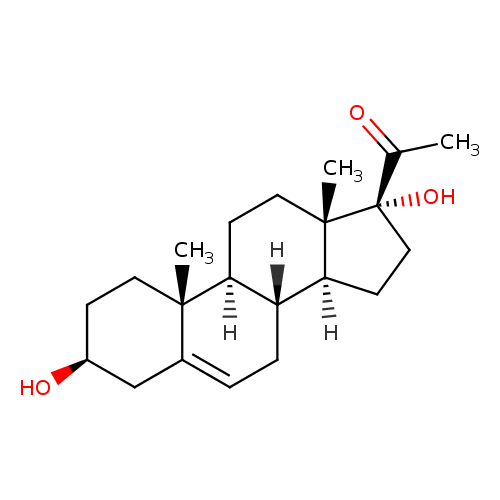
Common Name17a-Hydroxypregnenolone
ClassSmall Molecule
Description17a-Hydroxypregnenolone is a 21-carbon steroid that is converted from pregnenolone by cytochrome P450 17alpha hydroxylase/C17,20 lyase (CYP17, EC 1.14.99.9). 17a-Hydroxypregnenolone is an intermediate in the delta-5 pathway of biosynthesis of gonadal steroid hormones and the adrenal corticosteroids. The first, rate-limiting and hormonally regulated step in the biosynthesis of all steroid hormones is the conversion of cholesterol to pregnenolone. The conversion of cholesterol to pregnenolone is accomplished by the cleavage of the cholesterol side chain, catalyzed by a mitochondrial cytochrome P450 enzyme termed P450scc where scc designates Side Chain Cleavage. All steroid hormones are made from the pregnenolone produced by P450scc; thus, the presence or absence of each of the activities of CYP17 directs this pregnenolone towards its final metabolic pathway. While all cytochrome P450 enzymes can catalyze multiple reactions on a single active site, CYP17 is the only one described to date in which these multiple activities are differentially regulated by a physiologic process. 17a-Hydroxypregnenolone is converted to dehydroepiandrosterone by the 17,20 lyase activity of CYP17. The ratio of the 17,20 lyase to 17 alpha-hydroxylase activity of CYP17 determines the ratio of C21 to C19 steroids produced. This ratio is regulated post-translationally by at least three factors: the abundance of the electron-donating protein P450 oxidoreductase, the presence of cytochrome b5, and the serine phosphorylation of CYP17. (1).
Contaminant Sources
  • FooDB Chemicals
  • T3DB toxins
Contaminant Type
  • Animal Toxin
  • Food Toxin
  • Metabolite
  • Natural Compound
  • Organic Compound
Chemical Structure
Thumb
Synonyms
ValueSource
(3beta)-3,17-Dihydroxypregn-5-en-20-oneChEBI
17-HydroxypregnenoloneChEBI
5-Pregnen-3beta,17alpha-diol-20-oneChEBI
(3b)-3,17-Dihydroxypregn-5-en-20-oneGenerator
(3Β)-3,17-dihydroxypregn-5-en-20-oneGenerator
5-Pregnen-3b,17a-diol-20-oneGenerator
5-Pregnen-3β,17α-diol-20-oneGenerator
17-Hydroxy-D5-pregnenoloneHMDB
17-OH-PregnenoloneHMDB
17a-HydroxypregnoloneHMDB
17alpha-HydroxypregnanoloneHMDB
17alpha-HydroxypregnenoloneHMDB
3b,17-Dihydroxy-5-pregnen-20-oneHMDB
3b,17-Dihydroxy-pregn-5-en-20-oneHMDB
3b,17a-Dihydroxypregn-5-en-20-oneHMDB
17alpha HydroxypregnenoloneHMDB
HydroxypregnenoloneHMDB
17 HydroxypregnenoloneHMDB
17 alpha HydroxypregnenoloneHMDB
17-Hydroxypregnenolone, (3alpha)-isomerHMDB
17-Hydroxypregnenolone, (3beta,13alpha)-isomerHMDB
17-alpha-HydroxypregnenoloneHMDB
17 alpha-HydroxypregnenoloneHMDB
17-Hydroxypregnenolone, (3beta,13alpha,17alpha)-isomerHMDB
17-Hydroxypregnenolone, (3beta,17alpha)-isomerHMDB
Chemical FormulaC21H32O3
Average Molecular Mass332.477 g/mol
Monoisotopic Mass332.235 g/mol
CAS Registry Number387-79-1
IUPAC Name1-[(1S,2R,5S,10R,11S,14R,15S)-5,14-dihydroxy-2,15-dimethyltetracyclo[8.7.0.0^{2,7}.0^{11,15}]heptadec-7-en-14-yl]ethan-1-one
Traditional Name1-[(1S,2R,5S,10R,11S,14R,15S)-5,14-dihydroxy-2,15-dimethyltetracyclo[8.7.0.0^{2,7}.0^{11,15}]heptadec-7-en-14-yl]ethanone
SMILES[H][C@@]12CC[C@](O)(C(C)=O)[C@@]1(C)CC[C@@]1([H])[C@@]2([H])CC=C2C[C@@H](O)CC[C@]12C
InChI IdentifierInChI=1S/C21H32O3/c1-13(22)21(24)11-8-18-16-5-4-14-12-15(23)6-9-19(14,2)17(16)7-10-20(18,21)3/h4,15-18,23-24H,5-12H2,1-3H3/t15-,16+,17-,18-,19-,20-,21-/m0/s1
InChI KeyJERGUCIJOXJXHF-TVWVXWENSA-N
Chemical Taxonomy
Description belongs to the class of organic compounds known as gluco/mineralocorticoids, progestogins and derivatives. These are steroids with a structure based on a hydroxylated prostane moiety.
KingdomOrganic compounds
Super ClassLipids and lipid-like molecules
ClassSteroids and steroid derivatives
Sub ClassPregnane steroids
Direct ParentGluco/mineralocorticoids, progestogins and derivatives
Alternative Parents
Substituents
  • Progestogin-skeleton
  • 20-oxosteroid
  • 3-hydroxy-delta-5-steroid
  • 3-hydroxysteroid
  • 17-hydroxysteroid
  • 3-beta-hydroxysteroid
  • 3-beta-hydroxy-delta-5-steroid
  • Oxosteroid
  • Hydroxysteroid
  • Delta-5-steroid
  • Alpha-hydroxy ketone
  • Tertiary alcohol
  • Cyclic alcohol
  • Secondary alcohol
  • Ketone
  • Organic oxygen compound
  • Organooxygen compound
  • Carbonyl group
  • Hydrocarbon derivative
  • Alcohol
  • Organic oxide
  • Aliphatic homopolycyclic compound
Molecular FrameworkAliphatic homopolycyclic compounds
External Descriptors
Biological Properties
StatusDetected and Not Quantified
OriginEndogenous
Cellular Locations
  • Cytoplasm
  • Endoplasmic reticulum
  • Extracellular
  • Membrane
Biofluid LocationsNot Available
Tissue Locations
  • Adrenal Cortex
  • Testes
Pathways
NameSMPDB LinkKEGG Link
Androgen and Estrogen MetabolismSMP00068 map00150
SteroidogenesisSMP00130 map00140
21-hydroxylase deficiency (CYP21)SMP00576 Not Available
Adrenal Hyperplasia Type 3 or Congenital Adrenal Hyperplasia due to 21-hydroxylase DeficiencySMP00373 Not Available
ApplicationsNot Available
Biological Roles
Chemical RolesNot Available
Physical Properties
StateSolid
AppearanceWhite powder.
Experimental Properties
PropertyValue
Melting Point266 - 271°C
Boiling PointNot Available
SolubilityNot Available
Predicted Properties
PropertyValueSource
Water Solubility0.038 g/LALOGPS
logP3.15ALOGPS
logP2.83ChemAxon
logS-4ALOGPS
pKa (Strongest Acidic)12.7ChemAxon
pKa (Strongest Basic)-1.4ChemAxon
Physiological Charge0ChemAxon
Hydrogen Acceptor Count3ChemAxon
Hydrogen Donor Count2ChemAxon
Polar Surface Area57.53 ŲChemAxon
Rotatable Bond Count1ChemAxon
Refractivity95.16 m³·mol⁻¹ChemAxon
Polarizability38.66 ųChemAxon
Number of Rings4ChemAxon
Bioavailability1ChemAxon
Rule of FiveYesChemAxon
Ghose FilterYesChemAxon
Veber's RuleNoChemAxon
MDDR-like RuleNoChemAxon
Spectra
Spectra
Spectrum TypeDescriptionSplash KeyView
GC-MSGC-MS Spectrum - GC-MS (1 MEOX; 2 TMS)splash10-054x-4900000000-df86d10979d808f20e67Spectrum
GC-MSGC-MS Spectrum - GC-MS (1 MEOX; 2 TMS)splash10-0a73-3910000000-7a0eea991ac4d2fac97eSpectrum
GC-MSGC-MS Spectrum - EI-B (Non-derivatized)splash10-0f89-2891000000-3605ad7dd57f97382115Spectrum
GC-MSGC-MS Spectrum - EI-B (Non-derivatized)splash10-0ff0-3792000000-974e157d4c25e376b004Spectrum
GC-MSGC-MS Spectrum - GC-MS (Non-derivatized)splash10-054x-4900000000-df86d10979d808f20e67Spectrum
GC-MSGC-MS Spectrum - GC-MS (Non-derivatized)splash10-0a73-3910000000-7a0eea991ac4d2fac97eSpectrum
Predicted GC-MSPredicted GC-MS Spectrum - GC-MS (Non-derivatized) - 70eV, Positivesplash10-000f-3295000000-48ed11374901b134a70dSpectrum
Predicted GC-MSPredicted GC-MS Spectrum - GC-MS (2 TMS) - 70eV, Positivesplash10-03di-0111900000-e55e71b4d8c63cde89c2Spectrum
Predicted GC-MSPredicted GC-MS Spectrum - GC-MS (Non-derivatized) - 70eV, PositiveNot AvailableSpectrum
Predicted GC-MSPredicted GC-MS Spectrum - GC-MS (TMS_1_1) - 70eV, PositiveNot AvailableSpectrum
Predicted GC-MSPredicted GC-MS Spectrum - GC-MS (TMS_1_2) - 70eV, PositiveNot AvailableSpectrum
Predicted GC-MSPredicted GC-MS Spectrum - GC-MS (TMS_1_3) - 70eV, PositiveNot AvailableSpectrum
Predicted GC-MSPredicted GC-MS Spectrum - GC-MS (TMS_2_2) - 70eV, PositiveNot AvailableSpectrum
Predicted GC-MSPredicted GC-MS Spectrum - GC-MS (TMS_2_3) - 70eV, PositiveNot AvailableSpectrum
Predicted GC-MSPredicted GC-MS Spectrum - GC-MS (TBDMS_1_1) - 70eV, PositiveNot AvailableSpectrum
Predicted GC-MSPredicted GC-MS Spectrum - GC-MS (TBDMS_1_2) - 70eV, PositiveNot AvailableSpectrum
Predicted GC-MSPredicted GC-MS Spectrum - GC-MS (TBDMS_1_3) - 70eV, PositiveNot AvailableSpectrum
Predicted GC-MSPredicted GC-MS Spectrum - GC-MS (TBDMS_2_1) - 70eV, PositiveNot AvailableSpectrum
Predicted GC-MSPredicted GC-MS Spectrum - GC-MS (TBDMS_2_2) - 70eV, PositiveNot AvailableSpectrum
Predicted GC-MSPredicted GC-MS Spectrum - GC-MS (TBDMS_2_3) - 70eV, PositiveNot AvailableSpectrum
LC-MS/MSLC-MS/MS Spectrum - Quattro_QQQ 10V, Positive (Annotated)splash10-001i-0039000000-28c103ca6cdf072557bfSpectrum
LC-MS/MSLC-MS/MS Spectrum - Quattro_QQQ 25V, Positive (Annotated)splash10-0a4i-0900000000-ae3004bb674d9632cd0cSpectrum
LC-MS/MSLC-MS/MS Spectrum - Quattro_QQQ 40V, Positive (Annotated)splash10-014i-0900000000-a2f467560b451d5c9b0eSpectrum
LC-MS/MSLC-MS/MS Spectrum - EI-B (HITACHI M-52) , Positivesplash10-0f89-2891000000-82e62584fff36943bcbaSpectrum
Predicted LC-MS/MSPredicted LC-MS/MS Spectrum - 10V, Positivesplash10-0159-0029000000-131b75950fb7123106d9Spectrum
Predicted LC-MS/MSPredicted LC-MS/MS Spectrum - 20V, Positivesplash10-015i-0094000000-2a48017855d3965d5626Spectrum
Predicted LC-MS/MSPredicted LC-MS/MS Spectrum - 40V, Positivesplash10-0g29-2690000000-3d1b2b0525a2f6da149cSpectrum
Predicted LC-MS/MSPredicted LC-MS/MS Spectrum - 10V, Negativesplash10-001i-0009000000-4c286aa6d88850e66ba9Spectrum
Predicted LC-MS/MSPredicted LC-MS/MS Spectrum - 20V, Negativesplash10-008i-0098000000-77ce542de402b225ac27Spectrum
Predicted LC-MS/MSPredicted LC-MS/MS Spectrum - 40V, Negativesplash10-0avr-0092000000-e39f57cc01b46a017728Spectrum
Predicted LC-MS/MSPredicted LC-MS/MS Spectrum - 10V, Negativesplash10-001i-0009000000-08a5ce4022cbdbf8bfa1Spectrum
Predicted LC-MS/MSPredicted LC-MS/MS Spectrum - 20V, Negativesplash10-001i-0029000000-8619dcbabe228085742aSpectrum
Predicted LC-MS/MSPredicted LC-MS/MS Spectrum - 40V, Negativesplash10-000i-0091000000-4088584830d78ccb6fb2Spectrum
Predicted LC-MS/MSPredicted LC-MS/MS Spectrum - 10V, Positivesplash10-00lr-0029000000-275368791dddb24379f9Spectrum
Predicted LC-MS/MSPredicted LC-MS/MS Spectrum - 20V, Positivesplash10-014m-0910000000-b08f322c49579d81e79aSpectrum
Predicted LC-MS/MSPredicted LC-MS/MS Spectrum - 40V, Positivesplash10-0002-1940000000-1f423724847a658c9f85Spectrum
1D NMR1H NMR SpectrumNot AvailableSpectrum
2D NMR[1H,13C] 2D NMR SpectrumNot AvailableSpectrum
Toxicity Profile
Route of ExposureNot Available
Mechanism of ToxicityNot Available
MetabolismNot Available
Toxicity ValuesNot Available
Lethal DoseNot Available
Carcinogenicity (IARC Classification)No indication of carcinogenicity to humans (not listed by IARC).
Uses/SourcesThis is an endogenously produced metabolite found in the human body. It is used in metabolic reactions, catabolic reactions or waste generation.
Minimum Risk LevelNot Available
Health EffectsNot Available
SymptomsNot Available
TreatmentNot Available
Concentrations
Not Available
DrugBank IDNot Available
HMDB IDHMDB0000363
FooDB IDFDB021982
Phenol Explorer IDNot Available
KNApSAcK IDNot Available
BiGG ID45199
BioCyc IDCPD66-23
METLIN ID5352
PDB IDNot Available
Wikipedia Link17-Hydroxypregnenolone
Chemspider ID82579
ChEBI ID28750
PubChem Compound ID91451
Kegg Compound IDC05138
YMDB IDNot Available
ECMDB IDNot Available
References
Synthesis ReferenceKaspar, Emanuel; Hiersemann, Wolfgang; Schenck, Martin. Preparation from their esters of steroid alcohols that are sensitive to acids and alkali. (1958), DE 1028572 19580424 CAN 54:74845 AN 1960:74845 CAPLUS
MSDSLink
General References
1. https://www.ncbi.nlm.nih.gov/pubmed/?term=12213889
2. https://www.ncbi.nlm.nih.gov/pubmed/?term=20963882
3. https://www.ncbi.nlm.nih.gov/pubmed/?term=21787799
4. https://www.ncbi.nlm.nih.gov/pubmed/?term=23647561
5. Kaspar, Emanuel; Hiersemann, Wolfgang; Schenck, Martin. Preparation from their esters of steroid alcohols that are sensitive to acids and alkali. (1958), DE 1028572 19580424 CAN 54:74845 AN 1960:74845 CAPLUS
6. Shimozawa K, Saisho S, Yata J, Kambegawa A: Age-related changes in serum 17-hydroxypregnenolone and 17-hydroxypregnenolone sulfate concentrations in human infancy and childhood. Endocrinol Jpn. 1988 Apr;35(2):189-95.
7. Rodriguez-Rigau LJ, Weiss DB, Smith KD, Steinberger E: Suggestion of abnormal testicular steroidogenesis in some oligospermic men. Acta Endocrinol (Copenh). 1978 Feb;87(2):400-12.
8. Kaufman FR, Costin G, Goebelsmann U, Stanczyk FZ, Zachmann M: Male pseudohermaphroditism due to 17,20-desmolase deficiency. J Clin Endocrinol Metab. 1983 Jul;57(1):32-6.
9. Miller WL: Androgen biosynthesis from cholesterol to DHEA. Mol Cell Endocrinol. 2002 Dec 30;198(1-2):7-14.