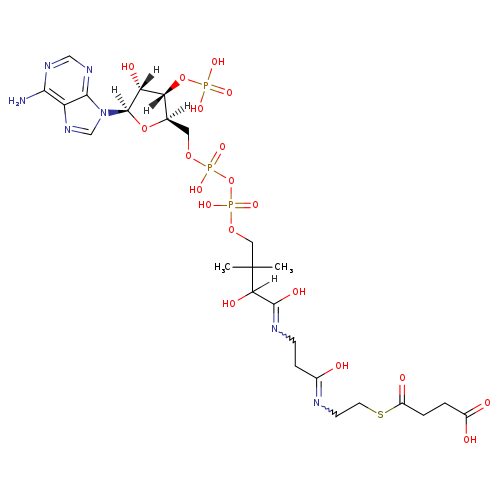
Succinyl-CoA is an important intermediate in the citric acid cycle, where it is synthesized from α-Ketoglutarate by α-ketoglutarate dehydrogenase (EC 1.2.4.2) through decarboxylation, and is converted into succinate through the hydrolytic release of coenzyme A by succinyl-CoA synthetase (EC 6.2.1.5). Succinyl-CoA may be an end product of peroxisomal beta-oxidation of dicarboxylic fatty acids; the identification of an apparently specific succinyl-CoA thioesterase (ACOT4, EC 3.1.2.3, hydrolyzes succinyl-CoA) in peroxisomes strongly suggests that succinyl-CoA is formed in peroxisomes. Acyl-CoA thioesterases (ACOTs) are a family of enzymes that catalyze the hydrolysis of the CoA esters of various lipids to the free acids and coenzyme A, thereby regulating levels of these compounds. (1).
belongs to the class of organic compounds known as acyl coas. These are organic compounds containing a coenzyme A substructure linked to an acyl chain.
Metabolism of organophosphates occurs principally by oxidation, by hydrolysis via esterases and by reaction with glutathione. Demethylation and glucuronidation may also occur. Oxidation of organophosphorus pesticides may result in moderately toxic products. In general, phosphorothioates are not directly toxic but require oxidative metabolism to the proximal toxin. The glutathione transferase reactions produce products that are, in most cases, of low toxicity. Paraoxonase (PON1) is a key enzyme in the metabolism of organophosphates. PON1 can inactivate some organophosphates through hydrolysis. PON1 hydrolyzes the active metabolites in several organophosphates insecticides as well as, nerve agents such as soman, sarin, and VX. The presence of PON1 polymorphisms causes there to be different enzyme levels and catalytic efficiency of this esterase, which in turn suggests that different individuals may be more susceptible to the toxic effect of organophosphate exposure.