Record Information
Version1.0
Creation Date2014-08-29 06:08:10 UTC
Update Date2026-04-06 12:37:34 UTC
Accession NumberCHEM003218
Identification
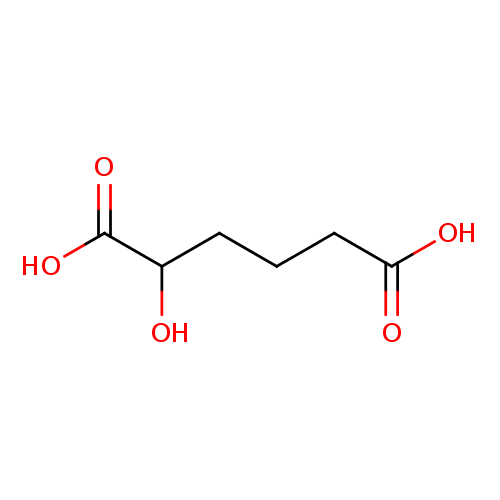
Common Name2-Hydroxyadipic acid
ClassSmall Molecule
Description2-Hydroxyadipic acid is a hydroxy-dicarboxylic acid formed by the reduction of 2-ketoadipic acid. Deficiency of 2-ketoadipic dehydrogenase causes 2-ketoadipic acidemia (OMIM 245130), a condition characterized by accumulation and excretion of 2-hydroxyadipic acid (with 2-ketoadipic and 2-aminoadipic) probably without adverse phenotypic effects.(OMMBID - The Metabolic and Molecular Bases of Inherited Disease, CH.95). A method involving derivatization and combined gas chromatography--mass spectrometry has been recently developed to separate the enantiomers of 3-hydroxyadipic acid It has been shown that 3-hydroxyadipic acid excreted in urine consists of at least 95% of the L-enantiomer. This finding supports the hypothesis that dicarboxylic acids are degraded by ordinary beta-oxidation, and indicates that adipic acid may be converted into succinic acid. (1, 1).
Contaminant Sources
  • FooDB Chemicals
  • HMDB Contaminants - Feces
  • HMDB Contaminants - Urine
  • T3DB toxins
Contaminant Type
  • Animal Toxin
  • Food Toxin
  • Metabolite
  • Natural Compound
  • Organic Compound
Chemical Structure
Thumb
Synonyms
ValueSource
2-HydroxyadipateChEBI
2-Hydroxyhexanedioic acidChEBI
2-HydroxyhexanedioateGenerator
2,3,4-TrideoxyhexarateHMDB
2,3,4-Trideoxyhexaric acidHMDB
2-Hydroxy-adipateHMDB
2-Hydroxy-adipic acidHMDB
2-Hydroxy-hexanedioateHMDB
2-Hydroxy-hexanedioic acidHMDB
a-HydroxyadipateHMDB
a-Hydroxyadipic acidHMDB
alpha-HydroxyadipateHMDB
alpha-Hydroxyadipic acidHMDB
DL-2-HydroxyadipateHMDB
DL-2-Hydroxyadipic acidHMDB
Chemical FormulaC6H10O5
Average Molecular Mass162.141 g/mol
Monoisotopic Mass162.053 g/mol
CAS Registry Number18294-85-4
IUPAC Name2-hydroxyhexanedioic acid
Traditional Nameα-hydroxyadipic acid
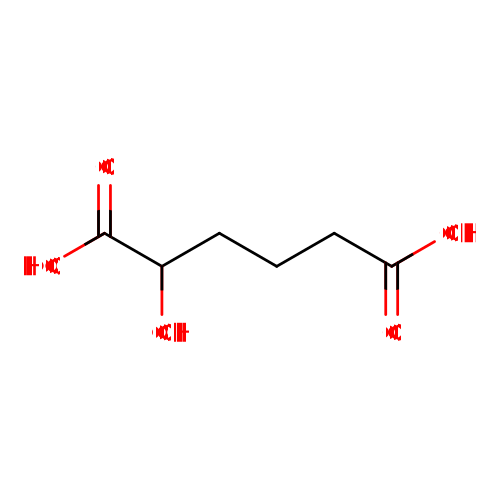
SMILESOC(CCCC(O)=O)C(O)=O
InChI IdentifierInChI=1S/C6H10O5/c7-4(6(10)11)2-1-3-5(8)9/h4,7H,1-3H2,(H,8,9)(H,10,11)
InChI KeyOTTXIFWBPRRYOG-UHFFFAOYSA-N
Chemical Taxonomy
Description belongs to the class of organic compounds known as medium-chain fatty acids. These are fatty acids with an aliphatic tail that contains between 4 and 12 carbon atoms.
KingdomOrganic compounds
Super ClassLipids and lipid-like molecules
ClassFatty Acyls
Sub ClassFatty acids and conjugates
Direct ParentMedium-chain fatty acids
Alternative Parents
Substituents
  • Medium-chain fatty acid
  • Hydroxy fatty acid
  • Monosaccharide
  • Hydroxy acid
  • Dicarboxylic acid or derivatives
  • Alpha-hydroxy acid
  • Secondary alcohol
  • Carboxylic acid
  • Carboxylic acid derivative
  • Hydrocarbon derivative
  • Organic oxygen compound
  • Organooxygen compound
  • Alcohol
  • Carbonyl group
  • Organic oxide
  • Aliphatic acyclic compound
Molecular FrameworkAliphatic acyclic compounds
External Descriptors
Biological Properties
StatusDetected and Not Quantified
OriginEndogenous
Cellular Locations
  • Cytoplasm
  • Extracellular
Biofluid LocationsNot Available
Tissue LocationsNot Available
Pathways
NameSMPDB LinkKEGG Link
2-aminoadipic 2-oxoadipic aciduriaSMP00719 Not Available
ApplicationsNot Available
Biological RolesNot Available
Chemical RolesNot Available
Physical Properties
StateSolid
AppearanceWhite powder.
Experimental Properties
PropertyValue
Melting PointNot Available
Boiling PointNot Available
SolubilityNot Available
Predicted Properties
PropertyValueSource
Water Solubility70.3 g/LALOGPS
logP-0.79ALOGPS
logP-0.38ChemAxon
logS-0.36ALOGPS
pKa (Strongest Acidic)3.44ChemAxon
pKa (Strongest Basic)-3.8ChemAxon
Physiological Charge-2ChemAxon
Hydrogen Acceptor Count5ChemAxon
Hydrogen Donor Count3ChemAxon
Polar Surface Area94.83 ŲChemAxon
Rotatable Bond Count5ChemAxon
Refractivity34.23 m³·mol⁻¹ChemAxon
Polarizability14.88 ųChemAxon
Number of Rings0ChemAxon
Bioavailability1ChemAxon
Rule of FiveYesChemAxon
Ghose FilterNoChemAxon
Veber's RuleNoChemAxon
MDDR-like RuleNoChemAxon
Spectra
Spectra
Spectrum TypeDescriptionSplash KeyView
GC-MSGC-MS Spectrum - GC-MS (3 TMS)splash10-00c0-2920000000-14e371ab410997076c08Spectrum
GC-MSGC-MS Spectrum - GC-MS (Non-derivatized)splash10-00c0-2920000000-14e371ab410997076c08Spectrum
Predicted GC-MSPredicted GC-MS Spectrum - GC-MS (Non-derivatized) - 70eV, Positivesplash10-00xu-9200000000-a5e63603281ceddefa05Spectrum
Predicted GC-MSPredicted GC-MS Spectrum - GC-MS (3 TMS) - 70eV, Positivesplash10-01w0-9273000000-da104d83dee59e6410a4Spectrum
Predicted GC-MSPredicted GC-MS Spectrum - GC-MS (Non-derivatized) - 70eV, PositiveNot AvailableSpectrum
Predicted GC-MSPredicted GC-MS Spectrum - GC-MS (TMS_1_1) - 70eV, PositiveNot AvailableSpectrum
Predicted GC-MSPredicted GC-MS Spectrum - GC-MS (TMS_1_2) - 70eV, PositiveNot AvailableSpectrum
Predicted GC-MSPredicted GC-MS Spectrum - GC-MS (TMS_1_3) - 70eV, PositiveNot AvailableSpectrum
Predicted GC-MSPredicted GC-MS Spectrum - GC-MS (TMS_2_1) - 70eV, PositiveNot AvailableSpectrum
Predicted GC-MSPredicted GC-MS Spectrum - GC-MS (TMS_2_2) - 70eV, PositiveNot AvailableSpectrum
Predicted GC-MSPredicted GC-MS Spectrum - GC-MS (TMS_2_3) - 70eV, PositiveNot AvailableSpectrum
Predicted GC-MSPredicted GC-MS Spectrum - GC-MS (TBDMS_1_1) - 70eV, PositiveNot AvailableSpectrum
Predicted GC-MSPredicted GC-MS Spectrum - GC-MS (TBDMS_1_2) - 70eV, PositiveNot AvailableSpectrum
Predicted GC-MSPredicted GC-MS Spectrum - GC-MS (TBDMS_1_3) - 70eV, PositiveNot AvailableSpectrum
Predicted GC-MSPredicted GC-MS Spectrum - GC-MS (TBDMS_2_1) - 70eV, PositiveNot AvailableSpectrum
Predicted GC-MSPredicted GC-MS Spectrum - GC-MS (TBDMS_2_2) - 70eV, PositiveNot AvailableSpectrum
Predicted GC-MSPredicted GC-MS Spectrum - GC-MS (TBDMS_2_3) - 70eV, PositiveNot AvailableSpectrum
Predicted GC-MSPredicted GC-MS Spectrum - GC-MS (TBDMS_3_1) - 70eV, PositiveNot AvailableSpectrum
LC-MS/MSLC-MS/MS Spectrum - Quattro_QQQ 10V, Negative (Annotated)splash10-03di-2900000000-00b8bf461ba454c702f9Spectrum
LC-MS/MSLC-MS/MS Spectrum - Quattro_QQQ 25V, Negative (Annotated)splash10-0ab9-9000000000-cbfcbe2f1e74c7fa8544Spectrum
LC-MS/MSLC-MS/MS Spectrum - Quattro_QQQ 40V, Negative (Annotated)splash10-052f-9000000000-1a3f1223d56568a37ca5Spectrum
LC-MS/MSLC-MS/MS Spectrum - 10V, Negativesplash10-03di-3900000000-2f9a1134097c3e464cfaSpectrum
LC-MS/MSLC-MS/MS Spectrum - 40V, Negativesplash10-0a4i-9000000000-38b55b37770b02b19786Spectrum
LC-MS/MSLC-MS/MS Spectrum - 20V, Negativesplash10-0600-9200000000-2e8f145f65b692f6de62Spectrum
Predicted LC-MS/MSPredicted LC-MS/MS Spectrum - 10V, Positivesplash10-0002-1900000000-c97aa5c57fc34910b084Spectrum
Predicted LC-MS/MSPredicted LC-MS/MS Spectrum - 20V, Positivesplash10-00kb-9800000000-8b422e7bd31b7715f936Spectrum
Predicted LC-MS/MSPredicted LC-MS/MS Spectrum - 40V, Positivesplash10-0596-9000000000-145898d967788e6a4370Spectrum
Predicted LC-MS/MSPredicted LC-MS/MS Spectrum - 10V, Negativesplash10-03dl-0900000000-b8d680487ea735b08660Spectrum
Predicted LC-MS/MSPredicted LC-MS/MS Spectrum - 20V, Negativesplash10-014m-5900000000-2748f3664e3329b9721bSpectrum
Predicted LC-MS/MSPredicted LC-MS/MS Spectrum - 40V, Negativesplash10-0aba-9000000000-7bd0454dd4e607bf327dSpectrum
Predicted LC-MS/MSPredicted LC-MS/MS Spectrum - 10V, Positivesplash10-002b-7900000000-ffa4a95821301025a0c9Spectrum
Predicted LC-MS/MSPredicted LC-MS/MS Spectrum - 20V, Positivesplash10-05fs-9200000000-91faff169b9ab7ca25fbSpectrum
Predicted LC-MS/MSPredicted LC-MS/MS Spectrum - 40V, Positivesplash10-0a4l-9000000000-f90638e9886a94d83928Spectrum
Predicted LC-MS/MSPredicted LC-MS/MS Spectrum - 10V, Negativesplash10-0007-5900000000-6ce0e78d81edfe6486c2Spectrum
Predicted LC-MS/MSPredicted LC-MS/MS Spectrum - 20V, Negativesplash10-00kb-9500000000-e93f435014ff8c6374e9Spectrum
Predicted LC-MS/MSPredicted LC-MS/MS Spectrum - 40V, Negativesplash10-0007-9000000000-af7c0163f8f183203d48Spectrum
1D NMR1H NMR SpectrumNot AvailableSpectrum
1D NMR13C NMR SpectrumNot AvailableSpectrum
1D NMR1H NMR SpectrumNot AvailableSpectrum
1D NMR13C NMR SpectrumNot AvailableSpectrum
1D NMR1H NMR SpectrumNot AvailableSpectrum
1D NMR13C NMR SpectrumNot AvailableSpectrum
1D NMR1H NMR SpectrumNot AvailableSpectrum
1D NMR13C NMR SpectrumNot AvailableSpectrum
1D NMR1H NMR SpectrumNot AvailableSpectrum
1D NMR13C NMR SpectrumNot AvailableSpectrum
1D NMR1H NMR SpectrumNot AvailableSpectrum
1D NMR13C NMR SpectrumNot AvailableSpectrum
1D NMR1H NMR SpectrumNot AvailableSpectrum
1D NMR13C NMR SpectrumNot AvailableSpectrum
1D NMR1H NMR SpectrumNot AvailableSpectrum
1D NMR13C NMR SpectrumNot AvailableSpectrum
1D NMR1H NMR SpectrumNot AvailableSpectrum
1D NMR13C NMR SpectrumNot AvailableSpectrum
1D NMR1H NMR SpectrumNot AvailableSpectrum
1D NMR13C NMR SpectrumNot AvailableSpectrum
1D NMR1H NMR SpectrumNot AvailableSpectrum
2D NMR[1H,13C] 2D NMR SpectrumNot AvailableSpectrum
Toxicity Profile
Route of ExposureNot Available
Mechanism of Toxicity2-Hydroxyadipic acid is a hydroxy-dicarboxylic acid formed by the reduction of 2-ketoadipic acid. Deficiency of 2-ketoadipic dehydrogenase causes 2-ketoadipic acidemia, a condition characterized by accumulation and excretion of 2-hydroxyadipic acid (with 2-ketoadipic and 2-aminoadipic) probably without adverse phenotypic effects.
MetabolismNot Available
Toxicity ValuesNot Available
Lethal DoseNot Available
Carcinogenicity (IARC Classification)No indication of carcinogenicity to humans (not listed by IARC).
Uses/SourcesThis is an endogenously produced metabolite found in the human body. It is used in metabolic reactions, catabolic reactions or waste generation.
Minimum Risk LevelNot Available
Health EffectsChronically high levels of 2-hydroxyadipic acid are associated with at least 2 inborn errors of metabolism including: : 2-aminoadipic and 2-oxoadipic aciduria.
SymptomsNot Available
TreatmentNot Available
Concentrations
Not Available
DrugBank IDNot Available
HMDB IDHMDB0000321
FooDB IDFDB021947
Phenol Explorer IDNot Available
KNApSAcK IDNot Available
BiGG IDNot Available
BioCyc IDNot Available
METLIN ID5310
PDB IDNot Available
Wikipedia LinkNot Available
Chemspider ID167943
ChEBI ID17023
PubChem Compound ID193530
Kegg Compound IDC02360
YMDB IDNot Available
ECMDB IDNot Available
References
Synthesis ReferenceGriot, Rudolf. a-Hydroxyadipic acid. Helvetica Chimica Acta (1958), 41 2236-41.
MSDSNot Available
General References
1. Griot, Rudolf. a-Hydroxyadipic acid. Helvetica Chimica Acta (1958), 41 2236-41.
2. Sewell AC, Heil M, Podebrad F, Mosandl A: Chiral compounds in metabolism: a look in the molecular mirror. Eur J Pediatr. 1998 Mar;157(3):185-91.
3. Guneral F, Bachmann C: Age-related reference values for urinary organic acids in a healthy Turkish pediatric population. Clin Chem. 1994 Jun;40(6):862-6.
4. Inoue Y, Shinka T, Ohse M, Kuhara T: Differential chemical diagnosis of primary hyperoxaluria type II. Highly sensitive analysis of optical isomers of glyceric acid by GC/MS as diastereoisomeric derivatives. J Chromatogr B Analyt Technol Biomed Life Sci. 2005 Aug 25;823(1):2-6. Epub 2005 Apr 25.
5. Svendsen JS, Whist JE, Sydnes LK: Absolute configuration of 3-hydroxyadipic acid in human urine. J Chromatogr. 1985 Jan 11;337(1):9-19.
6. Elshenawy S, Pinney SE, Stuart T, Doulias PT, Zura G, Parry S, Elovitz MA, Bennett MJ, Bansal A, Strauss JF 3rd, Ischiropoulos H, Simmons RA: The Metabolomic Signature of the Placenta in Spontaneous Preterm Birth. Int J Mol Sci. 2020 Feb 4;21(3). pii: ijms21031043. doi: 10.3390/ijms21031043.