Record Information
Version1.0
Creation Date2014-08-29 06:07:34 UTC
Update Date2026-04-06 14:06:17 UTC
Accession NumberCHEM003214
Identification
Common Name2-Ethylhydracrylic acid
ClassSmall Molecule
DescriptionIsolated excretion of 2-Ethylhydracrylic acid (2-methylbutyrylglycine; 2-MBG) is the hallmark of short/branched-chain acyl-CoA dehydrogenase deficiency (SBCADD), a defect in the proximal pathway of L-isoleucine oxidation Normal human urine contains small amounts (less than 4 mg/g of creatinine) of 2-ethylhydracrylic acid. Urinary excretion of 2-ethylhydracrylic acid is variably increased in defects of isoleucine oxidation at distal steps in the catabolic pathway (3-oxoacyl-CoA thiolase deficiency and methylmalonyl-CoA mutase deficiency) and is diminished when proximal steps of the oxidative pathway are blocked as in branched-chain oxo acid decarboxylase deficiency ('maple-syrup-urine' disease). (1, 2).
Contaminant Sources
  • FooDB Chemicals
  • HMDB Contaminants - Urine
  • T3DB toxins
Contaminant Type
  • Animal Toxin
  • Food Toxin
  • Metabolite
  • Natural Compound
  • Organic Compound
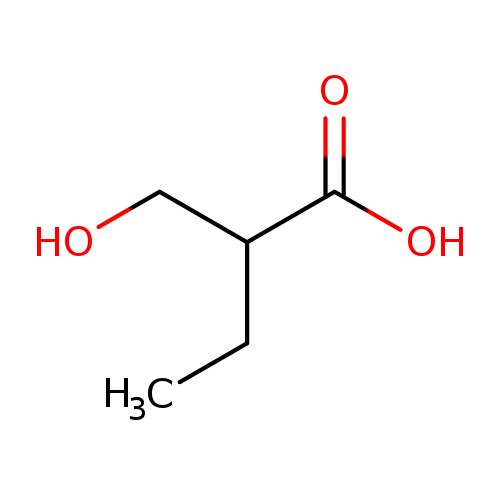
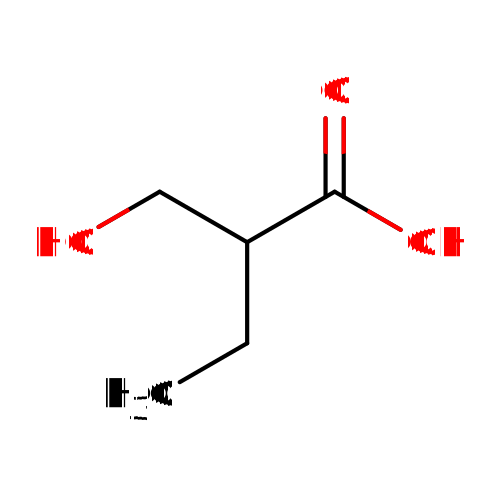
Chemical Structure
Thumb
Synonyms
ValueSource
2-(Hydroxymethyl)-butyric acidChEBI
3-Hydroxy-2-ethylpropanoic acidChEBI
beta-Hydroxy-alpha-ethylpropionic acidChEBI
2-(Hydroxymethyl)-butyrateGenerator
3-Hydroxy-2-ethylpropanoateGenerator
b-Hydroxy-a-ethylpropionateGenerator
b-Hydroxy-a-ethylpropionic acidGenerator
beta-Hydroxy-alpha-ethylpropionateGenerator
Β-hydroxy-α-ethylpropionateGenerator
Β-hydroxy-α-ethylpropionic acidGenerator
2-EthylhydracrylateGenerator
2-(Hydroxymethyl)butyrateHMDB
2-(Hydroxymethyl)butyric acidHMDB
2-Ethyl-3-hydroxypropionateHMDB
2-Ethyl-3-hydroxypropionic acidHMDB
3-Hydroxy-2-ethylpropionateHMDB
3-Hydroxy-2-ethylpropionic acidHMDB
3-Hydroxy-propionic acid ethyl esterHMDB
2-Ethyl-hydracrylateHMDB
2-Ethylhydracrylic acidMeSH
Chemical FormulaC5H10O3
Average Molecular Mass118.131 g/mol
Monoisotopic Mass118.063 g/mol
CAS Registry Number4374-62-3
IUPAC NameNot Available
Traditional Name2-ethylhydracrylic acid
SMILESCCC(CO)C(O)=O
InChI IdentifierInChI=1S/C5H10O3/c1-2-4(3-6)5(7)8/h4,6H,2-3H2,1H3,(H,7,8)
InChI KeyZMZQVAUJTDKQGE-UHFFFAOYSA-N
Chemical Taxonomy
Description belongs to the class of organic compounds known as hydroxy fatty acids. These are fatty acids in which the chain bears a hydroxyl group.
KingdomOrganic compounds
Super ClassLipids and lipid-like molecules
ClassFatty Acyls
Sub ClassFatty acids and conjugates
Direct ParentHydroxy fatty acids
Alternative Parents
Substituents
  • Hydroxy fatty acid
  • Branched fatty acid
  • Beta-hydroxy acid
  • Hydroxy acid
  • Monocarboxylic acid or derivatives
  • Carboxylic acid
  • Carboxylic acid derivative
  • Organic oxygen compound
  • Organic oxide
  • Hydrocarbon derivative
  • Primary alcohol
  • Organooxygen compound
  • Carbonyl group
  • Alcohol
  • Aliphatic acyclic compound
Molecular FrameworkAliphatic acyclic compounds
External Descriptors
Biological Properties
StatusDetected and Not Quantified
OriginEndogenous
Cellular Locations
  • Cytoplasm
  • Extracellular
Biofluid LocationsNot Available
Tissue LocationsNot Available
Pathways
NameSMPDB LinkKEGG Link
2-Methyl-3-Hydroxybutryl CoA Dehydrogenase DeficiencySMP00137 Not Available
ApplicationsNot Available
Biological RolesNot Available
Chemical RolesNot Available
Physical Properties
StateSolid
AppearanceWhite powder.
Experimental Properties
PropertyValue
Melting PointNot Available
Boiling PointNot Available
SolubilityNot Available
Predicted Properties
PropertyValueSource
Water Solubility387 g/LALOGPS
logP0.03ALOGPS
logP0.18ChemAxon
logS0.52ALOGPS
pKa (Strongest Acidic)4.51ChemAxon
pKa (Strongest Basic)-2.7ChemAxon
Physiological Charge-1ChemAxon
Hydrogen Acceptor Count3ChemAxon
Hydrogen Donor Count2ChemAxon
Polar Surface Area57.53 ŲChemAxon
Rotatable Bond Count3ChemAxon
Refractivity28.22 m³·mol⁻¹ChemAxon
Polarizability11.9 ųChemAxon
Number of Rings0ChemAxon
Bioavailability1ChemAxon
Rule of FiveYesChemAxon
Ghose FilterNoChemAxon
Veber's RuleNoChemAxon
MDDR-like RuleNoChemAxon
Spectra
Spectra
Spectrum TypeDescriptionSplash KeyView
Predicted GC-MSPredicted GC-MS Spectrum - GC-MS (Non-derivatized) - 70eV, Positivesplash10-00fr-9100000000-59a6eea0d0e7113fac3bSpectrum
Predicted GC-MSPredicted GC-MS Spectrum - GC-MS (2 TMS) - 70eV, Positivesplash10-00ds-9520000000-fe0d3d2aa8e758f26b61Spectrum
Predicted GC-MSPredicted GC-MS Spectrum - GC-MS (Non-derivatized) - 70eV, PositiveNot AvailableSpectrum
Predicted GC-MSPredicted GC-MS Spectrum - GC-MS (TMS_1_1) - 70eV, PositiveNot AvailableSpectrum
Predicted GC-MSPredicted GC-MS Spectrum - GC-MS (TMS_1_2) - 70eV, PositiveNot AvailableSpectrum
Predicted GC-MSPredicted GC-MS Spectrum - GC-MS (TBDMS_1_1) - 70eV, PositiveNot AvailableSpectrum
Predicted GC-MSPredicted GC-MS Spectrum - GC-MS (TBDMS_1_2) - 70eV, PositiveNot AvailableSpectrum
Predicted GC-MSPredicted GC-MS Spectrum - GC-MS (TBDMS_2_1) - 70eV, PositiveNot AvailableSpectrum
LC-MS/MSLC-MS/MS Spectrum - 40V, Negativesplash10-0006-9000000000-d329b2816688175f0721Spectrum
LC-MS/MSLC-MS/MS Spectrum - 10V, Negativesplash10-000i-9000000000-22531cd4192cb58bffc8Spectrum
LC-MS/MSLC-MS/MS Spectrum - 20V, Negativesplash10-000i-9000000000-28513bb053ccf9cda074Spectrum
Predicted LC-MS/MSPredicted LC-MS/MS Spectrum - 10V, Positivesplash10-0uxr-3900000000-f4f29b39d6efac6dea03Spectrum
Predicted LC-MS/MSPredicted LC-MS/MS Spectrum - 20V, Positivesplash10-0zfr-9500000000-033bb7e1b24d83c3260eSpectrum
Predicted LC-MS/MSPredicted LC-MS/MS Spectrum - 40V, Positivesplash10-0a4i-9000000000-f9809158ef0031b0966eSpectrum
Predicted LC-MS/MSPredicted LC-MS/MS Spectrum - 10V, Negativesplash10-014i-7900000000-2b7594fdf2745541476dSpectrum
Predicted LC-MS/MSPredicted LC-MS/MS Spectrum - 20V, Negativesplash10-00rl-9000000000-15a1a560605b3560b3c5Spectrum
Predicted LC-MS/MSPredicted LC-MS/MS Spectrum - 40V, Negativesplash10-0006-9000000000-e23602be1497f191e28fSpectrum
Predicted LC-MS/MSPredicted LC-MS/MS Spectrum - 10V, Positivesplash10-0lk9-8900000000-7d190d86968d376f371fSpectrum
Predicted LC-MS/MSPredicted LC-MS/MS Spectrum - 20V, Positivesplash10-0ab9-9000000000-d13a71b7a126b5b4db40Spectrum
Predicted LC-MS/MSPredicted LC-MS/MS Spectrum - 40V, Positivesplash10-0a4i-9000000000-187afb47dc1fef8de486Spectrum
Predicted LC-MS/MSPredicted LC-MS/MS Spectrum - 10V, Negativesplash10-014i-7900000000-9c57f47a79d94aa41b40Spectrum
Predicted LC-MS/MSPredicted LC-MS/MS Spectrum - 20V, Negativesplash10-00xs-9000000000-7eb9835e7021f42ca784Spectrum
Predicted LC-MS/MSPredicted LC-MS/MS Spectrum - 40V, Negativesplash10-014l-9000000000-ebe207f16b68bd130a7cSpectrum
Toxicity Profile
Route of ExposureNot Available
Mechanism of ToxicityNot Available
MetabolismNot Available
Toxicity ValuesNot Available
Lethal DoseNot Available
Carcinogenicity (IARC Classification)No indication of carcinogenicity to humans (not listed by IARC).
Uses/SourcesThis is an endogenously produced metabolite found in the human body. It is used in metabolic reactions, catabolic reactions or waste generation.
Minimum Risk LevelNot Available
Health EffectsNot Available
SymptomsNot Available
TreatmentNot Available
Concentrations
Not Available
DrugBank IDNot Available
HMDB IDHMDB0000396
FooDB IDFDB022014
Phenol Explorer IDNot Available
KNApSAcK IDNot Available
BiGG IDNot Available
BioCyc IDNot Available
METLIN ID3785
PDB IDNot Available
Wikipedia LinkNot Available
Chemspider ID164207
ChEBI ID82956
PubChem Compound ID188979
Kegg Compound IDNot Available
YMDB IDNot Available
ECMDB IDNot Available
References
Synthesis ReferencePrice, Charles C.; Cypher, George A.; Krishnamurti, I. V. Thermal reaction of formaldehyde with allyl cyanide. Journal of the American Chemical Society (1952), 74 2987-91.
MSDSNot Available
General References
1. https://www.ncbi.nlm.nih.gov/pubmed/?term=1016232
2. https://www.ncbi.nlm.nih.gov/pubmed/?term=15615815
3. https://www.ncbi.nlm.nih.gov/pubmed/?term=4458986
4. https://www.ncbi.nlm.nih.gov/pubmed/?term=759179
5. Price, Charles C.; Cypher, George A.; Krishnamurti, I. V. Thermal reaction of formaldehyde with allyl cyanide. Journal of the American Chemical Society (1952), 74 2987-91.
6. Mamer OA, Tjoa SS, Scriver CR, Klassen GA: Demonstration of a new mammalian isoleucine catabolic pathway yielding an Rseries of metabolites. Biochem J. 1976 Dec 15;160(3):417-26.
7. Guneral F, Bachmann C: Age-related reference values for urinary organic acids in a healthy Turkish pediatric population. Clin Chem. 1994 Jun;40(6):862-6.
8. Ohdoi C, Nyhan WL, Kuhara T: Chemical diagnosis of Lesch-Nyhan syndrome using gas chromatography-mass spectrometry detection. J Chromatogr B Analyt Technol Biomed Life Sci. 2003 Jul 15;792(1):123-30.
9. Korman SH, Andresen BS, Zeharia A, Gutman A, Boneh A, Pitt JJ: 2-ethylhydracrylic aciduria in short/branched-chain acyl-CoA dehydrogenase deficiency: application to diagnosis and implications for the R-pathway of isoleucine oxidation. Clin Chem. 2005 Mar;51(3):610-7. Epub 2004 Dec 22.