Record Information
Version1.0
Creation Date2014-08-29 06:03:49 UTC
Update Date2026-04-06 11:40:09 UTC
Accession NumberCHEM003211
Identification
Common NameD-2-Hydroxyglutaric acid
ClassSmall Molecule
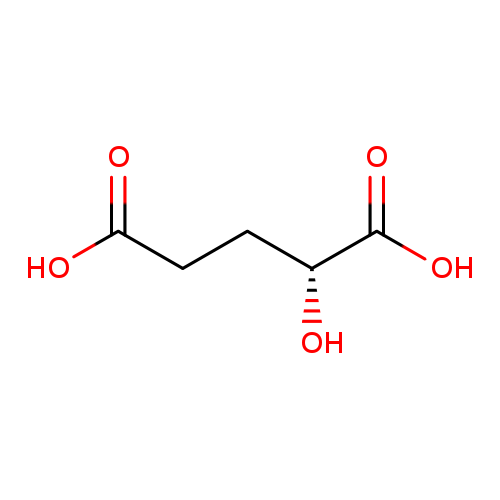
DescriptionD-2-Hydroxyglutaric acid is an alpha hydroxy acid. In humans the compound is formed by a hydroxyacid-oxoacid transhydrogenase whereas in bacteria is formed by a 2-hydroxyglutarate synthase. D-2-Hydroxyglutarate is also formed via the normal activity of hydroxyacid-oxoacid transhydrogenase during conversion of 4-hydroxybutyrate to succinate semialdehyde. The compound can be converted to α-ketoglutaric acid through the action of a 2-hydroxyglutarate dehydrogenase. In humans, there are two such enzymes called D2HGDH and L2HGDH. Tissue accumulation of high amounts of D-2-hydroxyglutaric acid is the biochemical hallmark of the inherited neurometabolic disorder D-2-hydroxyglutaric aciduria. Both the D and the L stereoisomers of hydroxyglutaric acid (EC 1.1.99.2) are found in body fluids. Accumulation of L-2-hydroxyglutaric acid has been reported in multiple patients who have a clinical phenotype of progressive neurodegeneration with extrapyramidal and cerebellar signs, seizures, and spongiform changes in the white matter. Patients who have excess accumulation of D-2-hydroxyglutaric acid in the urine exhibit a variable phenotype but included mental retardation, macrocephaly with cerebral atrophy, hypotonia, seizures, and involuntary movements. D-2-hydroxyglutarate mediates its neurotoxicity through activation of N-methyl-D-aspartate receptors. D-2-hydroxyglutarate is structurally similar to the excitatory amino acid glutamate and stimulates neurodegeneration by mechanisms well-known for glutamate, NMDA or mitochondrial toxins (9)
Contaminant Sources
  • FooDB Chemicals
  • HMDB Contaminants - Feces
  • HMDB Contaminants - Urine
  • T3DB toxins
Contaminant Type
  • Animal Toxin
  • Food Toxin
  • Metabolite
  • Natural Compound
  • Organic Compound
Chemical Structure
Thumb
Synonyms
ValueSource
(R)-2-HydroxyglutarateChEBI
(R)-HydroxyglutarateChEBI
(R)-2-Hydroxyglutaric acidGenerator
(R)-Hydroxyglutaric acidGenerator
D-2-HydroxyglutarateGenerator
(R)-2-Hydroxy-pentanedioateHMDB
(R)-2-Hydroxy-pentanedioic acidHMDB
(R)-a-HydroxyglutarateHMDB
(R)-a-Hydroxyglutaric acidHMDB
(R)-alpha-HydroxyglutarateHMDB
(R)-alpha-Hydroxyglutaric acidHMDB
2-Hydroxy-D-glutarateHMDB
2-Hydroxy-D-glutaric acidHMDB
2-Hydroxy-delta-glutarateHMDB
2-Hydroxy-delta-glutaric acidHMDB
D-a-HydroxyglutarateHMDB
D-a-Hydroxyglutaric acidHMDB
delta-2-HydroxyglutarateHMDB
delta-2-Hydroxyglutaric acidHMDB
delta-alpha-HydroxyglutarateHMDB
delta-alpha-Hydroxyglutaric acidHMDB
2-HydroxyglutarateHMDB
alpha-Hydroxyglutarate, (D)-isomerHMDB
alpha-Hydroxyglutarate, (DL)-isomerHMDB
2-Hydroxyglutaric acidHMDB
alpha-HydroxyglutarateHMDB
alpha-Hydroxyglutarate, (L)-isomerHMDB
alpha-Hydroxyglutarate, disodium saltHMDB
Chemical FormulaC5H8O5
Average Molecular Mass148.114 g/mol
Monoisotopic Mass148.037 g/mol
CAS Registry Number2889-31-8
IUPAC Name(2R)-2-hydroxypentanedioic acid
Traditional NameD-2-hydroxyglutaric acid
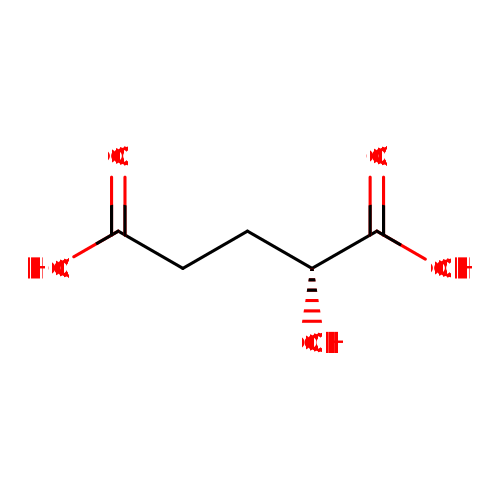
SMILESO[C@H](CCC(O)=O)C(O)=O
InChI IdentifierInChI=1S/C5H8O5/c6-3(5(9)10)1-2-4(7)8/h3,6H,1-2H2,(H,7,8)(H,9,10)/t3-/m1/s1
InChI KeyHWXBTNAVRSUOJR-GSVOUGTGSA-N
Chemical Taxonomy
Description belongs to the class of organic compounds known as short-chain hydroxy acids and derivatives. These are hydroxy acids with an alkyl chain the contains less than 6 carbon atoms.
KingdomOrganic compounds
Super ClassOrganic acids and derivatives
ClassHydroxy acids and derivatives
Sub ClassShort-chain hydroxy acids and derivatives
Direct ParentShort-chain hydroxy acids and derivatives
Alternative Parents
Substituents
  • Short-chain hydroxy acid
  • Fatty acid
  • Monosaccharide
  • Dicarboxylic acid or derivatives
  • Alpha-hydroxy acid
  • Secondary alcohol
  • Carboxylic acid
  • Carboxylic acid derivative
  • Organic oxygen compound
  • Organic oxide
  • Hydrocarbon derivative
  • Organooxygen compound
  • Carbonyl group
  • Alcohol
  • Aliphatic acyclic compound
Molecular FrameworkAliphatic acyclic compounds
External Descriptors
Biological Properties
StatusDetected and Not Quantified
OriginEndogenous
Cellular Locations
  • Cytoplasm
  • Extracellular
Biofluid LocationsNot Available
Tissue LocationsNot Available
Pathways
NameSMPDB LinkKEGG Link
2-Hydroxyglutric Aciduria (D And L Form)SMP00136 Not Available
ApplicationsNot Available
Biological Roles
Chemical RolesNot Available
Physical Properties
StateSolid
AppearanceWhite powder.
Experimental Properties
PropertyValue
Melting Point> 300°C
Boiling PointNot Available
SolubilityNot Available
Predicted Properties
PropertyValueSource
Water Solubility157 g/LALOGPS
logP-1ALOGPS
logP-0.82ChemAxon
logS0.03ALOGPS
pKa (Strongest Acidic)3.28ChemAxon
pKa (Strongest Basic)-3.8ChemAxon
Physiological Charge-2ChemAxon
Hydrogen Acceptor Count5ChemAxon
Hydrogen Donor Count3ChemAxon
Polar Surface Area94.83 ŲChemAxon
Rotatable Bond Count4ChemAxon
Refractivity29.63 m³·mol⁻¹ChemAxon
Polarizability12.97 ųChemAxon
Number of Rings0ChemAxon
Bioavailability1ChemAxon
Rule of FiveYesChemAxon
Ghose FilterNoChemAxon
Veber's RuleNoChemAxon
MDDR-like RuleNoChemAxon
Spectra
Spectra
Spectrum TypeDescriptionSplash KeyView
Predicted GC-MSPredicted GC-MS Spectrum - GC-MS (Non-derivatized) - 70eV, Positivesplash10-0zgl-9300000000-805667744aba36281cecSpectrum
Predicted GC-MSPredicted GC-MS Spectrum - GC-MS (3 TMS) - 70eV, Positivesplash10-00gv-8191000000-f6fdffd87ffe1acf65b4Spectrum
Predicted GC-MSPredicted GC-MS Spectrum - GC-MS (Non-derivatized) - 70eV, PositiveNot AvailableSpectrum
Predicted GC-MSPredicted GC-MS Spectrum - GC-MS (TMS_1_1) - 70eV, PositiveNot AvailableSpectrum
Predicted GC-MSPredicted GC-MS Spectrum - GC-MS (TMS_1_2) - 70eV, PositiveNot AvailableSpectrum
Predicted GC-MSPredicted GC-MS Spectrum - GC-MS (TMS_1_3) - 70eV, PositiveNot AvailableSpectrum
Predicted GC-MSPredicted GC-MS Spectrum - GC-MS (TMS_2_1) - 70eV, PositiveNot AvailableSpectrum
Predicted GC-MSPredicted GC-MS Spectrum - GC-MS (TMS_2_2) - 70eV, PositiveNot AvailableSpectrum
Predicted GC-MSPredicted GC-MS Spectrum - GC-MS (TMS_2_3) - 70eV, PositiveNot AvailableSpectrum
Predicted GC-MSPredicted GC-MS Spectrum - GC-MS (TBDMS_1_1) - 70eV, PositiveNot AvailableSpectrum
Predicted GC-MSPredicted GC-MS Spectrum - GC-MS (TBDMS_1_2) - 70eV, PositiveNot AvailableSpectrum
Predicted GC-MSPredicted GC-MS Spectrum - GC-MS (TBDMS_1_3) - 70eV, PositiveNot AvailableSpectrum
Predicted GC-MSPredicted GC-MS Spectrum - GC-MS (TBDMS_2_1) - 70eV, PositiveNot AvailableSpectrum
Predicted GC-MSPredicted GC-MS Spectrum - GC-MS (TBDMS_2_2) - 70eV, PositiveNot AvailableSpectrum
Predicted GC-MSPredicted GC-MS Spectrum - GC-MS (TBDMS_2_3) - 70eV, PositiveNot AvailableSpectrum
Predicted GC-MSPredicted GC-MS Spectrum - GC-MS (TBDMS_3_1) - 70eV, PositiveNot AvailableSpectrum
Predicted LC-MS/MSPredicted LC-MS/MS Spectrum - 10V, Positivesplash10-001j-1900000000-dbf80fc2b86ec60d623eSpectrum
Predicted LC-MS/MSPredicted LC-MS/MS Spectrum - 20V, Positivesplash10-0m5r-9600000000-d1bc7ce2206164b5bc2cSpectrum
Predicted LC-MS/MSPredicted LC-MS/MS Spectrum - 40V, Positivesplash10-0a4i-9000000000-df3e77cb42d6f7647a64Spectrum
Predicted LC-MS/MSPredicted LC-MS/MS Spectrum - 10V, Negativesplash10-0002-1900000000-095c1140772d4cdd149bSpectrum
Predicted LC-MS/MSPredicted LC-MS/MS Spectrum - 20V, Negativesplash10-0zfr-7900000000-ce158ac5b56eff867735Spectrum
Predicted LC-MS/MSPredicted LC-MS/MS Spectrum - 40V, Negativesplash10-0a4i-9000000000-e30760384709aa978986Spectrum
Predicted LC-MS/MSPredicted LC-MS/MS Spectrum - 10V, Negativesplash10-0fbi-3900000000-f88fcf3ac0dd06636b16Spectrum
Predicted LC-MS/MSPredicted LC-MS/MS Spectrum - 20V, Negativesplash10-0k9i-9400000000-31bf8d3bb7203e7bf200Spectrum
Predicted LC-MS/MSPredicted LC-MS/MS Spectrum - 40V, Negativesplash10-0a4u-9000000000-c0ac45c4d66178ac20cfSpectrum
Predicted LC-MS/MSPredicted LC-MS/MS Spectrum - 10V, Positivesplash10-0w39-4900000000-1385b471f7cdf14ca14dSpectrum
Predicted LC-MS/MSPredicted LC-MS/MS Spectrum - 20V, Positivesplash10-052r-9500000000-17ece6956644d4cf2069Spectrum
Predicted LC-MS/MSPredicted LC-MS/MS Spectrum - 40V, Positivesplash10-0a4r-9000000000-dbb4195080bddb5f6210Spectrum
1D NMR13C NMR SpectrumNot AvailableSpectrum
1D NMR1H NMR SpectrumNot AvailableSpectrum
1D NMR13C NMR SpectrumNot AvailableSpectrum
1D NMR1H NMR SpectrumNot AvailableSpectrum
1D NMR13C NMR SpectrumNot AvailableSpectrum
1D NMR1H NMR SpectrumNot AvailableSpectrum
1D NMR13C NMR SpectrumNot AvailableSpectrum
1D NMR1H NMR SpectrumNot AvailableSpectrum
1D NMR13C NMR SpectrumNot AvailableSpectrum
1D NMR1H NMR SpectrumNot AvailableSpectrum
1D NMR13C NMR SpectrumNot AvailableSpectrum
1D NMR1H NMR SpectrumNot AvailableSpectrum
1D NMR13C NMR SpectrumNot AvailableSpectrum
1D NMR1H NMR SpectrumNot AvailableSpectrum
1D NMR13C NMR SpectrumNot AvailableSpectrum
1D NMR1H NMR SpectrumNot AvailableSpectrum
1D NMR13C NMR SpectrumNot AvailableSpectrum
1D NMR1H NMR SpectrumNot AvailableSpectrum
1D NMR13C NMR SpectrumNot AvailableSpectrum
1D NMR1H NMR SpectrumNot AvailableSpectrum
Toxicity Profile
Route of ExposureEndogenous, Ingestion
Mechanism of Toxicity2-hydroxyglutarate is an oncometabolite. It is a competitive inhibitor of multiple α-ketoglutarate-dependent dioxygenases, including histone demethylases and the TET family of 5-methlycytosine (5mC) hydroxylases. As a result, high levels of 2-hydroxyglutarate lead to genome-wide histone and DNA methylation alterations, which in turn lead to mutations that ultimately cause cancer. High L-2-Hydroxyglutarate levels are associated with gliomas and acute myeloid leukemia. L-2-Hydroxyglutarate can reversibly promote leukemogenesis in vitro. D-2-hydroxyglutarate mediates its neurotoxicity through activation of N-methyl-D-aspartate receptors. D-2-hydroxyglutarate is structurally similar to the excitatory amino acid glutamate and stimulates neurodegeneration by mechanisms well-known for glutamate, NMDA or mitochondrial toxins (9).
Metabolism2-hydroxyglutarate can be converted to α-ketoglutaric acid through the action of a 2-hydroxyglutarate dehydrogenase.
Toxicity ValuesNot Available
Lethal DoseNot Available
Carcinogenicity (IARC Classification)Not listed by IARC. Has been implicated in oncogenesis (8, 7, 6).
Uses/SourcesNot Available
Minimum Risk LevelNot Available
Health EffectsHigh 2-Hydroxyglutarate levels are associated with gliomas and acute myeloid leukemia. L-2-Hydroxyglutarate can reversibly promote leukemogenesis in vitro. Chronically high levels of L-2-hydroxyglutaric acid are associated with the inborn error of metabolism called: D-2-Hydroxyglutaric Aciduria. The D form is rare, with symptoms including macrocephaly, cardiomyopathy, mental retardation, hypotonia, and cortical blindness.
SymptomsSymptoms of chronic exposure to D-2-Hydroxyglutarate include macrocephaly, cardiomyopathy, mental retardation, hypotonia, and cortical blindness.
TreatmentNot Available
Concentrations
Not Available
DrugBank IDNot Available
HMDB IDHMDB0000606
FooDB IDFDB022139
Phenol Explorer IDNot Available
KNApSAcK IDNot Available
BiGG IDNot Available
BioCyc IDR-2-HYDROXYGLUTARATE
METLIN ID5581
PDB IDNot Available
Wikipedia LinkAlpha-Hydroxyglutaric acid
Chemspider ID388508
ChEBI ID32796
PubChem Compound ID439391
Kegg Compound IDC01087
YMDB IDNot Available
ECMDB IDM2MDB005531
References
Synthesis ReferenceKobayashi, Hidehiko; Yamaguchi, Koretaka; Yamashita, Takeshi. a-Hydroxyglutaric acid from glutamic acid. Jpn. Tokkyo Koho (1968), 3 pp.
MSDSLink
General References
1. Kobayashi, Hidehiko; Yamaguchi, Koretaka; Yamashita, Takeshi. a-Hydroxyglutaric acid from glutamic acid. Jpn. Tokkyo Koho (1968), 3 pp.
2. Gibson KM, ten Brink HJ, Schor DS, Kok RM, Bootsma AH, Hoffmann GF, Jakobs C: Stable-isotope dilution analysis of D- and L-2-hydroxyglutaric acid: application to the detection and prenatal diagnosis of D- and L-2-hydroxyglutaric acidemias. Pediatr Res. 1993 Sep;34(3):277-80.
3. van der Knaap MS, Jakobs C, Hoffmann GF, Nyhan WL, Renier WO, Smeitink JA, Catsman-Berrevoets CE, Hjalmarson O, Vallance H, Sugita K, Bowe CM, Herrin JT, Craigen WJ, Buist NR, Brookfield DS, Chalmers RA: D-2-Hydroxyglutaric aciduria: biochemical marker or clinical disease entity? Ann Neurol. 1999 Jan;45(1):111-9.
4. Rashed MS, AlAmoudi M, Aboul-Enein HY: Chiral liquid chromatography tandem mass spectrometry in the determination of the configuration of 2-hydroxyglutaric acid in urine. Biomed Chromatogr. 2000 Aug;14(5):317-20.
5. da Silva CG, Bueno AR, Schuck PF, Leipnitz G, Ribeiro CA, Wannmacher CM, Wyse AT, Wajner M: D-2-hydroxyglutaric acid inhibits creatine kinase activity from cardiac and skeletal muscle of young rats. Eur J Clin Invest. 2003 Oct;33(10):840-7.
6. Clarke NF, Andrews I, Carpenter K, Jakobs C, van der Knaap MS, Kirk EP: D-2-hydroxyglutaric aciduria: a case with an intermediate phenotype and prenatal diagnosis of two affected fetuses. Am J Med Genet A. 2003 Aug 1;120A(4):523-7.
7. Collins RRJ, Patel K, Putnam WC, Kapur P, Rakheja D: Oncometabolites: A New Paradigm for Oncology, Metabolism, and the Clinical Laboratory. Clin Chem. 2017 Dec;63(12):1812-1820. doi: 10.1373/clinchem.2016.267666. Epub 2017 Oct 16.
8. Kolker S, Pawlak V, Ahlemeyer B, Okun JG, Horster F, Mayatepek E, Krieglstein J, Hoffmann GF, Kohr G: NMDA receptor activation and respiratory chain complex V inhibition contribute to neurodegeneration in d-2-hydroxyglutaric aciduria. Eur J Neurosci. 2002 Jul;16(1):21-8.
9. Elshenawy S, Pinney SE, Stuart T, Doulias PT, Zura G, Parry S, Elovitz MA, Bennett MJ, Bansal A, Strauss JF 3rd, Ischiropoulos H, Simmons RA: The Metabolomic Signature of the Placenta in Spontaneous Preterm Birth. Int J Mol Sci. 2020 Feb 4;21(3). pii: ijms21031043. doi: 10.3390/ijms21031043.