Record Information
Version1.0
Creation Date2014-08-29 06:02:56 UTC
Update Date2026-05-14 17:46:18 UTC
Accession NumberCHEM003206
Identification
Common NamePregnenolone
ClassSmall Molecule
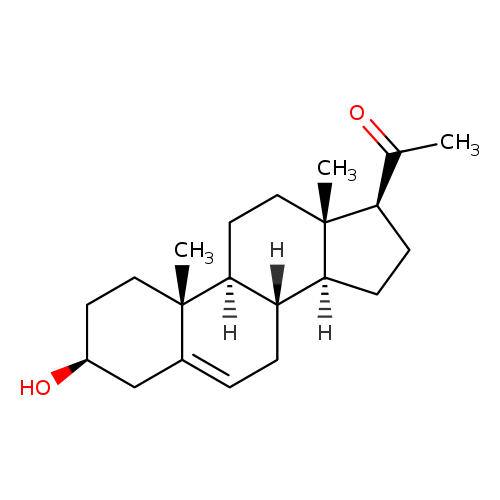
DescriptionPregnenolone is a derivative of cholesterol, the product of Cytochrome P450 side-chain cleavage (EC 1.14.15.6, CYP11A1); this reaction consists of three consecutive monooxygenations; a 22-hydroxylation, 20-hydroxylation and the cleavage of the C20-C22 bond, yielding pregnenolone. Pregnenolone is the precursor to gonadal steroid hormones and the adrenal corticosteroids. This reaction occurs in steroid hormone-producing tissues such as the adrenal cortex, corpus luteum and placenta. The most notable difference between the placenta and other steroidogenic tissues is that electron supply to CYP11A1 limits the rate at which cholesterol is converted to pregnenolone in the placenta. The limiting component for electron delivery to CYP11A1 is the concentration of adrenodoxin reductase in the mitochondrial matrix which is insufficient to maintain the adrenodoxin pool in a fully reduced state. Pregnenolone is also a neurosteroid, and is produced in the spinal cord; CYP11A1 is the key enzyme catalyzing the conversion of cholesterol into pregnenolone, the rate-limiting step in the biosynthesis of all classes of steroids, and has been localized in sensory networks of the spinal cord dorsal horn. In the adrenal glomerulosa cell angiotensin II, one of the major physiological regulators of mineralocorticoid synthesis, appears to affect most of the cholesterol transfer to the mitochondrial outer membrane and transport to the inner membrane steps and thus to exerts a powerful control over the use of cholesterol for aldosterone production. (1, 2, 3, 4).
Contaminant Sources
  • FooDB Chemicals
  • T3DB toxins
  • ToxCast & Tox21 Chemicals
Contaminant Type
  • Animal Toxin
  • Food Toxin
  • Industrial/Workplace Toxin
  • Metabolite
  • Natural Compound
  • Organic Compound
Chemical Structure
Thumb
Synonyms
ValueSource
(3BETA)-3-HYDROXYPREGN-5-en-20-oneChEBI
3beta-Hydroxypregn-5-en-20-oneChEBI
5-Pregnen-3beta-ol-20-oneChEBI
(3b)-3-HYDROXYPREGN-5-en-20-oneGenerator
(3Β)-3-hydroxypregn-5-en-20-oneGenerator
3b-Hydroxypregn-5-en-20-oneGenerator
3Β-hydroxypregn-5-en-20-oneGenerator
5-Pregnen-3b-ol-20-oneGenerator
5-Pregnen-3β-ol-20-oneGenerator
5-Pregnen-3-beta-ol-20-oneHMDB
5 Pregnen 3 beta ol 20 oneHMDB
Chemical FormulaC21H32O2
Average Molecular Mass316.478 g/mol
Monoisotopic Mass316.240 g/mol
CAS Registry Number145-13-1
IUPAC Name1-[(1S,3aS,3bS,7S,9aR,9bS,11aS)-7-hydroxy-9a,11a-dimethyl-1H,2H,3H,3aH,3bH,4H,6H,7H,8H,9H,9aH,9bH,10H,11H,11aH-cyclopenta[a]phenanthren-1-yl]ethan-1-one
Traditional Name1-[(1S,2R,5S,10S,11S,14S,15S)-5-hydroxy-2,15-dimethyltetracyclo[8.7.0.0^{2,7}.0^{11,15}]heptadec-7-en-14-yl]ethanone
SMILES[H][C@@]12CC[C@H](C(C)=O)[C@@]1(C)CC[C@@]1([H])C2CC=C2C[C@H](O)CC[C@]12C
InChI IdentifierInChI=1S/C21H32O2/c1-13(22)17-6-7-18-16-5-4-14-12-15(23)8-10-20(14,2)19(16)9-11-21(17,18)3/h4,15-19,23H,5-12H2,1-3H3/t15-,16?,17-,18+,19+,20+,21-/m1/s1
InChI KeyORNBQBCIOKFOEO-STZXPNGSSA-N
Chemical Taxonomy
Description belongs to the class of organic compounds known as gluco/mineralocorticoids, progestogins and derivatives. These are steroids with a structure based on a hydroxylated prostane moiety.
KingdomOrganic compounds
Super ClassLipids and lipid-like molecules
ClassSteroids and steroid derivatives
Sub ClassPregnane steroids
Direct ParentGluco/mineralocorticoids, progestogins and derivatives
Alternative Parents
Substituents
  • Progestogin-skeleton
  • 20-oxosteroid
  • 3-hydroxy-delta-5-steroid
  • 3-hydroxysteroid
  • 3-beta-hydroxysteroid
  • 3-beta-hydroxy-delta-5-steroid
  • Oxosteroid
  • Hydroxysteroid
  • Delta-5-steroid
  • Cyclic alcohol
  • Secondary alcohol
  • Ketone
  • Organic oxygen compound
  • Hydrocarbon derivative
  • Carbonyl group
  • Alcohol
  • Organooxygen compound
  • Organic oxide
  • Aliphatic homopolycyclic compound
Molecular FrameworkAliphatic homopolycyclic compounds
External Descriptors
Biological Properties
StatusDetected and Not Quantified
OriginEndogenous
Cellular Locations
  • Cytoplasm
  • Endoplasmic reticulum
  • Extracellular
  • Membrane
  • Mitochondria
Biofluid LocationsNot Available
Tissue Locations
  • Adrenal Cortex
  • Adrenal Gland
  • Brain
  • Gonads
  • Kidney
  • Myelin
  • Nerve Cells
  • Neuron
  • Placenta
  • Testes
Pathways
NameSMPDB LinkKEGG Link
SteroidogenesisSMP00130 map00140
17-alpha-hydroxylase deficiency (CYP17)SMP00566 Not Available
Adrenal Hyperplasia Type 5 or Congenital Adrenal Hyperplasia due to 17 Alpha-hydroxylase DeficiencySMP00372 Not Available
ApplicationsNot Available
Biological Roles
Chemical RolesNot Available
Physical Properties
StateSolid
AppearanceWhite powder.
Experimental Properties
PropertyValue
Melting Point192°C
Boiling PointNot Available
Solubility0.00706 mg/mL at 37°C
Predicted Properties
PropertyValueSource
Water Solubility0.014 g/LALOGPS
logP4.06ALOGPS
logP3.58ChemAxon
logS-4.4ALOGPS
pKa (Strongest Acidic)18.2ChemAxon
pKa (Strongest Basic)-1.4ChemAxon
Physiological Charge0ChemAxon
Hydrogen Acceptor Count2ChemAxon
Hydrogen Donor Count1ChemAxon
Polar Surface Area37.3 ŲChemAxon
Rotatable Bond Count1ChemAxon
Refractivity93.76 m³·mol⁻¹ChemAxon
Polarizability38.09 ųChemAxon
Number of Rings4ChemAxon
Bioavailability1ChemAxon
Rule of FiveYesChemAxon
Ghose FilterYesChemAxon
Veber's RuleYesChemAxon
MDDR-like RuleNoChemAxon
Spectra
Spectra
Spectrum TypeDescriptionSplash KeyView
GC-MSGC-MS Spectrum - GC-MS (1 MEOX; 1 TMS)splash10-0fic-5910000000-4b4de0891180a420522aSpectrum
GC-MSGC-MS Spectrum - EI-B (Non-derivatized)splash10-05o0-2982000000-90eb349ceb4f7cdf4bf0Spectrum
Predicted GC-MSPredicted GC-MS Spectrum - GC-MS (Non-derivatized) - 70eV, PositiveNot AvailableSpectrum
Predicted GC-MSPredicted GC-MS Spectrum - GC-MS (TMS_1_1) - 70eV, PositiveNot AvailableSpectrum
Predicted GC-MSPredicted GC-MS Spectrum - GC-MS (TMS_1_2) - 70eV, PositiveNot AvailableSpectrum
Predicted GC-MSPredicted GC-MS Spectrum - GC-MS (TMS_1_3) - 70eV, PositiveNot AvailableSpectrum
Predicted GC-MSPredicted GC-MS Spectrum - GC-MS (TBDMS_1_1) - 70eV, PositiveNot AvailableSpectrum
Predicted GC-MSPredicted GC-MS Spectrum - GC-MS (TBDMS_1_2) - 70eV, PositiveNot AvailableSpectrum
Predicted GC-MSPredicted GC-MS Spectrum - GC-MS (TBDMS_1_3) - 70eV, PositiveNot AvailableSpectrum
Predicted LC-MS/MSPredicted LC-MS/MS Spectrum - 10V, Positivesplash10-00kb-0195000000-742fffef9b8fa170f05eSpectrum
Predicted LC-MS/MSPredicted LC-MS/MS Spectrum - 20V, Positivesplash10-00kb-0391000000-7f19b3f9aed012b1e539Spectrum
Predicted LC-MS/MSPredicted LC-MS/MS Spectrum - 40V, Positivesplash10-0kbo-3390000000-f6f0115bbcd9afb5ddb9Spectrum
Predicted LC-MS/MSPredicted LC-MS/MS Spectrum - 10V, Negativesplash10-014i-0039000000-5c36ec019f325626a9b6Spectrum
Predicted LC-MS/MSPredicted LC-MS/MS Spectrum - 20V, Negativesplash10-014i-0089000000-99239f61c3086ee3d434Spectrum
Predicted LC-MS/MSPredicted LC-MS/MS Spectrum - 40V, Negativesplash10-0592-1090000000-66cb81b0a398e104af3cSpectrum
Predicted LC-MS/MSPredicted LC-MS/MS Spectrum - 10V, Negativesplash10-014i-0009000000-be6e06313d0abca8e664Spectrum
Predicted LC-MS/MSPredicted LC-MS/MS Spectrum - 20V, Negativesplash10-014j-0059000000-29a13c8b5bcf95bf2c0eSpectrum
Predicted LC-MS/MSPredicted LC-MS/MS Spectrum - 40V, Negativesplash10-00ls-0091000000-ceb36b1daa98969bf576Spectrum
Predicted LC-MS/MSPredicted LC-MS/MS Spectrum - 10V, Positivesplash10-014i-0069000000-4c14a1135d3725f8f03aSpectrum
Predicted LC-MS/MSPredicted LC-MS/MS Spectrum - 20V, Positivesplash10-05mk-0591000000-a85817c6a0529a583cdfSpectrum
Predicted LC-MS/MSPredicted LC-MS/MS Spectrum - 40V, Positivesplash10-0a4i-2920000000-465c7c1e069f6588a706Spectrum
MSMass Spectrum (Electron Ionization)splash10-052f-6920000000-2b11c86505b10fe4485fSpectrum
1D NMR1H NMR SpectrumNot AvailableSpectrum
1D NMR13C NMR SpectrumNot AvailableSpectrum
1D NMR1H NMR SpectrumNot AvailableSpectrum
1D NMR13C NMR SpectrumNot AvailableSpectrum
1D NMR1H NMR SpectrumNot AvailableSpectrum
1D NMR13C NMR SpectrumNot AvailableSpectrum
1D NMR1H NMR SpectrumNot AvailableSpectrum
1D NMR13C NMR SpectrumNot AvailableSpectrum
1D NMR1H NMR SpectrumNot AvailableSpectrum
1D NMR13C NMR SpectrumNot AvailableSpectrum
1D NMR1H NMR SpectrumNot AvailableSpectrum
1D NMR13C NMR SpectrumNot AvailableSpectrum
1D NMR1H NMR SpectrumNot AvailableSpectrum
1D NMR13C NMR SpectrumNot AvailableSpectrum
1D NMR1H NMR SpectrumNot AvailableSpectrum
1D NMR13C NMR SpectrumNot AvailableSpectrum
1D NMR1H NMR SpectrumNot AvailableSpectrum
1D NMR13C NMR SpectrumNot AvailableSpectrum
1D NMR1H NMR SpectrumNot AvailableSpectrum
1D NMR13C NMR SpectrumNot AvailableSpectrum
1D NMR1H NMR SpectrumNot AvailableSpectrum
Toxicity Profile
Route of ExposureNot Available
Mechanism of ToxicityNot Available
MetabolismNot Available
Toxicity ValuesNot Available
Lethal DoseNot Available
Carcinogenicity (IARC Classification)No indication of carcinogenicity to humans (not listed by IARC).
Uses/SourcesThis is an endogenously produced metabolite found in the human body. It is used in metabolic reactions, catabolic reactions or waste generation.
Minimum Risk LevelNot Available
Health EffectsNot Available
SymptomsNot Available
TreatmentNot Available
Concentrations
Not Available
DrugBank IDDB02789
HMDB IDHMDB0000253
FooDB IDNot Available
Phenol Explorer IDNot Available
KNApSAcK IDC00047082
BiGG IDNot Available
BioCyc IDNot Available
METLIN IDNot Available
PDB IDNot Available
Wikipedia LinkPregnenolone
Chemspider ID8611
ChEBI ID16581
PubChem Compound ID8955
Kegg Compound IDC01953
YMDB IDNot Available
ECMDB IDM2MDB005822
References
Synthesis Reference

Alexander James Bridges, “Efficient Process for Preparing Steroids and Vitamin D Derivatives With the Unnatural Configuration at C20 (20 Alpha-Methyl) from Pregnenolone.” U.S. Patent US20080171728, issued July 17, 2008.

MSDSLink
General References
1. Shingate, Bapurao B.; Hazra, Braja G.; Pore, Vandana S.; Gonnade, Rajesh G.; Bhadbhade, Mohan M. Stereoselective syntheses of 20-epi cholanic acid derivatives from 16-dehydropregnenolone acetate. Tetrahedron (2007), 63(25), 5622-5635.
2. Schoneshofer M, Weber B: Specific estimation of fifteen unconjugated, non-metabolized steroid hormones in human urine. J Steroid Biochem. 1983 Jan;18(1):65-73.
3. Morfin R, Young J, Corpechot C, Egestad B, Sjovall J, Baulieu EE: Neurosteroids: pregnenolone in human sciatic nerves. Proc Natl Acad Sci U S A. 1992 Aug 1;89(15):6790-3.
4. Kim YS, Zhang H, Kim HY: Profiling neurosteroids in cerebrospinal fluids and plasma by gas chromatography/electron capture negative chemical ionization mass spectrometry. Anal Biochem. 2000 Jan 15;277(2):187-95.
5. Eriksson CJ, Widenius TV, Leinonen P, Harkonen M, Ylikahri RH: Inhibition of testosterone biosynthesis by ethanol: relation to the pregnenolone-to-testosterone pathway. FEBS Lett. 1984 Jul 9;172(2):177-82.
6. George MS, Guidotti A, Rubinow D, Pan B, Mikalauskas K, Post RM: CSF neuroactive steroids in affective disorders: pregnenolone, progesterone, and DBI. Biol Psychiatry. 1994 May 15;35(10):775-80.
7. Hill M, Lukac D, Lapcik O, Sulcova J, Hampl R, Pouzar V, Starka L: Age relationships and sex differences in serum levels of pregnenolone and 17-hydroxypregnenolone in healthy subjects. Clin Chem Lab Med. 1999 Apr;37(4):439-47.
8. Diallo S, Lecanu L, Greeson J, Papadopoulos V: A capillary gas chromatography/mass spectrometric method for the quantification of hydroxysteroids in human plasma. Anal Biochem. 2004 Jan 1;324(1):123-30.
9. Saenger P, Klonari Z, Black SM, Compagnone N, Mellon SH, Fleischer A, Abrams CA, Shackelton CH, Miller WL: Prenatal diagnosis of congenital lipoid adrenal hyperplasia. J Clin Endocrinol Metab. 1995 Jan;80(1):200-5.
10. Meloun M, Hill M, Militky J, Kupka K: Analysis of large and small samples of biochemical and clinical data. Clin Chem Lab Med. 2001 Jan;39(1):53-61.
11. Lykkesfeldt G, Nielsen MD, Lykkesfeldt AE: Placental steroid sulfatase deficiency: biochemical diagnosis and clinical review. Obstet Gynecol. 1984 Jul;64(1):49-54.
12. Hill M, Havlikova H, Vrbikova J, Kancheva R, Kancheva L, Pouzar V, Cerny I, Starka L: The identification and simultaneous quantification of 7-hydroxylated metabolites of pregnenolone, dehydroepiandrosterone, 3beta,17beta-androstenediol, and testosterone in human serum using gas chromatography-mass spectrometry. J Steroid Biochem Mol Biol. 2005 Jul;96(2):187-200.
13. Weusten JJ, Smals AG, Hofman JA, Kloppenborg PW, Benraad TJ: Early time sequence in pregnenolone metabolism to testosterone in homogenates of human and rat testis. Endocrinology. 1987 May;120(5):1909-13.
14. Doouss TW, Skinner SJ, Couch RA: Synthesis of dehydroepiandrosterone and dehydroepiandrosterone sulphate by the human adrenal. J Endocrinol. 1975 Jul;66(1):1-12.
15. Nishida S, Matsumura S, Horino M, Matsuki M, Oyama H, Tenku A, Kakita K, Tanaka H, Omukai Y: Dexamethasone suppressibility of plasma pregnenolone or dehydroepiandrosterone in gonadectomized patients. Steroids. 1979 Oct;34(4):471-6.
16. Pearson Murphy BE, Steinberg SI, Hu FY, Allison CM: Neuroactive ring A-reduced metabolites of progesterone in human plasma during pregnancy: elevated levels of 5 alpha-dihydroprogesterone in depressed patients during the latter half of pregnancy. J Clin Endocrinol Metab. 2001 Dec;86(12):5981-7.
17. Ahboucha S, Pomier-Layrargues G, Mamer O, Butterworth RF: Increased levels of pregnenolone and its neuroactive metabolite allopregnanolone in autopsied brain tissue from cirrhotic patients who died in hepatic coma. Neurochem Int. 2006 Sep;49(4):372-8. Epub 2006 Mar 24.
18. Storbeck KH, Swart P, Swart AC: Cytochrome P450 side-chain cleavage: insights gained from homology modeling. Mol Cell Endocrinol. 2007 Feb;265-266:65-70. Epub 2007 Jan 12.
19. Tuckey RC: Progesterone synthesis by the human placenta. Placenta. 2005 Apr;26(4):273-81.
20. Patte-Mensah C, Kibaly C, Boudard D, Schaeffer V, Begle A, Saredi S, Meyer L, Mensah-Nyagan AG: Neurogenic pain and steroid synthesis in the spinal cord. J Mol Neurosci. 2006;28(1):17-31.
21. Capponi AM: The control by angiotensin II of cholesterol supply for aldosterone biosynthesis. Mol Cell Endocrinol. 2004 Mar 31;217(1-2):113-8.
22. https://www.ncbi.nlm.nih.gov/pubmed/?term=23572091
23. https://www.ncbi.nlm.nih.gov/pubmed/?term=24385629