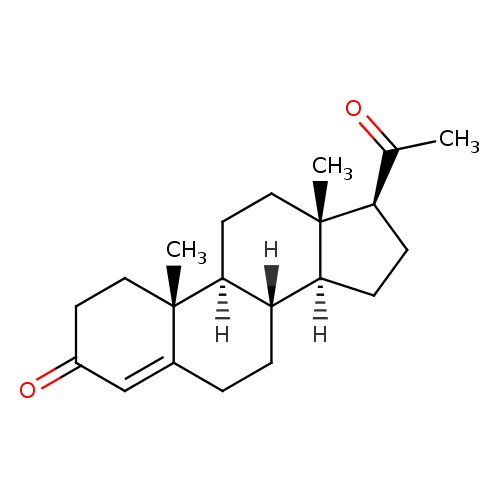
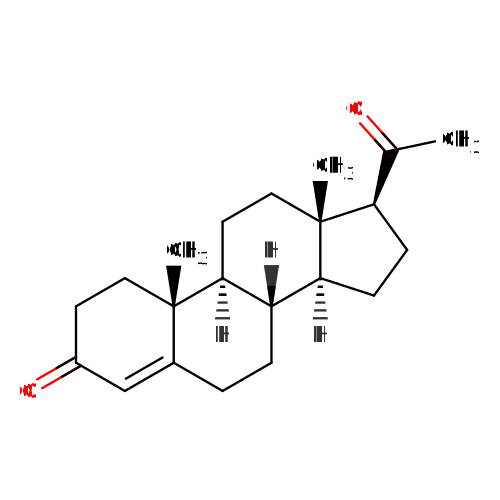
Record Information
Version1.0
Creation Date2014-08-29 06:01:46 UTC
Update Date2026-04-17 17:48:11 UTC
Accession NumberCHEM003204
Identification
Common NameProgesterone
ClassSmall Molecule
DescriptionThe major progestational steroid that is secreted primarily by the corpus luteum and the placenta. Progesterone acts on the uterus, the mammary glands and the brain. It is required in embryo implantation, pregnancy maintenance, and the development of mammary tissue for milk production. Progesterone, converted from pregnenolone, also serves as an intermediate in the biosynthesis of gonadal steroid hormones and adrenal corticosteroids. Progesterone is a C-21 steroid hormone involved in the female menstrual cycle, pregnancy (supports gestation) and embryogenesis of humans and other species. Progesterone belongs to a class of hormones called progestagens, and is the major naturally occurring human progestagen. During implantation and gestation, progesterone appears to decrease the maternal immune response to allow for the acceptance of the pregnancy. Progesterone decreases contractility of the uterine smooth muscle. The fetus metabolizes placental progesterone in the production of adrenal mineralo- and glucosteroids. A drop in progesterone levels is possibly one step that facilitates the onset of labor. In addition progesterone inhibits lactation during pregnancy. The fall in progesterone levels following delivery is one of the triggers for milk production.
Contaminant Sources
  • Cosmetic Chemicals
  • FooDB Chemicals
  • IARC Carcinogens Group 2B
  • STOFF IDENT Compounds
  • T3DB toxins
  • ToxCast & Tox21 Chemicals
Contaminant Type
  • Animal Toxin
  • Contraceptive Agent
  • Drug
  • Ester
  • Food Toxin
  • Metabolite
  • Natural Compound
  • Organic Compound
  • Progestin
Chemical Structure
Thumb
Synonyms
ValueSource
(S)-4-Pregnene-3,20-dioneChEBI
(S)-Pregn-4-en-3,20-dioneChEBI
(S)-ProgesteroneChEBI
17alpha-ProgesteroneChEBI
4-Pregnene-3,20-dioneChEBI
AgolutinChEBI
AkrolutinChEBI
Corpus luteum hormoneChEBI
CrinoneChEBI
Delta(4)-Pregnene-3,20-dioneChEBI
GelbkoerperhormonChEBI
LuteohormoneChEBI
ProgesteronChEBI
PrometriumKegg
17a-ProgesteroneGenerator
17Α-progesteroneGenerator
Δ(4)-pregnene-3,20-dioneGenerator
3,20-Pregnene-4HMDB
4-Pregnen-3,20-dioneHMDB
beta-ProgesteroneHMDB
Bio-lutonHMDB
CIDRHMDB
ColprosteroneHMDB
CorlutinHMDB
CorlutinaHMDB
CorluviteHMDB
CorporinHMDB
Crinone progesterone gelHMDB
CurretabHMDB
CyclogestHMDB
CyclogesterinHMDB
D4-Pregnene-3,20-dioneHMDB
DelalutinHMDB
DuraprogenHMDB
EstimaHMDB
FlavolutanHMDB
FologenonHMDB
GesterolHMDB
Gesterol 100HMDB
Gesterol 50HMDB
GestironHMDB
GestoneHMDB
GestormoneHMDB
GestronHMDB
GlanducorpinHMDB
GynlutinHMDB
GynolutonHMDB
GynolutoneHMDB
HormoflaveineHMDB
HormolutonHMDB
Hydroxyprogesterone caproateHMDB
Hydroxyprogesterone caproic acidHMDB
LingusorbsHMDB
Lipo-lutinHMDB
LucorteumHMDB
Lucorteum solHMDB
LugesteronHMDB
Luteal hormoneHMDB
Luteocrin normaleHMDB
LuteodynHMDB
LuteoganHMDB
LuteolHMDB
LuteopurHMDB
LuteosanHMDB
LuteostabHMDB
LuteovisHMDB
LuteumHMDB
LutexHMDB
LutidonHMDB
LutociclinaHMDB
Lutocuclin mHMDB
LutocyclinHMDB
Lutocyclin mHMDB
LutocylinHMDB
LutocylolHMDB
LutoformHMDB
LutogylHMDB
LutrenHMDB
LutromoneHMDB
MembrettesHMDB
MethylpregnoneHMDB
MPAHMDB
NalutronHMDB
PercutacrineHMDB
Percutacrine luteiniqueHMDB
PiapononHMDB
PranoneHMDB
Pregn-4-en-3,20-dioneHMDB
Pregn-4-ene-3,20-dioneHMDB
Pregnene-3,20-dioneHMDB
PregnenedioneHMDB
PrimolutHMDB
ProchieveHMDB
ProgeffikHMDB
ProgekanHMDB
ProgestanHMDB
ProgestasertHMDB
ProgesterolHMDB
ProgesteronumHMDB
ProgestinHMDB
ProgestogelHMDB
ProgestolHMDB
ProgestonHMDB
ProgestoneHMDB
ProgestosolHMDB
ProgestronHMDB
ProgestronolHMDB
ProjestajectHMDB
ProletsHMDB
ProlidonHMDB
ProlutinHMDB
ProlutonHMDB
ProlutoneHMDB
ProntogestHMDB
ProtormoneHMDB
SyngesteroneHMDB
SyngestretsHMDB
Synovex SHMDB
SyntolutanHMDB
UtrogestHMDB
UtrogestanHMDB
VitarrineHMDB
Progesterone, (13 alpha,17 alpha)-(+-)-isomerHMDB
Progesterone, (17 alpha)-isomerHMDB
Progesterone, (9 beta,10 alpha)-isomerHMDB
Chemical FormulaC21H30O2
Average Molecular Mass314.462 g/mol
Monoisotopic Mass314.225 g/mol
CAS Registry Number57-83-0
IUPAC Name(1S,2R,10S,11S,14S,15S)-14-acetyl-2,15-dimethyltetracyclo[8.7.0.0^{2,7}.0^{11,15}]heptadec-6-en-5-one
Traditional Name(1S,2R,10S,11S,14S,15S)-14-acetyl-2,15-dimethyltetracyclo[8.7.0.0^{2,7}.0^{11,15}]heptadec-6-en-5-one
SMILES[H][C@@]12CC[C@H](C(C)=O)[C@@]1(C)CC[C@@]1([H])[C@@]2([H])CCC2=CC(=O)CC[C@]12C
InChI IdentifierInChI=1S/C21H30O2/c1-13(22)17-6-7-18-16-5-4-14-12-15(23)8-10-20(14,2)19(16)9-11-21(17,18)3/h12,16-19H,4-11H2,1-3H3/t16-,17+,18-,19-,20-,21+/m0/s1
InChI KeyRJKFOVLPORLFTN-LEKSSAKUSA-N
Chemical Taxonomy
Description belongs to the class of organic compounds known as gluco/mineralocorticoids, progestogins and derivatives. These are steroids with a structure based on a hydroxylated prostane moiety.
KingdomOrganic compounds
Super ClassLipids and lipid-like molecules
ClassSteroids and steroid derivatives
Sub ClassPregnane steroids
Direct ParentGluco/mineralocorticoids, progestogins and derivatives
Alternative Parents
Substituents
  • Progestogin-skeleton
  • 20-oxosteroid
  • Oxosteroid
  • 3-oxosteroid
  • 3-oxo-delta-4-steroid
  • Delta-4-steroid
  • Cyclohexenone
  • Cyclic ketone
  • Ketone
  • Organic oxygen compound
  • Organic oxide
  • Hydrocarbon derivative
  • Organooxygen compound
  • Carbonyl group
  • Aliphatic homopolycyclic compound
Molecular FrameworkAliphatic homopolycyclic compounds
External Descriptors
Biological Properties
StatusDetected and Not Quantified
OriginEndogenous
Cellular Locations
  • Cytoplasm
  • Endoplasmic reticulum
  • Extracellular
  • Membrane
Biofluid LocationsNot Available
Tissue Locations
  • Adipose Tissue
  • Fibroblasts
  • Gonads
  • Neuron
  • Placenta
  • Platelet
  • Prostate
  • Testes
Pathways
NameSMPDB LinkKEGG Link
SteroidogenesisSMP00130 map00140
17-alpha-hydroxylase deficiency (CYP17)SMP00566 Not Available
Adrenal Hyperplasia Type 3 or Congenital Adrenal Hyperplasia due to 21-hydroxylase DeficiencySMP00373 Not Available
Adrenal Hyperplasia Type 5 or Congenital Adrenal Hyperplasia due to 17 Alpha-hydroxylase DeficiencySMP00372 Not Available
Applications
Biological Roles
Chemical RolesNot Available
Physical Properties
StateSolid
AppearanceWhite powder.
Experimental Properties
PropertyValue
Melting Point121°C
Boiling PointNot Available
Solubility8.81 mg/L (at 25°C)
Predicted Properties
PropertyValueSource
Water Solubility0.0055 g/LALOGPS
logP3.58ALOGPS
logP4.15ChemAxon
logS-4.8ALOGPS
pKa (Strongest Acidic)18.92ChemAxon
pKa (Strongest Basic)-4.8ChemAxon
Physiological Charge0ChemAxon
Hydrogen Acceptor Count2ChemAxon
Hydrogen Donor Count0ChemAxon
Polar Surface Area34.14 ŲChemAxon
Rotatable Bond Count1ChemAxon
Refractivity92.71 m³·mol⁻¹ChemAxon
Polarizability37.26 ųChemAxon
Number of Rings4ChemAxon
Bioavailability1ChemAxon
Rule of FiveYesChemAxon
Ghose FilterYesChemAxon
Veber's RuleYesChemAxon
MDDR-like RuleNoChemAxon
Spectra
Spectra
Spectrum TypeDescriptionSplash KeyView
GC-MSGC-MS Spectrum - GC-MS (Non-derivatized)splash10-0fbc-5910000000-422e38df6de7e8b0a4b7Spectrum
GC-MSGC-MS Spectrum - GC-MS (Non-derivatized)splash10-0fbc-5910000000-385f45345742235da8e0Spectrum
GC-MSGC-MS Spectrum - EI-B (Non-derivatized)splash10-024l-6923000000-639c7405f69825de7f90Spectrum
GC-MSGC-MS Spectrum - EI-B (Non-derivatized)splash10-0229-2941000000-1e075d8489b79cf4e34aSpectrum
GC-MSGC-MS Spectrum - EI-B (Non-derivatized)splash10-0229-3963000000-f35e3d9faf6b2ee87465Spectrum
GC-MSGC-MS Spectrum - GC-MS (Non-derivatized)splash10-0fbc-5910000000-422e38df6de7e8b0a4b7Spectrum
GC-MSGC-MS Spectrum - GC-MS (Non-derivatized)splash10-0fbc-5910000000-385f45345742235da8e0Spectrum
GC-MSGC-MS Spectrum - GC-EI-TOF (Non-derivatized)splash10-0f6x-2910000000-1baafb91a3e0b988caa7Spectrum
Predicted GC-MSPredicted GC-MS Spectrum - GC-MS (Non-derivatized) - 70eV, Positivesplash10-000g-1590000000-3ebb52b90c541e38c0b4Spectrum
Predicted GC-MSPredicted GC-MS Spectrum - GC-MS (Non-derivatized) - 70eV, PositiveNot AvailableSpectrum
LC-MS/MSLC-MS/MS Spectrum - Quattro_QQQ 10V, Positive (Annotated)splash10-014i-1009000000-0f8b7c3e6c2265c3889fSpectrum
LC-MS/MSLC-MS/MS Spectrum - Quattro_QQQ 25V, Positive (Annotated)splash10-052b-8900000000-0b0167121b798e7e7534Spectrum
LC-MS/MSLC-MS/MS Spectrum - Quattro_QQQ 40V, Positive (Annotated)splash10-052b-9400000000-881510cbcecd9cb61f4fSpectrum
LC-MS/MSLC-MS/MS Spectrum - EI-B (JEOL JMS-01-SG-2) , Positivesplash10-024l-6923000000-639c7405f69825de7f90Spectrum
LC-MS/MSLC-MS/MS Spectrum - EI-B (HITACHI M-52) , Positivesplash10-0229-2941000000-1e075d8489b79cf4e34aSpectrum
LC-MS/MSLC-MS/MS Spectrum - LC-ESI-qTof , Positivesplash10-004i-0950000000-ca28d8dfdf780c201716Spectrum
LC-MS/MSLC-MS/MS Spectrum - LC-ESI-qTof , Positivesplash10-000i-1900000000-857f6720dd17fb2547d1Spectrum
LC-MS/MSLC-MS/MS Spectrum - LC-ESI-qTof , Positivesplash10-004i-3930000000-fda87095285a83b85ad5Spectrum
LC-MS/MSLC-MS/MS Spectrum - LC-ESI-QTOF , positivesplash10-00kb-7955000000-a22f06eac940cd4f753dSpectrum
LC-MS/MSLC-MS/MS Spectrum - LC-ESI-QTOF , positivesplash10-014i-0139000000-6b47f75a44df3e20fa3bSpectrum
LC-MS/MSLC-MS/MS Spectrum - LC-ESI-QTOF , positivesplash10-0aba-0950000000-b26d04d179294aa67cc7Spectrum
LC-MS/MSLC-MS/MS Spectrum - LC-ESI-QTOF , positivesplash10-0aba-0920000000-d0a3365efe1f8a589564Spectrum
LC-MS/MSLC-MS/MS Spectrum - LC-ESI-QTOF , positivesplash10-05aj-0910000000-61d7a07e6be85600e1f1Spectrum
LC-MS/MSLC-MS/MS Spectrum - LC-ESI-QTOF , positivesplash10-014i-0009000000-67c6f0147801f0ece957Spectrum
LC-MS/MSLC-MS/MS Spectrum - LC-ESI-QFT , positivesplash10-05mk-8956000000-aa5fe992c41261b62fbfSpectrum
LC-MS/MSLC-MS/MS Spectrum - LC-ESI-QFT , positivesplash10-052b-6910000000-5e26497eb2d0150a30acSpectrum
LC-MS/MSLC-MS/MS Spectrum - LC-ESI-QFT , positivesplash10-0a4j-8900000000-7ca6fd15f0ccc18bfa31Spectrum
LC-MS/MSLC-MS/MS Spectrum - LC-ESI-QFT , positivesplash10-052b-9700000000-523fe1ad11bfcbb46f85Spectrum
LC-MS/MSLC-MS/MS Spectrum - LC-ESI-QFT , positivesplash10-054k-9400000000-e3d581bd8685e1d3f35dSpectrum
Predicted LC-MS/MSPredicted LC-MS/MS Spectrum - 10V, Positivesplash10-014i-0269000000-9aa25f8d44bc44ee4d4cSpectrum
Predicted LC-MS/MSPredicted LC-MS/MS Spectrum - 20V, Positivesplash10-06dj-0491000000-c312ac322a549be24facSpectrum
Predicted LC-MS/MSPredicted LC-MS/MS Spectrum - 40V, Positivesplash10-0pbc-2290000000-859101eb546be9ddc938Spectrum
Predicted LC-MS/MSPredicted LC-MS/MS Spectrum - 10V, Negativesplash10-03di-0019000000-e021f799bd2d232a0592Spectrum
Predicted LC-MS/MSPredicted LC-MS/MS Spectrum - 20V, Negativesplash10-03di-0049000000-55066424591bf87a4a49Spectrum
Predicted LC-MS/MSPredicted LC-MS/MS Spectrum - 40V, Negativesplash10-0002-1090000000-e9387b8ab692f5ef9083Spectrum
MSMass Spectrum (Electron Ionization)splash10-006x-7931000000-f6ad83adccd7e016fa29Spectrum
1D NMR1H NMR SpectrumNot AvailableSpectrum
1D NMR13C NMR SpectrumNot AvailableSpectrum
2D NMR[1H,13C] 2D NMR SpectrumNot AvailableSpectrum
Toxicity Profile
Route of ExposureProgesterone absorption is prolonged with an absorption half-life of approximately 25-50 hours.
Mechanism of ToxicityProgesterone shares the pharmacological actions of the progestins. Progesterone binds to the progesterone and estrogen receptors. Target cells include the female reproductive tract, the mammary gland, the hypothalamus, and the pituitary. Once bound to the receptor, progestins like Progesterone will slow the frequency of release of gonadotropin releasing hormone (GnRH) from the hypothalamus and blunt the pre-ovulatory LH (luteinizing hormone) surge. In women who have adequate endogenous estrogen, progesterone transforms a proliferative endometrium into a secretory one. Progesterone is essential for the development of decidual tissue and is necessary to increase endometrial receptivity for implantation of an embryo. Once an embryo has been implanted, progesterone acts to maintain the pregnancy. Progesterone also stimulates the growth of mammary alveolar tissue and relaxes uterine smooth muscle. It has little estrogenic and androgenic activity.
MetabolismProgesterone is metabolized primarily by the liver largely to pregnanediols and pregnanolones. Route of Elimination: The glucuronide and sulfate conjugates of pregnanediol and pregnanolone are excreted in the urine and bile. Progesterone metabolites which are excreted in the bile may undergo enterohepatic recycling or may be excreted in the feces. Progesterone metabolites are excreted mainly by the kidneys. Half Life: 34.8-55.13 hours
Toxicity ValuesNot Available
Lethal DoseNot Available
Carcinogenicity (IARC Classification)2B, possibly carcinogenic to humans. (21)
Uses/SourcesFor progesterone supplementation or replacement as part of an Assisted Reproductive Technology (ART) treatment for infertile women with progesterone deficiency and for the treatment of secondary amenorrhea. Also used for the reduction of the incidence of endometrial hyperplasia and the attendant risk of endometrial carcinoma in postmenopausal women receiving estrogen replacement therapy, as well as treatment of abnormal uterine bleeding due to hormonal imbalance in the absence of organic pathology such as fibroids or uterine cancer.
Minimum Risk LevelNot Available
Health EffectsChronically high levels of progesterone are associated with at least 3 inborn errors of metabolism including: Congenital adrenal hyperplasia, Adrenal Hyperplasia Type 3 and Adrenal hyperplasia type 5.
SymptomsNot Available
TreatmentNot Available
Concentrations
Not Available
DrugBank IDDB00396
HMDB IDHMDB0001830
FooDB IDFDB001871
Phenol Explorer IDNot Available
KNApSAcK IDC00034649
BiGG ID34898
BioCyc IDPROGESTERONE
METLIN ID402
PDB IDNot Available
Wikipedia LinkProgesterone
Chemspider ID5773
ChEBI ID17026
PubChem Compound ID5994
Kegg Compound IDC00410
YMDB IDNot Available
ECMDB IDM2MDB005073
References
Synthesis Reference

Nejib M. Nasraoui, Alain Piasco, “Derivatives of 19-nor progesterone; process for producing them and the pharmaceutical compositions incorporating them.” U.S. Patent US5223492, issued May, 1971.

MSDSLink
General References
1. Vasquez, L.; Alarcon, J.; Zunza, H.; Becerra, J.; Silva, M. Chemical-microbiological synthesis of progesterone. Boletin de la Sociedad Chilena de Quimica (2001), 46(1), 29-31.
2. Narendran R, Hacker RR, Smith VG, Lun A: Estrogen and progesterone concentrations in bovine milk during the estrous cycle. Theriogenology. 1979 Jul;12(1):19-25.
3. Colazo MG, Ambrose DJ, Kastelic JP, Small JA: Comparison of 2 enzyme immunoassays and a radioimmunoassay for measurement of progesterone concentrations in bovine plasma, skim milk, and whole milk. Can J Vet Res. 2008 Jan;72(1):32-6.
4. Vasquez, L.; Alarcon, J.; Zunza, H.; Becerra, J.; Silva, M. Chemical-microbiological synthesis of progesterone. Boletin de la Sociedad Chilena de Quimica (2001), 46(1), 29-31.
5. Afsar NA, Barakzai Q, Adil SN: Effect of a 'progestin only' contraceptive on platelet aggregation in a Pakistani set of population. J Ayub Med Coll Abbottabad. 2005 Jul-Sep;17(3):21-5.
6. Moguilewsky M, Tournemine C: The antiandrogen anandron potentiates the castrating effect of the LH-RH agonist buserelin in the rat. Am J Clin Oncol. 1988;11 Suppl 2:S148-51.
7. Wang C, Swerdloff RS: Male hormonal contraception. Am J Obstet Gynecol. 2004 Apr;190(4 Suppl):S60-8.
8. Landi N, Manfredini D, Lombardi I, Casarosa E, Bosco M: 17-beta-estradiol and progesterone serum levels in temporomandibular disorder patients. Minerva Stomatol. 2004 Nov-Dec;53(11-12):651-60.
9. Classen-Linke I, Alfer J, Krusche CA, Chwalisz K, Rath W, Beier HM: Progestins, progesterone receptor modulators, and progesterone antagonists change VEGF release of endometrial cells in culture. Steroids. 2000 Oct-Nov;65(10-11):763-71.
10. Callaghan MJ, Russell AJ, Woollatt E, Sutherland GR, Sutherland RL, Watts CK: Identification of a human HECT family protein with homology to the Drosophila tumor suppressor gene hyperplastic discs. Oncogene. 1998 Dec 31;17(26):3479-91.
11. Casey ML, MacDonald PC, Andersson S: 17 beta-Hydroxysteroid dehydrogenase type 2: chromosomal assignment and progestin regulation of gene expression in human endometrium. J Clin Invest. 1994 Nov;94(5):2135-41.
12. Lueprasitsakul P, Longcope C: Aromatase activity of human adipose tissue stromal cells: effects of thyroid hormones and progestogens. Proc Soc Exp Biol Med. 1990 Sep;194(4):337-41.
13. Kaaks R, Berrino F, Key T, Rinaldi S, Dossus L, Biessy C, Secreto G, Amiano P, Bingham S, Boeing H, Bueno de Mesquita HB, Chang-Claude J, Clavel-Chapelon F, Fournier A, van Gils CH, Gonzalez CA, Gurrea AB, Critselis E, Khaw KT, Krogh V, Lahmann PH, Nagel G, Olsen A, Onland-Moret NC, Overvad K, Palli D, Panico S, Peeters P, Quiros JR, Roddam A, Thiebaut A, Tjonneland A, Chirlaque MD, Trichopoulou A, Trichopoulos D, Tumino R, Vineis P, Norat T, Ferrari P, Slimani N, Riboli E: Serum sex steroids in premenopausal women and breast cancer risk within the European Prospective Investigation into Cancer and Nutrition (EPIC). J Natl Cancer Inst. 2005 May 18;97(10):755-65.
14. Oliveira RL, Aldrighi JM, Gebara OE, Rocha TR, D'Amico E, Rosano GM, Ramires JA: Postmenopausal hormone replacement therapy increases plasmatic thromboxane beta 2. Int J Cardiol. 2005 Mar 30;99(3):449-54.
15. Magee JA, Chang LW, Stormo GD, Milbrandt J: Direct, androgen receptor-mediated regulation of the FKBP5 gene via a distal enhancer element. Endocrinology. 2006 Jan;147(1):590-8. Epub 2005 Oct 6.
16. Schwarz S, Pohl P: Steroid hormones and steroid hormone binding globulins in cerebrospinal fluid studied in individuals with intact and with disturbed blood-cerebrospinal fluid barrier. Neuroendocrinology. 1992 Feb;55(2):174-82.
17. Pierson-Mullany LK, Lange CA: Phosphorylation of progesterone receptor serine 400 mediates ligand-independent transcriptional activity in response to activation of cyclin-dependent protein kinase 2. Mol Cell Biol. 2004 Dec;24(24):10542-57.
18. Baum LW: Sex, hormones, and Alzheimer's disease. J Gerontol A Biol Sci Med Sci. 2005 Jun;60(6):736-43.
19. Seibert B, Gunzel P: Animal toxicity studies performed for risk assessment of the once-a-month injectable contraceptive Mesigyna. Contraception. 1994 Apr;49(4):303-33.
20. Payer AF, Meyer WJ 3rd, Walker PA: The ultrastructural response of human Leydig cells to exogenous estrogens. Andrologia. 1979;11(6):423-36.
21. Hould FS, Fried GM, Fazekas AG, Tremblay S, Mersereau WA: Progesterone receptors regulate gallbladder motility. J Surg Res. 1988 Dec;45(6):505-12.
22. Allen WM: Progesterone: how did the name originate? South Med J. 1970 Oct;63(10):1151-5.
23. Schumacher M, Guennoun R, Robert F, Carelli C, Gago N, Ghoumari A, Gonzalez Deniselle MC, Gonzalez SL, Ibanez C, Labombarda F, Coirini H, Baulieu EE, De Nicola AF: Local synthesis and dual actions of progesterone in the nervous system: neuroprotection and myelination. Growth Horm IGF Res. 2004 Jun;14 Suppl A:S18-33.
24. Allen WM: THE ISOLATION OF CRYSTALLINE PROGESTIN. Science. 1935 Aug 2;82(2118):89-93.
25. Elshenawy S, Pinney SE, Stuart T, Doulias PT, Zura G, Parry S, Elovitz MA, Bennett MJ, Bansal A, Strauss JF 3rd, Ischiropoulos H, Simmons RA: The Metabolomic Signature of the Placenta in Spontaneous Preterm Birth. Int J Mol Sci. 2020 Feb 4;21(3). pii: ijms21031043. doi: 10.3390/ijms21031043.
26. https://www.ncbi.nlm.nih.gov/pubmed/?term=10438974
27. https://www.ncbi.nlm.nih.gov/pubmed/?term=9506942