Record Information
Version1.0
Creation Date2014-08-29 06:00:38 UTC
Update Date2026-05-14 18:16:20 UTC
Accession NumberCHEM003202
Identification
Common NameDehydroepiandrosterone sulfate
ClassSmall Molecule
DescriptionDehydroepiandrosterone sulfate or DHEAS is the sulfated form of dehydroepiandrosterone (DHEA). This sulfation is reversibly catalyzed by sulfotransferase 2A1 (SULT2A1) primarily in the adrenals, the liver, and small intestine. In the blood, most DHEA is found as DHEAS with levels that are about 300 times higher than those of free DHEA. Orally-ingested DHEA is converted to its sulfate when passing through intestines and liver. Whereas DHEA levels naturally reach their peak in the early morning hours, DHEAS levels show no diurnal variation. From a practical point of view, measurement of DHEAS is preferable to DHEA, as levels are more stable. DHEA (from which DHEAS comes from) is a natural steroid prohormone produced from cholesterol by the adrenal glands, the gonads, adipose tissue, brain and in the skin (by an autocrine mechanism). DHEA is the precursor of androstenedione, which can undergo further conversion to produce the androgen testosterone and the estrogens estrone and estradiol. DHEA is also a potent sigma-1 agonist. DHEAS can serve as a precursor for testosterone; androstenedione; estradiol; and estrone. Serum dehydroepiandrosterone sulfate is a classic marker for adrenarche and, subsequently, for the individual hormonal milieu Dehydroepiandrosterone sulfate is an endogenously produced sex steroid that has been hypothesized to have anti aging effects It also has been inversely associated with development of atherosclerosis (1, 2, 3). DHEA-S is the principal adrenal androgen and is secreted together with cortisol under the control of ACTH and prolactin. DHEA-S is elevated with hyperprolactinemia.
Contaminant Sources
  • FooDB Chemicals
  • HMDB Contaminants - Urine
  • T3DB toxins
Contaminant Type
  • Animal Toxin
  • Ester
  • Food Toxin
  • Metabolite
  • Natural Compound
  • Organic Compound
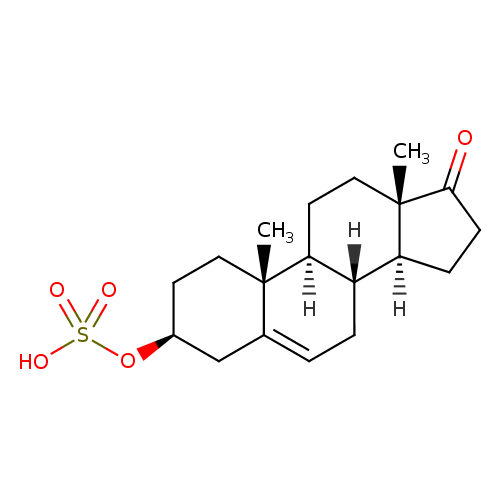
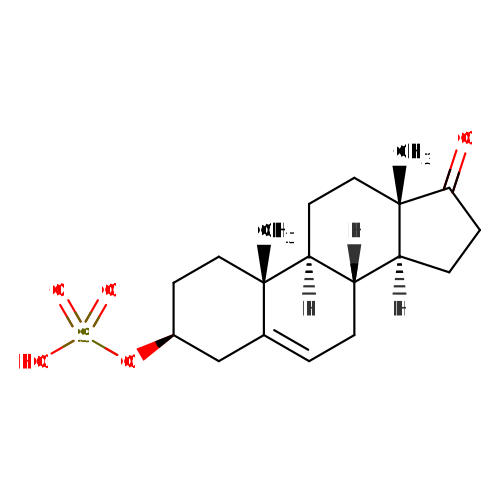
Chemical Structure
Thumb
Synonyms
ValueSource
(3-beta)-3-(Sulfooxy)androst-5-en-17-oneChEBI
17-Ketoandrost-5-en-3beta-yl sulfateChEBI
17-Oxoandrost-5-en-3beta-yl hydrogen sulphateChEBI
3-O-SulfodehydroepiandrosteroneChEBI
3beta-Hydroxyandrost-5-en-17-one 3-sulfateChEBI
Androst-5-en-17-on-3beta-yl sulfuric acidChEBI
Dehydroepiandrosterone 3-sulfateChEBI
Dehydroepiandrosterone monosulfateChEBI
Dehydroepiandrosterone sulphateChEBI
Dehydroisoandrosterone sulfateChEBI
Dehydroisoandrosterone-3-sulfateChEBI
DHEA sulfateChEBI
DHEA-SChEBI
DHEASChEBI
Prasterone sulfateChEBI
(3-b)-3-(Sulfooxy)androst-5-en-17-oneGenerator
(3-b)-3-(Sulphooxy)androst-5-en-17-oneGenerator
(3-beta)-3-(Sulphooxy)androst-5-en-17-oneGenerator
(3-Β)-3-(sulfooxy)androst-5-en-17-oneGenerator
(3-Β)-3-(sulphooxy)androst-5-en-17-oneGenerator
17-Ketoandrost-5-en-3b-yl sulfateGenerator
17-Ketoandrost-5-en-3b-yl sulfuric acidGenerator
17-Ketoandrost-5-en-3b-yl sulphateGenerator
17-Ketoandrost-5-en-3b-yl sulphuric acidGenerator
17-Ketoandrost-5-en-3beta-yl sulfuric acidGenerator
17-Ketoandrost-5-en-3beta-yl sulphateGenerator
17-Ketoandrost-5-en-3beta-yl sulphuric acidGenerator
17-Ketoandrost-5-en-3β-yl sulfateGenerator
17-Ketoandrost-5-en-3β-yl sulfuric acidGenerator
17-Ketoandrost-5-en-3β-yl sulphateGenerator
17-Ketoandrost-5-en-3β-yl sulphuric acidGenerator
17-Oxoandrost-5-en-3b-yl hydrogen sulfateGenerator
17-Oxoandrost-5-en-3b-yl hydrogen sulfuric acidGenerator
17-Oxoandrost-5-en-3b-yl hydrogen sulphateGenerator
17-Oxoandrost-5-en-3b-yl hydrogen sulphuric acidGenerator
17-Oxoandrost-5-en-3beta-yl hydrogen sulfateGenerator
17-Oxoandrost-5-en-3beta-yl hydrogen sulfuric acidGenerator
17-Oxoandrost-5-en-3beta-yl hydrogen sulphuric acidGenerator
17-Oxoandrost-5-en-3β-yl hydrogen sulfateGenerator
17-Oxoandrost-5-en-3β-yl hydrogen sulfuric acidGenerator
17-Oxoandrost-5-en-3β-yl hydrogen sulphateGenerator
17-Oxoandrost-5-en-3β-yl hydrogen sulphuric acidGenerator
3-O-SulphodehydroepiandrosteroneGenerator
3b-Hydroxyandrost-5-en-17-one 3-sulfateGenerator
3b-Hydroxyandrost-5-en-17-one 3-sulfuric acidGenerator
3b-Hydroxyandrost-5-en-17-one 3-sulphateGenerator
3b-Hydroxyandrost-5-en-17-one 3-sulphuric acidGenerator
3beta-Hydroxyandrost-5-en-17-one 3-sulfuric acidGenerator
3beta-Hydroxyandrost-5-en-17-one 3-sulphateGenerator
3beta-Hydroxyandrost-5-en-17-one 3-sulphuric acidGenerator
3Β-hydroxyandrost-5-en-17-one 3-sulfateGenerator
3Β-hydroxyandrost-5-en-17-one 3-sulfuric acidGenerator
3Β-hydroxyandrost-5-en-17-one 3-sulphateGenerator
3Β-hydroxyandrost-5-en-17-one 3-sulphuric acidGenerator
Androst-5-en-17-on-3b-yl sulfateGenerator
Androst-5-en-17-on-3b-yl sulfuric acidGenerator
Androst-5-en-17-on-3b-yl sulphateGenerator
Androst-5-en-17-on-3b-yl sulphuric acidGenerator
Androst-5-en-17-on-3beta-yl sulfateGenerator
Androst-5-en-17-on-3beta-yl sulphateGenerator
Androst-5-en-17-on-3beta-yl sulphuric acidGenerator
Androst-5-en-17-on-3β-yl sulfateGenerator
Androst-5-en-17-on-3β-yl sulfuric acidGenerator
Androst-5-en-17-on-3β-yl sulphateGenerator
Androst-5-en-17-on-3β-yl sulphuric acidGenerator
Dehydroepiandrosterone 3-sulfuric acidGenerator
Dehydroepiandrosterone 3-sulphateGenerator
Dehydroepiandrosterone 3-sulphuric acidGenerator
Dehydroepiandrosterone monosulfuric acidGenerator
Dehydroepiandrosterone monosulphateGenerator
Dehydroepiandrosterone monosulphuric acidGenerator
Dehydroepiandrosterone sulfuric acidGenerator
Dehydroepiandrosterone sulphuric acidGenerator
Dehydroisoandrosterone sulfuric acidGenerator
Dehydroisoandrosterone sulphateGenerator
Dehydroisoandrosterone sulphuric acidGenerator
Dehydroisoandrosterone-3-sulfuric acidGenerator
Dehydroisoandrosterone-3-sulphateGenerator
Dehydroisoandrosterone-3-sulphuric acidGenerator
DHEA sulfuric acidGenerator
DHEA sulphateGenerator
DHEA sulphuric acidGenerator
Prasterone sulfuric acidGenerator
Prasterone sulphateGenerator
Prasterone sulphuric acidGenerator
(3beta)-3-(Sulfooxy)-androst-5-en-17-oneHMDB
17-Oxoandrost-5-en-3-yl hydrogen sulfateHMDB
17-Oxoandrost-5-en-3-yl hydrogen sulphateHMDB
3-b-Hydroxyandrost-5-en-17-one 3-sulfateHMDB
3-b-Hydroxyandrost-5-en-17-one 3-sulphateHMDB
3-beta-Hydroxyandrost-5-en-17-one 3-sulfateHMDB
3-beta-Hydroxyandrost-5-en-17-one 3-sulphateHMDB
3b-Hydroxy-androst-5-en-17-one hydrogen sulfateHMDB
3b-Hydroxy-androst-5-en-17-one hydrogen sulphateHMDB
3beta-Hydroxy-androst-5-en-17-one hydrogen sulfateHMDB
3beta-Hydroxy-androst-5-en-17-one hydrogen sulphateHMDB
Dehydroepiandrosterone-3-sulfateHMDB
Dehydroepiandrosterone-3-sulphateHMDB
Formylisoglutamic acidHMDB
Prasterone-3-sulfateHMDB
Prasterone-3-sulphateHMDB
DHA sulfateHMDB
Sulfate, dehydroisoandrosteroneHMDB
Sulfate, prasteroneHMDB
Sulfate, dheaHMDB
Sulfate, dehydroepiandrosteroneHMDB
Sulfate, dhaHMDB
Chemical FormulaC19H28O5S
Average Molecular Mass368.488 g/mol
Monoisotopic Mass368.166 g/mol
CAS Registry Number651-48-9
IUPAC Name[(3aS,3bR,7S,9aR,9bS,11aS)-9a,11a-dimethyl-1-oxo-1H,2H,3H,3aH,3bH,4H,6H,7H,8H,9H,9aH,9bH,10H,11H,11aH-cyclopenta[a]phenanthren-7-yl]oxidanesulfonic acid
Traditional Name[(1S,2R,5S,10R,11S,15S)-2,15-dimethyl-14-oxotetracyclo[8.7.0.0^{2,7}.0^{11,15}]heptadec-7-en-5-yl]oxidanesulfonic acid
SMILES[H][C@@]12CCC(=O)[C@@]1(C)CC[C@@]1([H])[C@@]2([H])CC=C2C[C@H](CC[C@]12C)OS(O)(=O)=O
InChI IdentifierInChI=1S/C19H28O5S/c1-18-9-7-13(24-25(21,22)23)11-12(18)3-4-14-15-5-6-17(20)19(15,2)10-8-16(14)18/h3,13-16H,4-11H2,1-2H3,(H,21,22,23)/t13-,14-,15-,16-,18-,19-/m0/s1
InChI KeyCZWCKYRVOZZJNM-USOAJAOKSA-N
Chemical Taxonomy
Description belongs to the class of organic compounds known as sulfated steroids. These are sterol lipids containing a sulfate group attached to the steroid skeleton.
KingdomOrganic compounds
Super ClassLipids and lipid-like molecules
ClassSteroids and steroid derivatives
Sub ClassSulfated steroids
Direct ParentSulfated steroids
Alternative Parents
Substituents
  • Sulfated steroid skeleton
  • Androstane-skeleton
  • 17-oxosteroid
  • Oxosteroid
  • Delta-5-steroid
  • Sulfuric acid ester
  • Alkyl sulfate
  • Sulfuric acid monoester
  • Sulfate-ester
  • Organic sulfuric acid or derivatives
  • Ketone
  • Hydrocarbon derivative
  • Organooxygen compound
  • Organic oxygen compound
  • Carbonyl group
  • Organic oxide
  • Aliphatic homopolycyclic compound
Molecular FrameworkAliphatic homopolycyclic compounds
External Descriptors
Biological Properties
StatusDetected and Not Quantified
OriginEndogenous
Cellular Locations
  • Cytoplasm
  • Extracellular
  • Membrane
Biofluid LocationsNot Available
Tissue Locations
  • Kidney
  • Liver
  • Prostate
Pathways
NameSMPDB LinkKEGG Link
17-Beta Hydroxysteroid Dehydrogenase III DeficiencySMP00356 Not Available
ApplicationsNot Available
Biological Roles
Chemical Roles
Physical Properties
StateSolid
AppearanceWhite powder.
Experimental Properties
PropertyValue
Melting PointNot Available
Boiling PointNot Available
SolubilityNot Available
Predicted Properties
PropertyValueSource
Water Solubility0.0081 g/LALOGPS
logP0.49ALOGPS
logP3.42ChemAxon
logS-4.7ALOGPS
pKa (Strongest Acidic)-1.4ChemAxon
pKa (Strongest Basic)-7.5ChemAxon
Physiological Charge-1ChemAxon
Hydrogen Acceptor Count4ChemAxon
Hydrogen Donor Count1ChemAxon
Polar Surface Area80.67 ŲChemAxon
Rotatable Bond Count2ChemAxon
Refractivity94.65 m³·mol⁻¹ChemAxon
Polarizability39.85 ųChemAxon
Number of Rings4ChemAxon
Bioavailability1ChemAxon
Rule of FiveYesChemAxon
Ghose FilterYesChemAxon
Veber's RuleNoChemAxon
MDDR-like RuleNoChemAxon
Spectra
Spectra
Spectrum TypeDescriptionSplash KeyView
Predicted GC-MSPredicted GC-MS Spectrum - GC-MS (Non-derivatized) - 70eV, Positivesplash10-002f-0097000000-e6d4f60e9803940d2f55Spectrum
Predicted GC-MSPredicted GC-MS Spectrum - GC-MS (Non-derivatized) - 70eV, PositiveNot AvailableSpectrum
LC-MS/MSLC-MS/MS Spectrum - 10V, Negativesplash10-014i-0009000000-d49a8b7164a230745f20Spectrum
LC-MS/MSLC-MS/MS Spectrum - 20V, Negativesplash10-014i-3009000000-bd7e895ed74eba8a0f23Spectrum
LC-MS/MSLC-MS/MS Spectrum - 40V, Negativesplash10-0002-9000000000-8d7ea5bd8a8a0d5219c7Spectrum
LC-MS/MSLC-MS/MS Spectrum - 30V, Negativesplash10-0002-9001000000-5d89a4081c0f6b0c3324Spectrum
Predicted LC-MS/MSPredicted LC-MS/MS Spectrum - 10V, Positivesplash10-014i-0049000000-f9a938b029283c157bdfSpectrum
Predicted LC-MS/MSPredicted LC-MS/MS Spectrum - 20V, Positivesplash10-00di-0091000000-c2b83d86ae8174524e1dSpectrum
Predicted LC-MS/MSPredicted LC-MS/MS Spectrum - 40V, Positivesplash10-0udi-5792000000-20638b1484fe342eb3c9Spectrum
Predicted LC-MS/MSPredicted LC-MS/MS Spectrum - 10V, Negativesplash10-014i-0029000000-79344bc1ba3ea2c26db7Spectrum
Predicted LC-MS/MSPredicted LC-MS/MS Spectrum - 20V, Negativesplash10-00kr-1092000000-3b129a6c30b2629e1661Spectrum
Predicted LC-MS/MSPredicted LC-MS/MS Spectrum - 40V, Negativesplash10-008i-6090000000-35cc2726715438281170Spectrum
Predicted LC-MS/MSPredicted LC-MS/MS Spectrum - 10V, Negativesplash10-014i-0009000000-c58c9c29bacda1fca240Spectrum
Predicted LC-MS/MSPredicted LC-MS/MS Spectrum - 20V, Negativesplash10-014i-1009000000-d5f9b663138c7975150bSpectrum
Predicted LC-MS/MSPredicted LC-MS/MS Spectrum - 40V, Negativesplash10-0002-9105000000-a5c4a9d21c991c730dabSpectrum
Predicted LC-MS/MSPredicted LC-MS/MS Spectrum - 10V, Positivesplash10-014i-0019000000-e7315ac14210f0dc3930Spectrum
Predicted LC-MS/MSPredicted LC-MS/MS Spectrum - 20V, Positivesplash10-0uk9-0292000000-06a461930592bd575f19Spectrum
Predicted LC-MS/MSPredicted LC-MS/MS Spectrum - 40V, Positivesplash10-0a4m-4920000000-e6055497e2f92515f76aSpectrum
1D NMR13C NMR SpectrumNot AvailableSpectrum
1D NMR1H NMR SpectrumNot AvailableSpectrum
1D NMR13C NMR SpectrumNot AvailableSpectrum
1D NMR1H NMR SpectrumNot AvailableSpectrum
1D NMR13C NMR SpectrumNot AvailableSpectrum
1D NMR1H NMR SpectrumNot AvailableSpectrum
1D NMR13C NMR SpectrumNot AvailableSpectrum
1D NMR1H NMR SpectrumNot AvailableSpectrum
1D NMR13C NMR SpectrumNot AvailableSpectrum
1D NMR1H NMR SpectrumNot AvailableSpectrum
1D NMR13C NMR SpectrumNot AvailableSpectrum
1D NMR1H NMR SpectrumNot AvailableSpectrum
1D NMR13C NMR SpectrumNot AvailableSpectrum
1D NMR1H NMR SpectrumNot AvailableSpectrum
1D NMR13C NMR SpectrumNot AvailableSpectrum
1D NMR1H NMR SpectrumNot AvailableSpectrum
1D NMR13C NMR SpectrumNot AvailableSpectrum
1D NMR1H NMR SpectrumNot AvailableSpectrum
1D NMR13C NMR SpectrumNot AvailableSpectrum
1D NMR1H NMR SpectrumNot AvailableSpectrum
Toxicity Profile
Route of ExposureEndogenous, ingestion
Mechanism of ToxicityAlthough it predominantly functions as an endogenous precursor to more potent androgens such as testosterone and dihydroxytestosterone, DHEA (which is produced from DHEAS) has been found to possess some degree of androgenic activity in its own right, acting as a low affinity (Ki = 1 μM), weak partial agonist of the androgen receptor. DHEA has also been found to bind to and activate the ERα and ERβ estrogen receptors with Ki values of 1.1 μM and 0.5 μM, respectively. When taken in sufficient quantities DHEAS can cause masculinizing effects. DHEAS is considered an androgenic steroid precursor because testosterone (its product) is an androgen or male hormone. In males and females, conversion of DHEAS to testosterone requires the enzyme 17β-hydroxysteroid dehydrogenase. Testosterone plays a key role in the development of male reproductive tissues such as the testis and prostate as well as promoting secondary sexual characteristics such as increased muscle, bone mass, and the growth of body hair. High levels of testosterone can lead to masculinization in females or premature puberty in young boys. Chronically high levels in adults increase the incidence of heart attack, stroke and blood clots by lowering the level of HDL (good cholesterol). The development of breast tissue in males, a condition called gynecomastia (which is usually caused by high levels of circulating estradiol), arises because of increased conversion of testosterone to estradiol by the enzyme aromatase. Reduced sexual function and temporary infertility can also occur in males.
MetabolismDehydroepiandrosterone sulfate (DHEAS) is the sulfate ester of DHEA. This conversion is reversibly catalyzed by sulfotransferase (SULT2A1) primarily in the adrenals, the liver, and small intestine. DHEA sulfate can also be back-converted to DHEA through the action of steroid sulfatase. In the blood, most DHEA is found as DHEAS with levels that are about 300 times higher than those of free DHEA. Orally ingested DHEA is converted to its sulfate when passing through intestines and liver. DHEAS levels show no diurnal variation. In males and females, conversion of DHEAS to DHEA and then to testosterone requires the enzyme 17β-hydroxysteroid dehydrogenase.
Toxicity ValuesNot Available
Lethal DoseNot Available
Carcinogenicity (IARC Classification)No indication of carcinogenicity to humans (not listed by IARC).
Uses/SourcesInvestigated for use/treatment in asthma and burns and burn infections.
Minimum Risk LevelDehydroepiandrosterone sulfate levels above 1890 micromol/L or 700-800 µg/dL are highly suggestive of adrenal dysfunction.
Health EffectsSome researchers believe DHEAS supplements might actually raise the risk of breast cancer, prostate cancer, heart disease, diabetes and stroke. DHEAS may stimulate tumor growth in types of cancer that are sensitive to hormones, such as some types of breast, uterine, and prostate cancer. DHEAS may increase prostate swelling in men with benign prostatic hyperplasia (BPH), an enlarged prostate gland. High doses of DHEAS may cause aggressiveness, irritability, trouble sleeping, and the growth of body or facial hair on women. It also may stop menstruation and lower the levels of HDL ('good' cholesterol), which could raise the risk of heart disease. Other reported side effects include acne, heart rhythm problems, liver problems, hair loss (from the scalp), and oily skin. In women, DHEA may cause decreased breast size, a deep voice, increased genital size, irregular periods, oily skin, and unnatural hair growth. In men, DHEAS may cause aggression, breast tenderness or enlargement, decreased testes size, and urinary urgency. DHEAS may interfere with the way the body processes certain agents using the liver's cytochrome P450 enzyme system. Chronically high levels of Dehydroepiandrosterone sulfate are associated with male pseudohermaphrodism with gynecomastia.
SymptomsIn women, DHEAS may cause decreased breast size, a deep voice, increased genital size, irregular periods, oily skin, and unnatural hair growth. In men, DHEAS may cause aggression, breast tenderness or enlargement, decreased testes size, and urinary urgency.
TreatmentNot Available
Concentrations
Not Available
DrugBank IDDB05804
HMDB IDHMDB0001032
FooDB IDFDB022381
Phenol Explorer IDNot Available
KNApSAcK IDNot Available
BiGG ID44038
BioCyc IDDEHYDRO-EPIANDROSTERONE-SULFATE
METLIN ID4095
PDB IDNot Available
Wikipedia LinkDehydroepiandrosterone_sulfate
Chemspider ID12074
ChEBI ID16814
PubChem Compound ID12594
Kegg Compound IDC04555
YMDB IDNot Available
ECMDB IDNot Available
References
Synthesis ReferenceNot Available
MSDSNot Available
General References
1. Gu H, Li Y, Rong L: [The effect of sodium prasterone sulfate on lactation]. Zhonghua Fu Chan Ke Za Zhi. 1995 Apr;30(4):197-9.
2. Sreekumar A, Poisson LM, Rajendiran TM, Khan AP, Cao Q, Yu J, Laxman B, Mehra R, Lonigro RJ, Li Y, Nyati MK, Ahsan A, Kalyana-Sundaram S, Han B, Cao X, Byun J, Omenn GS, Ghosh D, Pennathur S, Alexander DC, Berger A, Shuster JR, Wei JT, Varambally S, Beecher C, Chinnaiyan AM: Metabolomic profiles delineate potential role for sarcosine in prostate cancer progression. Nature. 2009 Feb 12;457(7231):910-4. doi: 10.1038/nature07762.
3. Dalla Valle L, Toffolo V, Nardi A, Fiore C, Bernante P, Di Liddo R, Parnigotto PP, Colombo L: Tissue-specific transcriptional initiation and activity of steroid sulfatase complementing dehydroepiandrosterone sulfate uptake and intracrine steroid activations in human adipose tissue. J Endocrinol. 2006 Jul;190(1):129-39.
4. Roberts E: The importance of being dehydroepiandrosterone sulfate (in the blood of primates): a longer and healthier life? Biochem Pharmacol. 1999 Feb 15;57(4):329-46.
5. Zappulla F, Ventura D, Capelli M, Cassio A, Balsamo A, Frejaville E, Bolelli G, Cacciari E: Gonadal and adrenal secretion of dehydroepiandrosterone sulfate in prepubertal and pubertal subjects. J Endocrinol Invest. 1981 Apr-Jun;4(2):197-202.
6. Ankarberg C, Norjavaara E: Diurnal rhythm of testosterone secretion before and throughout puberty in healthy girls: correlation with 17beta-estradiol and dehydroepiandrosterone sulfate. J Clin Endocrinol Metab. 1999 Mar;84(3):975-84.
7. Gordon GB, Bush TL, Helzlsouer KJ, Miller SR, Comstock GW: Relationship of serum levels of dehydroepiandrosterone and dehydroepiandrosterone sulfate to the risk of developing postmenopausal breast cancer. Cancer Res. 1990 Jul 1;50(13):3859-62.
8. Chang HJ, Shi R, Rehse P, Lin SX: Identifying androsterone (ADT) as a cognate substrate for human dehydroepiandrosterone sulfotransferase (DHEA-ST) important for steroid homeostasis: structure of the enzyme-ADT complex. J Biol Chem. 2004 Jan 23;279(4):2689-96. Epub 2003 Oct 21.
9. De Pergola G, Zamboni M, Sciaraffia M, Turcato E, Pannacciulli N, Armellini F, Giorgino F, Perrini S, Bosello O, Giorgino R: Body fat accumulation is possibly responsible for lower dehydroepiandrosterone circulating levels in premenopausal obese women. Int J Obes Relat Metab Disord. 1996 Dec;20(12):1105-10.
10. Clauss SB, Holmes KW, Hopkins P, Stein E, Cho M, Tate A, Johnson-Levonas AO, Kwiterovich PO: Efficacy and safety of lovastatin therapy in adolescent girls with heterozygous familial hypercholesterolemia. Pediatrics. 2005 Sep;116(3):682-8.
11. Sipila S, Heikkinen E, Cheng S, Suominen H, Saari P, Kovanen V, Alen M, Rantanen T: Endogenous hormones, muscle strength, and risk of fall-related fractures in older women. J Gerontol A Biol Sci Med Sci. 2006 Jan;61(1):92-6.
12. Cutolo M, Sulli A, Capellino S, Villaggio B, Montagna P, Pizzorni C, Paolino S, Seriolo B, Felli L, Straub RH: Anti-TNF and sex hormones. Ann N Y Acad Sci. 2006 Jun;1069:391-400.
13. Benvenga S, Smedile G, Lo Giudice F, Trimarchi F: Testicular adrenal rests: evidence for luteinizing hormone receptors and for distinct types of testicular nodules differing for their autonomization. Eur J Endocrinol. 1999 Sep;141(3):231-7.
14. Rainey WE, Rehman KS, Carr BR: The human fetal adrenal: making adrenal androgens for placental estrogens. Semin Reprod Med. 2004 Nov;22(4):327-36.
15. Milewich L, Sontheimer RD, Herndon JH Jr: Steroid sulfatase activity in epidermis of acne-prone and non-acne-prone skin of patients with acne vulgaris. Arch Dermatol. 1990 Oct;126(10):1312-4.
16. Zouboulis CC, Degitz K: Androgen action on human skin -- from basic research to clinical significance. Exp Dermatol. 2004;13 Suppl 4:5-10.
17. Coulter CL, Jaffe RB: Functional maturation of the primate fetal adrenal in vivo: 3. Specific zonal localization and developmental regulation of CYP21A2 (P450c21) and CYP11B1/CYP11B2 (P450c11/aldosterone synthase) lead to integrated concept of zonal and temporal steroid biosynthesis. Endocrinology. 1998 Dec;139(12):5144-50.
18. Wang HS, Wang TH, Soong YK: Low dose flutamide in the treatment of acne vulgaris in women with or without oligomenorrhea or amenorrhea. Changgeng Yi Xue Za Zhi. 1999 Sep;22(3):423-32.
19. Ibanez L, Potau N, Marcos MV, de Zegher F: Exaggerated adrenarche and hyperinsulinism in adolescent girls born small for gestational age. J Clin Endocrinol Metab. 1999 Dec;84(12):4739-41.
20. Cappola AR, Xue QL, Walston JD, Leng SX, Ferrucci L, Guralnik J, Fried LP: DHEAS levels and mortality in disabled older women: the Women's Health and Aging Study I. J Gerontol A Biol Sci Med Sci. 2006 Sep;61(9):957-62.
21. Jaquish CE, Blangero J, Haffner SM, Stern MP, Maccluer JW: Quantitative genetics of dehydroepiandrosterone sulfate and its relation to possible cardiovascular disease risk factors in Mexican Americans. Hum Hered. 1996 Nov-Dec;46(6):301-9.
22. Elshenawy S, Pinney SE, Stuart T, Doulias PT, Zura G, Parry S, Elovitz MA, Bennett MJ, Bansal A, Strauss JF 3rd, Ischiropoulos H, Simmons RA: The Metabolomic Signature of the Placenta in Spontaneous Preterm Birth. Int J Mol Sci. 2020 Feb 4;21(3). pii: ijms21031043. doi: 10.3390/ijms21031043.
23. https://www.ncbi.nlm.nih.gov/pubmed/?term=15374110
24. https://www.ncbi.nlm.nih.gov/pubmed/?term=18307294
25. https://www.ncbi.nlm.nih.gov/pubmed/?term=20797618
26. https://www.ncbi.nlm.nih.gov/pubmed/?term=22770225
27. https://www.ncbi.nlm.nih.gov/pubmed/?term=9661815