Record Information
Version1.0
Creation Date2014-08-29 05:59:33 UTC
Update Date2026-05-14 17:07:27 UTC
Accession NumberCHEM003200
Identification
Common NameAndrostenedione
ClassSmall Molecule
DescriptionAndrostenedione is a delta-4 19-carbon steroid that is produced not only in the testis, but also in the ovary and the adrenal cortex. Depending on the tissue type, androstenedione can serve as a precursor to testosterone as well as estrone and estradiol. It is the common precursor of male and female sex hormones. Some androstenedione is also secreted into the plasma, and may be converted in peripheral tissues to testosterone and estrogens. Androstenedione originates either from the conversion of dehydroepiandrosterone or from 17-hydroxyprogesterone. It is further converted to either testosterone or estrone. The production of adrenal androstenedione is governed by ACTH, while production of gonadal androstenedione is under control by gonadotropins.
Contaminant Sources
  • FooDB Chemicals
  • HMDB Contaminants - Urine
  • STOFF IDENT Compounds
  • T3DB toxins
  • ToxCast & Tox21 Chemicals
Contaminant Type
  • Animal Toxin
  • Ester
  • Food Toxin
  • Industrial/Workplace Toxin
  • Metabolite
  • Natural Compound
  • Organic Compound
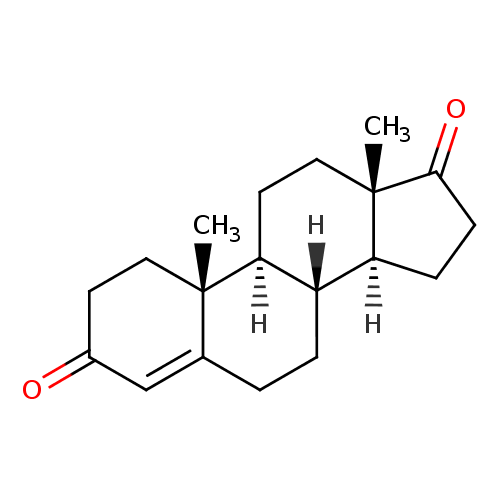
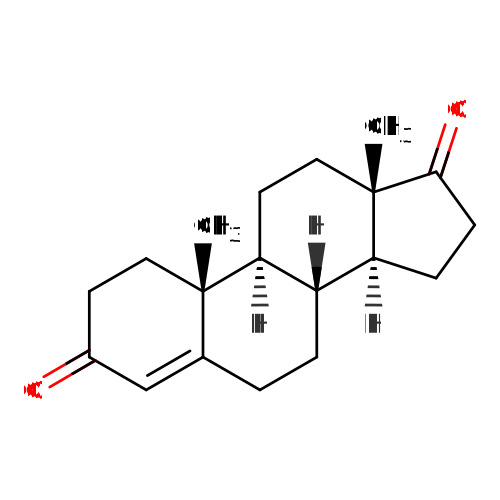
Chemical Structure
Thumb
Synonyms
ValueSource
4-Androstene-3,17-dioneChEBI
4-ANDROSTENE-3-17-dioneChEBI
delta(4)-Androsten-3,17-dioneChEBI
delta(4)-Androstene-3,17-dioneChEBI
Δ(4)-Androsten-3,17-dioneGenerator
Δ(4)-Androstene-3,17-dioneGenerator
(4)-Androsten-3,17-dioneHMDB
17-KetotestosteroneHMDB
3,17-Dioxoandrost-4-eneHMDB
4-Androsten-3,17-dioneHMDB
4-AndrostenedioneHMDB
Androst-4-ene-3,17-dioneHMDB, KEGG
AndrostendioneHMDB
D4-Androstene-3,17-dioneHMDB
delta4-AndrostenedioneHMDB
FecundinHMDB
delta 4 AndrostenedioneMeSH, HMDB
delta-4-AndrostenedioneMeSH, HMDB
4 Androstene 3,17 dioneMeSH, HMDB
AndrostenedioneHMDB
delta4-Androstene-3,17-dioneHMDB
Δ4-Androstene-3,17-dioneHMDB
Chemical FormulaC19H26O2
Average Molecular Mass286.409 g/mol
Monoisotopic Mass286.193 g/mol
CAS Registry Number63-05-8
IUPAC Name(3aS,3bR,9aR,9bS,11aS)-9a,11a-dimethyl-1H,2H,3H,3aH,3bH,4H,5H,7H,8H,9H,9aH,9bH,10H,11H,11aH-cyclopenta[a]phenanthrene-1,7-dione
Traditional Name(1S,2R,10R,11S,15S)-2,15-dimethyltetracyclo[8.7.0.0^{2,7}.0^{11,15}]heptadec-6-ene-5,14-dione
SMILES[H][C@@]12CCC(=O)[C@@]1(C)CC[C@@]1([H])[C@@]2([H])CCC2=CC(=O)CC[C@]12C
InChI IdentifierInChI=1S/C19H26O2/c1-18-9-7-13(20)11-12(18)3-4-14-15-5-6-17(21)19(15,2)10-8-16(14)18/h11,14-16H,3-10H2,1-2H3/t14-,15-,16-,18-,19-/m0/s1
InChI KeyAEMFNILZOJDQLW-QAGGRKNESA-N
Chemical Taxonomy
Description belongs to the class of organic compounds known as androgens and derivatives. These are 3-hydroxylated C19 steroid hormones. They are known to favor the development of masculine characteristics. They also show profound effects on scalp and body hair in humans.
KingdomOrganic compounds
Super ClassLipids and lipid-like molecules
ClassSteroids and steroid derivatives
Sub ClassAndrostane steroids
Direct ParentAndrogens and derivatives
Alternative Parents
Substituents
  • Androgen-skeleton
  • Oxosteroid
  • 17-oxosteroid
  • 3-oxosteroid
  • 3-oxo-delta-4-steroid
  • Delta-4-steroid
  • Cyclohexenone
  • Cyclic ketone
  • Ketone
  • Organic oxygen compound
  • Organic oxide
  • Hydrocarbon derivative
  • Organooxygen compound
  • Carbonyl group
  • Aliphatic homopolycyclic compound
Molecular FrameworkAliphatic homopolycyclic compounds
External Descriptors
Biological Properties
StatusDetected and Not Quantified
OriginEndogenous
Cellular Locations
  • Cytoplasm
  • Endoplasmic reticulum
  • Extracellular
  • Membrane
Biofluid LocationsNot Available
Tissue Locations
  • Adipose Tissue
  • Adrenal Cortex
  • Adrenal Gland
  • Fibroblasts
  • Gonads
  • Kidney
  • Liver
  • Muscle
  • Placenta
  • Prostate
  • Skin
  • Testes
Pathways
NameSMPDB LinkKEGG Link
Androgen and Estrogen MetabolismSMP00068 map00150
17-Beta Hydroxysteroid Dehydrogenase III DeficiencySMP00356 Not Available
Adrenal Hyperplasia Type 3 or Congenital Adrenal Hyperplasia due to 21-hydroxylase DeficiencySMP00373 Not Available
Aromatase deficiencySMP00565 Not Available
ApplicationsNot Available
Biological Roles
Chemical RolesNot Available
Physical Properties
StateSolid
AppearanceWhite powder.
Experimental Properties
PropertyValue
Melting Point170 - 173°C
Boiling PointNot Available
Solubility0.0578 mg/mL
Predicted Properties
PropertyValueSource
Water Solubility0.027 g/LALOGPS
logP2.93ALOGPS
logP3.93ChemAxon
logS-4ALOGPS
pKa (Strongest Acidic)19.03ChemAxon
pKa (Strongest Basic)-4.8ChemAxon
Physiological Charge0ChemAxon
Hydrogen Acceptor Count2ChemAxon
Hydrogen Donor Count0ChemAxon
Polar Surface Area34.14 ŲChemAxon
Rotatable Bond Count0ChemAxon
Refractivity83.61 m³·mol⁻¹ChemAxon
Polarizability33.21 ųChemAxon
Number of Rings4ChemAxon
Bioavailability1ChemAxon
Rule of FiveYesChemAxon
Ghose FilterYesChemAxon
Veber's RuleYesChemAxon
MDDR-like RuleNoChemAxon
Spectra
Spectra
Spectrum TypeDescriptionSplash KeyView
GC-MSGC-MS Spectrum - GC-MS (Non-derivatized)splash10-004l-5910000000-518e1ad38bcc73325b53Spectrum
GC-MSGC-MS Spectrum - GC-MS (Non-derivatized)splash10-004l-5910000000-5172e05f9889ee2bfaf4Spectrum
GC-MSGC-MS Spectrum - EI-B (Non-derivatized)splash10-000f-8940000000-f2892fe3b281d44164c8Spectrum
GC-MSGC-MS Spectrum - EI-B (Non-derivatized)splash10-007d-1960000000-167f1765b095da9d603bSpectrum
GC-MSGC-MS Spectrum - GC-MS (Non-derivatized)splash10-004l-5910000000-518e1ad38bcc73325b53Spectrum
GC-MSGC-MS Spectrum - GC-MS (Non-derivatized)splash10-004l-5910000000-5172e05f9889ee2bfaf4Spectrum
Predicted GC-MSPredicted GC-MS Spectrum - GC-MS (Non-derivatized) - 70eV, Positivesplash10-0a4i-0590000000-502d6b821317a01a1990Spectrum
Predicted GC-MSPredicted GC-MS Spectrum - GC-MS (Non-derivatized) - 70eV, PositiveNot AvailableSpectrum
LC-MS/MSLC-MS/MS Spectrum - Quattro_QQQ 10V, Positive (Annotated)splash10-000i-0090000000-36e848ba16b141eef47bSpectrum
LC-MS/MSLC-MS/MS Spectrum - Quattro_QQQ 25V, Positive (Annotated)splash10-052b-9600000000-712954fc35a84c8217deSpectrum
LC-MS/MSLC-MS/MS Spectrum - Quattro_QQQ 40V, Positive (Annotated)splash10-052b-9300000000-f8e9aa16b4b208b69f7bSpectrum
LC-MS/MSLC-MS/MS Spectrum - EI-B (HITACHI M-80) , Positivesplash10-000f-8940000000-e12025ea2b7808c64b9cSpectrum
LC-MS/MSLC-MS/MS Spectrum - LC-ESI-ITFT , positivesplash10-052b-6910000000-b616785c86a92f46158eSpectrum
LC-MS/MSLC-MS/MS Spectrum - LC-ESI-ITFT , positivesplash10-052b-9800000000-73e545a1eb2232d55371Spectrum
LC-MS/MSLC-MS/MS Spectrum - LC-ESI-ITFT , positivesplash10-00kb-5790000000-735473bc44dd70e29259Spectrum
LC-MS/MSLC-MS/MS Spectrum - LC-ESI-ITFT , positivesplash10-00kb-5790000000-114675a4457063901f2bSpectrum
LC-MS/MSLC-MS/MS Spectrum - 55V, Positivesplash10-052b-7910000000-f0d8591998137c42f717Spectrum
LC-MS/MSLC-MS/MS Spectrum - 35V, Positivesplash10-00kb-5790000000-f47366cff1ef47253455Spectrum
LC-MS/MSLC-MS/MS Spectrum - 80V, Positivesplash10-052b-9800000000-58ced8830fbdd255377eSpectrum
LC-MS/MSLC-MS/MS Spectrum - 55V, Positivesplash10-00kb-5790000000-4d32bf4d34aaef92de91Spectrum
LC-MS/MSLC-MS/MS Spectrum - 60V, Positivesplash10-052b-9700000000-5a645018a15e2dd1adebSpectrum
LC-MS/MSLC-MS/MS Spectrum - 75V, Positivesplash10-052b-9500000000-70913f3a4e21abdcf9eeSpectrum
LC-MS/MSLC-MS/MS Spectrum - 75V, Positivesplash10-052b-9500000000-1405c9c7f6ea07c8d1e4Spectrum
LC-MS/MSLC-MS/MS Spectrum - 20V, Positivesplash10-000i-0090000000-eec15e6fd9d08b27ef07Spectrum
LC-MS/MSLC-MS/MS Spectrum - 10V, Positivesplash10-000i-0090000000-778071650dcadc3b3069Spectrum
LC-MS/MSLC-MS/MS Spectrum - 50V, Positivesplash10-00c3-0900000000-faf22b1b9717d889edd8Spectrum
LC-MS/MSLC-MS/MS Spectrum - 30V, Positivesplash10-00ei-0940000000-930c091a3d1471221653Spectrum
Predicted LC-MS/MSPredicted LC-MS/MS Spectrum - 10V, Positivesplash10-000i-0190000000-0347db9e9578e8d5d6f2Spectrum
Predicted LC-MS/MSPredicted LC-MS/MS Spectrum - 20V, Positivesplash10-05pc-0490000000-d4049441f1c172450dc3Spectrum
Predicted LC-MS/MSPredicted LC-MS/MS Spectrum - 40V, Positivesplash10-0uk9-4790000000-355bc0834a6465ecad30Spectrum
Predicted LC-MS/MSPredicted LC-MS/MS Spectrum - 10V, Negativesplash10-000i-0090000000-887b6f223b77c683ef99Spectrum
Predicted LC-MS/MSPredicted LC-MS/MS Spectrum - 20V, Negativesplash10-000i-0090000000-9dafdd780cca012f1fb3Spectrum
Predicted LC-MS/MSPredicted LC-MS/MS Spectrum - 40V, Negativesplash10-05mo-2190000000-264074b1eefeed0e3103Spectrum
MSMass Spectrum (Electron Ionization)splash10-059m-3940000000-9cb32ac21e46afb2829aSpectrum
1D NMR1H NMR SpectrumNot AvailableSpectrum
1D NMR13C NMR SpectrumNot AvailableSpectrum
1D NMR1H NMR SpectrumNot AvailableSpectrum
2D NMR[1H,13C] 2D NMR SpectrumNot AvailableSpectrum
Toxicity Profile
Route of ExposureEndogenous, ingestion
Mechanism of ToxicityAndrostenedione is converted to testosterone and estrogen, and when taken in sufficient quantities androstenedione can cause unwanted masculinizing and feminizing effects. Androstenedione is considered an androgenic steroid precursor because testosterone is an androgen or male hormone. In males, conversion of androstenedione to testosterone requires the enzyme 17β-hydroxysteroid dehydrogenase. In females, conversion of androstenedione to estrogen (e.g., estrone and estradiol) requires the enzyme aromatase.
MetabolismAndrostenedione originates either from the conversion of dehydroepiandrosterone or from 17-hydroxyprogesterone. It is further converted to either testosterone or estrone. The production of adrenal androstenedione is governed by ACTH, while production of gonadal androstenedione is under control by gonadotropins. In males, conversion of androstenedione to testosterone requires the enzyme 17β-hydroxysteroid dehydrogenase. In females, conversion of androstenedione to estrogen (e.g., estrone and estradiol) requires the enzyme aromatase.
Toxicity ValuesNot Available
Lethal DoseNot Available
Carcinogenicity (IARC Classification)No indication of carcinogenicity to humans (not listed by IARC).
Uses/SourcesNot Available
Minimum Risk LevelNot Available
Health EffectsAndrostenedione was legally defined as an anabolic steroid by the FDA in 2004. It poses significant health risks commonly associated with steroids. The side effects for men include breast development, behavioral changes, heart disease, and more. Side effects for women are similar to the side effects from anabolic steroids in that their voices will deepen and they may grow facial hair since both occur from an increase level of testosterone. Another side effect of androstenedione is male pattern baldness. The main psychological side effect of androstenedione is depression. Mood swings are also common. Chronically high levels of androstenedione are associated with male pseudohermaphrodism with gynecomastia, Adrenal Hyperplasia Type 3 and Aromatase deficiency.
SymptomsBreast development (in men), behavioral changes, heart disease, male pattern baldness and depression. Side effects for women include a deepening and they may grow facial hair. In children or fetuses high levels of androstenedione (CAH) can lead to a number of changes. Females with congenital adrenal hyperplasia are born with an enlarged clitoris and normal internal reproductive tract structures. Males have normal genitals at birth. CAH causes abnormal growth for both sexes; patients will be tall as children and short as adults. Females develop male characteristics, and males experience premature sexual development.
TreatmentNot Available
Concentrations
Not Available
DrugBank IDDB01536
HMDB IDHMDB0000053
FooDB IDFDB030678
Phenol Explorer IDNot Available
KNApSAcK IDC00003644
BiGG ID2210012
BioCyc IDANDROST4ENE
METLIN ID2795
PDB IDNot Available
Wikipedia LinkAndrostenedione
Chemspider ID5898
ChEBI ID16422
PubChem Compound ID6128
Kegg Compound IDC00280
YMDB IDNot Available
ECMDB IDM2MDB005064
References
Synthesis Reference

Angela M. H. Brodie, Harry J. Brodie, David A. Marsh, “Ester derivatives of 4-hydroxy-4-androstene-3,17-dione and a method for inhibiting estrogen biosynthesis.” U.S. Patent US4235893, issued October, 1962.

MSDSNot Available
General References
1. Egorova, Olga V.; Gulevskaya, Seraphima A.; Puntus, Irina F.; Filonov, Andrey E.; Donova, Marina V. Production of androstenedione using mutants of Mycobacterium sp. Journal of Chemical Technology and Biotechnology (2002), 77(2), 141-147.
2. Courant F, Antignac JP, Maume D, Monteau F, Andre F, Le Bizec B: Determination of naturally occurring oestrogens and androgens in retail samples of milk and eggs. Food Addit Contam. 2007 Dec;24(12):1358-66. doi: 10.1080/02652030701329637.
3. Courant F, Antignac JP, Laille J, Monteau F, Andre F, Le Bizec B: Exposure assessment of prepubertal children to steroid endocrine disruptors. 2. Determination of steroid hormones in milk, egg, and meat samples. J Agric Food Chem. 2008 May 14;56(9):3176-84. doi: 10.1021/jf800096f. Epub 2008 Apr 16.
4. Egorova, Olga V.; Gulevskaya, Seraphima A.; Puntus, Irina F.; Filonov, Andrey E.; Donova, Marina V. Production of androstenedione using mutants of Mycobacterium sp. Journal of Chemical Technology and Biotechnology (2002), 77(2), 141-147.
5. Berkovitz GD, Guerami A, Brown TR, MacDonald PC, Migeon CJ: Familial gynecomastia with increased extraglandular aromatization of plasma carbon19-steroids. J Clin Invest. 1985 Jun;75(6):1763-9.
6. Cutolo M, Sulli A, Capellino S, Villaggio B, Montagna P, Pizzorni C, Paolino S, Seriolo B, Felli L, Straub RH: Anti-TNF and sex hormones. Ann N Y Acad Sci. 2006 Jun;1069:391-400.
7. Schwarz S, Pohl P: Steroid hormones and steroid hormone binding globulins in cerebrospinal fluid studied in individuals with intact and with disturbed blood-cerebrospinal fluid barrier. Neuroendocrinology. 1992 Feb;55(2):174-82.
8. van Vloten WA, van Haselen CW, van Zuuren EJ, Gerlinger C, Heithecker R: The effect of 2 combined oral Contraceptives containing either drospirenone or cyproterone acetate on acne and seborrhea. Cutis. 2002 Apr;69(4 Suppl):2-15.
9. Jasuja R, Ramaraj P, Mac RP, Singh AB, Storer TW, Artaza J, Miller A, Singh R, Taylor WE, Lee ML, Davidson T, Sinha-Hikim I, Gonzalez-Cadavid N, Bhasin S: Delta-4-androstene-3,17-dione binds androgen receptor, promotes myogenesis in vitro, and increases serum testosterone levels, fat-free mass, and muscle strength in hypogonadal men. J Clin Endocrinol Metab. 2005 Feb;90(2):855-63. Epub 2004 Nov 2.
10. Egloff M, Savoure N, Tardivel-Lacombe J, Massart C, Nicol M, Degrelle H: Influence of sex hormone binding globulin and serum albumin on the conversion of androstenedione to testosterone by human erythrocytes. Acta Endocrinol (Copenh). 1981 Jan;96(1):136-40.
11. Zarrilli S, Lombardi G, Paesano L, Di Somma C, Colao A, Mirone V, De Rosa M: Hormonal and seminal evaluation of Leydig cell tumour patients before and after orchiectomy. Andrologia. 2000 May;32(3):147-54.
12. Heikkila R, Aho K, Heliovaara M, Hakama M, Marniemi J, Reunanen A, Knekt P: Serum testosterone and sex hormone-binding globulin concentrations and the risk of prostate carcinoma: a longitudinal study. Cancer. 1999 Jul 15;86(2):312-5.
13. Schlaghecke R, Kley HK, Kruskemper HL: The measurement of 4-androstene-3, 11, 17-trione (11-oxo-androstenedione) by radioimmunoassay in human plasma. Steroids. 1984 Jul;44(1):23-33.
14. King DS, Sharp RL, Vukovich MD, Brown GA, Reifenrath TA, Uhl NL, Parsons KA: Effect of oral androstenedione on serum testosterone and adaptations to resistance training in young men: a randomized controlled trial. JAMA. 1999 Jun 2;281(21):2020-8.
15. Johansson A, Henriksson A, Olofsson BO, Olsson T: Adrenal steroid dysregulation in dystrophia myotonica. J Intern Med. 1999 Apr;245(4):345-51.
16. Atkinson G, Campbell DJ, Cawood ML, Oakey RE: Steroids in human intrauterine fluids of early pregnancy. Clin Endocrinol (Oxf). 1996 Apr;44(4):435-40.
17. Zarrilli S, Paesano L, Mirone V, Finelli L, De Rosa M: [Evaluation of seminal and hormonal parameters in idiopathic varicocele before and after surgical intervention]. Chir Ital. 1998 Mar-Aug;50(2-4):21-8.
18. Berria R, Gastaldelli A, Lucidi S, Belfort R, De Filippis E, Easton C, Brytzki R, Cusi K, Jovanovic L, DeFronzo R: Reduction in hematocrit level after pioglitazone treatment is correlated with decreased plasma free testosterone level, not hemodilution, in women with polycystic ovary syndrome. Clin Pharmacol Ther. 2006 Aug;80(2):105-14. Epub 2006 Jun 30.
19. Thomson S, Wallace AM, Cook B: A 125I-radioimmunoassay for measuring androstenedione in serum and in blood-spot samples from neonates. Clin Chem. 1989 Aug;35(8):1706-12.
20. Riikonen RS: How do cryptogenic and symptomatic infantile spasms differ? Review of biochemical studies in Finnish patients. J Child Neurol. 1996 Sep;11(5):383-8.
21. Azurmendi A, Braza F, Sorozabal A, Garcia A, Braza P, Carreras MR, Munoz JM, Cardas J, Sanchez-Martin JR: Cognitive abilities, androgen levels, and body mass index in 5-year-old children. Horm Behav. 2005 Aug;48(2):187-95.
22. Schairer C, Hill D, Sturgeon SR, Fears T, Mies C, Ziegler RG, Hoover RN, Sherman ME: Serum concentrations of estrogens, sex hormone binding globulin, and androgens and risk of breast hyperplasia in postmenopausal women. Cancer Epidemiol Biomarkers Prev. 2005 Jul;14(7):1660-5.
23. Feldman PS, Kovacs K, Horvath E, Adelson GL: Malignant Leydig cell tumor: clinical, histologic and electron microscopic features. Cancer. 1982 Feb 15;49(4):714-21.
24. Simons K, Toomre D: Lipid rafts and signal transduction. Nat Rev Mol Cell Biol. 2000 Oct;1(1):31-9.
25. Watson AD: Thematic review series: systems biology approaches to metabolic and cardiovascular disorders. Lipidomics: a global approach to lipid analysis in biological systems. J Lipid Res. 2006 Oct;47(10):2101-11. Epub 2006 Aug 10.
26. Sethi JK, Vidal-Puig AJ: Thematic review series: adipocyte biology. Adipose tissue function and plasticity orchestrate nutritional adaptation. J Lipid Res. 2007 Jun;48(6):1253-62. Epub 2007 Mar 20.
27. Lingwood D, Simons K: Lipid rafts as a membrane-organizing principle. Science. 2010 Jan 1;327(5961):46-50. doi: 10.1126/science.1174621.
28. The lipid handbook with CD-ROM
29. https://www.ncbi.nlm.nih.gov/pubmed/?term=24423344
30. https://www.ncbi.nlm.nih.gov/pubmed/?term=24740546