Record Information
Version1.0
Creation Date2014-08-29 05:53:29 UTC
Update Date2026-04-17 19:41:52 UTC
Accession NumberCHEM003173
Identification
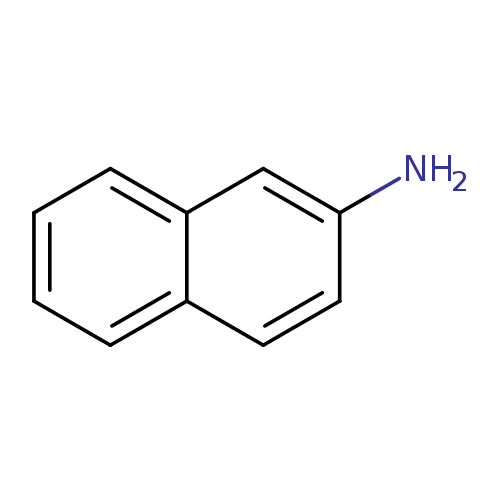
Common Name2-Aminonaphthalene
ClassSmall Molecule
Description2-Aminonaphthalene is an aromatic amine. It is used to make azo dyes. It is a known human carcinogen and has largely been replaced by less toxic compounds. 2-Aminonaphthalene is prepared by heating 2-naphthol with ammonium zinc chloride to 200-210 °C; or in the form of its acetyl derivative by heating 2-naphthol with ammonium acetate to 270-280 °C. It forms odorless, colorless plates which melt at 111-112 °C. It gives no color with ferric chloride. When reduced by sodium in boiling amyl alcohol solution it forms alicyclic tetrahydro-3-naphthylamine, which has most of the properties of the aliphatic amines; it is strongly alkaline in reaction, has an ammoniacal odor and cannot be diazotized. On oxidation it yields ortho-carboxy-hydrocinnamic acid, HO2CC6H4CH2CH2CO2H. Numerous sulfonic acidsderived from 2-aminonaphthalene are known. Of these, the delta-acid and Bronner's acid are of more value technically, since they combine with ortho-tetrazoditolyl to produce fine red dye-stuffs. 2-Aminonaphthalene is found in cigarette smoke and suspected to contribute to the development of bladder cancer.
Contaminant Sources
  • Clean Air Act Chemicals
  • HPV EPA Chemicals
  • IARC Carcinogens Group 1
  • T3DB toxins
  • Tobacco Smoke Compounds
  • ToxCast & Tox21 Chemicals
Contaminant Type
  • Amine
  • Cigarette Toxin
  • Industrial/Workplace Toxin
  • Metabolite
  • Organic Compound
  • Synthetic Compound
  • Uremic Toxin
Chemical Structure
Thumb
Synonyms
ValueSource
2-NaftilaminaChEBI
2-NaphthalenamineChEBI
2-NaphthylaminChEBI
6-NaphthylamineChEBI
beta-NaftilaminaChEBI
beta-NaphthylaminChEBI
beta-NaphthylamineChEBI
BNAChEBI
b-NaftilaminaGenerator
Β-naftilaminaGenerator
b-NaphthylaminGenerator
Β-naphthylaminGenerator
b-NaphthylamineGenerator
Β-naphthylamineGenerator
2-AminonaftalenHMDB
2-NaftylaminHMDB
2-NaftylamineHMDB
2-NaphthalamineHMDB
2-NaphthylamineHMDB
beta-NaftalaminHMDB
beta-NaftylaminHMDB
beta-NaftyloaminaHMDB
Fast scarlet base bHMDB
Naphthalen-2-amineHMDB
RCRA waste number u168HMDB
USAF CB-22HMDB
2 NaphthylamineHMDB
2 AminonaphthaleneHMDB
beta NaphthylamineHMDB
2-AminonaphthaleneChEBI
Chemical FormulaC10H9N
Average Molecular Mass143.185 g/mol
Monoisotopic Mass143.073 g/mol
CAS Registry Number91-59-8
IUPAC Namenaphthalen-2-amine
Traditional Nameβ naphthylamine
SMILESNC1=CC2=CC=CC=C2C=C1
InChI IdentifierInChI=1S/C10H9N/c11-10-6-5-8-3-1-2-4-9(8)7-10/h1-7H,11H2
InChI KeyJBIJLHTVPXGSAM-UHFFFAOYSA-N
Chemical Taxonomy
Description belongs to the class of organic compounds known as naphthalenes. Naphthalenes are compounds containing a naphthalene moiety, which consists of two fused benzene rings.
KingdomOrganic compounds
Super ClassBenzenoids
ClassNaphthalenes
Sub ClassNot Available
Direct ParentNaphthalenes
Alternative Parents
Substituents
  • Naphthalene
  • Organic nitrogen compound
  • Organopnictogen compound
  • Hydrocarbon derivative
  • Primary amine
  • Organonitrogen compound
  • Amine
  • Aromatic homopolycyclic compound
Molecular FrameworkAromatic homopolycyclic compounds
External Descriptors
Biological Properties
StatusDetected and Not Quantified
OriginExogenous
Cellular Locations
  • Cell surface
  • Cytosol
  • Membrane
Biofluid LocationsNot Available
Tissue LocationsNot Available
Pathways
NameSMPDB LinkKEGG Link
Nucleotide Excision RepairSMP00478 map03420
Base excision repairNot Availablemap03410
ApplicationsNot Available
Biological RolesNot Available
Chemical RolesNot Available
Physical Properties
StateSolid
AppearanceWhite powder.
Experimental Properties
PropertyValue
Melting Point113°C
Boiling PointNot Available
Solubility0.189 mg/mL at 25°C
Predicted Properties
PropertyValueSource
Water Solubility0.78 g/LALOGPS
logP2.3ALOGPS
logP2.13ChemAxon
logS-2.3ALOGPS
pKa (Strongest Basic)4.25ChemAxon
Physiological Charge0ChemAxon
Hydrogen Acceptor Count1ChemAxon
Hydrogen Donor Count1ChemAxon
Polar Surface Area26.02 ŲChemAxon
Rotatable Bond Count0ChemAxon
Refractivity47.21 m³·mol⁻¹ChemAxon
Polarizability16.06 ųChemAxon
Number of Rings2ChemAxon
Bioavailability1ChemAxon
Rule of FiveYesChemAxon
Ghose FilterNoChemAxon
Veber's RuleYesChemAxon
MDDR-like RuleNoChemAxon
Spectra
Spectra
Spectrum TypeDescriptionSplash KeyView
Predicted GC-MSPredicted GC-MS Spectrum - GC-MS (Non-derivatized) - 70eV, Positivesplash10-00kf-0900000000-ecc6ebe23a5149ac29abSpectrum
Predicted GC-MSPredicted GC-MS Spectrum - GC-MS (Non-derivatized) - 70eV, PositiveNot AvailableSpectrum
LC-MS/MSLC-MS/MS Spectrum - 75V, Positivesplash10-0006-0900000000-3bf8f62c0092962b9755Spectrum
LC-MS/MSLC-MS/MS Spectrum - 90V, Positivesplash10-00mo-0900000000-6b5ffaafdf95402a6216Spectrum
LC-MS/MSLC-MS/MS Spectrum - 30V, Positivesplash10-0006-0900000000-f2a5e8fa4fb64851b8cbSpectrum
LC-MS/MSLC-MS/MS Spectrum - 15V, Positivesplash10-0006-0900000000-25323b2ac58bb87e247aSpectrum
LC-MS/MSLC-MS/MS Spectrum - 45V, Positivesplash10-0006-0900000000-5915a9d18f20364e4263Spectrum
LC-MS/MSLC-MS/MS Spectrum - 60V, Positivesplash10-0006-0900000000-f27ef67ece738ba35154Spectrum
Predicted LC-MS/MSPredicted LC-MS/MS Spectrum - 10V, Positivesplash10-0006-0900000000-a6e33405c02f2304cfbeSpectrum
Predicted LC-MS/MSPredicted LC-MS/MS Spectrum - 20V, Positivesplash10-0006-0900000000-bd6d778c87db23cece65Spectrum
Predicted LC-MS/MSPredicted LC-MS/MS Spectrum - 40V, Positivesplash10-014i-4900000000-116c74f287b9a1de7adfSpectrum
Predicted LC-MS/MSPredicted LC-MS/MS Spectrum - 10V, Negativesplash10-0006-0900000000-a3754f2dae00f59bff44Spectrum
Predicted LC-MS/MSPredicted LC-MS/MS Spectrum - 20V, Negativesplash10-0006-0900000000-a3754f2dae00f59bff44Spectrum
Predicted LC-MS/MSPredicted LC-MS/MS Spectrum - 40V, Negativesplash10-0006-1900000000-7f97cf17cf9c604035f9Spectrum
Predicted LC-MS/MSPredicted LC-MS/MS Spectrum - 10V, Negativesplash10-0006-0900000000-3139ad0a41b8c84bdbc8Spectrum
Predicted LC-MS/MSPredicted LC-MS/MS Spectrum - 20V, Negativesplash10-0006-0900000000-3139ad0a41b8c84bdbc8Spectrum
Predicted LC-MS/MSPredicted LC-MS/MS Spectrum - 40V, Negativesplash10-0006-0900000000-5f22983ec8ec75c4235dSpectrum
Predicted LC-MS/MSPredicted LC-MS/MS Spectrum - 10V, Positivesplash10-0006-0900000000-e5d0ebf20455b6c0a953Spectrum
Predicted LC-MS/MSPredicted LC-MS/MS Spectrum - 20V, Positivesplash10-0006-0900000000-e5d0ebf20455b6c0a953Spectrum
Predicted LC-MS/MSPredicted LC-MS/MS Spectrum - 40V, Positivesplash10-014i-5900000000-93808191814dc1b4eaccSpectrum
MSMass Spectrum (Electron Ionization)splash10-0006-2900000000-ba05510fe794c267d8ffSpectrum
1D NMR1H NMR SpectrumNot AvailableSpectrum
1D NMR13C NMR SpectrumNot AvailableSpectrum
Toxicity Profile
Route of ExposureNot Available
Mechanism of ToxicityNot Available
MetabolismNot Available
Toxicity ValuesNot Available
Lethal DoseNot Available
Carcinogenicity (IARC Classification)1, carcinogenic to humans. (7)
Uses/SourcesNot Available
Minimum Risk LevelNot Available
Health EffectsNot Available
SymptomsNot Available
TreatmentNot Available
Concentrations
Not Available
DrugBank IDNot Available
HMDB IDHMDB0041802
FooDB IDNot Available
Phenol Explorer IDNot Available
KNApSAcK IDNot Available
BiGG IDNot Available
BioCyc IDNot Available
METLIN IDNot Available
PDB IDNot Available
Wikipedia Link2-Naphthylamine
Chemspider ID6790
ChEBI ID27878
PubChem Compound ID7057
Kegg Compound IDC02227
YMDB IDNot Available
ECMDB IDNot Available
References
Synthesis ReferenceNot Available
MSDSNot Available
General References
1. https://www.ncbi.nlm.nih.gov/pubmed/?term=11233991
2. https://www.ncbi.nlm.nih.gov/pubmed/?term=12149138
3. Armeli G: [Kidney neoplasm in a subject exposed to betanaphthylamine]. Med Lav. 1968 Jun-Jul;59(6):450-4.
4. Martynenko AG, Romanenko AM, Kartasheva LA: [Effect of liver functional disorders on the development of betanaphthylamine-induced tumors of the bladder in dogs]. Patol Fiziol Eksp Ter. 1973 May-Jun;17(3):55-6.
5. Mancuso TF, el-Attar AA: Cohort study of workers exposed to betanaphthylamine and benzidine. J Occup Med. 1967 Jun;9(6):277-85.
6. Ma XH, Sun GQ, Zhao YH, Jia XM: [Study on the properties of a novel glycine amino peptidase from Actinomucor elegans]. Sheng Wu Gong Cheng Xue Bao. 2004 Jul;20(4):578-83.
7. Bul'bulian MA: [An epidemiological study of the cancer morbidity in persons having industrial contact with carcinogenic amino compounds]. Vopr Onkol. 1991;37(3):275-9.