Record Information
Version1.0
Creation Date2014-08-29 05:53:23 UTC
Update Date2026-04-17 19:45:56 UTC
Accession NumberCHEM003172
Identification
Common NameSafrole
ClassSmall Molecule
DescriptionSafrole is found in anise. Safrole occurs in nutmeg. Banned by FDA for use in food. Safrole is formerly used as a food flavour It is a precursor in the synthesis of the insecticide synergist piperonyl butoxide and the recreational drug MDMA (Ecstacy). Safrole is a natural plant constituent, found in oil of sassafras and certain other essential oils. It is a member of the methylenedioxybenzene group of compounds, many of which (e.g. piperonyl butoxide) are extensively used as insecticide synergists. Safrole is a major source of human exposure to safrole is through consumption of spices, such as nutmeg, cinnamon and black pepper, in which safrole is a constituent. Safrole is also present in root beer, and has been used as an additive in chewing gum, toothpaste, soaps and certain pharmaceutical preparations. Safrole is a weak hepatocarcinogen and it is a matter of considerable interest whether the ally1 moiety or the methylenedioxy group, or both, are involved in the mechanism of its carcinogenesis. Safrole is extensively metabolized, giving rise to a large number of metabolites. Metabolism involves essentially two major routes, oxidation of the ally1 side chain, and oxidation of the methylenedioxy group with subsequent cleavage to form the catechol. Safrole undergoes oxidation of the allylic group to yield the 2, 3-epoxide (safrole epoxide). The dihydrodiol is one of the metabolites of safrole, and presumably arises from the hydration of the 2, 3-epoxide. The principal route of metabolism of safrole is through cleavage of the methylenedioxy group, the major metabolites being allylcatechol and its isomer, propenylcatechol. Eugenol and its isomer I-methoxy- 2-hydroxy-4-allylbenzene have been detected as minor metabolites in the rat, mouse and man. ; Safrole, also known as shikimol, is a colorless or slightly yellow oily liquid. It is typically extracted from the root-bark or the fruit of sassafras plants in the form of sassafras oil, or synthesized from other related methylenedioxy compounds. It is the principal component of brown camphor oil, and is found in small amounts in a wide variety of plants, where it functions as a natural pesticide. The Ocotea cymbarum[verification needed] oil made of the Ocotea pretiosa[verification needed], a plant growing in Brazil, and sassafras oil made of Sassafras albidum, a tree growing in eastern North America, are the main natural sources for safrole. It has a characteristic candy-shop aroma. Safrole has been shown to exhibit antibiotic and anti-angiogenic functions (1, 2, 3).
Contaminant Sources
  • Clean Air Act Chemicals
  • DEA Chemicals
  • EAFUS Chemicals
  • FooDB Chemicals
  • HPV EPA Chemicals
  • IARC Carcinogens Group 2B
  • T3DB toxins
  • Tobacco Smoke Compounds
  • ToxCast & Tox21 Chemicals
Contaminant Type
  • Cigarette Toxin
  • Food Toxin
  • Insecticide
  • Metabolite
  • Natural Compound
  • Organic Compound
  • Pesticide
  • Plant Toxin
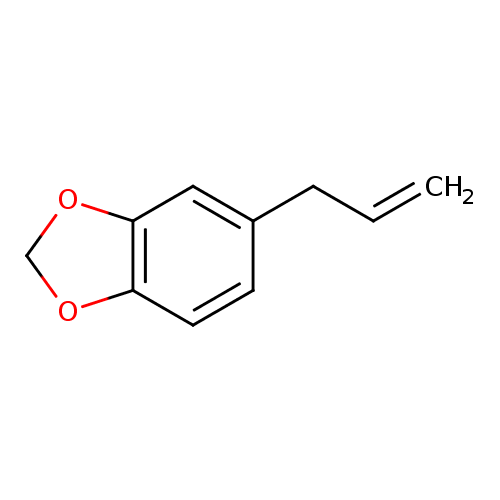
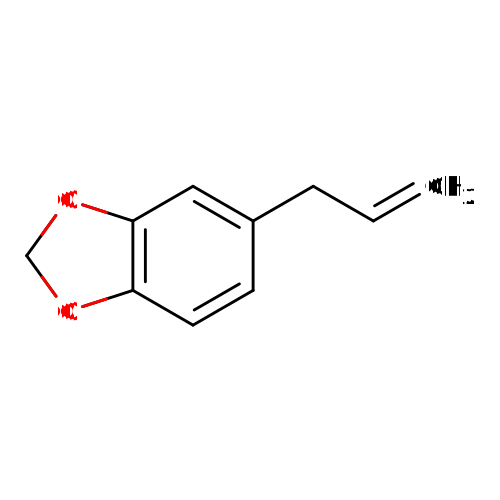
Chemical Structure
Thumb
Synonyms
ValueSource
1,2-Methylenedioxy-4-allylbenzeneChEBI
1-Allyl-3,4-methylenedioxybenzeneChEBI
3,4-(Methylenedioxy)allylbenzeneChEBI
3-(3,4-Methylenedioxyphenyl)prop-1-eneChEBI
4-Allyl-1,2-methylenedioxybenzeneChEBI
4-Allylpyrocatechol formaldehyde acetalChEBI
5-(2-Propenyl)-1,3-benzodioxoleChEBI
5-Allyl-benzo[1,3]dioxoleChEBI
Allylcatechol methylene etherChEBI
m-Allylpyrocatechin methylene etherChEBI
SafrolChEBI
ShikimolChEBI
ShikimoleChEBI
(1,2-(Methylenedioxy)-4-allyl)benzeneHMDB
(Allyldioxy)benzene methylene etherHMDB
(e)5-1-Propenyl]-1,3-benzodioxoleHMDB
1, 2-(Methylenedioxy)-4-allylbenzeneHMDB
1,2-(Methylenedioxy)-4-propenylbenzeneHMDB
1,2-Methylenedioxy-4-allyl-benzeneHMDB
1-Allyl,3,4-methylenedioxy benzeneHMDB
3, 4-(Methylenedioxy)allylbenzeneHMDB
3,4-(Methylenedioxy)-1-propenylbenzeneHMDB
3,4-Methylenedioxy-allybenzeneHMDB
3,4-MethylenedioxyallylbenzeneHMDB
4-Allyl-1, 2-(methylenedioxy)benzeneHMDB
4-Allyl-1,2-(methylenedioxy)benzene, 8ciHMDB
4-AllylpyrocatecholHMDB
4-Propenyl-1,2-methylenedioxybenzeneHMDB
4-Propenylcatechol methylene etherHMDB
5-(1-Propenyl)-1,3-benzodioxoleHMDB
5-(2-Propenyl)-1,3-benzodioxole, 9ciHMDB
5-Allyl-1,3-benzodioxolerlet DS baseHMDB
5-Prop-2-enyl-1,3-benzodioxoleHMDB
6-(1-Propenyl)-1,3-benzodioxoleHMDB
Allyldioxybenzene methylene etherHMDB
Allylpyrocatechol methylene etherHMDB
IsosafrolHMDB
IsosafroleHMDB
IzosafrolHMDB
ShikomolHMDB
4 Allyl 1,2 methylenedioxybenzeneMeSH
4-Allyl-1,2-methylenedioxybenzenesMeSH
SafrolesMeSH
ShikimolsMeSH
SafrolsMeSH
Chemical FormulaC10H10O2
Average Molecular Mass162.185 g/mol
Monoisotopic Mass162.068 g/mol
CAS Registry Number94-59-7
IUPAC Name5-(prop-2-en-1-yl)-2H-1,3-benzodioxole
Traditional Namesassafras
SMILESC=CCC1=CC2=C(OCO2)C=C1
InChI IdentifierInChI=1S/C10H10O2/c1-2-3-8-4-5-9-10(6-8)12-7-11-9/h2,4-6H,1,3,7H2
InChI KeyZMQAAUBTXCXRIC-UHFFFAOYSA-N
Chemical Taxonomy
Description belongs to the class of organic compounds known as benzodioxoles. These are organic compounds containing a benzene ring fused to either isomers of dioxole. Dioxole is a five-membered unsaturated ring of two oxygen atoms and three carbon atoms.
KingdomOrganic compounds
Super ClassOrganoheterocyclic compounds
ClassBenzodioxoles
Sub ClassNot Available
Direct ParentBenzodioxoles
Alternative Parents
Substituents
  • Benzodioxole
  • Benzenoid
  • Oxacycle
  • Acetal
  • Organic oxygen compound
  • Hydrocarbon derivative
  • Organooxygen compound
  • Aromatic heteropolycyclic compound
Molecular FrameworkAromatic heteropolycyclic compounds
External Descriptors
Biological Properties
StatusDetected and Not Quantified
OriginExogenous
Cellular Locations
  • Cytoplasm
  • Extracellular
  • Membrane
Biofluid LocationsNot Available
Tissue LocationsNot Available
PathwaysNot Available
Applications
Biological Roles
Chemical RolesNot Available
Physical Properties
StateLiquid
AppearanceNot Available
Experimental Properties
PropertyValue
Melting Point11.2°C
Boiling Point232 - 234°C
SolubilityNot Available
Predicted Properties
PropertyValueSource
Water Solubility1.24 g/LALOGPS
logP2.23ALOGPS
logP2.7ChemAxon
logS-2.1ALOGPS
pKa (Strongest Basic)-4.7ChemAxon
Physiological Charge0ChemAxon
Hydrogen Acceptor Count2ChemAxon
Hydrogen Donor Count0ChemAxon
Polar Surface Area18.46 ŲChemAxon
Rotatable Bond Count2ChemAxon
Refractivity46.11 m³·mol⁻¹ChemAxon
Polarizability17.24 ųChemAxon
Number of Rings2ChemAxon
Bioavailability1ChemAxon
Rule of FiveYesChemAxon
Ghose FilterYesChemAxon
Veber's RuleYesChemAxon
MDDR-like RuleNoChemAxon
Spectra
Spectra
Spectrum TypeDescriptionSplash KeyView
GC-MSGC-MS Spectrum - EI-B (Non-derivatized)splash10-0ik9-3900000000-27e98ee529004a2d8b66Spectrum
GC-MSGC-MS Spectrum - EI-B (Non-derivatized)splash10-0ik9-6900000000-54b4c1509456711936dfSpectrum
GC-MSGC-MS Spectrum - EI-B (Non-derivatized)splash10-03di-6900000000-87b7efd770862a8f97a5Spectrum
GC-MSGC-MS Spectrum - EI-B (Non-derivatized)splash10-0ik9-5900000000-0e7164aea8e5fa73ab55Spectrum
GC-MSGC-MS Spectrum - EI-B (Non-derivatized)splash10-03di-0900000000-cae3268c72651c72100cSpectrum
GC-MSGC-MS Spectrum - EI-B (Non-derivatized)splash10-0ik9-3900000000-27e98ee529004a2d8b66Spectrum
GC-MSGC-MS Spectrum - EI-B (Non-derivatized)splash10-0ik9-6900000000-54b4c1509456711936dfSpectrum
GC-MSGC-MS Spectrum - EI-B (Non-derivatized)splash10-03di-6900000000-87b7efd770862a8f97a5Spectrum
GC-MSGC-MS Spectrum - EI-B (Non-derivatized)splash10-0ik9-5900000000-0e7164aea8e5fa73ab55Spectrum
GC-MSGC-MS Spectrum - EI-B (Non-derivatized)splash10-03di-0900000000-cae3268c72651c72100cSpectrum
Predicted GC-MSPredicted GC-MS Spectrum - GC-MS (Non-derivatized) - 70eV, Positivesplash10-01sa-2900000000-390702c1e607859e4700Spectrum
Predicted GC-MSPredicted GC-MS Spectrum - GC-MS (Non-derivatized) - 70eV, PositiveNot AvailableSpectrum
Predicted LC-MS/MSPredicted LC-MS/MS Spectrum - 10V, Positivesplash10-03di-0900000000-ce90b24b2ef83a609261Spectrum
Predicted LC-MS/MSPredicted LC-MS/MS Spectrum - 20V, Positivesplash10-03di-1900000000-cb602c608751e483efceSpectrum
Predicted LC-MS/MSPredicted LC-MS/MS Spectrum - 40V, Positivesplash10-0udl-9600000000-85407378b64267759f6dSpectrum
Predicted LC-MS/MSPredicted LC-MS/MS Spectrum - 10V, Negativesplash10-03di-0900000000-f5650e9b49b023a3cfd2Spectrum
Predicted LC-MS/MSPredicted LC-MS/MS Spectrum - 20V, Negativesplash10-03di-0900000000-9dbd3903283425175546Spectrum
Predicted LC-MS/MSPredicted LC-MS/MS Spectrum - 40V, Negativesplash10-02ti-5900000000-4204c0caaf5bb9b5d258Spectrum
Predicted LC-MS/MSPredicted LC-MS/MS Spectrum - 10V, Positivesplash10-03di-0900000000-9b0c6d7bc981d77b1927Spectrum
Predicted LC-MS/MSPredicted LC-MS/MS Spectrum - 20V, Positivesplash10-03k9-0900000000-01530378eccaf5c845f0Spectrum
Predicted LC-MS/MSPredicted LC-MS/MS Spectrum - 40V, Positivesplash10-0fvr-9400000000-d251b0867c3f55c2e90eSpectrum
Predicted LC-MS/MSPredicted LC-MS/MS Spectrum - 10V, Negativesplash10-03di-0900000000-4d3d221c51bdf4e740a2Spectrum
Predicted LC-MS/MSPredicted LC-MS/MS Spectrum - 20V, Negativesplash10-03di-0900000000-3a92a79dc10e1183839fSpectrum
Predicted LC-MS/MSPredicted LC-MS/MS Spectrum - 40V, Negativesplash10-01ot-7900000000-1024f7dba32bfc58ce37Spectrum
MSMass Spectrum (Electron Ionization)splash10-0ik9-4900000000-9558c12b4c5a01a27490Spectrum
1D NMR1H NMR SpectrumNot AvailableSpectrum
1D NMR13C NMR SpectrumNot AvailableSpectrum
Toxicity Profile
Route of ExposureNot Available
Mechanism of ToxicityNot Available
MetabolismNot Available
Toxicity ValuesNot Available
Lethal DoseNot Available
Carcinogenicity (IARC Classification)2B, possibly carcinogenic to humans. (4)
Uses/SourcesThis is a natural compound that is used as a pesticide.
Minimum Risk LevelNot Available
Health EffectsNot Available
SymptomsNot Available
TreatmentNot Available
Concentrations
Not Available
DrugBank IDNot Available
HMDB IDHMDB0033591
FooDB IDFDB011672
Phenol Explorer IDNot Available
KNApSAcK IDC00002771
BiGG IDNot Available
BioCyc IDNot Available
METLIN IDNot Available
PDB IDNot Available
Wikipedia LinkSafrole
Chemspider ID13848731
ChEBI ID8994
PubChem Compound ID5144
Kegg Compound IDC10490
YMDB IDNot Available
ECMDB IDNot Available
References
Synthesis ReferenceNguyen, Duc Tao; Le, Huyen; Pham, Van Tin. Study on the preparation of isosafrol from essential oil of Xa Xi. Tap Chi Duoc Hoc (1998), (1), 9-10.
MSDSLink
General References
1. https://www.ncbi.nlm.nih.gov/pubmed/?term=14422
2. https://www.ncbi.nlm.nih.gov/pubmed/?term=15334724
3. https://www.ncbi.nlm.nih.gov/pubmed/?term=19656034
4. https://www.ncbi.nlm.nih.gov/pubmed/?term=21089955
5. https://www.ncbi.nlm.nih.gov/pubmed/?term=21173435
6. https://www.ncbi.nlm.nih.gov/pubmed/?term=21591240
7. https://www.ncbi.nlm.nih.gov/pubmed/?term=21863093
8. https://www.ncbi.nlm.nih.gov/pubmed/?term=23112005
9. https://www.ncbi.nlm.nih.gov/pubmed/?term=24150866
10. https://www.ncbi.nlm.nih.gov/pubmed/?term=6191767
11. https://www.ncbi.nlm.nih.gov/pubmed/?term=7030889
12. https://www.ncbi.nlm.nih.gov/pubmed/?term=7806308
13. Nguyen, Duc Tao; Le, Huyen; Pham, Van Tin. Study on the preparation of isosafrol from essential oil of Xa Xi. Tap Chi Duoc Hoc (1998), (1), 9-10.
14. Ioannides C, Lum PY, Parke DV: Cytochrome P-448 and the activation of toxic chemicals and carcinogens. Xenobiotica. 1984 Jan-Feb;14(1-2):119-37.
15. Hung SL, Chen YL, Chen YT: Effects of safrole on the defensive functions of human neutrophils. J Periodontal Res. 2003 Apr;38(2):130-4.
16. Zhao J, Miao J, Zhao B, Zhang S, Yin D: Safrole oxide inhibits angiogenesis by inducing apoptosis. Vascul Pharmacol. 2005 Jun;43(1):69-74.
17. Yannai, Shmuel. (2004) Dictionary of food compounds with CD-ROM: Additives, flavors, and ingredients. Boca Raton: Chapman & Hall/CRC.