Record Information
Version1.0
Creation Date2014-08-29 05:53:18 UTC
Update Date2026-04-02 23:27:22 UTC
Accession NumberCHEM003171
Identification
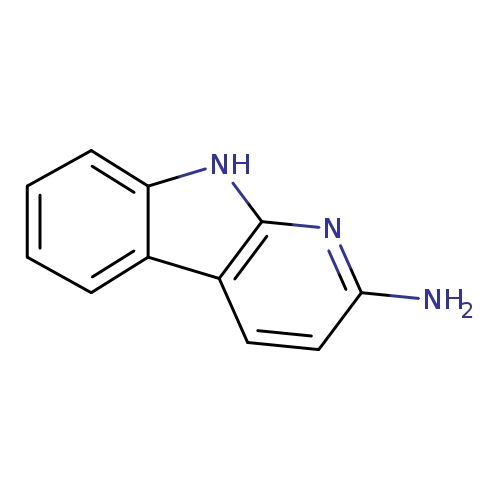
Common Name2-Amino-a-carboline
ClassSmall Molecule
Description2-Amino-a-carboline is found in cooked foods as pyrolysis produced of tryptophan.
Contaminant Sources
  • FooDB Chemicals
  • IARC Carcinogens Group 2B
  • Suspected Compounds
  • T3DB toxins
  • Tobacco Smoke Compounds
Contaminant Type
  • Cigarette Toxin
  • Food Toxin
  • Metabolite
  • Natural Compound
  • Organic Compound
Chemical Structure
Thumb
Synonyms
ValueSource
2-Amino-alpha-carbolineKegg
a-alpha-CKegg
2-Amino-α-carbolineGenerator
a-a-CGenerator
a-Α-CGenerator
2-Amino-9H-pyrido(2,3-b)indoleMeSH
2-Amino-9H-pyrido(2,3-b)indole, D-labeledMeSH
1H-pyrido(2,3-b)indol-2-AmineHMDB
2-amino-9H-pyrido[2,3-b]IndoleHMDB
3-amino-3-Carboline (obsol.)HMDB
9H-pyrido[2,3-b]indol-2-AmineHMDB
amino-alpha-CarbolineHMDB
Glob-P-2HMDB
2-Amino-a-carbolineGenerator
Chemical FormulaC11H9N3
Average Molecular Mass183.209 g/mol
Monoisotopic Mass183.080 g/mol
CAS Registry Number26148-68-5
IUPAC Name9H-pyrido[2,3-b]indol-2-amine
Traditional Name2-amino-9H-pyrido[2,3-b]indole
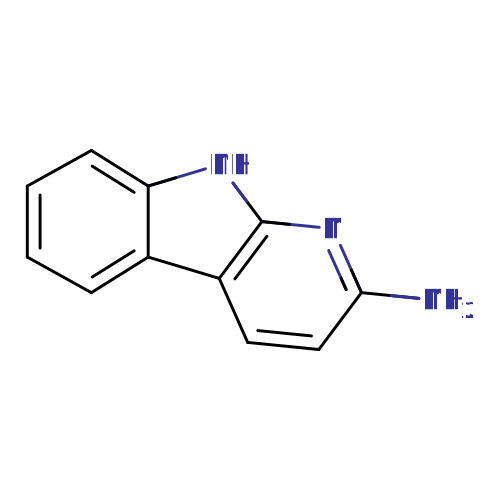
SMILESNC1=NC2=C(C=C1)C1=CC=CC=C1N2
InChI IdentifierInChI=1S/C11H9N3/c12-10-6-5-8-7-3-1-2-4-9(7)13-11(8)14-10/h1-6H,(H3,12,13,14)
InChI KeyFJTNLJLPLJDTRM-UHFFFAOYSA-N
Chemical Taxonomy
Description belongs to the class of organic compounds known as alpha carbolines. These are organic compounds containing a pyrido[2,3-b]indole core (which is a pyridine fused to an indole).
KingdomOrganic compounds
Super ClassOrganoheterocyclic compounds
ClassIndoles and derivatives
Sub ClassPyridoindoles
Direct ParentAlpha carbolines
Alternative Parents
Substituents
  • Alpha-carboline
  • Pyrrolopyridine
  • Indole
  • Imidolactam
  • Benzenoid
  • Pyridine
  • Heteroaromatic compound
  • Pyrrole
  • Azacycle
  • Organic nitrogen compound
  • Organopnictogen compound
  • Hydrocarbon derivative
  • Organonitrogen compound
  • Aromatic heteropolycyclic compound
Molecular FrameworkAromatic heteropolycyclic compounds
External Descriptors
Biological Properties
StatusDetected and Not Quantified
OriginExogenous
Cellular Locations
  • Cytoplasm
  • Extracellular
  • Membrane
Biofluid LocationsNot Available
Tissue LocationsNot Available
PathwaysNot Available
ApplicationsNot Available
Biological RolesNot Available
Chemical RolesNot Available
Physical Properties
StateSolid
AppearanceWhite powder.
Experimental Properties
PropertyValue
Melting Point202 - 203°C
Boiling PointNot Available
SolubilityNot Available
Predicted Properties
PropertyValueSource
Water Solubility0.45 g/LALOGPS
logP2.08ALOGPS
logP2.01ChemAxon
logS-2.6ALOGPS
pKa (Strongest Acidic)14.12ChemAxon
pKa (Strongest Basic)4.82ChemAxon
Physiological Charge0ChemAxon
Hydrogen Acceptor Count2ChemAxon
Hydrogen Donor Count2ChemAxon
Polar Surface Area54.7 ŲChemAxon
Rotatable Bond Count0ChemAxon
Refractivity56.28 m³·mol⁻¹ChemAxon
Polarizability19.81 ųChemAxon
Number of Rings3ChemAxon
Bioavailability1ChemAxon
Rule of FiveYesChemAxon
Ghose FilterYesChemAxon
Veber's RuleNoChemAxon
MDDR-like RuleNoChemAxon
Spectra
Spectra
Spectrum TypeDescriptionSplash KeyView
GC-MSGC-MS Spectrum - EI-B (Non-derivatized)splash10-001i-6900000000-f274c4663b258cba600dSpectrum
Predicted GC-MSPredicted GC-MS Spectrum - GC-MS (Non-derivatized) - 70eV, Positivesplash10-053r-0900000000-5c4ec40046c4c105b132Spectrum
Predicted GC-MSPredicted GC-MS Spectrum - GC-MS (Non-derivatized) - 70eV, PositiveNot AvailableSpectrum
LC-MS/MSLC-MS/MS Spectrum - APCI-ITFT , negativesplash10-0006-0900000000-3bdfae9d7010d49fc99aSpectrum
LC-MS/MSLC-MS/MS Spectrum - ESI-ITFT , positivesplash10-001i-0900000000-f6e28bb7831900d6ad8dSpectrum
LC-MS/MSLC-MS/MS Spectrum - APCI-ITFT , positivesplash10-00lr-0900000000-d7ca8cf399170a1846e1Spectrum
LC-MS/MSLC-MS/MS Spectrum - 10V, Positivesplash10-001i-0900000000-8f80b0ded52944ffe17eSpectrum
LC-MS/MSLC-MS/MS Spectrum - 20V, Positivesplash10-001i-0900000000-8456e1d36c9bed2d70beSpectrum
LC-MS/MSLC-MS/MS Spectrum - 40V, Positivesplash10-0006-0900000000-f70e6be8fbd6b9147b5aSpectrum
LC-MS/MSLC-MS/MS Spectrum - 30V, Positivesplash10-014l-0900000000-27f6450790ed85c55c52Spectrum
LC-MS/MSLC-MS/MS Spectrum - 50V, Positivesplash10-0006-0900000000-d3676e137577c5a0c8fbSpectrum
LC-MS/MSLC-MS/MS Spectrum - 35V, Positivesplash10-001i-0900000000-f6e28bb7831900d6ad8dSpectrum
Predicted LC-MS/MSPredicted LC-MS/MS Spectrum - 10V, Positivesplash10-001i-0900000000-40420b8554fb9b744f9aSpectrum
Predicted LC-MS/MSPredicted LC-MS/MS Spectrum - 20V, Positivesplash10-001i-0900000000-3a936d103eb70483c5bfSpectrum
Predicted LC-MS/MSPredicted LC-MS/MS Spectrum - 40V, Positivesplash10-014i-0900000000-abe05524e994f27c1662Spectrum
Predicted LC-MS/MSPredicted LC-MS/MS Spectrum - 10V, Negativesplash10-001i-0900000000-39da2723de9d6114edd8Spectrum
Predicted LC-MS/MSPredicted LC-MS/MS Spectrum - 20V, Negativesplash10-001i-0900000000-fb27400b5d7940df7bfeSpectrum
Predicted LC-MS/MSPredicted LC-MS/MS Spectrum - 40V, Negativesplash10-067i-1900000000-e2bd4f7e390fcf75eed8Spectrum
Predicted LC-MS/MSPredicted LC-MS/MS Spectrum - 10V, Negativesplash10-001i-0900000000-5ed329ab18240e3f7699Spectrum
Predicted LC-MS/MSPredicted LC-MS/MS Spectrum - 20V, Negativesplash10-001i-0900000000-5ed329ab18240e3f7699Spectrum
Predicted LC-MS/MSPredicted LC-MS/MS Spectrum - 40V, Negativesplash10-0f6x-0900000000-f789de2c65d991670b1bSpectrum
Predicted LC-MS/MSPredicted LC-MS/MS Spectrum - 10V, Positivesplash10-001i-0900000000-93c20d3cb3e863c5d375Spectrum
Predicted LC-MS/MSPredicted LC-MS/MS Spectrum - 20V, Positivesplash10-001i-0900000000-93c20d3cb3e863c5d375Spectrum
Predicted LC-MS/MSPredicted LC-MS/MS Spectrum - 40V, Positivesplash10-000x-0900000000-c78317e6ffd98846784fSpectrum
Toxicity Profile
Route of ExposureNot Available
Mechanism of ToxicityNot Available
MetabolismNot Available
Toxicity ValuesNot Available
Lethal DoseNot Available
Carcinogenicity (IARC Classification)2B, possibly carcinogenic to humans. (13)
Uses/SourcesThis is a toxic chemical found in cigarettes or generated by tobacco combustion.
Minimum Risk LevelNot Available
Health EffectsNot Available
SymptomsNot Available
TreatmentNot Available
Concentrations
Not Available
DrugBank IDNot Available
HMDB IDHMDB0033141
FooDB IDFDB011142
Phenol Explorer IDNot Available
KNApSAcK IDNot Available
BiGG IDNot Available
BioCyc IDNot Available
METLIN IDNot Available
PDB IDNot Available
Wikipedia LinkNot Available
Chemspider ID56541
ChEBI IDNot Available
PubChem Compound ID62805
Kegg Compound IDC19186
YMDB IDNot Available
ECMDB IDNot Available
References
Synthesis ReferenceNot Available
MSDSNot Available
General References
1. Melo A, Viegas O, Petisca C, Pinho O, Ferreira IM: Effect of beer/red wine marinades on the formation of heterocyclic aromatic amines in pan-fried beef. J Agric Food Chem. 2008 Nov 26;56(22):10625-32. doi: 10.1021/jf801837s.
2. Bessette EE, Yasa I, Dunbar D, Wilkens LR, Le Marchand L, Turesky RJ: Biomonitoring of carcinogenic heterocyclic aromatic amines in hair: a validation study. Chem Res Toxicol. 2009 Aug;22(8):1454-63. doi: 10.1021/tx900155f.
3. De Andres F, Zougagh M, Castaneda G, Rios A: Simultaneous determination of six non-polar heterocyclic amines in meat samples by supercritical fluid extraction-capillary electrophoresis under fluorimetric detection. Electrophoresis. 2010 Jul;31(13):2165-73. doi: 10.1002/elps.201000080.
4. Bessette EE, Goodenough AK, Langouet S, Yasa I, Kozekov ID, Spivack SD, Turesky RJ: Screening for DNA adducts by data-dependent constant neutral loss-triple stage mass spectrometry with a linear quadrupole ion trap mass spectrometer. Anal Chem. 2009 Jan 15;81(2):809-19. doi: 10.1021/ac802096p.
5. Stidl R, Sontag G, Koller V, Knasmuller S: Binding of heterocyclic aromatic amines by lactic acid bacteria: results of a comprehensive screening trial. Mol Nutr Food Res. 2008 Mar;52(3):322-9. doi: 10.1002/mnfr.200700034.
6. Turesky RJ, Bendaly J, Yasa I, Doll MA, Hein DW: The impact of NAT2 acetylator genotype on mutagenesis and DNA adducts from 2-amino-9H-pyrido[2,3-b]indole. Chem Res Toxicol. 2009 Apr;22(4):726-33. doi: 10.1021/tx800473w.
7. Bessette EE, Spivack SD, Goodenough AK, Wang T, Pinto S, Kadlubar FF, Turesky RJ: Identification of carcinogen DNA adducts in human saliva by linear quadrupole ion trap/multistage tandem mass spectrometry. Chem Res Toxicol. 2010 Jul 19;23(7):1234-44. doi: 10.1021/tx100098f.
8. Calbiani F, Careri M, Elviri L, Mangia A, Zagnoni I: Validation of an ion-pair liquid chromatography-electrospray-tandem mass spectrometry method for the determination of heterocyclic aromatic amines in meat-based infant foods. Food Addit Contam. 2007 Aug;24(8):833-41.
9. Costa M, Viegas O, Melo A, Petisca C, Pinho O, Ferreira IM: Heterocyclic aromatic amine formation in barbecued sardines (Sardina pilchardus) and Atlantic salmon (Salmo salar). J Agric Food Chem. 2009 Apr 22;57(8):3173-9. doi: 10.1021/jf8035808.
10. Back YM, Lee JH, Shin HS, Lee KG: Analysis of heterocyclic amines and beta-carbolines by liquid chromatography-mass spectrometry in cooked meats commonly consumed in Korea. Food Addit Contam Part A Chem Anal Control Expo Risk Assess. 2009 Mar;26(3):298-305. doi: 10.1080/02652030802526834.
11. Turesky RJ, Yuan JM, Wang R, Peterson S, Yu MC: Tobacco smoking and urinary levels of 2-amino-9H-pyrido[2,3-b]indole in men of Shanghai, China. Cancer Epidemiol Biomarkers Prev. 2007 Aug;16(8):1554-60.
12. Lopez-Mendez C, Bermudez-Fajardo A, Ioannides C, Oviedo-Orta E: Effect of 2-amino-9H-pyrido[2,3-b]indole (AalphaC), a carcinogenic heterocyclic amine present in food, on atherosclerotic plaque development in apoE deficient mice. Toxicol Lett. 2009 Mar 10;185(2):73-8. doi: 10.1016/j.toxlet.2008.11.014. Epub 2008 Dec 3.
13. Yannai, Shmuel. (2004) Dictionary of food compounds with CD-ROM: Additives, flavors, and ingredients. Boca Raton: Chapman & Hall/CRC.