Record Information
Version1.0
Creation Date2014-08-29 05:52:03 UTC
Update Date2026-04-05 12:03:53 UTC
Accession NumberCHEM003157
Identification
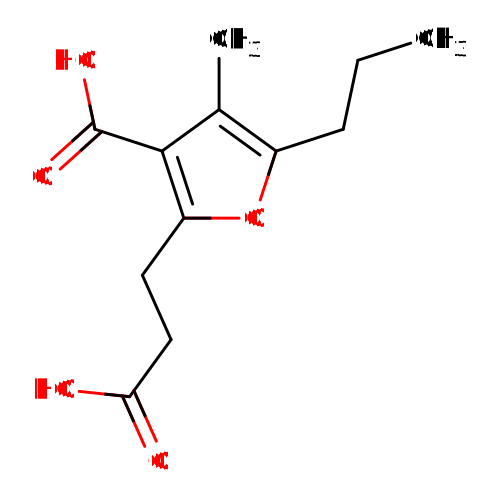
Common Name3-Carboxy-4-methyl-5-propyl-2-furan-propanoic acid
ClassSmall Molecule
Description3-Carboxy-4-methyl-5-propyl-2-furan-propanoic acid(CMPF) is a uremic toxin. Uremic toxins can be subdivided into three major groups based upon their chemical and physical characteristics: 1) small, water-soluble, non-protein-bound compounds, such as urea; 2) small, lipid-soluble and/or protein-bound compounds, such as the phenols and 3) larger so-called middle-molecules, such as beta2-microglobulin. Chronic exposure of uremic toxins can lead to a number of conditions including renal damage, chronic kidney disease and cardiovascular disease. 3-Carboxy-4-methyl-5-propyl-2-furan-propanoic acid(CMPF) is significantly accumulated in the serum of chronic kidney disease patients and is considered to be a potent uremic toxin There are several minor derivatives of CMPF that have been detected in serum and urine including 3-carboxy-4-methyl-5-pentyl-2-furanpropionic acid, 3-carboxy-4-methyl-5-ethyl-2-furanpropionic acid and 3-carboxy-5-propyl-2-furanpropionic acid. CMPF was first detected in human urine in 1979 and it is believed to be formed from the consumption of fish, vegetables and fruits CMPF is a strong inhibitor of mitochondrial respiration and is associated with thyroid dysfunction CMPF also directly inhibits renal secretion of various drugs and endogenous organic acids by competitively inhibiting OAT3 transporters It is also thought to contribute to various neurological abnormalities because it inhibits the transport of organic acids at the blood-brain barrier (2, 3, 4, 5).
Contaminant Sources
  • T3DB toxins
Contaminant Type
  • Ester
  • Metabolite
  • Natural Compound
  • Organic Compound
  • Uremic Toxin
Chemical Structure
Thumb
Synonyms
ValueSource
CMPFChEBI
3-Carboxy-4-methyl-5-propyl-2-furanpropionateGenerator
3-Carboxy-4-methyl-5-propyl-2-furan-propanoateHMDB
U(3,3)HMDB
CMPFPAHMDB
3-Carboxy-4-methyl-5-propyl-2-furanpropanoic acidHMDB
Propylurofuranic acidHMDB
3-Carboxy-4-methyl-5-propyl-2-furanpropanoateHMDB
2-(2-Carboxyethyl)-4-methyl-4-propylfuran-3-carboxylic acidHMDB
3-Carboxy-4-methyl-5-propyl-2-furanpropionic acidHMDB, ChEBI
Chemical FormulaC12H16O5
Average Molecular Mass240.252 g/mol
Monoisotopic Mass240.100 g/mol
CAS Registry Number86879-39-2
IUPAC Name2-(2-carboxyethyl)-4-methyl-5-propylfuran-3-carboxylic acid
Traditional Name2-(2-carboxyethyl)-4-methyl-5-propylfuran-3-carboxylic acid
SMILESCCCC1=C(C)C(C(O)=O)=C(CCC(O)=O)O1
InChI IdentifierInChI=1S/C12H16O5/c1-3-4-8-7(2)11(12(15)16)9(17-8)5-6-10(13)14/h3-6H2,1-2H3,(H,13,14)(H,15,16)
InChI KeyWMCQWXZMVIETAO-UHFFFAOYSA-N
Chemical Taxonomy
Description belongs to the class of organic compounds known as furanoid fatty acids. These are fatty acids containing a 5-alkylfuran-2-alkanoic acid.
KingdomOrganic compounds
Super ClassLipids and lipid-like molecules
ClassFatty Acyls
Sub ClassFatty acids and conjugates
Direct ParentFuranoid fatty acids
Alternative Parents
Substituents
  • Furanoid fatty acid
  • Furoic acid or derivatives
  • Furan-3-carboxylic acid
  • Furan-3-carboxylic acid or derivatives
  • Furoic acid
  • Dicarboxylic acid or derivatives
  • Furan
  • Heteroaromatic compound
  • Carboxylic acid derivative
  • Carboxylic acid
  • Oxacycle
  • Organoheterocyclic compound
  • Organic oxide
  • Organic oxygen compound
  • Hydrocarbon derivative
  • Organooxygen compound
  • Carbonyl group
  • Aromatic heteromonocyclic compound
Molecular FrameworkAromatic heteromonocyclic compounds
External Descriptors
Biological Properties
StatusDetected and Not Quantified
OriginEndogenous
Cellular Locations
  • Membrane
Biofluid LocationsNot Available
Tissue LocationsNot Available
PathwaysNot Available
ApplicationsNot Available
Biological Roles
Chemical RolesNot Available
Physical Properties
StateSolid
AppearanceWhite powder.
Experimental Properties
PropertyValue
Melting PointNot Available
Boiling PointNot Available
SolubilityNot Available
Predicted Properties
PropertyValueSource
Water Solubility0.22 g/LALOGPS
logP1.68ALOGPS
logP2.3ChemAxon
logS-3ALOGPS
pKa (Strongest Acidic)3.87ChemAxon
pKa (Strongest Basic)-2.9ChemAxon
Physiological Charge-2ChemAxon
Hydrogen Acceptor Count4ChemAxon
Hydrogen Donor Count2ChemAxon
Polar Surface Area87.74 ŲChemAxon
Rotatable Bond Count6ChemAxon
Refractivity61.08 m³·mol⁻¹ChemAxon
Polarizability25.26 ųChemAxon
Number of Rings1ChemAxon
Bioavailability1ChemAxon
Rule of FiveYesChemAxon
Ghose FilterYesChemAxon
Veber's RuleNoChemAxon
MDDR-like RuleNoChemAxon
Spectra
Spectra
Spectrum TypeDescriptionSplash KeyView
Predicted GC-MSPredicted GC-MS Spectrum - GC-MS (Non-derivatized) - 70eV, Positivesplash10-006x-2940000000-c178377899768707f7efSpectrum
Predicted GC-MSPredicted GC-MS Spectrum - GC-MS (2 TMS) - 70eV, Positivesplash10-00xr-9054000000-b2ed65a9650b6e0bed47Spectrum
Predicted GC-MSPredicted GC-MS Spectrum - GC-MS (Non-derivatized) - 70eV, PositiveNot AvailableSpectrum
LC-MS/MSLC-MS/MS Spectrum - LC-ESI-IT , negativesplash10-0002-0900000000-0bcba580e8c7fc7ff28dSpectrum
LC-MS/MSLC-MS/MS Spectrum - Linear Ion Trap , negativesplash10-0002-0900000000-d3d2687cc80d9e20e7a5Spectrum
LC-MS/MSLC-MS/MS Spectrum - Linear Ion Trap , positivesplash10-0002-0090000000-20d96334f84cb59f97b4Spectrum
LC-MS/MSLC-MS/MS Spectrum - Linear Ion Trap , positivesplash10-000i-0090000000-2e3fb6b1387a1189533eSpectrum
Predicted LC-MS/MSPredicted LC-MS/MS Spectrum - 10V, Positivesplash10-006x-0590000000-b88aab92167a5dbc423eSpectrum
Predicted LC-MS/MSPredicted LC-MS/MS Spectrum - 20V, Positivesplash10-002b-0920000000-f8bf7e8f3a2f5e6babddSpectrum
Predicted LC-MS/MSPredicted LC-MS/MS Spectrum - 40V, Positivesplash10-0udi-9700000000-8cde6db0deca358c0172Spectrum
Predicted LC-MS/MSPredicted LC-MS/MS Spectrum - 10V, Negativesplash10-000j-0980000000-46874398810fc7728529Spectrum
Predicted LC-MS/MSPredicted LC-MS/MS Spectrum - 20V, Negativesplash10-0002-1910000000-3c88cba9dade4657bc11Spectrum
Predicted LC-MS/MSPredicted LC-MS/MS Spectrum - 40V, Negativesplash10-0pc0-6900000000-84761c36ced8150db999Spectrum
Predicted LC-MS/MSPredicted LC-MS/MS Spectrum - 10V, Positivesplash10-00dm-0890000000-464423a298584f86963eSpectrum
Predicted LC-MS/MSPredicted LC-MS/MS Spectrum - 20V, Positivesplash10-004i-1930000000-39287c920da37a362af1Spectrum
Predicted LC-MS/MSPredicted LC-MS/MS Spectrum - 40V, Positivesplash10-00dr-6900000000-a12a03c9a4db8d16d281Spectrum
Predicted LC-MS/MSPredicted LC-MS/MS Spectrum - 10V, Negativesplash10-002b-0910000000-057236b313c6ed05bb75Spectrum
Predicted LC-MS/MSPredicted LC-MS/MS Spectrum - 20V, Negativesplash10-0udj-0900000000-e17797fad7625863d6b3Spectrum
Predicted LC-MS/MSPredicted LC-MS/MS Spectrum - 40V, Negativesplash10-054k-6900000000-f477479965ef2abe5fc4Spectrum
1D NMR13C NMR SpectrumNot AvailableSpectrum
1D NMR1H NMR SpectrumNot AvailableSpectrum
1D NMR13C NMR SpectrumNot AvailableSpectrum
1D NMR1H NMR SpectrumNot AvailableSpectrum
1D NMR13C NMR SpectrumNot AvailableSpectrum
1D NMR1H NMR SpectrumNot AvailableSpectrum
1D NMR13C NMR SpectrumNot AvailableSpectrum
1D NMR1H NMR SpectrumNot AvailableSpectrum
1D NMR13C NMR SpectrumNot AvailableSpectrum
1D NMR1H NMR SpectrumNot AvailableSpectrum
1D NMR13C NMR SpectrumNot AvailableSpectrum
1D NMR1H NMR SpectrumNot AvailableSpectrum
1D NMR13C NMR SpectrumNot AvailableSpectrum
1D NMR1H NMR SpectrumNot AvailableSpectrum
1D NMR13C NMR SpectrumNot AvailableSpectrum
1D NMR1H NMR SpectrumNot AvailableSpectrum
1D NMR13C NMR SpectrumNot AvailableSpectrum
1D NMR1H NMR SpectrumNot AvailableSpectrum
1D NMR13C NMR SpectrumNot AvailableSpectrum
1D NMR1H NMR SpectrumNot AvailableSpectrum
Toxicity Profile
Route of ExposureEndogenous, Ingestion, Dermal (contact)
Mechanism of ToxicityUremic toxins such as 3-Carboxy-4-methyl-5-propyl-2-furan-propanoic acid are actively transported into the kidneys via organic ion transporters (especially OAT3). Increased levels of uremic toxins can stimulate the production of reactive oxygen species. This seems to be mediated by the direct binding or inhibition by uremic toxins of the enzyme NADPH oxidase (especially NOX4 which is abundant in the kidneys and heart) (6). Reactive oxygen species can induce several different DNA methyltransferases (DNMTs) which are involved in the silencing of a protein known as KLOTHO. KLOTHO has been identified as having important roles in anti-aging, mineral metabolism, and vitamin D metabolism. A number of studies have indicated that KLOTHO mRNA and protein levels are reduced during acute or chronic kidney diseases in response to high local levels of reactive oxygen species (7).
MetabolismUremic toxins tend to accumulate in the blood either through dietary excess or through poor filtration by the kidneys. Most uremic toxins are metabolic waste products and are normally excreted in the urine or feces.
Toxicity ValuesNot Available
Lethal DoseNot Available
Carcinogenicity (IARC Classification)No indication of carcinogenicity to humans (not listed by IARC).
Uses/SourcesNaturally produced by the body (endogenous).
Minimum Risk LevelNot Available
Health EffectsChronic exposure to uremic toxins can lead to a number of conditions including renal damage, chronic kidney disease and cardiovascular disease.
SymptomsAs a uremic toxin, this compound can cause uremic syndrome. Uremic syndrome may affect any part of the body and can cause nausea, vomiting, loss of appetite, and weight loss. It can also cause changes in mental status, such as confusion, reduced awareness, agitation, psychosis, seizures, and coma. Abnormal bleeding, such as bleeding spontaneously or profusely from a very minor injury can also occur. Heart problems, such as an irregular heartbeat, inflammation in the sac that surrounds the heart (pericarditis), and increased pressure on the heart can be seen in patients with uremic syndrome. Shortness of breath from fluid buildup in the space between the lungs and the chest wall (pleural effusion) can also be present.
TreatmentKidney dialysis is usually needed to relieve the symptoms of uremic syndrome until normal kidney function can be restored.
Concentrations
Not Available
DrugBank IDDB07517
HMDB IDHMDB0061112
FooDB IDFDB093609
Phenol Explorer IDNot Available
KNApSAcK IDNot Available
BiGG IDNot Available
BioCyc IDNot Available
METLIN IDNot Available
PDB IDNot Available
Wikipedia LinkNot Available
Chemspider IDNot Available
ChEBI ID41254
PubChem Compound ID123979
Kegg Compound IDNot Available
YMDB IDNot Available
ECMDB IDNot Available
References
Synthesis ReferenceNot Available
MSDSNot Available
General References
1. https://www.ncbi.nlm.nih.gov/pubmed/?term=8787801
2. Niwa T: Organic acids and the uremic syndrome: protein metabolite hypothesis in the progression of chronic renal failure. Semin Nephrol. 1996 May;16(3):167-82.
3. Tsutsumi Y, Deguchi T, Takano M, Takadate A, Lindup WE, Otagiri M: Renal disposition of a furan dicarboxylic acid and other uremic toxins in the rat. J Pharmacol Exp Ther. 2002 Nov;303(2):880-7.
4. Niwa T: Recent progress in the analysis of uremic toxins by mass spectrometry. J Chromatogr B Analyt Technol Biomed Life Sci. 2009 Sep 1;877(25):2600-6. doi: 10.1016/j.jchromb.2008.11.032. Epub 2008 Nov 27.
5. Deguchi T, Ohtsuki S, Otagiri M, Takanaga H, Asaba H, Mori S, Terasaki T: Major role of organic anion transporter 3 in the transport of indoxyl sulfate in the kidney. Kidney Int. 2002 May;61(5):1760-8.
6. Duranton F, Cohen G, De Smet R, Rodriguez M, Jankowski J, Vanholder R, Argiles A: Normal and pathologic concentrations of uremic toxins. J Am Soc Nephrol. 2012 Jul;23(7):1258-70. doi: 10.1681/ASN.2011121175. Epub 2012 May 24.
7. Simons K, Toomre D: Lipid rafts and signal transduction. Nat Rev Mol Cell Biol. 2000 Oct;1(1):31-9.
8. Watson AD: Thematic review series: systems biology approaches to metabolic and cardiovascular disorders. Lipidomics: a global approach to lipid analysis in biological systems. J Lipid Res. 2006 Oct;47(10):2101-11. Epub 2006 Aug 10.
9. Sethi JK, Vidal-Puig AJ: Thematic review series: adipocyte biology. Adipose tissue function and plasticity orchestrate nutritional adaptation. J Lipid Res. 2007 Jun;48(6):1253-62. Epub 2007 Mar 20.
10. Lingwood D, Simons K: Lipid rafts as a membrane-organizing principle. Science. 2010 Jan 1;327(5961):46-50. doi: 10.1126/science.1174621.
11. The lipid handbook with CD-ROM