Record Information
Version1.0
Creation Date2014-08-29 05:51:58 UTC
Update Date2026-04-06 10:24:21 UTC
Accession NumberCHEM003156
Identification
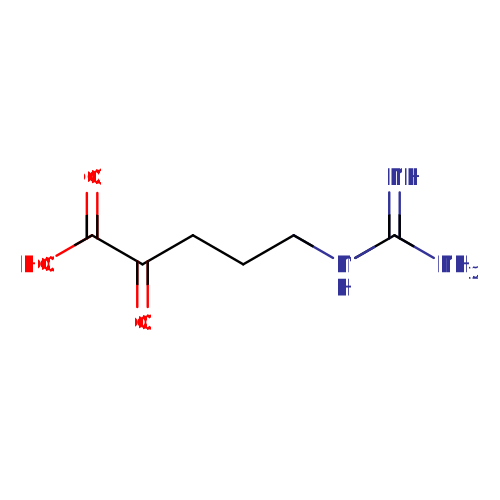
Common NameAlpha-keto-delta-guanidinovaleric acid
ClassSmall Molecule
DescriptionAlpha-keto-delta-guanidinoacetic acid is a uremic toxin. Uremic toxins can be subdivided into three major groups based upon their chemical and physical characteristics: 1) small, water-soluble, non-protein-bound compounds, such as urea; 2) small, lipid-soluble and/or protein-bound compounds, such as the phenols and 3) larger so-called middle-molecules, such as beta2-microglobulin. Chronic exposure of uremic toxins can lead to a number of conditions including renal damage, chronic kidney disease and cardiovascular disease. In all brain regions studied, concentrations of alpha-keto-delta-guanidinovaleric acid remained below detection limits in controls as well as in uremic patients.
Contaminant Sources
  • FooDB Chemicals
  • T3DB toxins
Contaminant Type
  • Amide
  • Amine
  • Natural Compound
  • Organic Compound
  • Uremic Toxin
Chemical Structure
Thumb
Synonyms
ValueSource
2-oxo-5-Guanidino-pentanoateChEBI
2-oxo-5-GuanidinopentanoateChEBI
2-oxo-5-Guanidinovaleric acidChEBI
5-((Aminoiminomethyl)amino)-2-oxopentanoic acidChEBI
5-Guanidino-2-oxo-pentanoateChEBI
5-Guanidino-2-oxopentanoateChEBI
alpha-Keto-delta-guanidinopentanoic acidChEBI
alpha-Keto-delta-guanidinovaleric acidChEBI
2-oxo-5-Guanidino-pentanoic acidGenerator
2-oxo-5-Guanidinopentanoic acidGenerator
2-oxo-5-GuanidinovalerateGenerator
5-((Aminoiminomethyl)amino)-2-oxopentanoateGenerator
5-Guanidino-2-oxo-pentanoic acidGenerator
5-Guanidino-2-oxopentanoic acidGenerator
a-Keto-delta-guanidinopentanoateGenerator
a-Keto-delta-guanidinopentanoic acidGenerator
alpha-Keto-delta-guanidinopentanoateGenerator
Α-keto-δ-guanidinopentanoateGenerator
Α-keto-δ-guanidinopentanoic acidGenerator
a-Keto-delta-guanidinovalerateGenerator
a-Keto-delta-guanidinovaleric acidGenerator
alpha-Keto-delta-guanidinovalerateGenerator
Α-keto-δ-guanidinovalerateGenerator
Α-keto-δ-guanidinovaleric acidGenerator
a-Keto-δ-guanidinovalerateHMDB
a-Keto-δ-guanidinovaleric acidHMDB
a-Keto-δ-guanidinopentanoateHMDB
a-Keto-δ-guanidinopentanoic acidHMDB
5-(Diaminomethylideneamino)-2-oxopentanoateHMDB
5-(Diaminomethylideneamino)-2-oxopentanoic acidHMDB
5-Guanidino-2-oxovaleric acidHMDB
a-Keto-D-guanidinovaleric acidHMDB
D-Guanidino-a-oxovaleric acidHMDB
D-Guanido-a-ketovaleric acidHMDB
delta-Guanidino-alpha-oxovaleric acidHMDB
delta-Guanido-alpha-ketovaleric acidHMDB
2-OxoarginineChEBI
5-[(Aminoiminomethyl)amino]-2-oxopentanoic acidPhytoBank
δ-Guanidino-α-oxovaleric acidPhytoBank
δ-Guanido-α-ketovaleric acidPhytoBank
Chemical FormulaC6H11N3O3
Average Molecular Mass173.170 g/mol
Monoisotopic Mass173.080 g/mol
CAS Registry Number3715-10-4
IUPAC Name5-[(diaminomethylidene)amino]-2-oxopentanoic acid
Traditional Name5-[(diaminomethylidene)amino]-2-oxopentanoic acid
SMILESNC(N)=NCCCC(=O)C(O)=O
InChI IdentifierInChI=1S/C6H11N3O3/c7-6(8)9-3-1-2-4(10)5(11)12/h1-3H2,(H,11,12)(H4,7,8,9)
InChI KeyARBHXJXXVVHMET-UHFFFAOYSA-N
Chemical Taxonomy
Description belongs to the class of organic compounds known as short-chain keto acids and derivatives. These are keto acids with an alkyl chain the contains less than 6 carbon atoms.
KingdomOrganic compounds
Super ClassOrganic acids and derivatives
ClassKeto acids and derivatives
Sub ClassShort-chain keto acids and derivatives
Direct ParentShort-chain keto acids and derivatives
Alternative Parents
Substituents
  • Short-chain keto acid
  • Alpha-keto acid
  • Alpha-hydroxy ketone
  • Guanidine
  • Ketone
  • Carboxylic acid derivative
  • Carboxylic acid
  • Organic 1,3-dipolar compound
  • Propargyl-type 1,3-dipolar organic compound
  • Carboximidamide
  • Monocarboxylic acid or derivatives
  • Organic nitrogen compound
  • Organonitrogen compound
  • Organooxygen compound
  • Hydrocarbon derivative
  • Organic oxide
  • Organopnictogen compound
  • Carbonyl group
  • Organic oxygen compound
  • Aliphatic acyclic compound
Molecular FrameworkAliphatic acyclic compounds
External Descriptors
Biological Properties
StatusDetected and Not Quantified
OriginEndogenous
Cellular Locations
  • Membrane
Biofluid LocationsNot Available
Tissue LocationsNot Available
Pathways
NameSMPDB LinkKEGG Link
ApoptosisNot Availablemap04210
ApplicationsNot Available
Biological Roles
Chemical RolesNot Available
Physical Properties
StateSolid
AppearanceWhite powder.
Experimental Properties
PropertyValue
Melting PointNot Available
Boiling PointNot Available
SolubilityNot Available
Predicted Properties
PropertyValueSource
Water Solubility1.97 g/LALOGPS
logP-1.4ALOGPS
logP-2.4ChemAxon
logS-1.9ALOGPS
pKa (Strongest Acidic)3.01ChemAxon
pKa (Strongest Basic)10.71ChemAxon
Physiological Charge0ChemAxon
Hydrogen Acceptor Count6ChemAxon
Hydrogen Donor Count3ChemAxon
Polar Surface Area118.77 ŲChemAxon
Rotatable Bond Count5ChemAxon
Refractivity41.23 m³·mol⁻¹ChemAxon
Polarizability16.72 ųChemAxon
Number of Rings0ChemAxon
Bioavailability1ChemAxon
Rule of FiveYesChemAxon
Ghose FilterNoChemAxon
Veber's RuleNoChemAxon
MDDR-like RuleNoChemAxon
Spectra
Spectra
Spectrum TypeDescriptionSplash KeyView
Predicted GC-MSPredicted GC-MS Spectrum - GC-MS (Non-derivatized) - 70eV, Positivesplash10-0096-9100000000-303513b0b209bca56206Spectrum
Predicted GC-MSPredicted GC-MS Spectrum - GC-MS (1 TMS) - 70eV, Positivesplash10-00r6-9710000000-95bf9765fd1fa4c2cd82Spectrum
Predicted GC-MSPredicted GC-MS Spectrum - GC-MS (Non-derivatized) - 70eV, PositiveNot AvailableSpectrum
LC-MS/MSLC-MS/MS Spectrum - Quattro_QQQ 10V, Positive (Annotated)splash10-001i-0900000000-4c337e4db09d448ecc63Spectrum
LC-MS/MSLC-MS/MS Spectrum - Quattro_QQQ 25V, Positive (Annotated)splash10-0563-9600000000-d97800b4db5ae44aebbaSpectrum
LC-MS/MSLC-MS/MS Spectrum - Quattro_QQQ 40V, Positive (Annotated)splash10-004i-9200000000-6286bbf95e4a4716e7d4Spectrum
Predicted LC-MS/MSPredicted LC-MS/MS Spectrum - 10V, Positivesplash10-0ab9-1900000000-05cd70e6e18e08b35be8Spectrum
Predicted LC-MS/MSPredicted LC-MS/MS Spectrum - 20V, Positivesplash10-0900-7900000000-aec8a82d0097632e2cc6Spectrum
Predicted LC-MS/MSPredicted LC-MS/MS Spectrum - 40V, Positivesplash10-03dl-9000000000-c27deb914dc894c12d6cSpectrum
Predicted LC-MS/MSPredicted LC-MS/MS Spectrum - 10V, Negativesplash10-001i-2900000000-67d1c875d2da6e075630Spectrum
Predicted LC-MS/MSPredicted LC-MS/MS Spectrum - 20V, Negativesplash10-001i-9800000000-1a3c6500b4d652bcaadbSpectrum
Predicted LC-MS/MSPredicted LC-MS/MS Spectrum - 40V, Negativesplash10-0006-9000000000-89a2ffbc759f6a2a5922Spectrum
Predicted LC-MS/MSPredicted LC-MS/MS Spectrum - 10V, Positivesplash10-00di-2900000000-fcee1bc9a64cc54c8a61Spectrum
Predicted LC-MS/MSPredicted LC-MS/MS Spectrum - 20V, Positivesplash10-014m-9100000000-884cb4184447c0cb50bdSpectrum
Predicted LC-MS/MSPredicted LC-MS/MS Spectrum - 40V, Positivesplash10-01ox-9000000000-d71574817dabeaf6e5e0Spectrum
Predicted LC-MS/MSPredicted LC-MS/MS Spectrum - 10V, Negativesplash10-00di-2900000000-48efdecf4dbd7823ddffSpectrum
Predicted LC-MS/MSPredicted LC-MS/MS Spectrum - 20V, Negativesplash10-08fu-6900000000-0ca535d235f66409d225Spectrum
Predicted LC-MS/MSPredicted LC-MS/MS Spectrum - 40V, Negativesplash10-000x-9000000000-82063658464a6dc17369Spectrum
1D NMR13C NMR SpectrumNot AvailableSpectrum
1D NMR1H NMR SpectrumNot AvailableSpectrum
1D NMR13C NMR SpectrumNot AvailableSpectrum
1D NMR1H NMR SpectrumNot AvailableSpectrum
1D NMR13C NMR SpectrumNot AvailableSpectrum
1D NMR1H NMR SpectrumNot AvailableSpectrum
1D NMR13C NMR SpectrumNot AvailableSpectrum
1D NMR1H NMR SpectrumNot AvailableSpectrum
1D NMR13C NMR SpectrumNot AvailableSpectrum
1D NMR1H NMR SpectrumNot AvailableSpectrum
1D NMR13C NMR SpectrumNot AvailableSpectrum
1D NMR1H NMR SpectrumNot AvailableSpectrum
1D NMR13C NMR SpectrumNot AvailableSpectrum
1D NMR1H NMR SpectrumNot AvailableSpectrum
1D NMR13C NMR SpectrumNot AvailableSpectrum
1D NMR1H NMR SpectrumNot AvailableSpectrum
1D NMR13C NMR SpectrumNot AvailableSpectrum
1D NMR1H NMR SpectrumNot AvailableSpectrum
1D NMR13C NMR SpectrumNot AvailableSpectrum
1D NMR1H NMR SpectrumNot AvailableSpectrum
Toxicity Profile
Route of ExposureEndogenous, Ingestion, Dermal (contact)
Mechanism of ToxicityUremic toxins such as alpha-keto-delta-guanidinoacetic acid are actively transported into the kidneys via organic ion transporters (especially OAT3). Increased levels of uremic toxins can stimulate the production of reactive oxygen species. This seems to be mediated by the direct binding or inhibition by uremic toxins of the enzyme NADPH oxidase (especially NOX4 which is abundant in the kidneys and heart) (3). Reactive oxygen species can induce several different DNA methyltransferases (DNMTs) which are involved in the silencing of a protein known as KLOTHO. KLOTHO has been identified as having important roles in anti-aging, mineral metabolism, and vitamin D metabolism. A number of studies have indicated that KLOTHO mRNA and protein levels are reduced during acute or chronic kidney diseases in response to high local levels of reactive oxygen species (4).
MetabolismUremic toxins tend to accumulate in the blood either through dietary excess or through poor filtration by the kidneys. Most uremic toxins are metabolic waste products and are normally excreted in the urine or feces.
Toxicity ValuesNot Available
Lethal DoseNot Available
Carcinogenicity (IARC Classification)No indication of carcinogenicity to humans (not listed by IARC).
Uses/SourcesNaturally produced by the body (endogenous).
Minimum Risk LevelNot Available
Health EffectsChronic exposure to uremic toxins can lead to a number of conditions including renal damage, chronic kidney disease and cardiovascular disease.
SymptomsAs a uremic toxin, this compound can cause uremic syndrome. Uremic syndrome may affect any part of the body and can cause nausea, vomiting, loss of appetite, and weight loss. It can also cause changes in mental status, such as confusion, reduced awareness, agitation, psychosis, seizures, and coma. Abnormal bleeding, such as bleeding spontaneously or profusely from a very minor injury can also occur. Heart problems, such as an irregular heartbeat, inflammation in the sac that surrounds the heart (pericarditis), and increased pressure on the heart can be seen in patients with uremic syndrome. Shortness of breath from fluid buildup in the space between the lungs and the chest wall (pleural effusion) can also be present.
TreatmentKidney dialysis is usually needed to relieve the symptoms of uremic syndrome until normal kidney function can be restored.
Concentrations
Not Available
DrugBank IDNot Available
HMDB IDHMDB0004225
FooDB IDFDB023338
Phenol Explorer IDNot Available
KNApSAcK IDNot Available
BiGG ID42500
BioCyc IDCPD-824
METLIN ID7030
PDB IDNot Available
Wikipedia LinkNot Available
Chemspider ID542
ChEBI ID28116
PubChem Compound ID558
Kegg Compound IDC03771
YMDB IDNot Available
ECMDB IDNot Available
References
Synthesis ReferenceNot Available
MSDSNot Available
General References
1. Chibata, Ichiro; Kakimoto, Toshio; Nabe, Koichi; Shibatani, Takeji. a-Keto-d-guanidinovalerianic acid. Jpn. Kokai Tokkyo Koho (1975), 4 pp.
2. Marescau B, Qureshi IA, De Deyn P, Letarte J, Ryba R, Lowenthal A: Guanidino compounds in plasma, urine and cerebrospinal fluid of hyperargininemic patients during therapy. Clin Chim Acta. 1985 Feb 28;146(1):21-7.
3. Mizutani N, Hayakawa C, Ohya Y, Watanabe K, Watanabe Y, Mori A: Guanidino compounds in hyperargininemia. Tohoku J Exp Med. 1987 Nov;153(3):197-205.
4. Marescau B, De Deyn PP, Lowenthal A, Qureshi IA, Antonozzi I, Bachmann C, Cederbaum SD, Cerone R, Chamoles N, Colombo JP, et al.: Guanidino compound analysis as a complementary diagnostic parameter for hyperargininemia: follow-up of guanidino compound levels during therapy. Pediatr Res. 1990 Mar;27(3):297-303.
5. Marescau B, Deshmukh DR, Kockx M, Possemiers I, Qureshi IA, Wiechert P, De Deyn PP: Guanidino compounds in serum, urine, liver, kidney, and brain of man and some ureotelic animals. Metabolism. 1992 May;41(5):526-32.
6. Wiechert P, Mortelmans J, Lavinha F, Clara R, Terheggen HG, Lowenthal A: Excretion of guanidino-derivates in urine of hyperargininemic patients. J Genet Hum. 1976 Mar;24(1):61-72.
7. Duranton F, Cohen G, De Smet R, Rodriguez M, Jankowski J, Vanholder R, Argiles A: Normal and pathologic concentrations of uremic toxins. J Am Soc Nephrol. 2012 Jul;23(7):1258-70. doi: 10.1681/ASN.2011121175. Epub 2012 May 24.